
BuddhistCatholicContemplativeEvangelicalGeneral ChristianHinduJewishLatter-day SaintMuslimNew VisionsProgressive Christian
Beliefs
- Buddhist
- Catholic
- Contemplative
- Evangelical
- General Christian
- Hindu
- Jewish
- Latter-day Saint
- More Voices
- Muslim
- New Visions
- Pagan
- Progressive Christian
Topics
- Religion News
- Food and Religion
- Sports and Religion
- Religious Art
- Religious Music and Entertainment
- Religious Events
- History and Religion
- Style and Religion
- Politics and Religion
- Women in Religion
- Recreation Outdoors and Religion
- Business Finance and Religion
- Careers Workplace and Religion
- Education and Religion
- Family Parenting and Religion
- Health Fitness and Religion
- Home and Religion
- Relationships and Religion
- Technology and Religion
- Travel and Religion
Columnists
- Buddhist Columnists
- Business Finance and Religion Columnists
- Careers Workplace and Religion Columnists
- Catholic Columnists
- Contemplative Columnists
- Education and Religion Columnists
- Evangelists Columnists
- Family Parenting and Religion Columnists
- General Christian Columnists
- Health Fitness and Religion Columnists
- Hindu Columnists
- History and Religion Columnists
- Home and Religion Columnists
- Jewish Columnists
- More Voices Columnists
- Latter Day Columnists
- Muslim Columnists
- New Visions Columnists
- Nonreligious Columnists
- Pagan Columnists
- Politics and Religion Columnists
- Progressive Columnists
- Recreation Outdoors and Religion Columnists
- Relationships and Religion Columnists
- Religion News Columnists
- Religious Art Columnists
- Religious Events Columnists
- Religious Music and Entertainment Columnists
- Sports and Religion Columnists
- Style and Religion Columnists
- Technology and Religion Columnists
- Travel and Religion Columnists
- Women in Religion Columnists
Resource Library
- 2026 Calendar
- Library of World Religions
- The 100 Most Holy Places on Earth
- Patheos Answers
- Podcasts
- Videos
- Faith Leaders Database
- Anglican Episcopalian
- Bahai
- Baptist
- Buddhism
- Christianity
- Confucianism
- Eastern Orthodoxy
- Hinduism
- Holiness and Pentecostal
- ISKCON
- Islam
- Judaism
- Lutheran
- Methodist
- The Church of Jesus Christ of Latter-day Saints
- New Age
- Paganism
- Presbytarian and Reformed
- Protestantism
- Religion Behind the Scenes
- Roman Catholic
- Scientology
- Shia Islam
- Sikhism
- Sufism
- Sunni Islam
- Taoism
- Zen
- See all religions
Research Tools
 Ad-Free & Subscriber Log-In Subscription Support
Ad-Free & Subscriber Log-In Subscription Support
Follow Patheos 

- Trending:
- Forgiveness
- |
- Marriage
- |
- Consciousness
- |
- Death Penalty
- |
- Election
- |
- Halloween
 Cosmos The In Lost
- Home
- Catholic
- Every Human Life Begins with a (Little) Bang!
Every Human Life Begins with a (Little) Bang!
Last updated on: May 2, 2016 at 9:21 pm by Artur Rosman
Every Human Life Begins with a (Little) Bang! 2016-05-02T21:21:30-07:00 Artur Rosman
Patheos Explore the world's faith through different perspectives on religion and spirituality! Patheos has the views of the prevalent religions and spiritualities of the world.
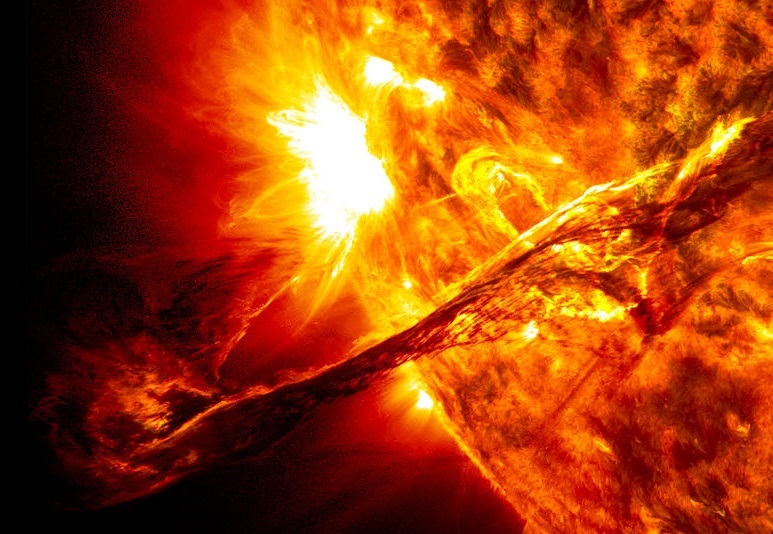
On Aug. 31, 2012, a giant prominence on the sun erupted, sending out particles and a shock wave that traveled near Earth, captured by NASA’s Solar Dynamics Observatory (SDO); PD-USGov-NASA.
We now know the universe began with a bang, even if it might end in a whimper.
The ancient view of the cosmos was based upon the higher spheres of existence being analogously reflected in the lower spheres all the way down to rocks (and lawyers).
This meant that there was a great chain of being that potentially connected every being through a kind of ladder of actualization with the highest rung in the created order occupied by the angels.
In this scheme humans occupied a special mediating role between the material and spiritual universes. Modern human beings have no special role, other than binge drinking and being replaceable cogs in the economy (the two activities are not unrelated).
Contemporary science is shifting in miraculous ways compared to early modern science, which gave us an unlivable vision of the world.
The ladder fell apart in the early modern period (17th century) when the notions of higher and lower were expunged from both science and, for the most part, philosophy. The shift depended upon a switch from a qualitative analysis to a quantitative analysis. Matter, wherever it came from, was by theoretical fiat assumed to be uniform, thereby effectively eliminating the ability to distinguish between cabbage and the human brain.
This modern shift got rid of many pseudo-problems of scholasticism and helped to fuel an explosion of technological innovation. It also simultaneously created a fair amount of its own pseudo-problems and the innovation has led us to the brink of environmental disaster, according to Benedict XVI. One of the major pseudo-problems was solving the mind-body puzzle of how a humanity that is composed of the same stuff as the rest of the cosmos stands outside of the cosmos by being able to analyze and manipulate it (see especially: Nagel’s Mind & Cosmos).
Luckily, as Oliver Davies has pointed out at length, we are on the cusp of a Second Scientific revolution that has the potential to reconnect humanity back to the rest of creation, while at the same time allowing the conceptualization of how humans are qualitatively different from the rest of creation.
The Telegraph, among many others, reports on a recent scientific finding that eclipses the early modern understanding of matter as inert and potentially reinserts the human microcosm back into the macrocosm:
Human life begins in bright flash of light as a sperm meets an egg, scientists have shown for the first time, after capturing the astonishing ‘fireworks’ on film.
An explosion of tiny sparks erupts from the egg at the exact moment of conception.
Scientists had seen the phenomenon occur in other animals but it is the first time is has been also shown to happen in humans.
Not only is it an incredible spectacle, highlighting the very moment that a new life begins, the size of the flash can be used to determine the quality of the fertilised egg.
Fascinating, isn’t it? We have the Big Bang, first put forward by a Catholic priest, reflected at the moment when human life begins. Now take a look at the fertilization of a human egg happening:
I’m reminded here of a passage from Pierre Teilhard de Chardin’s Toward the Future:
The day will come when, after harnessing space, the winds, the tides, and gravitation, we shall harness for God the energies of love. And on that day, for the second time in the history of the world, we shall have discovered fire.
As usual his thinking is a little bit sloppy. Plenty of mystics and ordinary believers (there’s usually nothing ordinary about them) have already discovered and harnessed, or rather, have been harnessed, by this fire. It’s called the Holy Spirit.
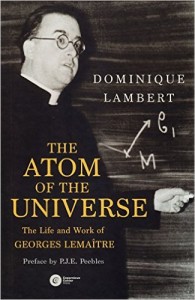
A Catholic priest invented the Big Bang. There’s no reason why Catholics shouldn’t devise analogies between it and the Little Bang.
Anyway, as Czeslaw Milosz argued in The Land of Ulro, science and theology need each other, because they can only address the mystery of man’s place in the universe together. It seems that recent discoveries in biology, physics, and especially neuroscience are beginning to move us away from the modern picture of nature as a mindless mechanism toward an after-modern poetic picture of nature as intelligent and many-tiered–with the various tiers interacting with each other in highly creative ways (R.G. Collingwood’s The Idea of Nature predicted and described this shift nearly 100 years ago).
Just take a look at How Forests Think if you don’t believe how drastically our understanding of the world is shifting. The general axiom is that it takes scientific shifts and discoveries about two hundred years to percolate down into the general population (an some scientists have the temerity to claim priests kept people in ignorance to profit from their ignorance!) Let’s hope the shift won’t come too late.
Here’s a poetic take to-go from Lanois’s album Shine to keep you warm the rest of the day:
If you thought this post is about sexuality (perv) then you might want to read Sexuality is at the Heart of Christianity’s Place in the World
Stay in touch! Like Cosmos the in Lost on Facebook:
Please also consider making a donation to this blog through the donation button on the upper right side of its homepage.
Previous Post

May 1, 2016
Happy May Day (Resurrection Sunday) to the Russian Orthodox!
Next Post
May 2, 2016 This 1 Thing Has Never Before Happened in the Sistine Chapel
Browse Our Archives
Select a Category #WhyRemainCatholic Abortion Advent Anti-Catholicism Arts Atheism Beauty Benedict XVI Bible Book Review Catholic Cinema Comedy Cosmos: A Space-Time Odyssey Czesław Miłosz Dariusz Karłowicz Devil Easter Eastern Orthodoxy Economics Environment Family Famous Atheists Who Weren't Atheists Guest Post Hans Urs von Balthasar HHS Mandate History Imagination Interview Islam Jean-Luc Marion John Paul II Judaism Just War Lent Literature Little Sisters of the Poor Liturgy Martyrdom Music News Paganism Patristics Phenomenology Philosophy Pierre Hadot Poetry Poland Pop Culture Pope Francis Poverty Prayer Protestantism Rabelais Race Remi Brague Rene Girard Russia Sam Rocha Science & Religion SCOTUS Secularization Sexual Abuse Sexuality Silence Solidarity Stratford Caldecott Synod14 Terrorism Top 10 Uncategorized Walker Percy War Weakened Edition World War II World Youth Day WYD Krakow
Select a Month July 2017 June 2017 May 2017 April 2017 March 2017 February 2017 January 2017 December 2016 October 2016 September 2016 August 2016 July 2016 June 2016 May 2016 April 2016 March 2016 February 2016 January 2016 December 2015 November 2015 October 2015 September 2015 August 2015 July 2015 June 2015 May 2015 April 2015 March 2015 February 2015 January 2015 December 2014 November 2014 October 2014 September 2014 August 2014 July 2014 May 2014 April 2014 March 2014 February 2014 January 2014 December 2013 November 2013 October 2013 September 2013 August 2013 July 2013 June 2013 May 2013
Follow Us!
TAKE THE
Religious Wisdom Quiz
Which prophet said, "I desire mercy, not sacrifice"?
Select your answer to see how you score.
Joel Amos Hosea Daniel
Related posts from Cosmos The In Lost


The Holy Family as an Icon of World...

Atheists Have "National Day of Reason," But American...

2 Reasons Why the March for Science is...
TRENDING AT PATHEOS Catholic

Creation, Preservation, and Teleology in Catholic Theology
As I write this, it is very early Monday morning. Like millions...

The Parable Of The Sower And The Word...
One of Christ’s most famous parables is that of the sower who...

Rejecting Doom: Christian Hope And Human Action
Christianity is a religion of hope. We are to have hope and...

Why I Choose the Eucharist Over the Sermon
Choose the Eucharist, Not the Sermon What are we supposed to get...

5 Design Elements Found in Spiritually Rooted Homes
Putting Spirituality Into Home Decor Our homes are more than our living...

Credo: A Story of God Told with the...
About 10 years ago, I began to imagine a personal "Credo" that...
view all Catholic blogs
Ad-Free & Subscriber Log-In Subscription Support
- About Us
- 2026 Calendar
- Videos
- Podcasts
- Library of World Religions
- Faith In Media Tracker
- Advertise With Us
- Write for Us
- Privacy Policy
- Terms of Service
- Do Not Sell My Data
- Contact Us
- Radiant Digital
- Manage Newsletter Subscriptions
- Unsubscribe From Notifications
- Sitemap
Copyright 2008-2026, Patheos. All rights reserved.
Subscription Support Ad-Free & Subscriber Log-In
Follow Patheos