
BuddhistCatholicContemplativeEvangelicalGeneral ChristianHinduJewishLatter-day SaintMuslimNew VisionsProgressive Christian
Beliefs
- Buddhist
- Catholic
- Contemplative
- Evangelical
- General Christian
- Hindu
- Jewish
- Latter-day Saint
- More Voices
- Muslim
- New Visions
- Pagan
- Progressive Christian
Topics
- Religion News
- Food and Religion
- Sports and Religion
- Religious Art
- Religious Music and Entertainment
- Religious Events
- History and Religion
- Style and Religion
- Politics and Religion
- Women in Religion
- Recreation Outdoors and Religion
- Business Finance and Religion
- Careers Workplace and Religion
- Education and Religion
- Family Parenting and Religion
- Health Fitness and Religion
- Home and Religion
- Relationships and Religion
- Technology and Religion
- Travel and Religion
Columnists
- Buddhist Columnists
- Business Finance and Religion Columnists
- Careers Workplace and Religion Columnists
- Catholic Columnists
- Contemplative Columnists
- Education and Religion Columnists
- Evangelists Columnists
- Family Parenting and Religion Columnists
- General Christian Columnists
- Health Fitness and Religion Columnists
- Hindu Columnists
- History and Religion Columnists
- Home and Religion Columnists
- Jewish Columnists
- More Voices Columnists
- Latter Day Columnists
- Muslim Columnists
- New Visions Columnists
- Nonreligious Columnists
- Pagan Columnists
- Politics and Religion Columnists
- Progressive Columnists
- Recreation Outdoors and Religion Columnists
- Relationships and Religion Columnists
- Religion News Columnists
- Religious Art Columnists
- Religious Events Columnists
- Religious Music and Entertainment Columnists
- Sports and Religion Columnists
- Style and Religion Columnists
- Technology and Religion Columnists
- Travel and Religion Columnists
- Women in Religion Columnists
Resource Library
- 2026 Calendar
- Library of World Religions
- The 100 Most Holy Places on Earth
- Patheos Answers
- Podcasts
- Videos
- Faith Leaders Database
- Anglican Episcopalian
- Bahai
- Baptist
- Buddhism
- Christianity
- Confucianism
- Eastern Orthodoxy
- Hinduism
- Holiness and Pentecostal
- ISKCON
- Islam
- Judaism
- Lutheran
- Methodist
- The Church of Jesus Christ of Latter-day Saints
- New Age
- Paganism
- Presbytarian and Reformed
- Protestantism
- Religion Behind the Scenes
- Roman Catholic
- Scientology
- Shia Islam
- Sikhism
- Sufism
- Sunni Islam
- Taoism
- Zen
- See all religions
Research Tools
 Ad-Free & Subscriber Log-In Subscription Support
Ad-Free & Subscriber Log-In Subscription Support
Follow Patheos 

- Trending:
- Forgiveness
- |
- Marriage
- |
- Consciousness
- |
- Death Penalty
- |
- Election
- |
- Halloween
 Cosmos The In Lost
- Home
- Catholic
- Happy 1050th Birthday Poland!
Happy 1050th Birthday Poland!
Last updated on: April 14, 2016 at 6:09 pm by Artur Rosman
Happy 1050th Birthday Poland! 2016-04-14T18:09:48-07:00 Artur Rosman
Patheos Explore the world's faith through different perspectives on religion and spirituality! Patheos has the views of the prevalent religions and spiritualities of the world.
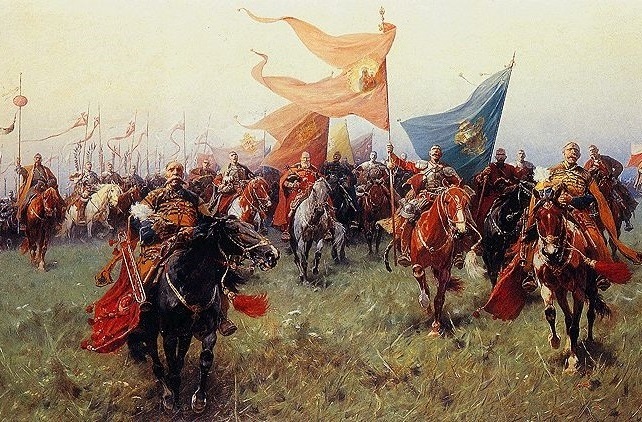
Singing of Bogurodzica at Battle of Grunwald; the mix of religion and war grates modern eyes, but was typical of the time (Jozef Brandt, Bogurodzica, 1909; Source: Wikimedia Commons, PD-Old-100).
I ran across the oldest recorded text in Poland’s history today. The hymn in question is not in Latin, but rather in colloquial Polish. So much for medievals being Latin fetishists.
[Reading Suggestion: scroll down to the bottom of this post and hit play on the YouTube video, then start reading from the top.]
I couldn’t figure out why it popped up in my feed until I read the following:
Happy 1,050th birthday, Poland! On this day in 966, the Polish ruler converted to Christianity, transforming Poland into a recognized European state.
Poland had existed prior to this in some form, of course. As the Roman Empire collapsed in the early centuries AD, Germanic and Slavic tribes moved in and began to take over lands in central and eastern Europe. Already by the sixth century, western Slavic people began to settle throughout what is today Poland.
These western Slavs broke off into various tribes, such as the Vistulans, who settled in Krakow, and the Polans, who settled around Gniezno and Poznan. Poland grew out of the Polans. The Polan rulers were known as the Piasts.
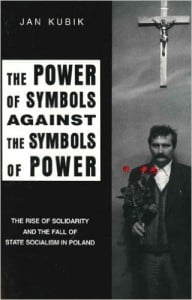
Gadamer’s hermeneutics meet Polish history.
The 1000th anniversary of Poland’s baptism was the occasion of an epic battle between the communists and the Church for legitimation. The church with Cardinal Wyszynski and then Bishop Wojtyla won hands down. When the Church wasn’t allowed to tour the Black Madonna painting all around the country, it toured the frame of the painting. Hundreds of thousands, if not millions, showed up to see the frame. It was the ultimate surrealist happening. The whole episode is recounted in great detail in The Power of Symbols Against the Symbols of Power: The Rise of Solidarity and the Fall of State Socialism in Poland:
The icon was forcefully detained…. But the pilgrimage went on. The icon’s empty frame, sometimes adorned with flowers, sometimes with a burning candle or a Bible inside, continued its tour and visited four southern and two eastern dioceses. The perils and power of religion in Communist Poland came to be symbolized by the vacant frame. According to the bishops, “The difficulties and harassment encountered [by the traveling icon] did not diminish the respect shown for the Mother of God. On the contrary, they inspired even greater love for the Divine Traveler. People, with broken hearts, looked at the empty frame, but gathered in ever growing numbers.”
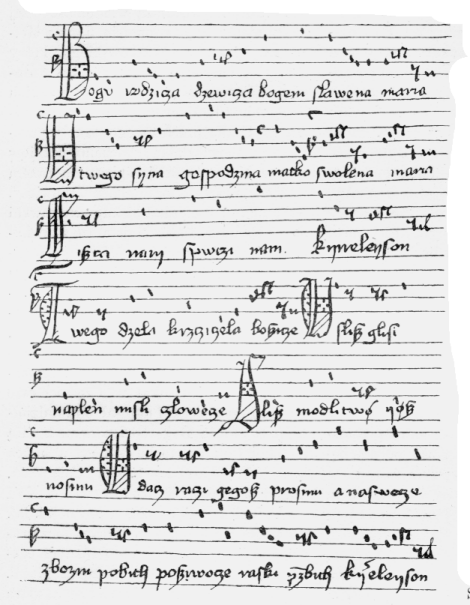
(Score of the Bogurodzica from 1407; Source: Wikimedia Commons, PD-Old-100)
Back to the text in question. It is known as “Bogurodzica,” that is, Theotokos (Mother of God*)*. Here are the lyrics from the collection Selected Masterpieces of Polish Poetry.
First in Polish:
Bogurodzica dziewica, Bogiem sławiena Maryja,
U twego syna Gospodzina Matko zwolena, Maryja!
Zyszczy nam, spuści nam.
Kyrie elison!Twego dziela Krzciciela, bożycze,
Usłysz głosy, napełń myśli człowiecze.
Słysz modlitwę, jąż nosimy,
A dać raczy, jegoż prosimy:
A na świecie zbożny pobyt,
Po żywocie rajski przebyt.
Kyrie elison!
Now in English:
Virgin, Mother of God, God-famed Mary!
Ask Thy Son, our Lord, God-named Mary,
To have mercy upon us and hand it over to us!
Kyrie eleison!Son of God, for Thy Baptist’s sake,
Hear the voices, fulfill the pleas we make!
Listen to the prayer we say,
For what we ask, give us today:
Life on earth free of vice;
After life: paradise!
Kyrie eleison!
 “Bogurodzica” was composed sometime between the 10th and 13th centuries. The first print record of it appeared in the 15th century (see picture above).
The eminent historian of Norman Davies also reminds us in his now classic history of Poland (its translation is used in Polish schools), God’s Playground: A History of Poland, Vol. 1: The Origins to 1795, that the hymn was sung at Piast dynasty coronations, and during the Battle of Gruenwald in 1410 (Remember that one? Hitler did.).
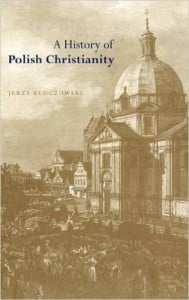
Contemporary Poland is probably the most Catholic nation in the world. Upwards of 90% of Poles are Catholics, but this is merely an accident of history. Poland was about 65-70% Catholic before the Germans and Soviets redrew its boundaries after WW2. Weekly Mass attendance is somewhere between 50% and 60%. The most complete account of the complicated twists and turns of Polish Christianity can be found in Kloczowski’s A History of Polish Christianity. You can find out more about early modern Poland by reading this book as well. The Polish Commonwealth was the largest state in Europe since it included modern day Poland, Ukraine, and Lithuania. Even more significantly, it was the first properly pluralistic nation-state, multi-ethnic and multi-religious, long before the United States usurped that title for itself.
Finally, to round everything out, here’s a stunning rendition of “Bogurodzica” by Agnieszka Budzinska-Bennett from the CD Sacer Nidus:
Poland’s history is much more complicated than the country being an appendage of the Papal States. If you want the insider knowledge about the country’s religious history then take a look at my Catholiclandia series.
Please also consider making a donation to this blog through the donation button on the upper right side of its homepage.
Stay in touch! Like Cosmos the in Lost on Facebook:

Browse Our Archives
Select a Category #WhyRemainCatholic Abortion Advent Anti-Catholicism Arts Atheism Beauty Benedict XVI Bible Book Review Catholic Cinema Comedy Cosmos: A Space-Time Odyssey Czesław Miłosz Dariusz Karłowicz Devil Easter Eastern Orthodoxy Economics Environment Family Famous Atheists Who Weren't Atheists Guest Post Hans Urs von Balthasar HHS Mandate History Imagination Interview Islam Jean-Luc Marion John Paul II Judaism Just War Lent Literature Little Sisters of the Poor Liturgy Martyrdom Music News Paganism Patristics Phenomenology Philosophy Pierre Hadot Poetry Poland Pop Culture Pope Francis Poverty Prayer Protestantism Rabelais Race Remi Brague Rene Girard Russia Sam Rocha Science & Religion SCOTUS Secularization Sexual Abuse Sexuality Silence Solidarity Stratford Caldecott Synod14 Terrorism Top 10 Uncategorized Walker Percy War Weakened Edition World War II World Youth Day WYD Krakow
Select a Month July 2017 June 2017 May 2017 April 2017 March 2017 February 2017 January 2017 December 2016 October 2016 September 2016 August 2016 July 2016 June 2016 May 2016 April 2016 March 2016 February 2016 January 2016 December 2015 November 2015 October 2015 September 2015 August 2015 July 2015 June 2015 May 2015 April 2015 March 2015 February 2015 January 2015 December 2014 November 2014 October 2014 September 2014 August 2014 July 2014 May 2014 April 2014 March 2014 February 2014 January 2014 December 2013 November 2013 October 2013 September 2013 August 2013 July 2013 June 2013 May 2013
Follow Us!
TAKE THE
Religious Wisdom Quiz
What did Jesus use to heal a blind man in John 9?
Select your answer to see how you score.
Mud and saliva His robe Olive oil A fig leaf
Related posts from Cosmos The In Lost

The Surprising Anti-Capitalist Logic Behind the Catholic Church's...

The Holy Family as an Icon of World...

Biblical Authority After Babel Cannot Be Built Upon...
Western Civ Doesn't Need Tenured Radicals to Ruin...
TRENDING AT PATHEOS Catholic

Rejecting Doom: Christian Hope And Human Action
Christianity is a religion of hope. We are to have hope and...

It’s What Comes From Within Which Matters
One of the most difficult things for us to understand is why...

Why I Choose the Eucharist Over the Sermon
Choose the Eucharist, Not the Sermon What are we supposed to get...

5 Design Elements Found in Spiritually Rooted Homes
Putting Spirituality Into Home Decor Our homes are more than our living...

Credo: A Story of God Told with the...
About 10 years ago, I began to imagine a personal "Credo" that...

The Anatomy of Divine Revelation in Catholic Thought
The claim that God has made Himself known to human beings is...
view all Catholic blogs
Ad-Free & Subscriber Log-In Subscription Support
- About Us
- 2026 Calendar
- Videos
- Podcasts
- Library of World Religions
- Faith In Media Tracker
- Advertise With Us
- Write for Us
- Privacy Policy
- Terms of Service
- Do Not Sell My Data
- Contact Us
- Radiant Digital
- Manage Newsletter Subscriptions
- Unsubscribe From Notifications
- Sitemap
Copyright 2008-2026, Patheos. All rights reserved.
Subscription Support Ad-Free & Subscriber Log-In
Follow Patheos