
BuddhistCatholicContemplativeEvangelicalGeneral ChristianHinduJewishLatter-day SaintMuslimNew VisionsProgressive Christian
Beliefs
- Buddhist
- Catholic
- Contemplative
- Evangelical
- General Christian
- Hindu
- Jewish
- Latter-day Saint
- More Voices
- Muslim
- New Visions
- Pagan
- Progressive Christian
Topics
- Religion News
- Food and Religion
- Sports and Religion
- Religious Art
- Religious Music and Entertainment
- Religious Events
- History and Religion
- Style and Religion
- Politics and Religion
- Women in Religion
- Recreation Outdoors and Religion
- Business Finance and Religion
- Careers Workplace and Religion
- Education and Religion
- Family Parenting and Religion
- Health Fitness and Religion
- Home and Religion
- Relationships and Religion
- Technology and Religion
- Travel and Religion
Columnists
- Buddhist Columnists
- Business Finance and Religion Columnists
- Careers Workplace and Religion Columnists
- Catholic Columnists
- Contemplative Columnists
- Education and Religion Columnists
- Evangelists Columnists
- Family Parenting and Religion Columnists
- General Christian Columnists
- Health Fitness and Religion Columnists
- Hindu Columnists
- History and Religion Columnists
- Home and Religion Columnists
- Jewish Columnists
- More Voices Columnists
- Latter Day Columnists
- Muslim Columnists
- New Visions Columnists
- Nonreligious Columnists
- Pagan Columnists
- Politics and Religion Columnists
- Progressive Columnists
- Recreation Outdoors and Religion Columnists
- Relationships and Religion Columnists
- Religion News Columnists
- Religious Art Columnists
- Religious Events Columnists
- Religious Music and Entertainment Columnists
- Sports and Religion Columnists
- Style and Religion Columnists
- Technology and Religion Columnists
- Travel and Religion Columnists
- Women in Religion Columnists
Resource Library
- 2026 Calendar
- Library of World Religions
- The 100 Most Holy Places on Earth
- Patheos Answers
- Podcasts
- Videos
- Faith Leaders Database
- Anglican Episcopalian
- Bahai
- Baptist
- Buddhism
- Christianity
- Confucianism
- Eastern Orthodoxy
- Hinduism
- Holiness and Pentecostal
- ISKCON
- Islam
- Judaism
- Lutheran
- Methodist
- The Church of Jesus Christ of Latter-day Saints
- New Age
- Paganism
- Presbytarian and Reformed
- Protestantism
- Religion Behind the Scenes
- Roman Catholic
- Scientology
- Shia Islam
- Sikhism
- Sufism
- Sunni Islam
- Taoism
- Zen
- See all religions
Research Tools
 Ad-Free & Subscriber Log-In Subscription Support
Ad-Free & Subscriber Log-In Subscription Support
Follow Patheos 

- Trending:
- Forgiveness
- |
- Marriage
- |
- Consciousness
- |
- Death Penalty
- |
- Election
- |
- Halloween
 Cosmos The In Lost
- Home
- Catholic
- God is with Humankind Right Down to the Cellar of Creaturely Existence
God is with Humankind Right Down to the Cellar of Creaturely Existence
Last updated on: February 10, 2016 at 6:51 pm by Guest Contributor
God is with Humankind Right Down to the Cellar of Creaturely Existence 2016-02-10T18:51:46-07:00 Guest Contributor
Patheos Explore the world's faith through different perspectives on religion and spirituality! Patheos has the views of the prevalent religions and spiritualities of the world.
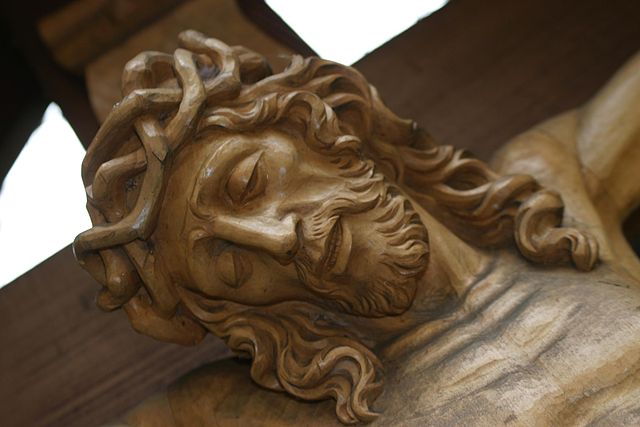
(Source: Wikipedia, Author: Gownley, Statue of the Crucifixion of Jesus outside of Campion Hall; PD)
Thanks to “the sacrifice of Christ on the Cross and His transformation of human existence from within,” humankind “can engage the ruins of its existence” (Delp, The Cross – The Mystery of God and the Way of Life for Humanity). Alfred Delp, SJ, whom the Nazis would execute on February 2, 1945, scribbled this thought prior to giving a retreat in 1943 to his parishioners on the meaning of the Cross. This Jesuit-martyr’s insight on the manner of Christian discipleship can assist us on our Lenten pilgrimage, which entails making those difficult human journeys of becoming fully human ever anew within the ruins of our lives. We know this journey is achievable because Jesus has made it before us. In taking this path, he breaks the bonds of sin, and destroys the shame that insists we are unworthy. For Delp, such spiritual pilgrimage, as noted in his retreat, is deemed the “Way of the Cross.” The retreat talk survives as a rough outline, and represents the young priest’s attempt to explore the salvific meaning of the Cross in the midst of his country’s descent into sin. The way of the Cross tells us that we can become like God only when we enter the path of the Son.
Delp starts by noting that the Cross confronts the sins of the world and “touches the heart of our lives.” This Cross is “one of the holy, untouchable symbols of humanity,” and refers to “a deeper reality and to the order of life.” With the next train of thought, Delp lays out the cost of discipleship that the Cross represents. The “way of the Cross represents the decision for Christ,” because there can be no neutral relationship with Christ. The young pastor tells his parishioners that their decision to follow Christ is not contingent on whether the symbol of the cross is beautiful. Delp points out that Thomas More, who was held captive in the Tower of London, drew crosses on the wall. Other English martyrs used wood and stalks to assemble the sign of the Cross on the floor of the prison in the Tower of London. For Delp, these depictions of the Cross came from authentic realization and reveal a more genuine commitment to faith than some famous masterpieces.
Delp emphasizes that we must “speak of this Cross, we accept it, because it is the sign of our lives and because our lives are subjected to the way of the Cross.” This way consists of suffering because of the sins of humankind: “There will be losses and hurts, but the way out consists of sacrifices.” The path demands an acknowledgment of and engagement with, not an avoidance of, broken and sinful reality. For Delp, the Cross of Christ enables individuals to confront sins, both their own and others, by taking on their personal cross as a sacrifice to participate in the redemption of the world. The divine initiative of God in Christ indicates that someone undergirds our lives, including our struggles: “Faith in the Cross of Calvary is faith in a God who is with humankind right down to the cellar of creaturely existence. How different life looks when God has carried us—an experience of solidarity.” The Cross is God’s commitment to save powerless humankind, mired in iniquity and sin. It is the overcoming of powerlessness and iniquity.
Delp tells his parishioners that God’s faithfulness to His creation, as represented by the Cross, irrevocably binds Him to human persons and ultimately opens up and safeguards for persons a path beyond their sins. The Cross breaks through the prison walls of fate; Christ breaks through the slavery of irresolvable sins. We are able to take up our own crosses and make the way of the Cross, because iniquity and sin have “been overcome and because God has met us in our fate.” For Delp, in the Cross our forsakenness is defeated and “a first ray of meaning and sight has emerged. The passion for the Cross is a passion both for God and for ourselves.”
To clarify what Delp means by engaging sin and evil as the path to human flourishing, I turn to his reflection on the Sacrament of Penance (Delp, Collected Writings III: Homilies and Speeches). In the autumn of 1940, Delp gave a series of sermons on the seven sacraments of the Catholic Church. Addressing the Sacrament of Penance, he speaks of the need for honest acknowledgment of sin and evil. He refers to a few examples from Friedrich Nietzsche’s Ariadne’s Lament to illustrate the ways in which people minimize the phenomenon of sin and thereby block themselves from redemption. The path of the Christian is different; it is the way of penance. He writes that penance leads us back to the “underground” of human existence, where sin is to be redeemed.” Here, the human person can encounter a merciful God whose offer of forgiveness can make “their nights, their falls, their sins” part of the condition for the possibility of salvation. Thus, one can find one’s identity and purpose in the face of darkness and death because God has entered into human history with all its misery and wretchedness. One can conform oneself to a God who finds “community with humankind” in its most difficult situations.
The love that comes forth from the Cross invites us to enter into a penitential movement that is at once and the same time so personal and so beyond our own imagining that we sense that we are being impelled from feeling being resigned to fate to participating in God’s providence. We recognize our limitations, which manifests in the graces of shame. This is not a masochistic guilt trip, but rather the experience of conversion in the presence of a merciful God. Without the recognition of our darkness and the desire to repent, we remain deaf and blind to God. Encountering the Cross and taking up our own personal crosses, liberates us from ourselves for God and for others. Within this dynamism, we are not guaranteed that the path we have been invited to trek on will turn out right. Indeed, we are called to follow and be with Jesus at a deeper level. And Jesus promises that he will be present to us in our engagement with human poverty. As such, we can reach out to others in their brokenness as Christ reaches out to us.
What is humbling about the Christian view of reality is the honest acceptance of the disfigurement of human life by sin, as revealed by our personal and social relationships. Yet, as we walk through those wildernesses of emptiness we encounter an inviolable relationship with human persons: God’s love in Christ for each one of us. The way the Cross is more than just about becoming oneself in relation to Christ, but allowing Christ to give Himself to oneself and within oneself in a fallen world for the sake of others. Such is a love that creates, sustains, and redeems. The love that embraces the way of the Cross does not ignore destructiveness of sin or belittles its consequences. Rather it manifests a love that makes a pilgrimage through the ruins of humanity in order to attest a love that is stronger than sin, a hope that refuses to be overwhelmed by despair. As we set to embark on our Lenten pilgrimage, let us to testify with our lives that love is beyond hatred and hope is beyond despair, because Christ has met us at the cellars of our existence and has undergirds our lives. The mystery of the Cross that calls Jesus invites us also.
Peter Nguyen, SJ is a Jesuit priest and an instructor of theology at Creighton University. He is finishing a PhD in Theology at Regis College, University of Toronto. Theology and jiu-jitsu are his hobbies. His real job involves hearing confessions and rooting for the Chicago Cubs.
If this Lent reflection struck a chord with you, then you will also want to read Squishy New Atheist Pieties Miss Gospel Love’s Ruthless Demands.
* * * * * * *
Stay in touch! Like Cosmos the in Lost on Facebook:
Previous Post

February 9, 2016
Catholic Historian Takes Back "Secular" Enlightenment


Browse Our Archives
Select a Category #WhyRemainCatholic Abortion Advent Anti-Catholicism Arts Atheism Beauty Benedict XVI Bible Book Review Catholic Cinema Comedy Cosmos: A Space-Time Odyssey Czesław Miłosz Dariusz Karłowicz Devil Easter Eastern Orthodoxy Economics Environment Family Famous Atheists Who Weren't Atheists Guest Post Hans Urs von Balthasar HHS Mandate History Imagination Interview Islam Jean-Luc Marion John Paul II Judaism Just War Lent Literature Little Sisters of the Poor Liturgy Martyrdom Music News Paganism Patristics Phenomenology Philosophy Pierre Hadot Poetry Poland Pop Culture Pope Francis Poverty Prayer Protestantism Rabelais Race Remi Brague Rene Girard Russia Sam Rocha Science & Religion SCOTUS Secularization Sexual Abuse Sexuality Silence Solidarity Stratford Caldecott Synod14 Terrorism Top 10 Uncategorized Walker Percy War Weakened Edition World War II World Youth Day WYD Krakow
Select a Month July 2017 June 2017 May 2017 April 2017 March 2017 February 2017 January 2017 December 2016 October 2016 September 2016 August 2016 July 2016 June 2016 May 2016 April 2016 March 2016 February 2016 January 2016 December 2015 November 2015 October 2015 September 2015 August 2015 July 2015 June 2015 May 2015 April 2015 March 2015 February 2015 January 2015 December 2014 November 2014 October 2014 September 2014 August 2014 July 2014 May 2014 April 2014 March 2014 February 2014 January 2014 December 2013 November 2013 October 2013 September 2013 August 2013 July 2013 June 2013 May 2013
Follow Us!
TAKE THE
Religious Wisdom Quiz
What does the name "Elijah" mean?
Select your answer to see how you score.
My God is Yahweh God Provides God Saves God is Light
Related posts from Cosmos The In Lost

The Surprising Anti-Capitalist Logic Behind the Catholic Church's...


The Holy Family as an Icon of World...

Biblical Authority After Babel Cannot Be Built Upon...
TRENDING AT PATHEOS Catholic

Creation, Preservation, and Teleology in Catholic Theology
As I write this, it is very early Monday morning. Like millions...

The Parable Of The Sower And The Word...
One of Christ’s most famous parables is that of the sower who...

Rejecting Doom: Christian Hope And Human Action
Christianity is a religion of hope. We are to have hope and...

Why I Choose the Eucharist Over the Sermon
Choose the Eucharist, Not the Sermon What are we supposed to get...

5 Design Elements Found in Spiritually Rooted Homes
Putting Spirituality Into Home Decor Our homes are more than our living...

Credo: A Story of God Told with the...
About 10 years ago, I began to imagine a personal "Credo" that...
view all Catholic blogs
Ad-Free & Subscriber Log-In Subscription Support
- About Us
- 2026 Calendar
- Videos
- Podcasts
- Library of World Religions
- Faith In Media Tracker
- Advertise With Us
- Write for Us
- Privacy Policy
- Terms of Service
- Do Not Sell My Data
- Contact Us
- Radiant Digital
- Manage Newsletter Subscriptions
- Unsubscribe From Notifications
- Sitemap
Copyright 2008-2026, Patheos. All rights reserved.
Subscription Support Ad-Free & Subscriber Log-In
Follow Patheos