
BuddhistCatholicContemplativeEvangelicalGeneral ChristianHinduJewishLatter-day SaintMuslimNew VisionsProgressive Christian
Beliefs
- Buddhist
- Catholic
- Contemplative
- Evangelical
- General Christian
- Hindu
- Jewish
- Latter-day Saint
- More Voices
- Muslim
- New Visions
- Pagan
- Progressive Christian
Topics
- Religion News
- Food and Religion
- Sports and Religion
- Religious Art
- Religious Music and Entertainment
- Religious Events
- History and Religion
- Style and Religion
- Politics and Religion
- Women in Religion
- Recreation Outdoors and Religion
- Business Finance and Religion
- Careers Workplace and Religion
- Education and Religion
- Family Parenting and Religion
- Health Fitness and Religion
- Home and Religion
- Relationships and Religion
- Technology and Religion
- Travel and Religion
Columnists
- Buddhist Columnists
- Business Finance and Religion Columnists
- Careers Workplace and Religion Columnists
- Catholic Columnists
- Contemplative Columnists
- Education and Religion Columnists
- Evangelists Columnists
- Family Parenting and Religion Columnists
- General Christian Columnists
- Health Fitness and Religion Columnists
- Hindu Columnists
- History and Religion Columnists
- Home and Religion Columnists
- Jewish Columnists
- More Voices Columnists
- Latter Day Columnists
- Muslim Columnists
- New Visions Columnists
- Nonreligious Columnists
- Pagan Columnists
- Politics and Religion Columnists
- Progressive Columnists
- Recreation Outdoors and Religion Columnists
- Relationships and Religion Columnists
- Religion News Columnists
- Religious Art Columnists
- Religious Events Columnists
- Religious Music and Entertainment Columnists
- Sports and Religion Columnists
- Style and Religion Columnists
- Technology and Religion Columnists
- Travel and Religion Columnists
- Women in Religion Columnists
Resource Library
- 2026 Calendar
- Library of World Religions
- The 100 Most Holy Places on Earth
- Patheos Answers
- Podcasts
- Videos
- Faith Leaders Database
- Anglican Episcopalian
- Bahai
- Baptist
- Buddhism
- Christianity
- Confucianism
- Eastern Orthodoxy
- Hinduism
- Holiness and Pentecostal
- ISKCON
- Islam
- Judaism
- Lutheran
- Methodist
- The Church of Jesus Christ of Latter-day Saints
- New Age
- Paganism
- Presbytarian and Reformed
- Protestantism
- Religion Behind the Scenes
- Roman Catholic
- Scientology
- Shia Islam
- Sikhism
- Sufism
- Sunni Islam
- Taoism
- Zen
- See all religions
Research Tools
 Ad-Free & Subscriber Log-In Subscription Support
Ad-Free & Subscriber Log-In Subscription Support
Follow Patheos 

- Trending:
- Forgiveness
- |
- Marriage
- |
- Consciousness
- |
- Death Penalty
- |
- Election
- |
- Halloween
 Cosmos The In Lost
- Home
- Catholic
- Miracle at Cana: Drinking with the Bible in Hand
Miracle at Cana: Drinking with the Bible in Hand
Last updated on: January 21, 2016 at 6:17 am by Artur Rosman
Miracle at Cana: Drinking with the Bible in Hand 2016-01-21T00:36:03-07:00 Artur Rosman
Patheos Explore the world's faith through different perspectives on religion and spirituality! Patheos has the views of the prevalent religions and spiritualities of the world.
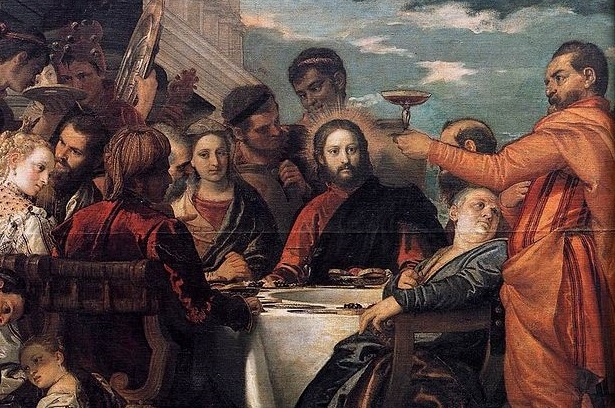
Our Savior looking Dionysian (Paolo Veronese, Wedding at Cana, c. 1572; Source: Wikimedia Commons, PD-Old-100)
Karl Barth is said to have recommended taking “your Bible and newspaper, and reading both.” He added, “But interpret newspapers from your Bible.” Last Sunday’s reading has me wondering whether the same could be said about your drinks.
Our Irish priest launched into his Wedding at Cana sermon with, “I have no problem believing the Miracle at Cana.” This sounded odd enough for an audience raised upon a demythologized worldview. Then came the punchline in the next sentence, “What’s implausible is how there weren’t people following Jesus with jugs of water for the rest of John’s Gospel.”
Later my friend responded to this sermon with a biblical-critical flourish, “it could’ve happened but been one of the many things ‘which are not written in this book.'” Another one added, “Sounds like it was entirely possible, ‘The Son of Man came eating and drinking, and they say, ‘Behold, a gluttonous man and a drunkard, a friend of tax collectors and sinners!’ Yet wisdom is vindicated by her deeds.'”
The average person could be excused for thinking that Ecclesiastes’ cynical “Eat, drink, and be merry, for tomorrow we die” is the last word of the Bible on drinking. But Ecclesiastes is an odd duck in a much more uniformly merry biblical canon.
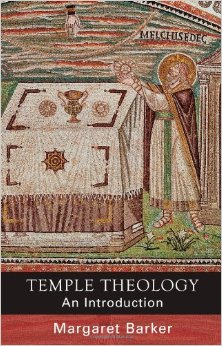
Maybe there’s way, way more to the biblical worldview than what’s written in the Bible? Margaret Barker thinks so.
While reading through the Wisdom literature lately, spurred on by my reading of Margaret Barker’s controversial work, I was surprised how frequently the Wisdom Literature recommends drinking. For example, there’s this wonderful flourish in Sirach that combines a robust theology of Creation with boozing responsibly, “What is life to one who is without wine? It has been created to make people happy.” Sirach also advises the poor to drown their sorrows in wine. Goodness knows I follow that excellent advice from time to time because of my frequently precarious financial situation. I won’t track down the relevant passages for you in the hope that it encourages you to dig into the Wisdom literature.
What’s interesting is how difficult it is to track down references to drinking in the Bible on the internet. They seem to have been censored. They actually have. Luther expunged them from the Bible when he threw out several Catholic books from the Old Testament canon. It’s odd Luther did so given how much he was known for boozing it up. Later generations of Reformers did not follow his drinking lead. This is sad.
Revelation also describes heaven as a great party, a wedding banquet, a celebratory dinner. This is a profound theme most viewers missed when watching Stephen Colbert invite Bill Maher back to the Catholic faith. Colbert riffed on the heavenly banquet theme after Maher accused him of pushing his beliefs upon him by comically impersonating Maher saying, “This guy gave me a huge lecture about going to dinner.” That dinner is heaven; heaven is that dinner.
Our Irish priest picked up on the banquet theme in his sermon too. How could he not after he playfully, but for all that seriously, chastised his parishioners for giving him tons of cookies around Christmastime, but no whiskey?
He did this by comparing American and Mexican wedding receptions. According to him the difference is that American receptions tend to be short and cheap affairs, whereas Mexican ones run into the night, and not infrequently for several days. In his judgement Mexican merrymaking mirrors the biblical metaphors of the heavenly banquet and God as groom and the Church as his bride more perfectly. Weddings are not the place for thrift, they are a space for the gift, just as God gives us our existence gratuitously.
It is also true that inebriation, if done right, can be comical. This is something that the padre did not pick up on. It’s also something that Chesterton missed in the otherwise almost Dionysian prose of his Orthodoxy:
There was something that He hid from all men when He went up a mountain to pray. There was something that He covered constantly by abrupt silence or impetuous isolation. There was some one thing that was too great for God to show us when He walked upon our earth; and I have sometimes fancied that it was His mirth.
Granted, on a more generous reading, this statement can be taken to imply that mirth is an attribute of God. It’s just one he chose to mysteriously hide in the New Testament. But did he? Let’s take a look at last Sunday’s reading:
Jesus told [the servants],
“Fill the jars with water.”
So they filled them to the brim.
Then he told them,
“Draw some out now and take it to the headwaiter.”
So they took it.
And when the headwaiter tasted the water that had become wine,
without knowing where it came from
— although the servers who had drawn the water knew —,
the headwaiter called the bridegroom and said to him,
“Everyone serves good wine first,
and then when people have drunk freely, an inferior one;
but you have kept the good wine until now.”
Jesus did this as the beginning of his signs at Cana in Galilee
and so revealed his glory,
and his disciples began to believe in him.
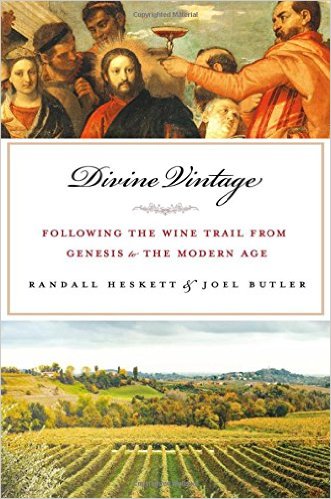
Wine speaks more to believers than sober-minded atheists.
Did you notice the joke Jesus played on the headwaiter with the servants? The servants knew all along, but the headwaiter had no idea. If this is how Jesus “revealed his glory,” and made his disciples “believe in him” then Nietzsche, as is frequently the case, was half right in identifying drinking and Christianity in his Twilight of the Idols:
What the German spirit might be — who has not had his melancholy ideas about that! But this people has deliberately made itself stupid, for nearly a millennium: nowhere have the two great European narcotics, alcohol and Christianity, been abused more dissolutely.
You can perhaps blame his Lutheran upbringing for this uptightness. Although he probably found the idea of a drinking Christ attractive secretly as evidenced by his all-consuming love for the god of wine and revelry, Dionysus. Then again, there’s a charitable reading: What if abuse implies the laudatory nature of the proper use of both Christianity and alcohol?
The Ante-Nicene Fathers liked to argue that the divine Logos stood behind all that is good and great in human culture, for example, wine. A couple of my friends even traced the wine trail in world and religious history in their Divine Vintage: Following the Wine Trail from Genesis to the Modern Age. The afterparty to their book presentation featured a tasting of wine types from all over the world and history. The wines were set up in chronological order. The oldest (in terms of manufacture and grape type) were some Armenian and Georgian wines. Making this liquid historical journey, and the fellowship that followed, are some of the finest memories I’ll take with me to the heavenly banquet–if I make it there. I suppose now I have more motivation to strive for it. Not by bread alone, because the Eucharist of the Divine Word also includes wine.
It is probably not an insignificant fact that the water stored in the containers at Cana was intended for ritual purification. Furthermore, according to Stone and Dung, Oil and Spit: Jewish Daily Life in the Time of Jesus, wine was used by Jesus’s coreligionists to ritually was their hands. The difference between the two, water and wine, might not be so great after all.
The Bible and drinking alcohol go hand in hand. Chances are you do it every Sunday at Mass.
* * * * * * * * *
I couldn’t find a good serious video on drinking and theology, but this seems appropriate:
If you’ve traveled with me this far then you’ll definitely want to take a look at my thoughts on the theology of food.
Previous Post

January 19, 2016
"René Girard never played the Great Man," says biographer.
Browse Our Archives
Select a Category #WhyRemainCatholic Abortion Advent Anti-Catholicism Arts Atheism Beauty Benedict XVI Bible Book Review Catholic Cinema Comedy Cosmos: A Space-Time Odyssey Czesław Miłosz Dariusz Karłowicz Devil Easter Eastern Orthodoxy Economics Environment Family Famous Atheists Who Weren't Atheists Guest Post Hans Urs von Balthasar HHS Mandate History Imagination Interview Islam Jean-Luc Marion John Paul II Judaism Just War Lent Literature Little Sisters of the Poor Liturgy Martyrdom Music News Paganism Patristics Phenomenology Philosophy Pierre Hadot Poetry Poland Pop Culture Pope Francis Poverty Prayer Protestantism Rabelais Race Remi Brague Rene Girard Russia Sam Rocha Science & Religion SCOTUS Secularization Sexual Abuse Sexuality Silence Solidarity Stratford Caldecott Synod14 Terrorism Top 10 Uncategorized Walker Percy War Weakened Edition World War II World Youth Day WYD Krakow
Select a Month July 2017 June 2017 May 2017 April 2017 March 2017 February 2017 January 2017 December 2016 October 2016 September 2016 August 2016 July 2016 June 2016 May 2016 April 2016 March 2016 February 2016 January 2016 December 2015 November 2015 October 2015 September 2015 August 2015 July 2015 June 2015 May 2015 April 2015 March 2015 February 2015 January 2015 December 2014 November 2014 October 2014 September 2014 August 2014 July 2014 May 2014 April 2014 March 2014 February 2014 January 2014 December 2013 November 2013 October 2013 September 2013 August 2013 July 2013 June 2013 May 2013
Follow Us!
TAKE THE
Religious Wisdom Quiz
What mountain did Jesus ascend from into heaven?
Select your answer to see how you score.
Mount of Olives Mount Zion Mount Carmel Mount Sinai
Related posts from Cosmos The In Lost

The Surprising Anti-Capitalist Logic Behind the Catholic Church's...

The Holy Family as an Icon of World...

How is Classical Philosophy is Like War?

Why Does the World's Leading Philosopher Remain a...
TRENDING AT PATHEOS Catholic

Rejecting Doom: Christian Hope And Human Action
Christianity is a religion of hope. We are to have hope and...

It’s What Comes From Within Which Matters
One of the most difficult things for us to understand is why...

Why I Choose the Eucharist Over the Sermon
Choose the Eucharist, Not the Sermon What are we supposed to get...

5 Design Elements Found in Spiritually Rooted Homes
Putting Spirituality Into Home Decor Our homes are more than our living...

Credo: A Story of God Told with the...
About 10 years ago, I began to imagine a personal "Credo" that...

The Anatomy of Divine Revelation in Catholic Thought
The claim that God has made Himself known to human beings is...
view all Catholic blogs
Ad-Free & Subscriber Log-In Subscription Support
- About Us
- 2026 Calendar
- Videos
- Podcasts
- Library of World Religions
- Faith In Media Tracker
- Advertise With Us
- Write for Us
- Privacy Policy
- Terms of Service
- Do Not Sell My Data
- Contact Us
- Radiant Digital
- Manage Newsletter Subscriptions
- Unsubscribe From Notifications
- Sitemap
Copyright 2008-2026, Patheos. All rights reserved.
Subscription Support Ad-Free & Subscriber Log-In
Follow Patheos