
BuddhistCatholicContemplativeEvangelicalGeneral ChristianHinduJewishLatter-day SaintMuslimNew VisionsProgressive Christian
Beliefs
- Buddhist
- Catholic
- Contemplative
- Evangelical
- General Christian
- Hindu
- Jewish
- Latter-day Saint
- More Voices
- Muslim
- New Visions
- Pagan
- Progressive Christian
Topics
- Religion News
- Food and Religion
- Sports and Religion
- Religious Art
- Religious Music and Entertainment
- Religious Events
- History and Religion
- Style and Religion
- Politics and Religion
- Women in Religion
- Recreation Outdoors and Religion
- Business Finance and Religion
- Careers Workplace and Religion
- Education and Religion
- Family Parenting and Religion
- Health Fitness and Religion
- Home and Religion
- Relationships and Religion
- Technology and Religion
- Travel and Religion
Columnists
- Buddhist Columnists
- Business Finance and Religion Columnists
- Careers Workplace and Religion Columnists
- Catholic Columnists
- Contemplative Columnists
- Education and Religion Columnists
- Evangelists Columnists
- Family Parenting and Religion Columnists
- General Christian Columnists
- Health Fitness and Religion Columnists
- Hindu Columnists
- History and Religion Columnists
- Home and Religion Columnists
- Jewish Columnists
- More Voices Columnists
- Latter Day Columnists
- Muslim Columnists
- New Visions Columnists
- Nonreligious Columnists
- Pagan Columnists
- Politics and Religion Columnists
- Progressive Columnists
- Recreation Outdoors and Religion Columnists
- Relationships and Religion Columnists
- Religion News Columnists
- Religious Art Columnists
- Religious Events Columnists
- Religious Music and Entertainment Columnists
- Sports and Religion Columnists
- Style and Religion Columnists
- Technology and Religion Columnists
- Travel and Religion Columnists
- Women in Religion Columnists
Resource Library
- 2026 Calendar
- Library of World Religions
- The 100 Most Holy Places on Earth
- Patheos Answers
- Podcasts
- Videos
- Faith Leaders Database
- Anglican Episcopalian
- Bahai
- Baptist
- Buddhism
- Christianity
- Confucianism
- Eastern Orthodoxy
- Hinduism
- Holiness and Pentecostal
- ISKCON
- Islam
- Judaism
- Lutheran
- Methodist
- The Church of Jesus Christ of Latter-day Saints
- New Age
- Paganism
- Presbytarian and Reformed
- Protestantism
- Religion Behind the Scenes
- Roman Catholic
- Scientology
- Shia Islam
- Sikhism
- Sufism
- Sunni Islam
- Taoism
- Zen
- See all religions
Research Tools
 Ad-Free & Subscriber Log-In Subscription Support
Ad-Free & Subscriber Log-In Subscription Support
Follow Patheos 

- Trending:
- Forgiveness
- |
- Marriage
- |
- Consciousness
- |
- Death Penalty
- |
- Election
- |
- Halloween
 Cosmos The In Lost
- Home
- Catholic
- God DOES Play Dice and Cheats?
God DOES Play Dice and Cheats?
Last updated on: January 13, 2016 at 4:46 am by Artur Rosman
God DOES Play Dice and Cheats? 2016-01-13T04:46:44-07:00 Artur Rosman
Patheos Explore the world's faith through different perspectives on religion and spirituality! Patheos has the views of the prevalent religions and spiritualities of the world.
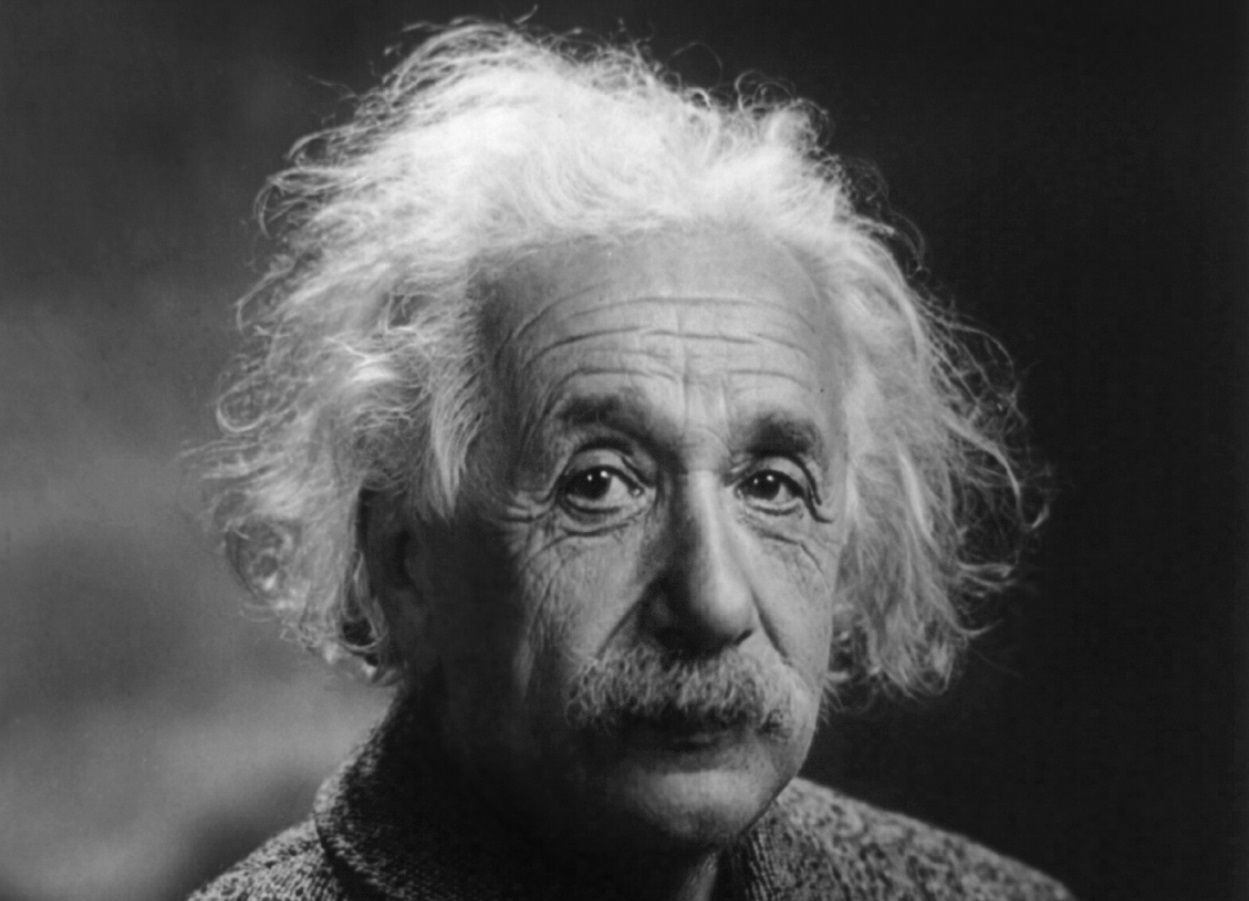
(Portrait of Albert Einstein, 1947, copyright not renewed; Source: Wikimedia Commons, PD)
I bet on completing a PhD in the humanities. Therefore, I am a betting man. As such Einstein’s retort to quantum mechanics, “God doesn’t play dice,” always seemed a bit Puritan to me.
According to Max Jammer, Einstein’s bon mot was religiously motivated. Religion was one of the physicist’s major intellectual obsessions outside of his day job of revolutionizing everything we know. Jammer even wrote a book, Einstein and Religion: Physics and Theology, about how Einstein not only engaged religion all of his life, but also how his theory of relativity might transform theological thinking itself.
Einstein and Religion’s sent me on a search for modern physics-inflected theology, which resulted in disappointment.
I’ve discovered that modern theology–with the notable exceptions of Ian Torrance (Space, Time, and Resurrection), Wolfhart Pannenberg (Toward a Theology of Nature), and Fr. Michal Heller (Infinity: New Research Perspectives)–hasn’t put much effort into integrating Einstein’s insights into theological thinking. For whatever reasons, theology hasn’t gambled much on physics.
The theme of gambling keeps returning regularly in my life.There is the looming Powerball jackpot, which is an integral part of my financial planning to pay off my college debts. I also saw a picture of Ella Fitzgerald jailed for gambling. Pascal’s gamble on practicing piety, whether you fully believe or not, is part of my resolution to pray and read more and write less.
Ulrich Lehner’s forthcoming The Catholic Enlightenment is part of my gamble upon reading more. It the academic orthodoxy overturning story of how 18th century Catholics–extending Trent and looking forward to Vatican II and Pope Francis–gambled upon education and structural reform in order to make Catholicism both more faithful to its roots and more open to critically engaging the modern world.

It is a brave move to defend both Catholicism and the Enlightenment when they are both hated and juxtaposed so much in our intellectual climate.
One of the more amusing anecdotes in Lehner’s country by country survey in The Catholic Enlightenment is the following speech the Catholic Enlightener Galiani was supposed to have given in response to the mocking skepticism of Denis Diderot at a dinner party:
Let us suppose . . . that he among you who is most convinced that the world is a work of chance is playing dice, not in a gambling house but in the most honorable home in Paris, and that his opponent gets seven twice, three times, four times, and keeps on constantly. After the game lasts for a while, my friend Diderot, who is losing his money, will not hesitate to say: “The dice are loaded, I am among cutthroats!” “Ah, Philosopher, what are you saying!” Because ten or twelves throws have left the dice box in such a way as to make you lose six francs, you believe firmly in an artificial combination, in a well-organized swindle, and on seeing in this universe universe so prodigious a number of combinations, a thousand and thousand more difficult and more complicated and more lasting, and more useful, you do not suspect that the dice of nature are also loaded and that there is up there a great thief who makes a game out of catching you.
Lehner’s comments upon the scandal this speech probably gave to the very group it was supposed to defend:
For the average Catholic it was, of course, blasphemous to call God a “thief”” or a “rascal”–yet by shocking his listeners, many of whom had become indifferent to a belief in God, he made them think, attracted laughter, and earned intellectual respect.
That is, if we assume, the average Catholic forgets that Jesus, ever the rascal by our human expectations, told a parable comparing the return of the Son of Man to a thief in the night.
Isn’t it also a big gamble to put yourself in the hands of such a God? Maybe the cheating of our expectations of such a God was blasphemous to Einstein? [If you want to see more of the unexpected see the book Disturbing Divine Behavior.]
Here’s an acquaintance, and author of the Uncontrolling Love of God, with yet another possible take on the Einstein comment:
You might also want to take a look at my exhaustive list of books (way more than 20) on the wide range of dialogue between contemporary theology and science.
Previous Post

January 8, 2016
Dow Jones vs. Paula Jones & Christian Unity
Next Post

January 13, 2016 Oh! You Pretty Things: Spotlight on David Bowie and Catholic Sex Scandals
Browse Our Archives
Select a Category #WhyRemainCatholic Abortion Advent Anti-Catholicism Arts Atheism Beauty Benedict XVI Bible Book Review Catholic Cinema Comedy Cosmos: A Space-Time Odyssey Czesław Miłosz Dariusz Karłowicz Devil Easter Eastern Orthodoxy Economics Environment Family Famous Atheists Who Weren't Atheists Guest Post Hans Urs von Balthasar HHS Mandate History Imagination Interview Islam Jean-Luc Marion John Paul II Judaism Just War Lent Literature Little Sisters of the Poor Liturgy Martyrdom Music News Paganism Patristics Phenomenology Philosophy Pierre Hadot Poetry Poland Pop Culture Pope Francis Poverty Prayer Protestantism Rabelais Race Remi Brague Rene Girard Russia Sam Rocha Science & Religion SCOTUS Secularization Sexual Abuse Sexuality Silence Solidarity Stratford Caldecott Synod14 Terrorism Top 10 Uncategorized Walker Percy War Weakened Edition World War II World Youth Day WYD Krakow
Select a Month July 2017 June 2017 May 2017 April 2017 March 2017 February 2017 January 2017 December 2016 October 2016 September 2016 August 2016 July 2016 June 2016 May 2016 April 2016 March 2016 February 2016 January 2016 December 2015 November 2015 October 2015 September 2015 August 2015 July 2015 June 2015 May 2015 April 2015 March 2015 February 2015 January 2015 December 2014 November 2014 October 2014 September 2014 August 2014 July 2014 May 2014 April 2014 March 2014 February 2014 January 2014 December 2013 November 2013 October 2013 September 2013 August 2013 July 2013 June 2013 May 2013
Follow Us!
TAKE THE
Religious Wisdom Quiz
Who was Paul's hometown companion?
Select your answer to see how you score.
Silas Timothy Barnabas Luke
Related posts from Cosmos The In Lost

The Surprising Anti-Capitalist Logic Behind the Catholic Church's...

The Holy Family as an Icon of World...

Where Does the Body of Christ Go After...

How is Classical Philosophy is Like War?
TRENDING AT PATHEOS Catholic

Rejecting Doom: Christian Hope And Human Action
Christianity is a religion of hope. We are to have hope and...

It’s What Comes From Within Which Matters
One of the most difficult things for us to understand is why...

Why I Choose the Eucharist Over the Sermon
Choose the Eucharist, Not the Sermon What are we supposed to get...

5 Design Elements Found in Spiritually Rooted Homes
Putting Spirituality Into Home Decor Our homes are more than our living...

Credo: A Story of God Told with the...
About 10 years ago, I began to imagine a personal "Credo" that...

The Anatomy of Divine Revelation in Catholic Thought
The claim that God has made Himself known to human beings is...
view all Catholic blogs
Ad-Free & Subscriber Log-In Subscription Support
- About Us
- 2026 Calendar
- Videos
- Podcasts
- Library of World Religions
- Faith In Media Tracker
- Advertise With Us
- Write for Us
- Privacy Policy
- Terms of Service
- Do Not Sell My Data
- Contact Us
- Radiant Digital
- Manage Newsletter Subscriptions
- Unsubscribe From Notifications
- Sitemap
Copyright 2008-2026, Patheos. All rights reserved.
Subscription Support Ad-Free & Subscriber Log-In
Follow Patheos