
BuddhistCatholicContemplativeEvangelicalGeneral ChristianHinduJewishLatter-day SaintMuslimNew VisionsProgressive Christian
Beliefs
- Buddhist
- Catholic
- Contemplative
- Evangelical
- General Christian
- Hindu
- Jewish
- Latter-day Saint
- More Voices
- Muslim
- New Visions
- Pagan
- Progressive Christian
Topics
- Religion News
- Food and Religion
- Sports and Religion
- Religious Art
- Religious Music and Entertainment
- Religious Events
- History and Religion
- Style and Religion
- Politics and Religion
- Women in Religion
- Recreation Outdoors and Religion
- Business Finance and Religion
- Careers Workplace and Religion
- Education and Religion
- Family Parenting and Religion
- Health Fitness and Religion
- Home and Religion
- Relationships and Religion
- Technology and Religion
- Travel and Religion
Columnists
- Buddhist Columnists
- Business Finance and Religion Columnists
- Careers Workplace and Religion Columnists
- Catholic Columnists
- Contemplative Columnists
- Education and Religion Columnists
- Evangelists Columnists
- Family Parenting and Religion Columnists
- General Christian Columnists
- Health Fitness and Religion Columnists
- Hindu Columnists
- History and Religion Columnists
- Home and Religion Columnists
- Jewish Columnists
- More Voices Columnists
- Latter Day Columnists
- Muslim Columnists
- New Visions Columnists
- Nonreligious Columnists
- Pagan Columnists
- Politics and Religion Columnists
- Progressive Columnists
- Recreation Outdoors and Religion Columnists
- Relationships and Religion Columnists
- Religion News Columnists
- Religious Art Columnists
- Religious Events Columnists
- Religious Music and Entertainment Columnists
- Sports and Religion Columnists
- Style and Religion Columnists
- Technology and Religion Columnists
- Travel and Religion Columnists
- Women in Religion Columnists
Resource Library
- 2026 Calendar
- Library of World Religions
- The 100 Most Holy Places on Earth
- Patheos Answers
- Podcasts
- Videos
- Faith Leaders Database
- Anglican Episcopalian
- Bahai
- Baptist
- Buddhism
- Christianity
- Confucianism
- Eastern Orthodoxy
- Hinduism
- Holiness and Pentecostal
- ISKCON
- Islam
- Judaism
- Lutheran
- Methodist
- The Church of Jesus Christ of Latter-day Saints
- New Age
- Paganism
- Presbytarian and Reformed
- Protestantism
- Religion Behind the Scenes
- Roman Catholic
- Scientology
- Shia Islam
- Sikhism
- Sufism
- Sunni Islam
- Taoism
- Zen
- See all religions
Research Tools
 Ad-Free & Subscriber Log-In Subscription Support
Ad-Free & Subscriber Log-In Subscription Support
Follow Patheos 

- Trending:
- Forgiveness
- |
- Marriage
- |
- Consciousness
- |
- Death Penalty
- |
- Election
- |
- Halloween
 Cosmos The In Lost
- Home
- Catholic
- Edith Stein and the Assassination of God’s Epiphany
Edith Stein and the Assassination of God’s Epiphany
Last updated on: January 7, 2016 at 1:58 am by Artur Rosman
Edith Stein and the Assassination of God’s Epiphany 2016-01-07T01:58:15-07:00 Artur Rosman
Patheos Explore the world's faith through different perspectives on religion and spirituality! Patheos has the views of the prevalent religions and spiritualities of the world.
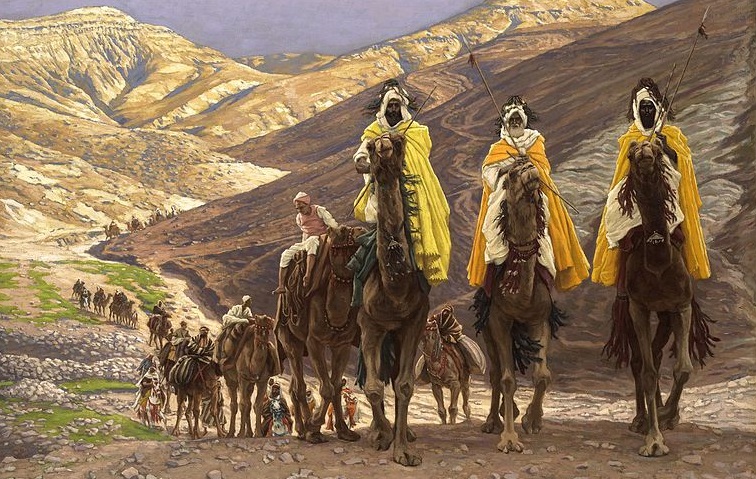
Encountering the strange(r) is at the heart of Christianity and the Feast of the Epiphany (James Tissot, Journey of the Magi, 1892; Source: Wiki Commons, PD-Old-100)
I forced myself to reflect upon the importance of getting our pictures of God sorted out in a previous post by briefly engaging what Justice Scalia said about God and state in Louisiana. It would be easy to say Scalia Santo Subito after his showboating in a St. Thomas More hat during the Obama inaugural if, if we didn’t pay attention to his theological language. The theological language neither matches the bombast of the headware, nor the demands of orthodoxy. Scalia might be talking about the Judeo-Christian God, but he does so in radically inadequate ways.
Nietzsche’s death-of-God is less a historical event where the Divinity is literally assassinated, but more of a linguistic and existential situation where our notions of God are completely inadequate to the reality they aim for and to the demands that reality makes upon us. One such example is that Scalia line I cited yesterday:
God takes care of little children, drunkards and the United States of America, I think that’s true. God has been very good to us. One of the reasons God has been good to us is that we have done him honor.
Honor is a peripheral value to the Bible’s theologies. It is much more important for Greeks, the myths of modern nation-states, and, more recently, identity politics. On the other hand, hospitality is much more fundamental to the message of the Bible. In his A History of the Church in Latin America: Colonialism to Liberation Enrique Dussel demonstrates how hospitality, the event at the center of the Feast of the Three Kings, is so important that it ties directly to what the West Experiences as the Death of God:
The authentic epiphany of the Word of God is that word spoken by the poor man who says, “I am hungry!” And only the person who hears this cry of the poor and who is in effect a nonbeliever, a negator of the system, can hear the genuine Word of God. God has not died, but God’s epiphany has been assassinated in the Indian, the African, and the Asian. Therefore God can no longer reveal himself Abel died in the deification of Europe, of the “center ,” and God is now hidden. The norm of interpretation that has been revealed is: “I was hungry and you never gave me food. …Then it will be their turn to ask, ‘Lord, when did we see you hungry …?’ ”(Matt. 25:42-44).36 Now by the death of the deification of Europe faith can be born in the breast of the “peripheral” poor. Faith in God mediated by the poor is the new manifestation of God in history, and faith becomes reality not by the writing of theological or theoretical treatises on “the death of God,” but by means of applied justice.
Why are the poor so central to the Gospel message? To avoid scandal after quoting someone who practices something called a “Philosophy of Liberation” I’ll quote St. John Paul II from his homily during the canonization of St. Edith Stein.
The following passage from the homily makes it clear that Europe didn’t only kill the Stranger in Latin America, but also on its own territories and very recently at that (not to mention during the forced conversions of the European continent, a religious colonizing practiced on the future colonizers before colonialism):
Dear brothers and sisters! Because she was Jewish, Edith Stein was taken with her sister Rosa and many other Catholic Jews from the Netherlands to the concentration camp in Auschwitz, where she died with them in the gas chambers. Today we remember them all with deep respect. A few days before her deportation, the woman religious had dismissed the question about a possible rescue: “Do not do it! Why should I be spared? Is it not right that I should gain no advantage from my Baptism? If I cannot share the lot of my brothers and sisters, my life, in a certain sense, is destroyed”.
From now on, as we celebrate the memory of this new saint from year to year, we must also remember the Shoah, that cruel plan to exterminate a people — a plan to which millions of our Jewish brothers and sisters fell victim. May the Lord let his face shine upon them and grant them peace (cf. Nm 6:25f.).
For the love of God and man, once again I raise an anguished cry: May such criminal deeds never be repeated against any ethnic group, against any race, in any corner of this world! It is a cry to everyone: to all people of goodwill; to all who believe in the Just and Eternal God; to all who know they are joined to Christ, the Word of God made man. We must all stand together: human dignity is at stake. There is only one human family. The new saint also insisted on this: “Our love of neighbour is the measure of our love of God. For Christians — and not only for them — no one is a ‘stranger’. The love of Christ knows no borders”.
That Christian nation that Michael Baxter discussed in yesterday’s post knows no borders. It invites strangers like the Magi to epiphanies as strange as a swaddled child, pooping and breastfeeding.
This Christianity thing is truly strange.
Don’t kill it.
For more on the philosophy and theology of hospitality see my post on anatheism, or peruse Henri Cardinal de Lubac’s thoughts on the Death of God.
While I am employed part-time I am by no means rich. If you feel inclined to give to the stranger then you can donate through the PayPal button on this page.
Previous Post

January 5, 2016
Do Catholics Worship the Same God as the Americans & Judge Scalia?
Next Post

January 7, 2016 The Altar Girl Storm in a Teacup
Browse Our Archives
Select a Category #WhyRemainCatholic Abortion Advent Anti-Catholicism Arts Atheism Beauty Benedict XVI Bible Book Review Catholic Cinema Comedy Cosmos: A Space-Time Odyssey Czesław Miłosz Dariusz Karłowicz Devil Easter Eastern Orthodoxy Economics Environment Family Famous Atheists Who Weren't Atheists Guest Post Hans Urs von Balthasar HHS Mandate History Imagination Interview Islam Jean-Luc Marion John Paul II Judaism Just War Lent Literature Little Sisters of the Poor Liturgy Martyrdom Music News Paganism Patristics Phenomenology Philosophy Pierre Hadot Poetry Poland Pop Culture Pope Francis Poverty Prayer Protestantism Rabelais Race Remi Brague Rene Girard Russia Sam Rocha Science & Religion SCOTUS Secularization Sexual Abuse Sexuality Silence Solidarity Stratford Caldecott Synod14 Terrorism Top 10 Uncategorized Walker Percy War Weakened Edition World War II World Youth Day WYD Krakow
Select a Month July 2017 June 2017 May 2017 April 2017 March 2017 February 2017 January 2017 December 2016 October 2016 September 2016 August 2016 July 2016 June 2016 May 2016 April 2016 March 2016 February 2016 January 2016 December 2015 November 2015 October 2015 September 2015 August 2015 July 2015 June 2015 May 2015 April 2015 March 2015 February 2015 January 2015 December 2014 November 2014 October 2014 September 2014 August 2014 July 2014 May 2014 April 2014 March 2014 February 2014 January 2014 December 2013 November 2013 October 2013 September 2013 August 2013 July 2013 June 2013 May 2013
Follow Us!
TAKE THE
Religious Wisdom Quiz
Multitudes, multitudes in the valley of decision! What is this valley also called?
Select your answer to see how you score.
The valley of Kidron The valley of Jehoshaphat The valley of judgment The valley of Megiddo
Related posts from Cosmos The In Lost

The Surprising Anti-Capitalist Logic Behind the Catholic Church's...

The Holy Family as an Icon of World...

How is Classical Philosophy is Like War?

Why Does the World's Leading Philosopher Remain a...
TRENDING AT PATHEOS Catholic

The Parable Of The Sower And The Word...
One of Christ’s most famous parables is that of the sower who...

Rejecting Doom: Christian Hope And Human Action
Christianity is a religion of hope. We are to have hope and...

Why I Choose the Eucharist Over the Sermon
Choose the Eucharist, Not the Sermon What are we supposed to get...

5 Design Elements Found in Spiritually Rooted Homes
Putting Spirituality Into Home Decor Our homes are more than our living...

Credo: A Story of God Told with the...
About 10 years ago, I began to imagine a personal "Credo" that...

The Anatomy of Divine Revelation in Catholic Thought
The claim that God has made Himself known to human beings is...
view all Catholic blogs
Ad-Free & Subscriber Log-In Subscription Support
- About Us
- 2026 Calendar
- Videos
- Podcasts
- Library of World Religions
- Faith In Media Tracker
- Advertise With Us
- Write for Us
- Privacy Policy
- Terms of Service
- Do Not Sell My Data
- Contact Us
- Radiant Digital
- Manage Newsletter Subscriptions
- Unsubscribe From Notifications
- Sitemap
Copyright 2008-2026, Patheos. All rights reserved.
Subscription Support Ad-Free & Subscriber Log-In
Follow Patheos