
BuddhistCatholicContemplativeEvangelicalGeneral ChristianHinduJewishLatter-day SaintMuslimNew VisionsProgressive Christian
Beliefs
- Buddhist
- Catholic
- Contemplative
- Evangelical
- General Christian
- Hindu
- Jewish
- Latter-day Saint
- More Voices
- Muslim
- New Visions
- Pagan
- Progressive Christian
Topics
- Religion News
- Food and Religion
- Sports and Religion
- Religious Art
- Religious Music and Entertainment
- Religious Events
- History and Religion
- Style and Religion
- Politics and Religion
- Women in Religion
- Recreation Outdoors and Religion
- Business Finance and Religion
- Careers Workplace and Religion
- Education and Religion
- Family Parenting and Religion
- Health Fitness and Religion
- Home and Religion
- Relationships and Religion
- Technology and Religion
- Travel and Religion
Columnists
- Buddhist Columnists
- Business Finance and Religion Columnists
- Careers Workplace and Religion Columnists
- Catholic Columnists
- Contemplative Columnists
- Education and Religion Columnists
- Evangelists Columnists
- Family Parenting and Religion Columnists
- General Christian Columnists
- Health Fitness and Religion Columnists
- Hindu Columnists
- History and Religion Columnists
- Home and Religion Columnists
- Jewish Columnists
- More Voices Columnists
- Latter Day Columnists
- Muslim Columnists
- New Visions Columnists
- Nonreligious Columnists
- Pagan Columnists
- Politics and Religion Columnists
- Progressive Columnists
- Recreation Outdoors and Religion Columnists
- Relationships and Religion Columnists
- Religion News Columnists
- Religious Art Columnists
- Religious Events Columnists
- Religious Music and Entertainment Columnists
- Sports and Religion Columnists
- Style and Religion Columnists
- Technology and Religion Columnists
- Travel and Religion Columnists
- Women in Religion Columnists
Resource Library
- 2026 Calendar
- Library of World Religions
- The 100 Most Holy Places on Earth
- Patheos Answers
- Podcasts
- Videos
- Faith Leaders Database
- Anglican Episcopalian
- Bahai
- Baptist
- Buddhism
- Christianity
- Confucianism
- Eastern Orthodoxy
- Hinduism
- Holiness and Pentecostal
- ISKCON
- Islam
- Judaism
- Lutheran
- Methodist
- The Church of Jesus Christ of Latter-day Saints
- New Age
- Paganism
- Presbytarian and Reformed
- Protestantism
- Religion Behind the Scenes
- Roman Catholic
- Scientology
- Shia Islam
- Sikhism
- Sufism
- Sunni Islam
- Taoism
- Zen
- See all religions
Research Tools
 Ad-Free & Subscriber Log-In Subscription Support
Ad-Free & Subscriber Log-In Subscription Support
Follow Patheos 

- Trending:
- Forgiveness
- |
- Marriage
- |
- Consciousness
- |
- Death Penalty
- |
- Election
- |
- Halloween
 Cosmos The In Lost
- Home
- Catholic
- Which Renegade Pope Encouraged Dialogue with Atheists?
Which Renegade Pope Encouraged Dialogue with Atheists?
Last updated on: December 21, 2015 at 12:19 pm by Artur Rosman
Which Renegade Pope Encouraged Dialogue with Atheists? 2015-12-21T12:19:25-07:00 Artur Rosman
Patheos Explore the world's faith through different perspectives on religion and spirituality! Patheos has the views of the prevalent religions and spiritualities of the world.
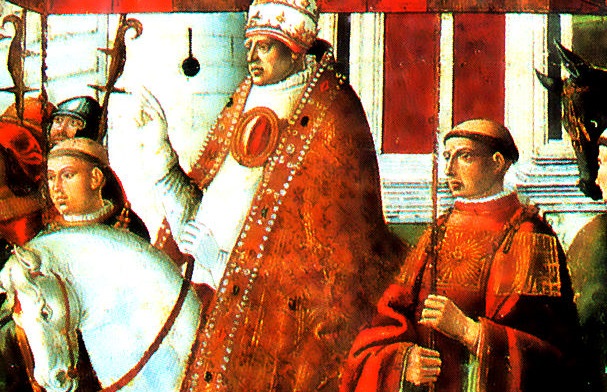
No, not this Avignon pope, although he sure could put on a show. (Gregory XI, Girolamo do Benvenuto, Circa late 15th c.; Source: Wikimedia Commons, PD-Old-100).
If the post on interreligious dialogue with Muslims is any indication, then the following words from a pope might blow a few gaskets:
Today, in addition to interreligious dialogue, there should be a dialogue with those to whom religion is something foreign, to whom God is unknown and who nevertheless do not want to be left merely Godless, but rather to draw near to him, albeit as the Unknown.
These words come from Pope Emeritus Benedict XVI again. He delivered them in 2009 during his founding speech for The Courtyard of the Gentiles initiative. The Courtyard is the Church’s permanent institution for dialogue with atheists. It’s not something entirely new, since it extends initiatives that go way beyond Vatican II, reaching, at the very least, into the pontificate of Pius XII.
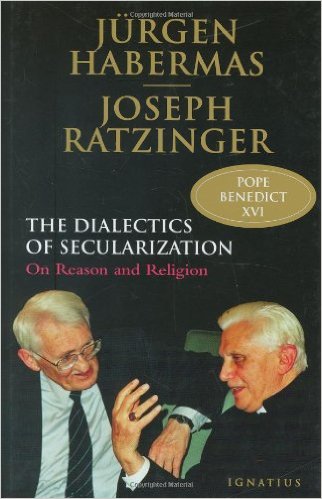
Are you following the example set by Joseph Ratzinger? Does it make you feel uncomfortable? It should.
When in 2006 Pope Benedict initiated an interreligious dialogue with Islam called for by Vatican II he didn’t stop there. He also later, in 2009, consolidated the Church’s efforts to remain in conversation with people who don’t believe in God. This development shouldn’t be surprising to those who have honestly followed Joseph Ratzinger’s career instead of projecting their pet projects and obsessions onto him. One of his longest intellectual engagements is dialogue with atheists, culminating in a much-publicized exchange with philosopher Jurgen Habermas in 2004. Their conversations were later collected in the volume The Dialectics of Secularization: On Reason and Religion. The depth of Benedict’s sincere engagement with atheists can be gauged by his invitation of atheist philosopher Julia Kristeva to the 2011 World Day of Prayer. Kristeva spoke there eloquently about what atheists and believers share.
She told the former, echoing John Paul II, not to fear Christianity:
The words of John Paul II, “Be not afraid!” are not directed solely toward believers, because they may take heart in their resistance to totalitarianism. The appeal of that Pope, an apostle of human rights, also drives us not to fear European culture, but on the contrary, to dare humanism: the construct complicity between the Christian humanism and that which emerged from the Renaissance and Enlightenment, and which has the ambition of opening the dangerous ways of freedom. Thanks today to Pope Benedict XVI, for having invited, for the first time in these places, humanists among you.
Kristeva’s output on Catholicism can be found in the collection This Incredible Need to Believe. I’ve found her appreciation of John Paul II’s teachings (and personal example) on suffering especially profound. As an honest dialogue partner she readily admits that secular culture is not equipped to show the dignity of suffering humanity like Catholicism has done, especially since the Baroque. You can see from my list of 10 Atheists Who Engage Religion Charitably over at Strange Notions (a website dedicated to engaging atheists) that Kristeva is not a lone voice. There are plenty of atheists who can teach believers things they didn’t know.
This is part of what I appreciate about writing for Patheos Catholic. Our forum is not safely sealed off from those who believe other things like most Catholic sites are. Therefore, it is much more difficult for our writers to ignore Benedict’s clarion call to “a dialogue [even] with those to whom religion is something foreign.” This situation faithfully reflects both our daily post-Christian world and the ancient world of the Early Fathers. Thinkers such as Justin Martyr, Clement of Alexandria, and Tertullian engaged, you might say baptized, what was best in their culture–whether it be Socrates, the soul’s testimony , natural law, or the all-pervading Logos–in order to demonstrate the deep-down Christian essence of everything.
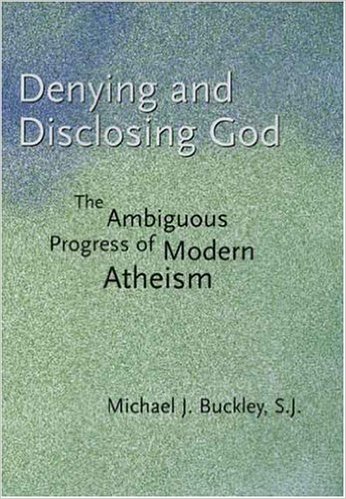
A theism and atheism have things in common?
Our task is a little simpler, because as Marc Barnes pointed out in The Other Benedict Option, our situation isn’t pre-Christian. Western atheism (and other reactions to orthodoxy) draw heavily upon resources that belong to very orthodoxy. Unbelief, as Charles Taylor argues in his A Secular Age, is not a simple story of subtraction. That is, atheism in the West has never been about removing theology and hitting the non-religious core of humanity.
Instead, as you might discover more in-depth in books such as Atheists: The Origin of the Species and Denying and Disclosing God: The Ambiguous Progress of Modern Atheism, atheism always works in tandem with Christian theology, sometimes sifting through Christian beliefs without being explicitly aware of it. As Simone Weil puts it in Gravity and Grace:
There are two atheisms of which one is a purification of the notion of God.
St. Augustine’s City of God, a favorite book of the Pope Emeritus, adds another insight as to why dialogue with atheists makes sense. Augustine’s ecclesiology hinges upon the observation that those we see on a weekly basis in church might ultimately end up on the side of the City of Man. Furthermore, those who are the Church’s greatest enemies (like Sts. Peter and Paul) might ultimately end up squarely in the City of God. We don’t know. It is a great mystery.
For now we should remain agnostic about last things because they are not in our hands. This is why interreligious dialogue and dialogue with the non-religious is a pressing expedience. Benedict XVI understood this and that is part of the reason why his papacy was so radical (and traditional, as in Ante-Nicene traditional).
It’s much more than Fry and Laurie’s tricky linguistics:
You probably now want the following questions answered:
1. What Do We Make of a Disturbingly Radical Papacy?
2. How did Benedict Revolutionize Dialogue with Islam?
Previous Post

December 20, 2015
Cosmos: Weakened Edition, 12

Browse Our Archives
Select a Category #WhyRemainCatholic Abortion Advent Anti-Catholicism Arts Atheism Beauty Benedict XVI Bible Book Review Catholic Cinema Comedy Cosmos: A Space-Time Odyssey Czesław Miłosz Dariusz Karłowicz Devil Easter Eastern Orthodoxy Economics Environment Family Famous Atheists Who Weren't Atheists Guest Post Hans Urs von Balthasar HHS Mandate History Imagination Interview Islam Jean-Luc Marion John Paul II Judaism Just War Lent Literature Little Sisters of the Poor Liturgy Martyrdom Music News Paganism Patristics Phenomenology Philosophy Pierre Hadot Poetry Poland Pop Culture Pope Francis Poverty Prayer Protestantism Rabelais Race Remi Brague Rene Girard Russia Sam Rocha Science & Religion SCOTUS Secularization Sexual Abuse Sexuality Silence Solidarity Stratford Caldecott Synod14 Terrorism Top 10 Uncategorized Walker Percy War Weakened Edition World War II World Youth Day WYD Krakow
Select a Month July 2017 June 2017 May 2017 April 2017 March 2017 February 2017 January 2017 December 2016 October 2016 September 2016 August 2016 July 2016 June 2016 May 2016 April 2016 March 2016 February 2016 January 2016 December 2015 November 2015 October 2015 September 2015 August 2015 July 2015 June 2015 May 2015 April 2015 March 2015 February 2015 January 2015 December 2014 November 2014 October 2014 September 2014 August 2014 July 2014 May 2014 April 2014 March 2014 February 2014 January 2014 December 2013 November 2013 October 2013 September 2013 August 2013 July 2013 June 2013 May 2013
Follow Us!
TAKE THE
Religious Wisdom Quiz
According to Hebrews, Jesus is the same yesterday, today, and when?
Select your answer to see how you score.
Throughout all generations Until the end of the age In all eternity past Forever
Related posts from Cosmos The In Lost

The Holy Family as an Icon of World...

Atheists Have "National Day of Reason," But American...

Famous Atheists Who Aren't Atheist: Facebook Creator Mark...

The Left Has Magically Discovered Religious Freedom!
TRENDING AT PATHEOS Catholic

Rejecting Doom: Christian Hope And Human Action
Christianity is a religion of hope. We are to have hope and...

It’s What Comes From Within Which Matters
One of the most difficult things for us to understand is why...

Why I Choose the Eucharist Over the Sermon
Choose the Eucharist, Not the Sermon What are we supposed to get...

5 Design Elements Found in Spiritually Rooted Homes
Putting Spirituality Into Home Decor Our homes are more than our living...

Credo: A Story of God Told with the...
About 10 years ago, I began to imagine a personal "Credo" that...

The Anatomy of Divine Revelation in Catholic Thought
The claim that God has made Himself known to human beings is...
view all Catholic blogs
Ad-Free & Subscriber Log-In Subscription Support
- About Us
- 2026 Calendar
- Videos
- Podcasts
- Library of World Religions
- Faith In Media Tracker
- Advertise With Us
- Write for Us
- Privacy Policy
- Terms of Service
- Do Not Sell My Data
- Contact Us
- Radiant Digital
- Manage Newsletter Subscriptions
- Unsubscribe From Notifications
- Sitemap
Copyright 2008-2026, Patheos. All rights reserved.
Subscription Support Ad-Free & Subscriber Log-In
Follow Patheos