
BuddhistCatholicContemplativeEvangelicalGeneral ChristianHinduJewishLatter-day SaintMuslimNew VisionsProgressive Christian
Beliefs
- Buddhist
- Catholic
- Contemplative
- Evangelical
- General Christian
- Hindu
- Jewish
- Latter-day Saint
- More Voices
- Muslim
- New Visions
- Pagan
- Progressive Christian
Topics
- Religion News
- Food and Religion
- Sports and Religion
- Religious Art
- Religious Music and Entertainment
- Religious Events
- History and Religion
- Style and Religion
- Politics and Religion
- Women in Religion
- Recreation Outdoors and Religion
- Business Finance and Religion
- Careers Workplace and Religion
- Education and Religion
- Family Parenting and Religion
- Health Fitness and Religion
- Home and Religion
- Relationships and Religion
- Technology and Religion
- Travel and Religion
Columnists
- Buddhist Columnists
- Business Finance and Religion Columnists
- Careers Workplace and Religion Columnists
- Catholic Columnists
- Contemplative Columnists
- Education and Religion Columnists
- Evangelists Columnists
- Family Parenting and Religion Columnists
- General Christian Columnists
- Health Fitness and Religion Columnists
- Hindu Columnists
- History and Religion Columnists
- Home and Religion Columnists
- Jewish Columnists
- More Voices Columnists
- Latter Day Columnists
- Muslim Columnists
- New Visions Columnists
- Nonreligious Columnists
- Pagan Columnists
- Politics and Religion Columnists
- Progressive Columnists
- Recreation Outdoors and Religion Columnists
- Relationships and Religion Columnists
- Religion News Columnists
- Religious Art Columnists
- Religious Events Columnists
- Religious Music and Entertainment Columnists
- Sports and Religion Columnists
- Style and Religion Columnists
- Technology and Religion Columnists
- Travel and Religion Columnists
- Women in Religion Columnists
Resource Library
- 2026 Calendar
- Library of World Religions
- The 100 Most Holy Places on Earth
- Patheos Answers
- Podcasts
- Videos
- Faith Leaders Database
- Anglican Episcopalian
- Bahai
- Baptist
- Buddhism
- Christianity
- Confucianism
- Eastern Orthodoxy
- Hinduism
- Holiness and Pentecostal
- ISKCON
- Islam
- Judaism
- Lutheran
- Methodist
- The Church of Jesus Christ of Latter-day Saints
- New Age
- Paganism
- Presbytarian and Reformed
- Protestantism
- Religion Behind the Scenes
- Roman Catholic
- Scientology
- Shia Islam
- Sikhism
- Sufism
- Sunni Islam
- Taoism
- Zen
- See all religions
Research Tools
 Ad-Free & Subscriber Log-In Subscription Support
Ad-Free & Subscriber Log-In Subscription Support
Follow Patheos 

- Trending:
- Forgiveness
- |
- Marriage
- |
- Consciousness
- |
- Death Penalty
- |
- Election
- |
- Halloween
 Cosmos The In Lost
- Home
- Catholic
- EXCLUSIVE: Bosnian-Muslim Scholar & Immigrant on American Fears
EXCLUSIVE: Bosnian-Muslim Scholar & Immigrant on American Fears
Last updated on: December 16, 2015 at 2:15 pm by Guest Contributor
EXCLUSIVE: Bosnian-Muslim Scholar & Immigrant on American Fears 2015-12-16T14:15:44-07:00 Guest Contributor
Patheos Explore the world's faith through different perspectives on religion and spirituality! Patheos has the views of the prevalent religions and spiritualities of the world.
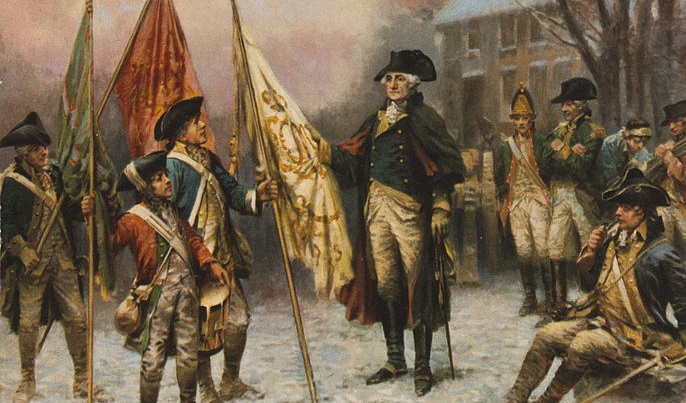
What is the essence of American assimilation? (Washington inspecting the captured colors after the battle of Trenton. Lithograph of painting by Hayes Litho. Co., Buffalo, N.Y., 1914; Source: Wikimedia Commons, PD-Published-Before-1923).
The issue of Muslim identity in America is front and center of late after the Paris attacks, the political debates that have followed, the comparisons between Catholic and Muslim persecution in the States, and the recent suspension of a professor at Wheaton who argued that Christians worship the same God as Muslims. What follows is a guest post from a young Muslim scholar on the topic of assimilating Muslims to American culture.
Criticizing America is easy. Let’s face it: there is plenty to criticize. When I first came to the United States in 1996, I was a bit disappointed. I could not see that unique American ambition and passion that I thought existed. People seemed dejected and lazy. OK, so, maybe I saw too many 80’s movies when I was a kid and I was naive in my expectations! Despite the naivete, which I am sure every immigrant has felt to a certain extent, I still have to say that my immediate experience felt hollow.
The first few years were brutal. We were poor, barely making it. To buy a t-shirt at the Gap was equivalent to buying a Chanel or Yves Saint Laurent! (Just for clarification purposes: now I can afford the Gap t-shirt, but alas, I’m still far from haute couture. I was seventeen and enrolled in public high school, 11th grade. Students being students when faced with otherness would say silly and mean words to me, convinced I could not understand them. But I already spoke English so they stopped quickly. Some people thought that I needed an “explanation” on how to flush a toilet, which was an interesting experience. Beginnings are always tough and alienation was inevitable. So, I turned to what I know best: studying.
There is so much more to my story, but I begin this short essay with a brief bio because I want to say a few words about cultural assimilation. America was a “culture shock” – but then again, any new environment is. And yet, it is easy to adapt to the new ways of daily life. One simply has to assimilate in order to survive. It seems completely obvious to say this but I did not expect to see Bosnia in America. At first, I considered myself a guest. Then, I was a Green Card holder. And after that, I became a naturalized citizen. I observed and evaluated immediately what I had to do to adapt in order to succeed. I think that most Bosnian immigrants have done the same.
How much should an immigrant assimilate? What does that even mean? Preserving one’s cultural heritage in the United States is not difficult. We see this everywhere: from cultural organizations to restaurants. The point is that one has the freedom to honor one’s past because it cannot be erased. It should not be erased. Part of my soul is still in Bosnia and it will always be there – this is a fact for every immigrant as they relate to their country of origin.
Another important point is that everyone has the freedom to worship God in their particular tradition, as well as to not believe in God. And at the same time, thank goodness that we do not live in a theocracy.
An assimilation is a strange word. It has a connotation of disappearance, of complete change, of getting rid of anything, which reminds one of where they came from, and some choose to do exactly that. But one does not have to disappear. At the same time, one can become and remain an American.
The way I view “assimilation” is the understanding of and belief in the US Constitution, and it is the only necessary assimilation. This was not hard for me because I already believed in those principles of humanism. Any other “assimilation” had to do with practical matters, and those, I assure you, did not threaten my existence or were catalysts for an extinction of my Bosnian soul.
In a letter to James Madison dated January 30th, 1787, Thomas Jefferson wrote: “I hold it that a little rebellion now and then is a good thing, and as necessary in the political world as storms in the physical.” The American experiment is certainly not free of its paradoxes and weaknesses. However, when a citizen begins to pervert the Constitution, we are surely looking at the dismantling and a destruction of the American essence. The country will cease to be what it was meant to be: a refuge for those who need protection and freedom to be. Such notions have to be protected (while being mindful of the dignity of human life) and I deem that to be a duty of every American citizen.
Emina Melonic is originally from Bosnia, a survivor of the Bosnian war and its aftermath of refugee camps. She immigrated to the United States in 1996. She holds BA in English, German, and Art History, Master’s degrees in the Humanities, Theology, and Philosophy, and is currently a PhD candidate in Comparative Literature at SUNY Buffalo. Emina and her husband, Charlie, live near Buffalo, NY with their nutty and lovable cat, Lulu. She blogs about culture, art, and politics at Illumination and about film at The Magic Lantern.
This was a guest post.
You should also see what Roman Christian group says it worships the same God as Muslims.
Finally, do you know how thorough the refugee vetting process is?
Previous Post
December 15, 2015
The Cosmos TOP10 Literary Books of 2015
Browse Our Archives
Select a Category #WhyRemainCatholic Abortion Advent Anti-Catholicism Arts Atheism Beauty Benedict XVI Bible Book Review Catholic Cinema Comedy Cosmos: A Space-Time Odyssey Czesław Miłosz Dariusz Karłowicz Devil Easter Eastern Orthodoxy Economics Environment Family Famous Atheists Who Weren't Atheists Guest Post Hans Urs von Balthasar HHS Mandate History Imagination Interview Islam Jean-Luc Marion John Paul II Judaism Just War Lent Literature Little Sisters of the Poor Liturgy Martyrdom Music News Paganism Patristics Phenomenology Philosophy Pierre Hadot Poetry Poland Pop Culture Pope Francis Poverty Prayer Protestantism Rabelais Race Remi Brague Rene Girard Russia Sam Rocha Science & Religion SCOTUS Secularization Sexual Abuse Sexuality Silence Solidarity Stratford Caldecott Synod14 Terrorism Top 10 Uncategorized Walker Percy War Weakened Edition World War II World Youth Day WYD Krakow
Select a Month July 2017 June 2017 May 2017 April 2017 March 2017 February 2017 January 2017 December 2016 October 2016 September 2016 August 2016 July 2016 June 2016 May 2016 April 2016 March 2016 February 2016 January 2016 December 2015 November 2015 October 2015 September 2015 August 2015 July 2015 June 2015 May 2015 April 2015 March 2015 February 2015 January 2015 December 2014 November 2014 October 2014 September 2014 August 2014 July 2014 May 2014 April 2014 March 2014 February 2014 January 2014 December 2013 November 2013 October 2013 September 2013 August 2013 July 2013 June 2013 May 2013
Follow Us!
TAKE THE
Religious Wisdom Quiz
What is the ecumenical council where Roman Catholicism addressed modernization in the 1960s?
Select your answer to see how you score.
Vatican II Council of Nicaea Trent Ephesus
Related posts from Cosmos The In Lost

Syrian Catholic Bishops Unequivocally Condemn American Bombing of...

The Left Has Magically Discovered Religious Freedom!
Reflections of a Priest from India on the...

Don't Look to Secularism if You Want to...
TRENDING AT PATHEOS Catholic

Creation, Preservation, and Teleology in Catholic Theology
As I write this, it is very early Monday morning. Like millions...

The Parable Of The Sower And The Word...
One of Christ’s most famous parables is that of the sower who...

Rejecting Doom: Christian Hope And Human Action
Christianity is a religion of hope. We are to have hope and...

Why I Choose the Eucharist Over the Sermon
Choose the Eucharist, Not the Sermon What are we supposed to get...

5 Design Elements Found in Spiritually Rooted Homes
Putting Spirituality Into Home Decor Our homes are more than our living...

Credo: A Story of God Told with the...
About 10 years ago, I began to imagine a personal "Credo" that...
view all Catholic blogs
Ad-Free & Subscriber Log-In Subscription Support
- About Us
- 2026 Calendar
- Videos
- Podcasts
- Library of World Religions
- Faith In Media Tracker
- Advertise With Us
- Write for Us
- Privacy Policy
- Terms of Service
- Do Not Sell My Data
- Contact Us
- Radiant Digital
- Manage Newsletter Subscriptions
- Unsubscribe From Notifications
- Sitemap
Copyright 2008-2026, Patheos. All rights reserved.
Subscription Support Ad-Free & Subscriber Log-In
Follow Patheos