
BuddhistCatholicContemplativeEvangelicalGeneral ChristianHinduJewishLatter-day SaintMuslimNew VisionsProgressive Christian
Beliefs
- Buddhist
- Catholic
- Contemplative
- Evangelical
- General Christian
- Hindu
- Jewish
- Latter-day Saint
- More Voices
- Muslim
- New Visions
- Pagan
- Progressive Christian
Topics
- Religion News
- Food and Religion
- Sports and Religion
- Religious Art
- Religious Music and Entertainment
- Religious Events
- History and Religion
- Style and Religion
- Politics and Religion
- Women in Religion
- Recreation Outdoors and Religion
- Business Finance and Religion
- Careers Workplace and Religion
- Education and Religion
- Family Parenting and Religion
- Health Fitness and Religion
- Home and Religion
- Relationships and Religion
- Technology and Religion
- Travel and Religion
Columnists
- Buddhist Columnists
- Business Finance and Religion Columnists
- Careers Workplace and Religion Columnists
- Catholic Columnists
- Contemplative Columnists
- Education and Religion Columnists
- Evangelists Columnists
- Family Parenting and Religion Columnists
- General Christian Columnists
- Health Fitness and Religion Columnists
- Hindu Columnists
- History and Religion Columnists
- Home and Religion Columnists
- Jewish Columnists
- More Voices Columnists
- Latter Day Columnists
- Muslim Columnists
- New Visions Columnists
- Nonreligious Columnists
- Pagan Columnists
- Politics and Religion Columnists
- Progressive Columnists
- Recreation Outdoors and Religion Columnists
- Relationships and Religion Columnists
- Religion News Columnists
- Religious Art Columnists
- Religious Events Columnists
- Religious Music and Entertainment Columnists
- Sports and Religion Columnists
- Style and Religion Columnists
- Technology and Religion Columnists
- Travel and Religion Columnists
- Women in Religion Columnists
Resource Library
- 2026 Calendar
- Library of World Religions
- The 100 Most Holy Places on Earth
- Patheos Answers
- Podcasts
- Videos
- Faith Leaders Database
- Anglican Episcopalian
- Bahai
- Baptist
- Buddhism
- Christianity
- Confucianism
- Eastern Orthodoxy
- Hinduism
- Holiness and Pentecostal
- ISKCON
- Islam
- Judaism
- Lutheran
- Methodist
- The Church of Jesus Christ of Latter-day Saints
- New Age
- Paganism
- Presbytarian and Reformed
- Protestantism
- Religion Behind the Scenes
- Roman Catholic
- Scientology
- Shia Islam
- Sikhism
- Sufism
- Sunni Islam
- Taoism
- Zen
- See all religions
Research Tools
 Ad-Free & Subscriber Log-In Subscription Support
Ad-Free & Subscriber Log-In Subscription Support
Follow Patheos 

- Trending:
- Forgiveness
- |
- Marriage
- |
- Consciousness
- |
- Death Penalty
- |
- Election
- |
- Halloween
 Cosmos The In Lost
- Home
- Catholic
- Benedict XVI’s Theology of Bacon (& Creation)
Benedict XVI’s Theology of Bacon (& Creation)
Last updated on: December 8, 2015 at 1:35 pm by Artur Rosman
Benedict XVI’s Theology of Bacon (& Creation) 2015-12-08T13:35:13-07:00 Artur Rosman
Patheos Explore the world's faith through different perspectives on religion and spirituality! Patheos has the views of the prevalent religions and spiritualities of the world.
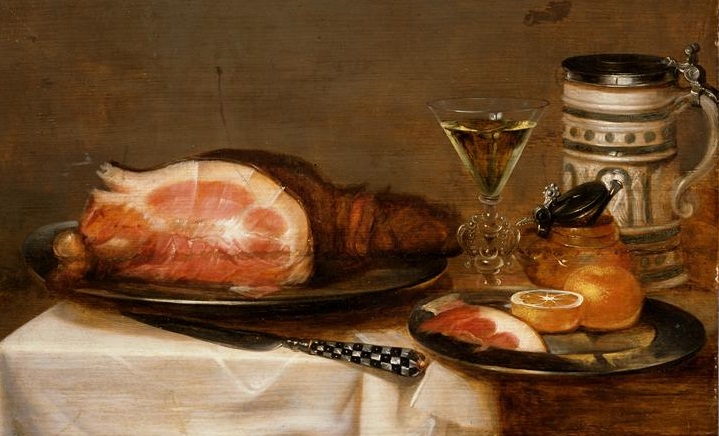
The theology of food is a whole fantastic subset of the discipline (Jacob Foppens van Es, Still Life with Bacon, 17th c.; Source: Wikimedia Commons, PD-Old-100).
The environment and Bacon are closely tied in Benedict XVI’s theology.
The lack of major prohibitions against bacon is something that clearly sets apart Christianity from the other major world religions, that is, besides the more obvious examples of the spiritualized materialism of the Incarnation and Resurrection.
Islam doesn’t do bacon. Judaism is not hot on bacon. Hinduism is somewhat ambivalent about pork too–depends on your caste.
This disdain for pork is related to taboos around boundary-mixing of the sort you find all over Leviticus. It’s also the reason why shellfish are all verboten too. If you want to go further into the details of this see Catholic anthropologist Mary Douglas’s seminal work Purity and Danger for all the details on the ritual logic of ancient societies.
I have a healthy affection for bacon as a daily component of my diet, except on Fridays, of course. There are plenty of excellent theologies of food, but there is no sub-discipline for bacon.
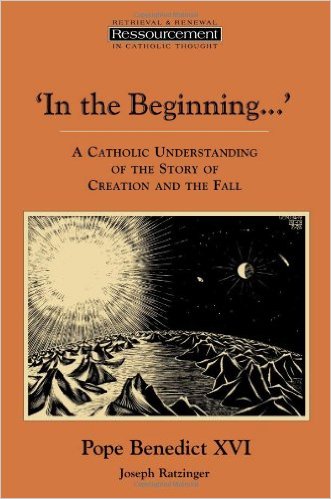
Bacon is only the jumping off point for Pope Benedict’s theology of Creation.
Can you imagine how warmly I welcomed the following out-of-context Spe Salvi passage as it fried itself onto my laptop screen and my consciousness?
Thus hope too, in Bacon, acquires a new form. Now it is called: faith in progress. For Bacon, it is clear that the recent spate of discoveries and inventions is just the beginning; through the interplay of science and praxis, totally new discoveries will follow, a totally new world will emerge, the kingdom of man. He even put forward a vision of foreseeable inventions—including the aeroplane and the submarine. As the ideology of progress developed further, joy at visible advances in human potential remained a continuing confirmation of faith in progress as such.
The bacon he’s talking about here is not of pork made. It is Francis Bacon, whose New Organon, was the charter of the dominant strain of modern science and philosophy. Meaning, a science and philosophy based upon submitting God’s creation to its materialistic impulses.
The impulse is something that Joseph Ratzinger elsewhere calls scientism–science as the ideology refashioning of nature in man’s image, rather than allowing it to stand on its own as an icon pointing toward beyond itself to its Creator.
Curiously enough this discussion of Bacon dovetails nicely into something the then Cardinal Ratzinger said in the lectures In the Beginning . . . on the doctrine of Creation in the modern period:
Only in recent years has the doctrine of creation begun to have an unprecedented topicality. Human beings’ concentration on “doing,” on fashioning a new and eventually better world for themselves, has made the resistance to creation stand out with increasing clarity: God’s creation and “nature” are having to defend themselves against the limitless pretensions of human beings as creators. Human beings want to understand the discovered world only as material for their own creativity. Suddenly humans’ own creations no longer appear simply as a hope, possibly humankind’s only one, but rather as a threat: humans are sawing off the branch on which they sit. The real creation seems like a refuge, to which they look back and which they seek anew.
When Cardinal Ratzinger speaks of sawing off the branch he speaks of the ecological crises of our age. Only when it is almost too late did theology attempt to escape its imprisonment in the solpsistic subjectivism, of which the German theological idealism of Kant, Schleiermacher, and Hegel is but one symptom, into a full blown theology of Creation, not just man.
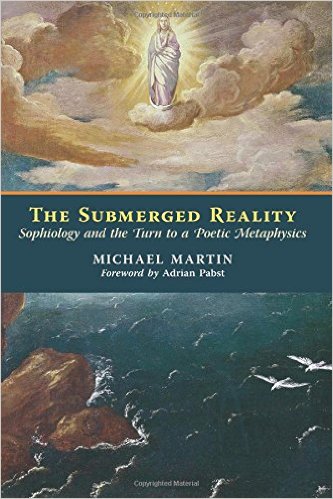
One of the finest books on modern theology’s forgetfulness of nature and Creation.
According to the future ex-pope, theology moved so completely away from the full blown theology of Creation–so dear to, for example, Church Doctors such as Maximus Confessor and Thomas Aquinas–that environmentalist critics blamed theology for the ecological crisis. The very crisis caused by modern patterns of thinking that had destroyed the traditional, more holistic and non-subjectivist, way of doing theology:
In a radical about-turn, the Christian doctrine of creation is now regarded as the cause of the pillage of the world.
In the Beginning . . . concludes its meditations on the topic of theology’s forgetting of nature and Creation with the following clarion call:
Hitherto creation has been a theme for theoretical reasoning, a, so to speak, purely “objective theme”; now it is becoming practical and can no longer be ignored. Redemption cannot happen without or against creation. Indeed, the question arises as to whether perhaps creation is the only redemption. It is becoming clearer that we cannot give the right answer to the question about where we should be. “What can we do?” will be false and pernicious while we refrain from asking, “Who are we?” The question of being and the question of our hopes are inseparable.
“Creation is the only redemption” is something worth pondering seriously. One of the saddest ironies is how much the pro-life movement positions itself against environmentalism, and vice-versa. The connections between the two movements are blindingly obvious. The both face the same foe: science and technology shorn of any awareness of the finitude of Creation.
Michael Martin’s The Submerged Reality: Sophiology and the Turn to a Poetic Metaphysics is one excellent jumping off point for further reflections on these topics. He does not fear to make connections across neuralgic points. This is one of the reasons why it will be on my upcoming list of TOP10 non-fictions books of this year.
The Simpsons, take it away!
If you want to ponder these problems more . . . take a look at Michael Martin’s guest post Laudato Si’, The Most Sophiological Encyclical of All.
Please remember to donate to this blog and its impoverished proprietor through its paypal donation button on this page.
Hermeneutic of Continuity: You might also enjoy the post where I made Benedict XVI’s environmentalist statements look a little bit like a leaked version of Laudato Si’. The combox alone is worth the price of admission.
Previous Post

December 7, 2015
Was Vatican 1 Shockingly More Political Than Vatican 2?
Next Post
December 9, 2015 George W. Obama Says Islam is a Religion of Peace
Browse Our Archives
Select a Category #WhyRemainCatholic Abortion Advent Anti-Catholicism Arts Atheism Beauty Benedict XVI Bible Book Review Catholic Cinema Comedy Cosmos: A Space-Time Odyssey Czesław Miłosz Dariusz Karłowicz Devil Easter Eastern Orthodoxy Economics Environment Family Famous Atheists Who Weren't Atheists Guest Post Hans Urs von Balthasar HHS Mandate History Imagination Interview Islam Jean-Luc Marion John Paul II Judaism Just War Lent Literature Little Sisters of the Poor Liturgy Martyrdom Music News Paganism Patristics Phenomenology Philosophy Pierre Hadot Poetry Poland Pop Culture Pope Francis Poverty Prayer Protestantism Rabelais Race Remi Brague Rene Girard Russia Sam Rocha Science & Religion SCOTUS Secularization Sexual Abuse Sexuality Silence Solidarity Stratford Caldecott Synod14 Terrorism Top 10 Uncategorized Walker Percy War Weakened Edition World War II World Youth Day WYD Krakow
Select a Month July 2017 June 2017 May 2017 April 2017 March 2017 February 2017 January 2017 December 2016 October 2016 September 2016 August 2016 July 2016 June 2016 May 2016 April 2016 March 2016 February 2016 January 2016 December 2015 November 2015 October 2015 September 2015 August 2015 July 2015 June 2015 May 2015 April 2015 March 2015 February 2015 January 2015 December 2014 November 2014 October 2014 September 2014 August 2014 July 2014 May 2014 April 2014 March 2014 February 2014 January 2014 December 2013 November 2013 October 2013 September 2013 August 2013 July 2013 June 2013 May 2013
Follow Us!
TAKE THE
Religious Wisdom Quiz
What ritual involved ashes of a red heifer?
Select your answer to see how you score.
Inheritance Marriage Purification Harvest
Related posts from Cosmos The In Lost

The Surprising Anti-Capitalist Logic Behind the Catholic Church's...

The Holy Family as an Icon of World...

How is Classical Philosophy is Like War?

Why Does the World's Leading Philosopher Remain a...
TRENDING AT PATHEOS Catholic

The Parable Of The Sower And The Word...
One of Christ’s most famous parables is that of the sower who...

Rejecting Doom: Christian Hope And Human Action
Christianity is a religion of hope. We are to have hope and...

Why I Choose the Eucharist Over the Sermon
Choose the Eucharist, Not the Sermon What are we supposed to get...

5 Design Elements Found in Spiritually Rooted Homes
Putting Spirituality Into Home Decor Our homes are more than our living...

Credo: A Story of God Told with the...
About 10 years ago, I began to imagine a personal "Credo" that...

The Anatomy of Divine Revelation in Catholic Thought
The claim that God has made Himself known to human beings is...
view all Catholic blogs
Ad-Free & Subscriber Log-In Subscription Support
- About Us
- 2026 Calendar
- Videos
- Podcasts
- Library of World Religions
- Faith In Media Tracker
- Advertise With Us
- Write for Us
- Privacy Policy
- Terms of Service
- Do Not Sell My Data
- Contact Us
- Radiant Digital
- Manage Newsletter Subscriptions
- Unsubscribe From Notifications
- Sitemap
Copyright 2008-2026, Patheos. All rights reserved.
Subscription Support Ad-Free & Subscriber Log-In
Follow Patheos