
BuddhistCatholicContemplativeEvangelicalGeneral ChristianHinduJewishLatter-day SaintMuslimNew VisionsProgressive Christian
Beliefs
- Buddhist
- Catholic
- Contemplative
- Evangelical
- General Christian
- Hindu
- Jewish
- Latter-day Saint
- More Voices
- Muslim
- New Visions
- Pagan
- Progressive Christian
Topics
- Religion News
- Food and Religion
- Sports and Religion
- Religious Art
- Religious Music and Entertainment
- Religious Events
- History and Religion
- Style and Religion
- Politics and Religion
- Women in Religion
- Recreation Outdoors and Religion
- Business Finance and Religion
- Careers Workplace and Religion
- Education and Religion
- Family Parenting and Religion
- Health Fitness and Religion
- Home and Religion
- Relationships and Religion
- Technology and Religion
- Travel and Religion
Columnists
- Buddhist Columnists
- Business Finance and Religion Columnists
- Careers Workplace and Religion Columnists
- Catholic Columnists
- Contemplative Columnists
- Education and Religion Columnists
- Evangelists Columnists
- Family Parenting and Religion Columnists
- General Christian Columnists
- Health Fitness and Religion Columnists
- Hindu Columnists
- History and Religion Columnists
- Home and Religion Columnists
- Jewish Columnists
- More Voices Columnists
- Latter Day Columnists
- Muslim Columnists
- New Visions Columnists
- Nonreligious Columnists
- Pagan Columnists
- Politics and Religion Columnists
- Progressive Columnists
- Recreation Outdoors and Religion Columnists
- Relationships and Religion Columnists
- Religion News Columnists
- Religious Art Columnists
- Religious Events Columnists
- Religious Music and Entertainment Columnists
- Sports and Religion Columnists
- Style and Religion Columnists
- Technology and Religion Columnists
- Travel and Religion Columnists
- Women in Religion Columnists
Resource Library
- 2026 Calendar
- Library of World Religions
- The 100 Most Holy Places on Earth
- Patheos Answers
- Podcasts
- Videos
- Faith Leaders Database
- Anglican Episcopalian
- Bahai
- Baptist
- Buddhism
- Christianity
- Confucianism
- Eastern Orthodoxy
- Hinduism
- Holiness and Pentecostal
- ISKCON
- Islam
- Judaism
- Lutheran
- Methodist
- The Church of Jesus Christ of Latter-day Saints
- New Age
- Paganism
- Presbytarian and Reformed
- Protestantism
- Religion Behind the Scenes
- Roman Catholic
- Scientology
- Shia Islam
- Sikhism
- Sufism
- Sunni Islam
- Taoism
- Zen
- See all religions
Research Tools
 Ad-Free & Subscriber Log-In Subscription Support
Ad-Free & Subscriber Log-In Subscription Support
Follow Patheos 

- Trending:
- Forgiveness
- |
- Marriage
- |
- Consciousness
- |
- Death Penalty
- |
- Election
- |
- Halloween
 Cosmos The In Lost
- Home
- Catholic
- Was Vatican 1 Shockingly More Political Than Vatican 2?
Was Vatican 1 Shockingly More Political Than Vatican 2?
Last updated on: December 7, 2015 at 10:36 am by Guest Contributor
Was Vatican 1 Shockingly More Political Than Vatican 2? 2015-12-07T10:36:05-07:00 Guest Contributor
Patheos Explore the world's faith through different perspectives on religion and spirituality! Patheos has the views of the prevalent religions and spiritualities of the world.
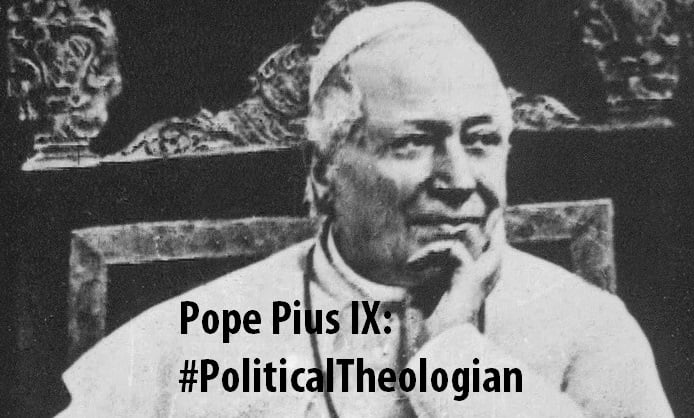
Chase Padnusiak says Pius IX makes William T. Cavanaugh look like a political theology rookie (Detail: Picture of Pope Pius IX, c. 1878; Source: Wikimedia Commons, PD-Before-1923).
Catholic History is stranger than you think.
[Léger] spoke to me with excitement about his disappointment with the doctrinal schemas: speculative theses that only repeat Vatican I and don’t consider the needs and possibilities of our time. We aren’t any longer at the time of the doctrinal liberalism of 1860 . . .
Marie-Dominique Chenu, Vatican II Notebook
Vatican II has been, since it was convened, the most controversial council in the history of the contemporary church.
Soft traditionalists, many of whom have an odd and anachronistic love of the free market, voice skepticism about its effect, if not its very essence. At best, it can be reconciled to the Church’s history as an afterthought; at worst, it requires damage control.
Hardline traditionalists, like the ill-named SSPX, walk a razor’s edge due to their unease with some of its decrees.
Sedevacantists go so far as to say it means the popes since the Council have forfeited their authority; in other words, the Chair of Peter is vacant. Common to all of these views is a political hermeneutic: Vatican II was, in some sense, a politically-motivated affair, devoted either to a direct or indirection erosion of tradition, a capitulation to Karl Rahner, the congress of Congars, and the playground of such clearly non-Catholic figures as Pope Benedict XVI. It was so bad that it now requires explaining away or repudiation.
But this view is wholly out of touch with tradition. In fact, the council often lauded by those who identify as “traditionalists” for its relationship with the great anti-Modernist, Blessed Pope Pius IX, as well as its general distaste for “Modernism.”
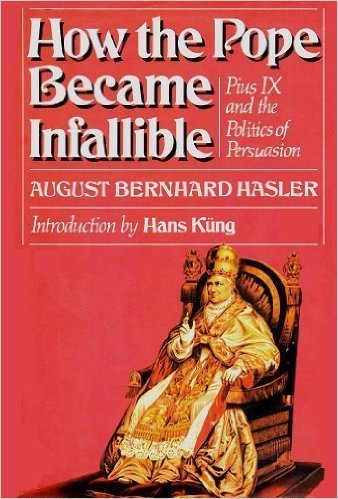
Ever wonder? Fr. Hasler appears to be your man!
Vatican I, is demonstrably more political, less necessary, and generally harder to swallow than its successor. In his unfortunately under-read exposé of Vatican I (with a preface by Fr. Hans Küng of all people), Fr. August Bernhard Hasler, S.J. (a Vatican official with access to detailed records) argues that the Council was highly-political and little more than a rubberstamp for a highly authoritarian pope.
And, regardless, of one’s view of Pius IX, the Council did convene in a crazier period than the relative peace of its post-WWII successor. Pius was elected, and initially ruled, in sympathy with Europe’s rising liberal tendencies, but a number of terrorist attacks by Italian Nationalists led to a change of mind and a turn to the French for protection. Vatican I itself was interrupted (and essentially shutdown) by the Italian Nationalist conquest of Rome, leading to Pius’ identification as “captivus Vaticani.”
Furthermore, his attempts at defining papal infallibility met with resistance (here the relationship between Cardinals Newman and Manning is fascinating). Witness, this disturbing anecdote from Hasler’s How the Pope Became Infallible:
On June 18, 1870, emotions were running high in the great hall of the Council. A Dominican cardinal, Filippo Maria Guidi had come forward to speak against the pope and the Infallibilists (the first Roman prelate to do so), emphatically stating that the pope was not infallible in and of himself, independent of the Church, but only insofar as he reflected the views of the bishops and the tradition of the Church…That very evening Pius IX had Cardinal Guidi called in and bitterly castigated him for his speech. In reply to Guidi’s protest that he had only spoken as a witness to tradition, the pope snapped back at him with the oft-repeated phrase, “I am tradition.”
Pastor Aeternus, which defined papal infallibility, retroactively made unassailable Pius’s earlier proclamation on the Immaculate Conception of Mary (an action which might’ve upset St. Thomas Aquinas, whose epigones proliferated following Vatican I, and who had the honor of being depicted in a mural alongside Jesus and Pius, celebrating the Council). In some ways, this council (or, at least Pastor Aeternus) begins to look a bit like a modern Unam Sanctam, though more clearly delineated and with an even more transparent political context.

Up to this point, no one has tried to use Pastor Aeternus retroactively to force Unam Sanctam on us all. Deo gratias!
Click here to keep reading . . .
Previous Post

December 6, 2015
Cosmos: Weakened Edition, 10
Next Post

December 8, 2015 Benedict XVI's Theology of Bacon (& Creation)
Browse Our Archives
Select a Category #WhyRemainCatholic Abortion Advent Anti-Catholicism Arts Atheism Beauty Benedict XVI Bible Book Review Catholic Cinema Comedy Cosmos: A Space-Time Odyssey Czesław Miłosz Dariusz Karłowicz Devil Easter Eastern Orthodoxy Economics Environment Family Famous Atheists Who Weren't Atheists Guest Post Hans Urs von Balthasar HHS Mandate History Imagination Interview Islam Jean-Luc Marion John Paul II Judaism Just War Lent Literature Little Sisters of the Poor Liturgy Martyrdom Music News Paganism Patristics Phenomenology Philosophy Pierre Hadot Poetry Poland Pop Culture Pope Francis Poverty Prayer Protestantism Rabelais Race Remi Brague Rene Girard Russia Sam Rocha Science & Religion SCOTUS Secularization Sexual Abuse Sexuality Silence Solidarity Stratford Caldecott Synod14 Terrorism Top 10 Uncategorized Walker Percy War Weakened Edition World War II World Youth Day WYD Krakow
Select a Month July 2017 June 2017 May 2017 April 2017 March 2017 February 2017 January 2017 December 2016 October 2016 September 2016 August 2016 July 2016 June 2016 May 2016 April 2016 March 2016 February 2016 January 2016 December 2015 November 2015 October 2015 September 2015 August 2015 July 2015 June 2015 May 2015 April 2015 March 2015 February 2015 January 2015 December 2014 November 2014 October 2014 September 2014 August 2014 July 2014 May 2014 April 2014 March 2014 February 2014 January 2014 December 2013 November 2013 October 2013 September 2013 August 2013 July 2013 June 2013 May 2013
Follow Us!
TAKE THE
Religious Wisdom Quiz
Which book contains the story of Hosea's marriage to an unfaithful wife?
Select your answer to see how you score.
Joel Hosea Micah Jonah
Related posts from Cosmos The In Lost

The Surprising Anti-Capitalist Logic Behind the Catholic Church's...

The Holy Family as an Icon of World...

How is Classical Philosophy is Like War?

Why Does the World's Leading Philosopher Remain a...
TRENDING AT PATHEOS Catholic

The Parable Of The Sower And The Word...
One of Christ’s most famous parables is that of the sower who...

Rejecting Doom: Christian Hope And Human Action
Christianity is a religion of hope. We are to have hope and...

Why I Choose the Eucharist Over the Sermon
Choose the Eucharist, Not the Sermon What are we supposed to get...

5 Design Elements Found in Spiritually Rooted Homes
Putting Spirituality Into Home Decor Our homes are more than our living...

Credo: A Story of God Told with the...
About 10 years ago, I began to imagine a personal "Credo" that...

The Anatomy of Divine Revelation in Catholic Thought
The claim that God has made Himself known to human beings is...
view all Catholic blogs
Ad-Free & Subscriber Log-In Subscription Support
- About Us
- 2026 Calendar
- Videos
- Podcasts
- Library of World Religions
- Faith In Media Tracker
- Advertise With Us
- Write for Us
- Privacy Policy
- Terms of Service
- Do Not Sell My Data
- Contact Us
- Radiant Digital
- Manage Newsletter Subscriptions
- Unsubscribe From Notifications
- Sitemap
Copyright 2008-2026, Patheos. All rights reserved.
Subscription Support Ad-Free & Subscriber Log-In
Follow Patheos