
BuddhistCatholicContemplativeEvangelicalGeneral ChristianHinduJewishLatter-day SaintMuslimNew VisionsProgressive Christian
Beliefs
- Buddhist
- Catholic
- Contemplative
- Evangelical
- General Christian
- Hindu
- Jewish
- Latter-day Saint
- More Voices
- Muslim
- New Visions
- Pagan
- Progressive Christian
Topics
- Religion News
- Food and Religion
- Sports and Religion
- Religious Art
- Religious Music and Entertainment
- Religious Events
- History and Religion
- Style and Religion
- Politics and Religion
- Women in Religion
- Recreation Outdoors and Religion
- Business Finance and Religion
- Careers Workplace and Religion
- Education and Religion
- Family Parenting and Religion
- Health Fitness and Religion
- Home and Religion
- Relationships and Religion
- Technology and Religion
- Travel and Religion
Columnists
- Buddhist Columnists
- Business Finance and Religion Columnists
- Careers Workplace and Religion Columnists
- Catholic Columnists
- Contemplative Columnists
- Education and Religion Columnists
- Evangelists Columnists
- Family Parenting and Religion Columnists
- General Christian Columnists
- Health Fitness and Religion Columnists
- Hindu Columnists
- History and Religion Columnists
- Home and Religion Columnists
- Jewish Columnists
- More Voices Columnists
- Latter Day Columnists
- Muslim Columnists
- New Visions Columnists
- Nonreligious Columnists
- Pagan Columnists
- Politics and Religion Columnists
- Progressive Columnists
- Recreation Outdoors and Religion Columnists
- Relationships and Religion Columnists
- Religion News Columnists
- Religious Art Columnists
- Religious Events Columnists
- Religious Music and Entertainment Columnists
- Sports and Religion Columnists
- Style and Religion Columnists
- Technology and Religion Columnists
- Travel and Religion Columnists
- Women in Religion Columnists
Resource Library
- 2026 Calendar
- Library of World Religions
- The 100 Most Holy Places on Earth
- Patheos Answers
- Podcasts
- Videos
- Faith Leaders Database
- Anglican Episcopalian
- Bahai
- Baptist
- Buddhism
- Christianity
- Confucianism
- Eastern Orthodoxy
- Hinduism
- Holiness and Pentecostal
- ISKCON
- Islam
- Judaism
- Lutheran
- Methodist
- The Church of Jesus Christ of Latter-day Saints
- New Age
- Paganism
- Presbytarian and Reformed
- Protestantism
- Religion Behind the Scenes
- Roman Catholic
- Scientology
- Shia Islam
- Sikhism
- Sufism
- Sunni Islam
- Taoism
- Zen
- See all religions
Research Tools
 Ad-Free & Subscriber Log-In Subscription Support
Ad-Free & Subscriber Log-In Subscription Support
Follow Patheos 

- Trending:
- Forgiveness
- |
- Marriage
- |
- Consciousness
- |
- Death Penalty
- |
- Election
- |
- Halloween
 Cosmos The In Lost
- Home
- Catholic
- On Noses and the Incarnation
On Noses and the Incarnation
Last updated on: December 2, 2015 at 9:49 pm by Guest Contributor
On Noses and the Incarnation 2015-12-02T21:49:01-07:00 Guest Contributor
Patheos Explore the world's faith through different perspectives on religion and spirituality! Patheos has the views of the prevalent religions and spiritualities of the world.
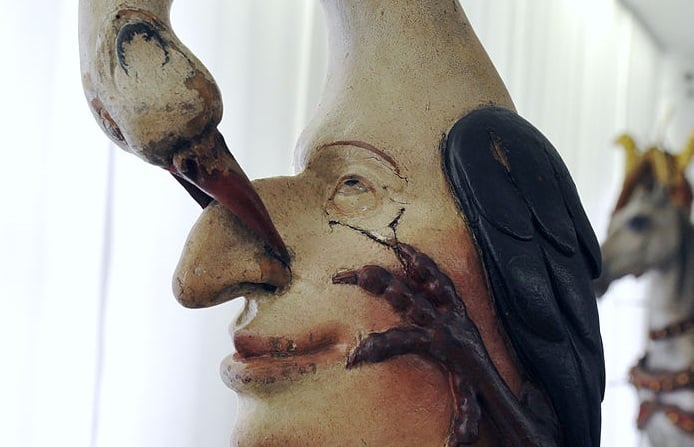
Yeah, I don’t know . . . people of the Middle Age were much odder than this–a lot of German follows in the attribution: Sammlung des Landesmuseums Württemberg; Katalog Nr. 20; Karnevalsschlitten „Jonas im Maul des Walfischs“, an der Kufe Figur mit Vogel, der an die eigene Nase fasst, South Germany, End of 18th C.; Source: Wikimedia Commons, PD-Old-100.
“For the Son of God became man so that we might become God.”
–St. Athanasius of Alexandria, On the Incarnation
Have you ever thought much about noses, and how weird we might look without them? Noses, in a sense, follow from having a human being in front of you. Case in point: Voldemort does not have a nose. Whatever he might have once been, after fracturing his soul seven times and having a metaphysical crisis, he certainly isn’t human. In hiding himself, he lost his nose and much of his what-is-it-ness. Now, not everyone has a nose and for many around the world, such a loss has more to do with politics than metaphysics, but unlike Voldemort, such individuals would probably take their nose back if they could. Noses are part of what it means to have a body: if you can find a human being, it’s reasonable to suppose you will be able to find their nose.
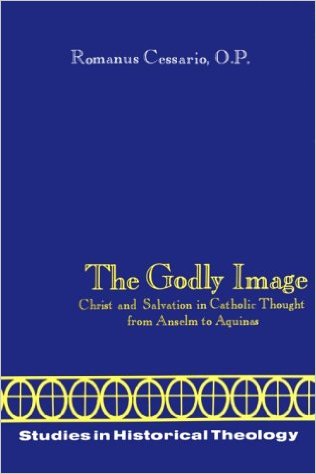
The Godly Image presents an exhaustive study of St. Thomas’ theological delineation of sin, satisfaction, the suffering of Christ, and the fulfillment of God’s saving plan in the believer.
Being human means having a body. Incarnation, a very important word to Catholics and Christians of all stripes, is generally agreed to be the word we use to sum the idea “the Word became flesh and pitched His tent among us.” And who doesn’t like the result? A baby in a manger, who is God, and also presents and cookies and celebrations? And yet, as Romanus Cessario, O.P., noted, “the union of the Word of God to a human soul and flesh constitutes at once the wonder and scandal of the incarnation.” As we enter Advent season, it is so easy to get lost in the wonder, to give ourselves over to candles and cries of veni, veni. Come, come.
Yet, it is worth dwelling on the scandal, or else we risk forgetting the wondrous amazement of the phrase “God became Man.” What causes the scandal is the reality of what being human in all its particular messiness means. This claim that God absolutely, truly, really, messily became man caused many to seek another understanding, and so they ran to the earliest christological heresies. Cessario explains that these heretics “judged it unfitting that God, the supreme uncreated spirit, should find compatibility with a material body which remains as [seemingly] distant from him as wickedness from supreme goodness.”
What is important is to realize that such a position is not unreasonable, and in fact makes a lot of sense. After all, Jesus as a cherub-faced infant at Mary’s breast is a lovely image and easy to consider. But what about the notion of a member of the Blessed Trinity, one God in three Divine Persons, soiling His diapers or spitting up?
The apparent scandal has little to do with the Christmas Card Child, and far more to do with the living, breathing, eating, and thus waste eliminating Child. This scandal ultimately extends throughout His entire ministry, and forces us to wonder: what does it mean for God to die? What does it mean for the Logos to undergo a crucifixion in all the bodily agony such torture causes, to have the human nature he assumed break under the weight of our sins? What are we to say of a God Who loved us enough to undergo the (likely) humiliation of not only emptying out His tears and blood, but His bladder as well?
St. Thomas Aquinas argues in his Summa Theologiae that Christ assumed the “disabilities” or “deficits” that are shared by all men when He assumed human nature, namely “death, hunger, thirst, and the like,” the deficits that Damascene calls “the natural and unembarrassing afflictions.” Despite using the word unembarrassing, we must certainly say that there are many things that are both natural, not rooted in vice in anyway, and nevertheless embarrassing about being human. Artur Rosman wrote about this topic as relating to Christ’s genitalia a while back, referencing the Franciscan motto of “nudus nudum Christum sequi,” or “follow naked the naked Christ.” Perhaps the focus or notion of Christ being a man in a non-neutered sense is scandalizing, but it seems that this sense of scandal might be misplaced.
St. John Paul II taught in his Theology of the Body, very much within the tradition of thinkers like Aquinas, that “the body, as the expression of the person, was the first sign of the presence of man in the visible world.” The former Holy Father went on to write that when it comes to the shame we associate with nakedness, it is due to “a specific fracture of the personal integrity of his own body, particularly in that which determines its sexuality and which is directly linked with the call to that unity in which man and woman ‘will be one flesh.'” Thus, a nude Christ, or nude saints in the Sistine Chapel, cause us to flush and avert our eyes, because we ourselves still bear the fracture of personal integrity within our own bodies. Christ was never fractured in that way, and so His Body would not react in any unseemly way. The Saints in Heaven are currently without bodies, but after the Resurrection they will no longer need clothing to cover their shame; the fracture of their personal integrity has been healed by the wounds borne in Christ’s flesh.
Is laughter ever an appropriate Christian response, or was Chesterton right when he said God hid his humor from us?
Christ assumed the gritty, messy reality of human nature; nevertheless, His “being human” is analogous to our “being human,” not identical. Because words like analogy, to a certain sector of academics, are “fightin’ words,” I will only say that an analogy is neither univocal speech (calling Rover and Fido both dogs) nor equivocal speech (that I can hit a bat, a flying mammal, with a bat, an aluminum stick, is merely linguistic chance). Analogy, instead, indicates that there is something sort of/kind of/somewhat the same in how both parties are being human, and yet, their respective being human is in another sense very, very different. After all, it requires being God to become Man as God has. God became Man to be Man in such a way that His suffering could bring about the salvation of all other humans.
To save us, the Word became Flesh. What remarkable, astonishing words. In some way this is the speech of comedy, if we understand comedy in the sense of comedia, or a story with a happy ending. But it is also the speech of comedy, taken in the loose sense of laughter. The two honest responses to the notion that “God is with us” are either descending into weep or collapsing into bellyaching laughs, and to do both with utterly sacred joy.
So this season, seek contemplation by seeking Christ’s nose. When you do find His nose, remember to not be scandalized by the ramifications of His being human. Instead, in each of those effects and affects of the true human nature He assumed, in all their real, messy, temporal being-ness, hear the truth proclaimed: Ecce Homo. Behold, the Man.

Marina Olson has been a lot of things including a writer, researcher, journalist, student, bridesmaid, event planner, editor, climber, and a runner. She wanted to include an analogy that would tell you more about herself, but sometimes finding the right analogy is as hard as- as hard as- well, regardless. She obtained her BA in Liberal Arts from Thomas Aquinas College and her MA in Theology from Ave Maria University. She is currently working on completing her English teaching credential while also student teaching.
This was a guest post.
You might also want to take a peek at: Nudus Nudum Christum Sequi: On Christ’s Genitalia and Squishy New Atheist Pieties Miss Gospel Love’s Ruthless Demands.
You might also consider reading Gogol’s classic novella, The Nose.
Previous Post
December 1, 2015
Advent and the Pointlessness of God
Next Post

December 3, 2015 The Discovery of God: God IS Dead? Long Live God!
Browse Our Archives
Select a Category #WhyRemainCatholic Abortion Advent Anti-Catholicism Arts Atheism Beauty Benedict XVI Bible Book Review Catholic Cinema Comedy Cosmos: A Space-Time Odyssey Czesław Miłosz Dariusz Karłowicz Devil Easter Eastern Orthodoxy Economics Environment Family Famous Atheists Who Weren't Atheists Guest Post Hans Urs von Balthasar HHS Mandate History Imagination Interview Islam Jean-Luc Marion John Paul II Judaism Just War Lent Literature Little Sisters of the Poor Liturgy Martyrdom Music News Paganism Patristics Phenomenology Philosophy Pierre Hadot Poetry Poland Pop Culture Pope Francis Poverty Prayer Protestantism Rabelais Race Remi Brague Rene Girard Russia Sam Rocha Science & Religion SCOTUS Secularization Sexual Abuse Sexuality Silence Solidarity Stratford Caldecott Synod14 Terrorism Top 10 Uncategorized Walker Percy War Weakened Edition World War II World Youth Day WYD Krakow
Select a Month July 2017 June 2017 May 2017 April 2017 March 2017 February 2017 January 2017 December 2016 October 2016 September 2016 August 2016 July 2016 June 2016 May 2016 April 2016 March 2016 February 2016 January 2016 December 2015 November 2015 October 2015 September 2015 August 2015 July 2015 June 2015 May 2015 April 2015 March 2015 February 2015 January 2015 December 2014 November 2014 October 2014 September 2014 August 2014 July 2014 May 2014 April 2014 March 2014 February 2014 January 2014 December 2013 November 2013 October 2013 September 2013 August 2013 July 2013 June 2013 May 2013
Follow Us!
TAKE THE
Religious Wisdom Quiz
Which book of the Bible contains the most direct prophecies about the Messiah?
Select your answer to see how you score.
Micah Zechariah Isaiah Psalms
Related posts from Cosmos The In Lost

The Surprising Anti-Capitalist Logic Behind the Catholic Church's...


Where Does the Body of Christ Go After...

How is Classical Philosophy is Like War?
TRENDING AT PATHEOS Catholic

Rejecting Doom: Christian Hope And Human Action
Christianity is a religion of hope. We are to have hope and...

It’s What Comes From Within Which Matters
One of the most difficult things for us to understand is why...

Why I Choose the Eucharist Over the Sermon
Choose the Eucharist, Not the Sermon What are we supposed to get...

5 Design Elements Found in Spiritually Rooted Homes
Putting Spirituality Into Home Decor Our homes are more than our living...

Credo: A Story of God Told with the...
About 10 years ago, I began to imagine a personal "Credo" that...

The Anatomy of Divine Revelation in Catholic Thought
The claim that God has made Himself known to human beings is...
view all Catholic blogs
Ad-Free & Subscriber Log-In Subscription Support
- About Us
- 2026 Calendar
- Videos
- Podcasts
- Library of World Religions
- Faith In Media Tracker
- Advertise With Us
- Write for Us
- Privacy Policy
- Terms of Service
- Do Not Sell My Data
- Contact Us
- Radiant Digital
- Manage Newsletter Subscriptions
- Unsubscribe From Notifications
- Sitemap
Copyright 2008-2026, Patheos. All rights reserved.
Subscription Support Ad-Free & Subscriber Log-In
Follow Patheos