
BuddhistCatholicContemplativeEvangelicalGeneral ChristianHinduJewishLatter-day SaintMuslimNew VisionsProgressive Christian
Beliefs
- Buddhist
- Catholic
- Contemplative
- Evangelical
- General Christian
- Hindu
- Jewish
- Latter-day Saint
- More Voices
- Muslim
- New Visions
- Pagan
- Progressive Christian
Topics
- Religion News
- Food and Religion
- Sports and Religion
- Religious Art
- Religious Music and Entertainment
- Religious Events
- History and Religion
- Style and Religion
- Politics and Religion
- Women in Religion
- Recreation Outdoors and Religion
- Business Finance and Religion
- Careers Workplace and Religion
- Education and Religion
- Family Parenting and Religion
- Health Fitness and Religion
- Home and Religion
- Relationships and Religion
- Technology and Religion
- Travel and Religion
Columnists
- Buddhist Columnists
- Business Finance and Religion Columnists
- Careers Workplace and Religion Columnists
- Catholic Columnists
- Contemplative Columnists
- Education and Religion Columnists
- Evangelists Columnists
- Family Parenting and Religion Columnists
- General Christian Columnists
- Health Fitness and Religion Columnists
- Hindu Columnists
- History and Religion Columnists
- Home and Religion Columnists
- Jewish Columnists
- More Voices Columnists
- Latter Day Columnists
- Muslim Columnists
- New Visions Columnists
- Nonreligious Columnists
- Pagan Columnists
- Politics and Religion Columnists
- Progressive Columnists
- Recreation Outdoors and Religion Columnists
- Relationships and Religion Columnists
- Religion News Columnists
- Religious Art Columnists
- Religious Events Columnists
- Religious Music and Entertainment Columnists
- Sports and Religion Columnists
- Style and Religion Columnists
- Technology and Religion Columnists
- Travel and Religion Columnists
- Women in Religion Columnists
Resource Library
- 2026 Calendar
- Library of World Religions
- The 100 Most Holy Places on Earth
- Patheos Answers
- Podcasts
- Videos
- Faith Leaders Database
- Anglican Episcopalian
- Bahai
- Baptist
- Buddhism
- Christianity
- Confucianism
- Eastern Orthodoxy
- Hinduism
- Holiness and Pentecostal
- ISKCON
- Islam
- Judaism
- Lutheran
- Methodist
- The Church of Jesus Christ of Latter-day Saints
- New Age
- Paganism
- Presbytarian and Reformed
- Protestantism
- Religion Behind the Scenes
- Roman Catholic
- Scientology
- Shia Islam
- Sikhism
- Sufism
- Sunni Islam
- Taoism
- Zen
- See all religions
Research Tools
 Ad-Free & Subscriber Log-In Subscription Support
Ad-Free & Subscriber Log-In Subscription Support
Follow Patheos 

- Trending:
- Forgiveness
- |
- Marriage
- |
- Consciousness
- |
- Death Penalty
- |
- Election
- |
- Halloween
 Cosmos The In Lost
- Home
- Catholic
- Advent and the Pointlessness of God
Advent and the Pointlessness of God
Last updated on: December 1, 2015 at 12:01 pm by Artur Rosman
Advent and the Pointlessness of God 2015-12-01T12:01:03-07:00 Artur Rosman
Patheos Explore the world's faith through different perspectives on religion and spirituality! Patheos has the views of the prevalent religions and spiritualities of the world.
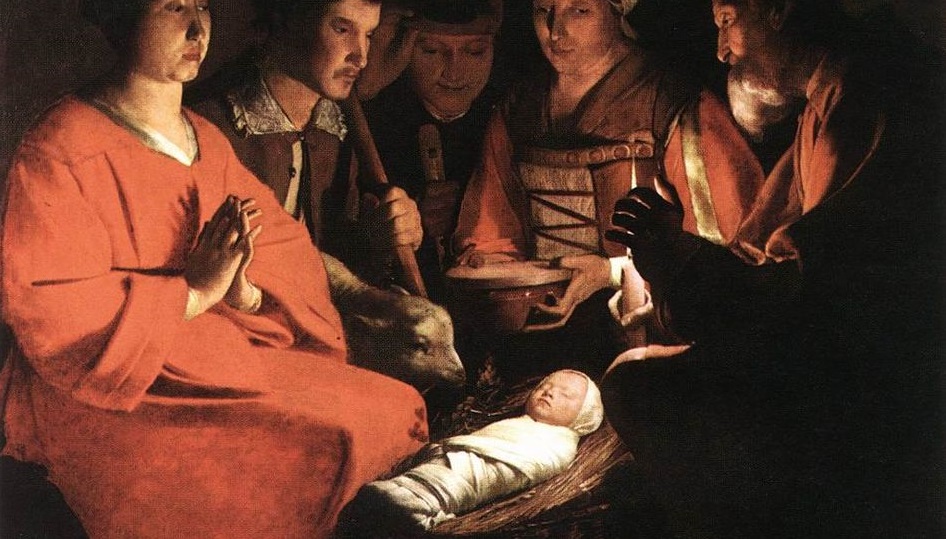
Georges de La Tour was the original Painter of Light (Georges de La Tour, Adoration of the Shepherds, 1644; Source: Wikimedia Commons, PD-Old-100).
The helplessness and weakness of the Christ Child should be a scandal to our ears.
As a believer I still have trouble swaddling my mind and life around the Pauline imperative of preaching strength in weakness.
I struggle with it.
Terry Eagleton–a Marxist philosopher and literary theorist who was raised Catholic, and seems to be thinking himself back into the faith in books such as Hope Without Optimism–is one important ally I’ve found in helping me think through this scandalous aspect of Christian belief.
He summarizes the glorious gratuity of God’s free gift of Creation in Reason, Faith, and Revolution: Reflections on the God Debate, a book where he also dismantles the New Atheists whom he conflates into a legendary creature he calls Ditchkins, thus:
A book that tears up preconceived notions and alliances.
To see [as the atheists do] God as completely pointless, and the moral life as much the same, is not to deny that instrumental reason has its place. There would, for example, be no emancipatory politics without it, and no science or technology either. Aestheticians are seized by the beauty and sensuous particularity of things, theologians by the fact that their existence is so mindbendingly contingent; while scientists and technologists have to press these things into the knowledge and service of humankind, and so cannot afford to spend all their time emitting grunts of pleasure or shouts of astonishment. Even so, on this theological view, morality is quite as pointless as the universe itself. It is a question of how to live most richly and enjoyably, relishing one’s powers and capacities purely for their own sake. This self-delighting energy, which is entirely without point or function, stands in no need of justification before some grim-faced tribunal of History, Duty, Geist, Prouduction, Utility, or Teleology.
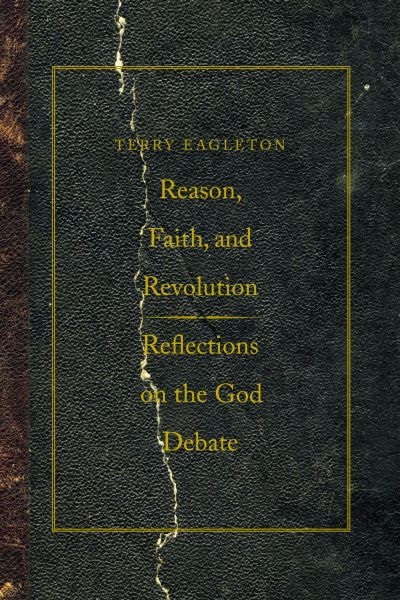
Pointlessness is his cheeky Britisher way of naming the gift of grace that cannot be imprisoned by human instrumentality. As Pseudo-Dionysus, and legions of theologians after him, have said: God is beyond the instrumental schemes and projects that human minds might project onto him. These projections are what we traditionally call idolatry.
Eagleton continues in Reason, Faith, and Revolution by describing how the life of Jesus embodies this “pointlessness” while overlooking the obvious example of the Christ Child (can’t win them all):
Jesus, unlike most responsible American citizens, appears to do no work, and is accused of being a glutton and a drunkard. He is presented as homeless, propertyless, celibate, peripatetic, socially marginal, disdainful of kinsfolk, without a trade, a friend of outcasts and pariahs, averse to material possessions, without fear for his own safety, careless about purity regulations, critical of traditional authority, a thorn in the side of the Establishment, and a scourge of the rich and powerful. Though he was no revolutionary in the modern sense of the term, he has something of the lifestyle of one. He sounds like a cross between a hippie and a guerilla fighter. He respects the Sabbath not because it means going to church but because it represents a temporary escape from the burden of labor. The Sabbath is about resting, not religion. One of the best reasons for being a Christian, as for being a socialist, is that you don’t like having to work, and reject the fearful idolatry of it so rife in countries like the United States. Truly civilized societies do not hold predawn power breakfasts.
Isn’t all of this stumbling block to our piety and foolishness to reason? Doesn’t it strike at the American way of life?
Now see how all of this compares with the theology of gratuity (grace, pointlessness from the point of view of instrumentality) laid down by Eagleton’s former teacher, the Dominican Herbert McCabe in his Faith Within Reason:
This book has my neck craning up. I’m all ears.
He could not make man by nature divine, but he has given him divinity as gift. This is what we call grace. We do share in the divine nature, we do behave like God, but not by nature… Just as it would be supernatural for a horse to write a poem, so it is supernatural to a human being to behave like God. This means that our divinity must always come to us as a surprise, something eternally astonishing…Now one of the things that sharing in God’s life involves is sharing in his knowledge of himself. This share in God’s self-knowledge is called faith, it is a kind of knowledge that we have not by nature (we could never have it by nature) but as gift.
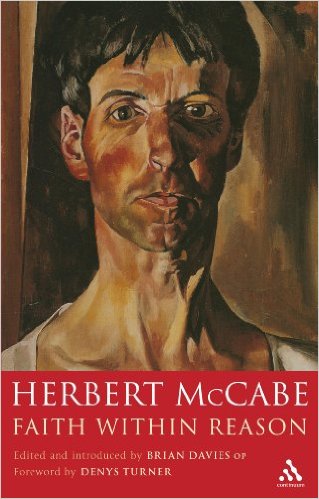
Our instrumental reason, with its clamoring competition for the position of top-dog, is a pointless and embarrassing spectacle in comparison to every good and perfect gift, which is always from above.
I think here of Charles de Foucauld’s wise saying as exemplifying the latter attitude of hospitality and gratitude:
Be as tender and attentive towards those whom God puts on our path, as a brother towards brother or as a mother for her child.
Which in turn reminds me of Auden’s poem “Like a Calling“:
. . . But somewhere always, nowhere particularly unusual,
Almost anywhere in the landscape of water and houses,
His crying competing unsuccessfully with the cry
Of the traffic or the birds, is always standing
The one who needs you, that terrified
Imaginative child who only knows you
As what the uncles call a lie,
But knows he has to be the future and that only
The meek inherit the earth, and is neither
Charming, successful, nor a crowd;
Alone among the noise and policies of summer,
His weeping climbs towards your life like a vocation.
In fine, after all this, I confess my regret at missing this vocation in exchanges with friend, family, and foe. We all should have climbed down from our towers of power and treated each other more like the imaginative children (of God) we are.
I consciously make this confession mostly with the words of others, because I believe in the gift of speech. Frequently the words of others are a gift that helps us to express what is innermost in us. Some might see that as a weakness, but then for a Christian there is nothing wrong with weakness.
Remembering this will be the focal point of my Advent.
Mea culpa, mea culpa, mea maxima culpa. The rest is for my confessor to untangle.
As a parting gift I leave you Eagleton explaining the point from Reason, Faith, and Revolution about pointlessness:
If want to delve deeper into the spirituality of Advent see: In the Beginning Was Poverty: Advent Should Rob You Blind.
You might also want to see my piece on Eagleton: Squishy New Atheist Pieties Miss Gospel Love’s Ruthless Demands.
Previous Post
November 29, 2015
Cosmos: Weakened Edition, 9
Next Post

December 2, 2015 On Noses and the Incarnation
Browse Our Archives
Select a Category #WhyRemainCatholic Abortion Advent Anti-Catholicism Arts Atheism Beauty Benedict XVI Bible Book Review Catholic Cinema Comedy Cosmos: A Space-Time Odyssey Czesław Miłosz Dariusz Karłowicz Devil Easter Eastern Orthodoxy Economics Environment Family Famous Atheists Who Weren't Atheists Guest Post Hans Urs von Balthasar HHS Mandate History Imagination Interview Islam Jean-Luc Marion John Paul II Judaism Just War Lent Literature Little Sisters of the Poor Liturgy Martyrdom Music News Paganism Patristics Phenomenology Philosophy Pierre Hadot Poetry Poland Pop Culture Pope Francis Poverty Prayer Protestantism Rabelais Race Remi Brague Rene Girard Russia Sam Rocha Science & Religion SCOTUS Secularization Sexual Abuse Sexuality Silence Solidarity Stratford Caldecott Synod14 Terrorism Top 10 Uncategorized Walker Percy War Weakened Edition World War II World Youth Day WYD Krakow
Select a Month July 2017 June 2017 May 2017 April 2017 March 2017 February 2017 January 2017 December 2016 October 2016 September 2016 August 2016 July 2016 June 2016 May 2016 April 2016 March 2016 February 2016 January 2016 December 2015 November 2015 October 2015 September 2015 August 2015 July 2015 June 2015 May 2015 April 2015 March 2015 February 2015 January 2015 December 2014 November 2014 October 2014 September 2014 August 2014 July 2014 May 2014 April 2014 March 2014 February 2014 January 2014 December 2013 November 2013 October 2013 September 2013 August 2013 July 2013 June 2013 May 2013
Follow Us!
TAKE THE
Religious Wisdom Quiz
Which high priest led in the reading and explaining of the Law to the people?
Select your answer to see how you score.
Zerubbabel Eliashib Ezra Nehemiah
Related posts from Cosmos The In Lost

The Surprising Anti-Capitalist Logic Behind the Catholic Church's...

Where Does the Body of Christ Go After...

How is Classical Philosophy is Like War?

Why Does the World's Leading Philosopher Remain a...
TRENDING AT PATHEOS Catholic

Creation, Preservation, and Teleology in Catholic Theology
As I write this, it is very early Monday morning. Like millions...

The Parable Of The Sower And The Word...
One of Christ’s most famous parables is that of the sower who...

Rejecting Doom: Christian Hope And Human Action
Christianity is a religion of hope. We are to have hope and...

Why I Choose the Eucharist Over the Sermon
Choose the Eucharist, Not the Sermon What are we supposed to get...

5 Design Elements Found in Spiritually Rooted Homes
Putting Spirituality Into Home Decor Our homes are more than our living...

Credo: A Story of God Told with the...
About 10 years ago, I began to imagine a personal "Credo" that...
view all Catholic blogs
Ad-Free & Subscriber Log-In Subscription Support
- About Us
- 2026 Calendar
- Videos
- Podcasts
- Library of World Religions
- Faith In Media Tracker
- Advertise With Us
- Write for Us
- Privacy Policy
- Terms of Service
- Do Not Sell My Data
- Contact Us
- Radiant Digital
- Manage Newsletter Subscriptions
- Unsubscribe From Notifications
- Sitemap
Copyright 2008-2026, Patheos. All rights reserved.
Subscription Support Ad-Free & Subscriber Log-In
Follow Patheos