
BuddhistCatholicContemplativeEvangelicalGeneral ChristianHinduJewishLatter-day SaintMuslimNew VisionsProgressive Christian
Beliefs
- Buddhist
- Catholic
- Contemplative
- Evangelical
- General Christian
- Hindu
- Jewish
- Latter-day Saint
- More Voices
- Muslim
- New Visions
- Pagan
- Progressive Christian
Topics
- Religion News
- Food and Religion
- Sports and Religion
- Religious Art
- Religious Music and Entertainment
- Religious Events
- History and Religion
- Style and Religion
- Politics and Religion
- Women in Religion
- Recreation Outdoors and Religion
- Business Finance and Religion
- Careers Workplace and Religion
- Education and Religion
- Family Parenting and Religion
- Health Fitness and Religion
- Home and Religion
- Relationships and Religion
- Technology and Religion
- Travel and Religion
Columnists
- Buddhist Columnists
- Business Finance and Religion Columnists
- Careers Workplace and Religion Columnists
- Catholic Columnists
- Contemplative Columnists
- Education and Religion Columnists
- Evangelists Columnists
- Family Parenting and Religion Columnists
- General Christian Columnists
- Health Fitness and Religion Columnists
- Hindu Columnists
- History and Religion Columnists
- Home and Religion Columnists
- Jewish Columnists
- More Voices Columnists
- Latter Day Columnists
- Muslim Columnists
- New Visions Columnists
- Nonreligious Columnists
- Pagan Columnists
- Politics and Religion Columnists
- Progressive Columnists
- Recreation Outdoors and Religion Columnists
- Relationships and Religion Columnists
- Religion News Columnists
- Religious Art Columnists
- Religious Events Columnists
- Religious Music and Entertainment Columnists
- Sports and Religion Columnists
- Style and Religion Columnists
- Technology and Religion Columnists
- Travel and Religion Columnists
- Women in Religion Columnists
Resource Library
- 2026 Calendar
- Library of World Religions
- The 100 Most Holy Places on Earth
- Patheos Answers
- Podcasts
- Videos
- Faith Leaders Database
- Anglican Episcopalian
- Bahai
- Baptist
- Buddhism
- Christianity
- Confucianism
- Eastern Orthodoxy
- Hinduism
- Holiness and Pentecostal
- ISKCON
- Islam
- Judaism
- Lutheran
- Methodist
- The Church of Jesus Christ of Latter-day Saints
- New Age
- Paganism
- Presbytarian and Reformed
- Protestantism
- Religion Behind the Scenes
- Roman Catholic
- Scientology
- Shia Islam
- Sikhism
- Sufism
- Sunni Islam
- Taoism
- Zen
- See all religions
Research Tools
 Ad-Free & Subscriber Log-In Subscription Support
Ad-Free & Subscriber Log-In Subscription Support
Follow Patheos 

- Trending:
- Forgiveness
- |
- Marriage
- |
- Consciousness
- |
- Death Penalty
- |
- Election
- |
- Halloween
 Cosmos The In Lost
- Home
- Catholic
- Thanksgiving as Forgiveness
Thanksgiving as Forgiveness
Last updated on: November 25, 2015 at 10:34 am by Artur Rosman
Thanksgiving as Forgiveness 2015-11-25T10:34:05-07:00 Artur Rosman
Patheos Explore the world's faith through different perspectives on religion and spirituality! Patheos has the views of the prevalent religions and spiritualities of the world.
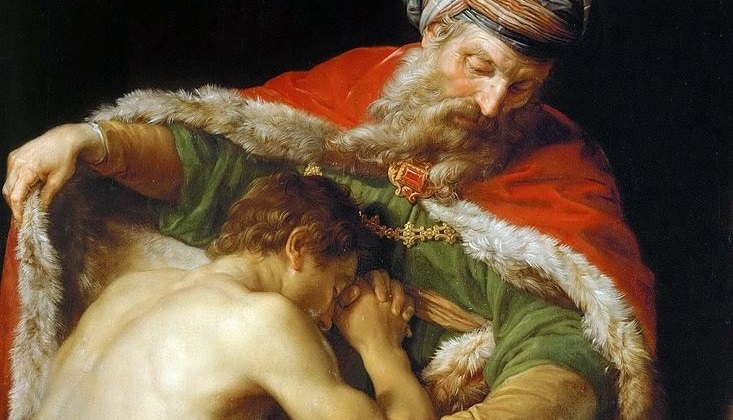
How is forgiveness related to giving thanks? (Pompeo Batoni, The Return of the Prodigal Son, 1773; Source: Wikimedia Commons, PD-Old-100).
“The duties of each moment are the shadows beneath which hides the divine operation.”
― Jean-Pierre de Caussade, Abandonment to Divine Providence
=============
Sam Rocha is Assistant Professor of Philosophy of Education at the University of British Columbia. He is author of A Primer for the Philosophy and Education and the recently released Folk Phenomenology. He is also an accomplished musician who has two albums, Freedom for Love and Late to Love, under his belt. His upcoming third album will not have the noun “love” in the title, but will instead utilize a verbal form of the word.
This is a guest post.
=============
“Thank you.” — “I’m sorry.” A simple redemption lives in those utterances. There is grace there.
During the hey-day of the charismatic renewal, at prayer meetings and Lord Day’s, there was always a time of thanksgiving, usually during praise and worship. A guitar would strum a sustained chord and await prayers of thanksgiving to chime in aloud: “I want to thank you Lord for the gift of life…” “Thank you Jesus for healing my sister…” “Thank you for gathering us all together here today…” A skilled worship leader had a sense of when it was the right time to start and finish, and how to use dynamics to lead right into the next song, usually on the chorus. An antiphon of sorts — I’m Forever Grateful or Give Thanks or something along those lines.
The insight I gleaned from this ritual was beautiful: we should give thanks at all times, for all things. Prayers of thanksgiving ought to measure our prayers of intercession and adoration.
“The Strength of Simplicity: The soul in the state of abandonment knows how to see God even in the proud who oppose His action. All creatures, good or evil, reveal Him to it.”
The simplicity of those times and rituals, throughout my childhood and adolescence, often makes them less memorable. There is nothing terribly special about them. Nothing stands out. No pyrotechnics. So I focus my attention elsewhere and, oftentimes, create alternate realities. I re-write my past according to the way I choose to recall and recast it in the present. I am often, then, thankful in a selective way. There is something inherently ungrateful about that. It’s out of tune, out of step, out of balance.
To be truly thankful, one must be thankful for ALL. Thanksgiving is a time to be thankful for more than what we choose to give thanks for; it is time to be chastened by the gift of total gratitude. In this sense, thanksgiving is forgiveness.
An act of total thanksgiving can become a moment of true forgiveness. Healing. Thanksgiving as forgiveness heals without anesthesia — it remembers everything, dulls nothing. Have no fear! We can thank God for suffering, pain, weakness, and doubt. The Cross. There is nothing we cannot be thankful for. There are no wrong answers. We have nothing to repress or withhold.
Today I am thankful for my life. All of it. Every part of it. Every piece that builds and sustains the whole. Even the pieces I try to hide from others and, especially, from myself. From memory. We can’t remember everything, but the choice of what to remember and to forget is not as innocent as it seems. Today I try to give thanks as an act of surrender to the total, wholesome graciousness of existence, life, and being. I am especially thankful for forgiveness, the chance to try again and again. For conversion.
Giving total thanks is impossible. We are incapable of rendering an account of everything. The finite cannot grasp the infinite. This absolute gap is worthy of our thanks too. For only emptiness requires grace.
“Thank you.” — “I’m sorry.” A simple redemption lives in those utterances. There is grace there.
I know Sam won’t forgive me for concluding this post with the following song, but it’s entirely appropriate:
You might also want to take a look at my meditation, Forgiveness Wins: The Perversity of the Prodigal Father, that jams on Hannah Arendt’s The Human Condition.
There’s also a booklist with the tantalizing title, Thanksgiving Special: Eating, Theology, Philosophy, and the Hungry Soul. Take a bite.
Previous Post

November 24, 2015
Rod Dreher's Scandal
Next Post

November 26, 2015 Thanksgiving: An American Celebration of a Deadly Sin?
Browse Our Archives
Select a Category #WhyRemainCatholic Abortion Advent Anti-Catholicism Arts Atheism Beauty Benedict XVI Bible Book Review Catholic Cinema Comedy Cosmos: A Space-Time Odyssey Czesław Miłosz Dariusz Karłowicz Devil Easter Eastern Orthodoxy Economics Environment Family Famous Atheists Who Weren't Atheists Guest Post Hans Urs von Balthasar HHS Mandate History Imagination Interview Islam Jean-Luc Marion John Paul II Judaism Just War Lent Literature Little Sisters of the Poor Liturgy Martyrdom Music News Paganism Patristics Phenomenology Philosophy Pierre Hadot Poetry Poland Pop Culture Pope Francis Poverty Prayer Protestantism Rabelais Race Remi Brague Rene Girard Russia Sam Rocha Science & Religion SCOTUS Secularization Sexual Abuse Sexuality Silence Solidarity Stratford Caldecott Synod14 Terrorism Top 10 Uncategorized Walker Percy War Weakened Edition World War II World Youth Day WYD Krakow
Select a Month July 2017 June 2017 May 2017 April 2017 March 2017 February 2017 January 2017 December 2016 October 2016 September 2016 August 2016 July 2016 June 2016 May 2016 April 2016 March 2016 February 2016 January 2016 December 2015 November 2015 October 2015 September 2015 August 2015 July 2015 June 2015 May 2015 April 2015 March 2015 February 2015 January 2015 December 2014 November 2014 October 2014 September 2014 August 2014 July 2014 May 2014 April 2014 March 2014 February 2014 January 2014 December 2013 November 2013 October 2013 September 2013 August 2013 July 2013 June 2013 May 2013
Follow Us!
TAKE THE
Religious Wisdom Quiz
What does the name "Bethlehem" mean?
Select your answer to see how you score.
Place of Peace God's Dwelling City of Kings House of Bread
Related posts from Cosmos The In Lost

The Surprising Anti-Capitalist Logic Behind the Catholic Church's...


How is Classical Philosophy is Like War?

Why Does the World's Leading Philosopher Remain a...
TRENDING AT PATHEOS Catholic

Rejecting Doom: Christian Hope And Human Action
Christianity is a religion of hope. We are to have hope and...

It’s What Comes From Within Which Matters
One of the most difficult things for us to understand is why...

Why I Choose the Eucharist Over the Sermon
Choose the Eucharist, Not the Sermon What are we supposed to get...

5 Design Elements Found in Spiritually Rooted Homes
Putting Spirituality Into Home Decor Our homes are more than our living...

Credo: A Story of God Told with the...
About 10 years ago, I began to imagine a personal "Credo" that...

The Anatomy of Divine Revelation in Catholic Thought
The claim that God has made Himself known to human beings is...
view all Catholic blogs
Ad-Free & Subscriber Log-In Subscription Support
- About Us
- 2026 Calendar
- Videos
- Podcasts
- Library of World Religions
- Faith In Media Tracker
- Advertise With Us
- Write for Us
- Privacy Policy
- Terms of Service
- Do Not Sell My Data
- Contact Us
- Radiant Digital
- Manage Newsletter Subscriptions
- Unsubscribe From Notifications
- Sitemap
Copyright 2008-2026, Patheos. All rights reserved.
Subscription Support Ad-Free & Subscriber Log-In
Follow Patheos