
BuddhistCatholicContemplativeEvangelicalGeneral ChristianHinduJewishLatter-day SaintMuslimNew VisionsProgressive Christian
Beliefs
- Buddhist
- Catholic
- Contemplative
- Evangelical
- General Christian
- Hindu
- Jewish
- Latter-day Saint
- More Voices
- Muslim
- New Visions
- Pagan
- Progressive Christian
Topics
- Religion News
- Food and Religion
- Sports and Religion
- Religious Art
- Religious Music and Entertainment
- Religious Events
- History and Religion
- Style and Religion
- Politics and Religion
- Women in Religion
- Recreation Outdoors and Religion
- Business Finance and Religion
- Careers Workplace and Religion
- Education and Religion
- Family Parenting and Religion
- Health Fitness and Religion
- Home and Religion
- Relationships and Religion
- Technology and Religion
- Travel and Religion
Columnists
- Buddhist Columnists
- Business Finance and Religion Columnists
- Careers Workplace and Religion Columnists
- Catholic Columnists
- Contemplative Columnists
- Education and Religion Columnists
- Evangelists Columnists
- Family Parenting and Religion Columnists
- General Christian Columnists
- Health Fitness and Religion Columnists
- Hindu Columnists
- History and Religion Columnists
- Home and Religion Columnists
- Jewish Columnists
- More Voices Columnists
- Latter Day Columnists
- Muslim Columnists
- New Visions Columnists
- Nonreligious Columnists
- Pagan Columnists
- Politics and Religion Columnists
- Progressive Columnists
- Recreation Outdoors and Religion Columnists
- Relationships and Religion Columnists
- Religion News Columnists
- Religious Art Columnists
- Religious Events Columnists
- Religious Music and Entertainment Columnists
- Sports and Religion Columnists
- Style and Religion Columnists
- Technology and Religion Columnists
- Travel and Religion Columnists
- Women in Religion Columnists
Resource Library
- 2026 Calendar
- Library of World Religions
- The 100 Most Holy Places on Earth
- Patheos Answers
- Podcasts
- Videos
- Faith Leaders Database
- Anglican Episcopalian
- Bahai
- Baptist
- Buddhism
- Christianity
- Confucianism
- Eastern Orthodoxy
- Hinduism
- Holiness and Pentecostal
- ISKCON
- Islam
- Judaism
- Lutheran
- Methodist
- The Church of Jesus Christ of Latter-day Saints
- New Age
- Paganism
- Presbytarian and Reformed
- Protestantism
- Religion Behind the Scenes
- Roman Catholic
- Scientology
- Shia Islam
- Sikhism
- Sufism
- Sunni Islam
- Taoism
- Zen
- See all religions
Research Tools
 Ad-Free & Subscriber Log-In Subscription Support
Ad-Free & Subscriber Log-In Subscription Support
Follow Patheos 

- Trending:
- Forgiveness
- |
- Marriage
- |
- Consciousness
- |
- Death Penalty
- |
- Election
- |
- Halloween
 Cosmos The In Lost
- Home
- Catholic
- Halloween Special: Catholics for Extreme Metal?
Halloween Special: Catholics for Extreme Metal?
Last updated on: October 31, 2015 at 5:35 am by Artur Rosman
Halloween Special: Catholics for Extreme Metal? 2015-10-30T23:25:10-07:00 Artur Rosman
Patheos Explore the world's faith through different perspectives on religion and spirituality! Patheos has the views of the prevalent religions and spiritualities of the world.
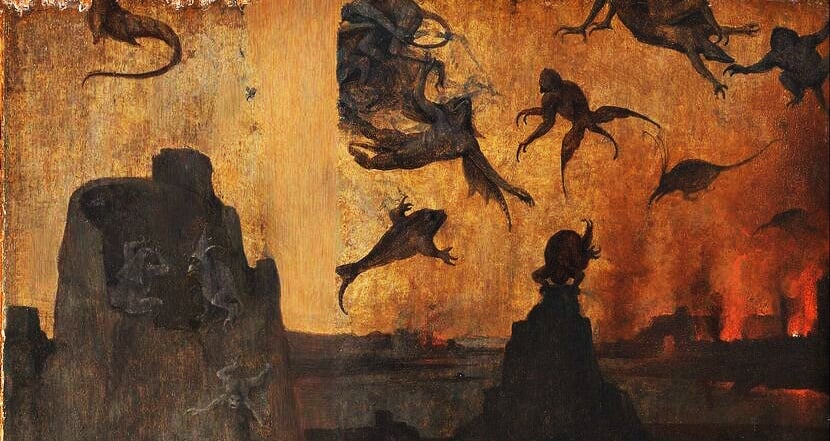
Hell is Catholic too (Hieronymus Bosch, The Fall of the Angels, 1514; Source: Wikimedia Commons, PD-Old-100).
Sean Taylor is a husband and father of one as well as a Ph.D. student in mathematics. He has studied philosophy and theology for the last several years after coming back into communion with the Church.
This is a guest post.
=============
Chuck Schuldiner once wrote, “I don’t mean to dwell, but I can’t help myself,” as the beginning of Death’s classic album Symbolic. I have thought for some time now that this is an remarkable way to describe my fixation with metal of all sorts. Contrary to popular opinion, metal is quite a varied genre. There is plenty of it that has nothing to do with screams and crazily distorted guitars. There are metal albums dedicated to The Lord of the Rings and plenty of other nerdy things. Then there’s extreme metal. Usually, doom metal, thrash metal, death metal, and black metal get lumped into this category. If you go listen to some typical examples of these genres you’ll quickly see that what makes them “extreme” musically (although some are also extreme in other ways) is quite different between them. There is even a good amount of diversity among them as to what boundaries are pushed.
All of them, however, tend to have broadly similar lyrical themes. You could sum up what they sing about by saying that it’s the most abject parts of the human experience: agony, anxiety, hatred, death, and evil itself are common subjects. There are usually two different types of common reactions you get to metal lyrics depending on if you’re listening to doom/thrash metal or death/black metal.
The first common reaction is perplexity: “But why would you want to surround yourself with this?” The second common reaction is revulsion: “How can you listen to that? It’s evil!” Now, there are plenty of different responses to these types of comments, but I would like to make a point about how as a Catholic I find metal to sit comfortably within my worldview in a way that makes it wonderful to listen to.
As readers of this blog will know, the Catholic imagination is anthropocentric, earthy, and at times gory. Our entire religious worldview has to do with an admission of the awfulness of this world due to the fall and a complete surrender to Christ for hope of salvation. In other words, this world is pretty awful as it is and it won’t get considerably better until the Second Coming.
In politics, for instance, I tend to be very pessimistic. I think that virtually all politicians are corrupt and that nothing will ever change that. I’ve said before that I think that life stripped of its spiritual dimensions is meaningless and futile. To paraphrase Ecclesiastes: the faces change but the script remains the same. Be that as it may, we do have a Savior! That doesn’t mean that my experience of this world just goes away though. I am a stranger in a strange land until I die and, because of that, I not only have to deal with evil, but I also can experience a great deal of angst and anguish in persevering to the end.
This is where metal comes in: Extreme metal deals with these experiences. Sometimes it can propose an answer, but more often it just presents these problems for you to communally experience with the band and fellow listeners – not too differently from how some modern phenomenologists write poetic philosophy to evoke an encounter with various aspects of reality in the reader and in themselves. It’s also true that, as I once read a composer say, metal – like classical music – is about releasing energy. If you combine those aspects – the catharsis of communally encountering the worst in life with the release of energy – you can get something intensely therapeutic. This is probably one reason why many people have found such solace in this type of music over the past 50 or so years.
But what about black metal? For those not “in the know,” black metal is that sub-genre that tends to sing about things like hatred, pagan/nature gods, and Satan frequently. How can this possibly be consistent with a Catholic worldview? Well, first of all, these are real things. They are realities that, as Catholics, we interact with more than other religion. We have to deal with them.
There’s another reason that this music is, I think, most fully appreciated by precisely us Catholics. For the atheist (and some, not all, black metal musicians are atheists), the lyrical content is nothing more than a zombie flick set to music. Now, zombie movies can be fun and maybe a little scary, but I personally have never been truly terrified by one, because they’re so far from the realm of the possible. For Protestants, too, there is a little bit less of a sense of these realities. There’s a reason people still think only of the Catholic Church when they need an exorcism.
What about for Satanists? There are certainly Satanists of all types in black metal, including theistic Satanists, i.e. the type most people think of when they hear the word. Well, it seems to me that for them it is at best worship music, and, at worst, their equivalent of Christian rock. The latter is obviously no good, but what about their ability to appreciate it as worship music? Well, first of all, there is a certain dissonance with using it as worship music, given what worship is supposed to elicit. Moreover, as a Catholic, I think that they are in a situation of severely misunderstanding the real meaning of their own lyrics. As a Catholic, I can experience the true horror and evil that these lyrics are meant to convey and realize it as such. I am able to fully appreciate the phenomenon as it is.
Of course, as a Catholic, I think the Satanists are wrong, but that doesn’t mean Satan isn’t real and it doesn’t mean that people don’t really worship him (although not as often as is usually imagined) and, finally, it doesn’t mean that I don’t have to deal with those things in the here and now.
But isn’t it sinful to listen this? No more than reading Stephen King or The Exorcist is. “But!” I hear you say, “This is different! At least some of these people mean this stuff! Stephen King is a Christian!” Yes, that is true, but it doesn’t matter. It also wouldn’t apply to such people as Jimmy Page who was reportedly a practitioner of the occult. Nor would it apply to reading, say, the works of Homer. Let’s not forget that Homer’s writings had religious significance for the Greeks. When faced with such questions I think back to St. Paul talking about eating meat sacrificed to idols, or of the Church Fathers talking about Christianity despoiling the pagans by taking everything as truly meant by the Creator for us. I also think of St. Thomas Aquinas reading from books by people of any faith. This is perhaps the most appropriate comparison, because, just as Aristotle and his pagan philosophy necessarily underwent a change in being brought into Christianity, so does Satanic metal change when listened to and appreciated by a Catholic from within his or her faith.
So, in the end, I’m not saying that everyone “should” go listen to metal of any sort. I am saying that it is a wonderful art form and I am saying that it deserves to be judged (like any work of art) on its own merit and not on the merit of its creators. I’m saying that the type of catharsis that metal provides can be invaluable to those in need and fun for everyone else. Rock on!
If you want to read more on the Catholic propensity for the creepy read about Kristeva praising the Catholic appreciation of suffering and on the real (creepy) Catholic St. Valentine.
Please donate to this blog via the PayPal button on its homepage. Our family of five is really struggling to make rent payments month-to-month. The readers of this blog have kept us from falling through the cracks and we really do appreciate it.
Previous Post
October 29, 2015
TOP10 Books on Religion and Ecology
Next Post
November 1, 2015 Cosmos: Weakened Edition, 5
Browse Our Archives
Select a Category #WhyRemainCatholic Abortion Advent Anti-Catholicism Arts Atheism Beauty Benedict XVI Bible Book Review Catholic Cinema Comedy Cosmos: A Space-Time Odyssey Czesław Miłosz Dariusz Karłowicz Devil Easter Eastern Orthodoxy Economics Environment Family Famous Atheists Who Weren't Atheists Guest Post Hans Urs von Balthasar HHS Mandate History Imagination Interview Islam Jean-Luc Marion John Paul II Judaism Just War Lent Literature Little Sisters of the Poor Liturgy Martyrdom Music News Paganism Patristics Phenomenology Philosophy Pierre Hadot Poetry Poland Pop Culture Pope Francis Poverty Prayer Protestantism Rabelais Race Remi Brague Rene Girard Russia Sam Rocha Science & Religion SCOTUS Secularization Sexual Abuse Sexuality Silence Solidarity Stratford Caldecott Synod14 Terrorism Top 10 Uncategorized Walker Percy War Weakened Edition World War II World Youth Day WYD Krakow
Select a Month July 2017 June 2017 May 2017 April 2017 March 2017 February 2017 January 2017 December 2016 October 2016 September 2016 August 2016 July 2016 June 2016 May 2016 April 2016 March 2016 February 2016 January 2016 December 2015 November 2015 October 2015 September 2015 August 2015 July 2015 June 2015 May 2015 April 2015 March 2015 February 2015 January 2015 December 2014 November 2014 October 2014 September 2014 August 2014 July 2014 May 2014 April 2014 March 2014 February 2014 January 2014 December 2013 November 2013 October 2013 September 2013 August 2013 July 2013 June 2013 May 2013
Follow Us!
TAKE THE
Religious Wisdom Quiz
Where was Jesus' first miracle performed?
Select your answer to see how you score.
Jerusalem Nazareth Cana Capernaum
Related posts from Cosmos The In Lost

The Surprising Anti-Capitalist Logic Behind the Catholic Church's...


Where Does the Body of Christ Go After...

How is Classical Philosophy is Like War?
TRENDING AT PATHEOS Catholic

Creation, Preservation, and Teleology in Catholic Theology
As I write this, it is very early Monday morning. Like millions...

The Parable Of The Sower And The Word...
One of Christ’s most famous parables is that of the sower who...

Rejecting Doom: Christian Hope And Human Action
Christianity is a religion of hope. We are to have hope and...

Why I Choose the Eucharist Over the Sermon
Choose the Eucharist, Not the Sermon What are we supposed to get...

5 Design Elements Found in Spiritually Rooted Homes
Putting Spirituality Into Home Decor Our homes are more than our living...

Credo: A Story of God Told with the...
About 10 years ago, I began to imagine a personal "Credo" that...
view all Catholic blogs
Ad-Free & Subscriber Log-In Subscription Support
- About Us
- 2026 Calendar
- Videos
- Podcasts
- Library of World Religions
- Faith In Media Tracker
- Advertise With Us
- Write for Us
- Privacy Policy
- Terms of Service
- Do Not Sell My Data
- Contact Us
- Radiant Digital
- Manage Newsletter Subscriptions
- Unsubscribe From Notifications
- Sitemap
Copyright 2008-2026, Patheos. All rights reserved.
Subscription Support Ad-Free & Subscriber Log-In
Follow Patheos