
BuddhistCatholicContemplativeEvangelicalGeneral ChristianHinduJewishLatter-day SaintMuslimNew VisionsProgressive Christian
Beliefs
- Buddhist
- Catholic
- Contemplative
- Evangelical
- General Christian
- Hindu
- Jewish
- Latter-day Saint
- More Voices
- Muslim
- New Visions
- Pagan
- Progressive Christian
Topics
- Religion News
- Food and Religion
- Sports and Religion
- Religious Art
- Religious Music and Entertainment
- Religious Events
- History and Religion
- Style and Religion
- Politics and Religion
- Women in Religion
- Recreation Outdoors and Religion
- Business Finance and Religion
- Careers Workplace and Religion
- Education and Religion
- Family Parenting and Religion
- Health Fitness and Religion
- Home and Religion
- Relationships and Religion
- Technology and Religion
- Travel and Religion
Columnists
- Buddhist Columnists
- Business Finance and Religion Columnists
- Careers Workplace and Religion Columnists
- Catholic Columnists
- Contemplative Columnists
- Education and Religion Columnists
- Evangelists Columnists
- Family Parenting and Religion Columnists
- General Christian Columnists
- Health Fitness and Religion Columnists
- Hindu Columnists
- History and Religion Columnists
- Home and Religion Columnists
- Jewish Columnists
- More Voices Columnists
- Latter Day Columnists
- Muslim Columnists
- New Visions Columnists
- Nonreligious Columnists
- Pagan Columnists
- Politics and Religion Columnists
- Progressive Columnists
- Recreation Outdoors and Religion Columnists
- Relationships and Religion Columnists
- Religion News Columnists
- Religious Art Columnists
- Religious Events Columnists
- Religious Music and Entertainment Columnists
- Sports and Religion Columnists
- Style and Religion Columnists
- Technology and Religion Columnists
- Travel and Religion Columnists
- Women in Religion Columnists
Resource Library
- 2026 Calendar
- Library of World Religions
- The 100 Most Holy Places on Earth
- Patheos Answers
- Podcasts
- Videos
- Faith Leaders Database
- Anglican Episcopalian
- Bahai
- Baptist
- Buddhism
- Christianity
- Confucianism
- Eastern Orthodoxy
- Hinduism
- Holiness and Pentecostal
- ISKCON
- Islam
- Judaism
- Lutheran
- Methodist
- The Church of Jesus Christ of Latter-day Saints
- New Age
- Paganism
- Presbytarian and Reformed
- Protestantism
- Religion Behind the Scenes
- Roman Catholic
- Scientology
- Shia Islam
- Sikhism
- Sufism
- Sunni Islam
- Taoism
- Zen
- See all religions
Research Tools
 Ad-Free & Subscriber Log-In Subscription Support
Ad-Free & Subscriber Log-In Subscription Support
Follow Patheos 

- Trending:
- Forgiveness
- |
- Marriage
- |
- Consciousness
- |
- Death Penalty
- |
- Election
- |
- Halloween
 Cosmos The In Lost
- Home
- Catholic
- Against the Defense of Christendom
Against the Defense of Christendom
Last updated on: October 21, 2015 at 11:53 am by Artur Rosman
Against the Defense of Christendom 2015-10-21T11:53:21-07:00 Artur Rosman
Patheos Explore the world's faith through different perspectives on religion and spirituality! Patheos has the views of the prevalent religions and spiritualities of the world.
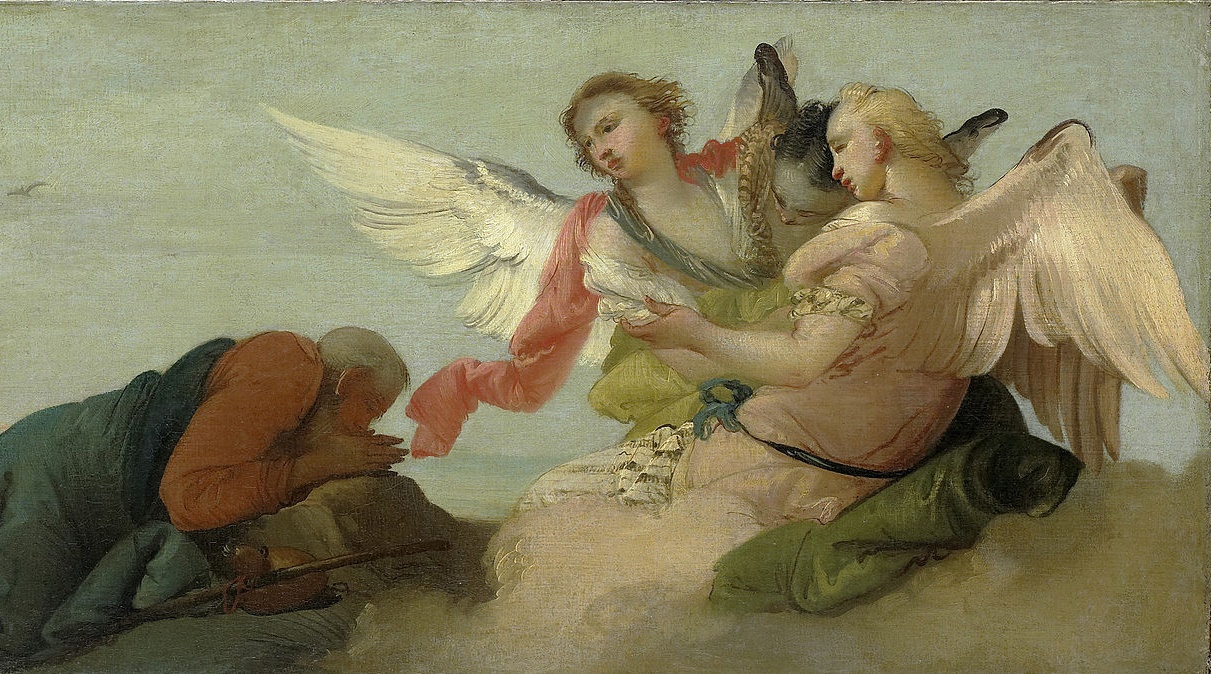
Hospitality to the total stranger is one of the primary biblical values (Francesco Zugno after Tiepolo, Abraham and the Three Angels, c. 1780; Source: Wikimedia Commons, PD-Old-100).
A Wall Street Journal piece by Bret Stephens, In Defense of Christendom, is unfortunately making the rounds. Cultural warriors are crying tears of joy as the pass it along blindly. The defense is an extremely superficial defense of Christian culture from a man who recently blindly blamed celibacy for the Catholic scandals. How quickly they forget!
I find it troubling that Stephens, who clearly has no qualifications to comment on complicated matters theological or historical, mixes Judaism and Christianity with things that have little or nothing to do with them:
What Europeans no longer believe in are the things from which their beliefs spring: Judaism and Christianity; liberalism and the Enlightenment; martial pride and capability; capitalism and wealth. Still less do they believe in fighting or sacrificing or paying or even arguing for these things. Having ignored and undermined their own foundations, they wonder why their house is coming apart.

Hospitality not machtpolitik is the essence of Christianity.
The Stephens piece is really about defending the last two items on that list, capitalism, wealth, but also also macthpolitik (Let’s not forget that the radical Enlightenment put a stake through the cadaver of Post-Reformation Christianity).
The author, while complaining about Angela Merkel, shows his true cards:
Yet there she [Merkel] was in Istanbul on Sunday, offering a deal in which Europe would agree to visa-free travel for Turks in Europe starting next year, along with quicker movement on Turkish membership in the European Union, if only Ankara will do more to resettle Syrian and other refugees in their own country. Europe would also foot the bill.
This is machtpolitik in reverse, in which the chancellor is begging small favors from weaker powers on temporary matters in exchange for broad concessions with far-reaching ramifications. There are 75 million Turks, whose per capita income doesn’t match that of Panamanians. The country is led by an elected Islamist with an autocratic streak, prone to anti-Semitic outbursts, who openly supports Hamas, denies the Armenian genocide, jails journalists in record numbers, and orchestrates Soviet-style show trials against his political opponents. Turkey also has borders with Syria, Iraq and Iran. These would become Europe’s borders in the event of Turkish membership.
Machtpolitik is foreign in theory, if not always in practice, to the biblical religion and its tradition of hospitality. Merkel is actually sticking to her Christian Democratic roots by extending hospitality to foreigners. Plus, let’s be honest, Germany is the avant-garde of the coming population crash caused by capitalism. They simply need more people, irrespective of their affiliations, to keep their country running, because Germans can’t be bothered to have procreative-organic Christian sex.
Contrary to the gist of the Stephens defense, all the things the author lists as weakening once powerful Europe are much more profoundly tied to the Judeo-Christian tradition than the things he praises in the passages above:
Europe is dying because it has become morally incompetent. It isn’t that Europe stands for nothing. It’s that it stands for shallow things, shallowly. Europeans believe in human rights, tolerance, openness, peace, progress, the environment, pleasure. These beliefs are all very nice, but they are also secondary.
By rejecting these fundamental values, the defense of Christendom is actually a Nietzschean critique of the victim-mentality as not something inherently Christian. Now, Nietzsche was correct to identify Christianity as a religion of weaklings; he only didn’t see it as the positive thing it is. Whom do you see hanging above your altars? Mammon, the WSJ, or the crucified victim? If you’re having trouble with this question, then you shouldn’t comment on Christianity.
What the Christendom piece ultimately lacks, as it veers much too close to xenophobia, is an understanding of the fact that Christendom does not need to be defended. Whatever is left of Christianity in the lands of forced-conversions before the Conquistadors should live faithful and humble self-sacrificial lives. Then the words the WSJ piece quotes last will be more than tendentious proof-texting of Ratzinger’s Without Roots:
“It is commendable that the West is trying to be more open, to be more understanding of the values of outsiders, but it has lost the capacity for self-love,” a prominent German theologian noted about a decade ago. “All that it sees in its own history is the despicable and the destructive; it is no longer able to perceive what is great and pure. What Europe needs is a new self-acceptance, a self acceptance that is critical and humble, if it truly wishes to survive.”
That’s Joseph Ratzinger, better known as Benedict XVI. He’s out of fashion, which makes him that much more worth hearing.
Yes, but then in the next sentence of Without Roots Ratzinger continues by not condemning multiculturalism, but rather by planting it firmly within its Christian roots and Christian practice . . .
Click here to keep reading and see Ratzinger’s real intent.
Previous Post

October 20, 2015
Michel Houellebecq's Submission to Catholicism
Next Post

October 22, 2015 TOP10 Books On Theology and Neuroscience
Browse Our Archives
Select a Category #WhyRemainCatholic Abortion Advent Anti-Catholicism Arts Atheism Beauty Benedict XVI Bible Book Review Catholic Cinema Comedy Cosmos: A Space-Time Odyssey Czesław Miłosz Dariusz Karłowicz Devil Easter Eastern Orthodoxy Economics Environment Family Famous Atheists Who Weren't Atheists Guest Post Hans Urs von Balthasar HHS Mandate History Imagination Interview Islam Jean-Luc Marion John Paul II Judaism Just War Lent Literature Little Sisters of the Poor Liturgy Martyrdom Music News Paganism Patristics Phenomenology Philosophy Pierre Hadot Poetry Poland Pop Culture Pope Francis Poverty Prayer Protestantism Rabelais Race Remi Brague Rene Girard Russia Sam Rocha Science & Religion SCOTUS Secularization Sexual Abuse Sexuality Silence Solidarity Stratford Caldecott Synod14 Terrorism Top 10 Uncategorized Walker Percy War Weakened Edition World War II World Youth Day WYD Krakow
Select a Month July 2017 June 2017 May 2017 April 2017 March 2017 February 2017 January 2017 December 2016 October 2016 September 2016 August 2016 July 2016 June 2016 May 2016 April 2016 March 2016 February 2016 January 2016 December 2015 November 2015 October 2015 September 2015 August 2015 July 2015 June 2015 May 2015 April 2015 March 2015 February 2015 January 2015 December 2014 November 2014 October 2014 September 2014 August 2014 July 2014 May 2014 April 2014 March 2014 February 2014 January 2014 December 2013 November 2013 October 2013 September 2013 August 2013 July 2013 June 2013 May 2013
Follow Us!
TAKE THE
Religious Wisdom Quiz
Which book is known as the "Weeping Prophet's" book?
Select your answer to see how you score.
Jeremiah Lamentations Isaiah Ezekiel
Related posts from Cosmos The In Lost

The Surprising Anti-Capitalist Logic Behind the Catholic Church's...

The Holy Family as an Icon of World...

How is Classical Philosophy is Like War?

Why Does the World's Leading Philosopher Remain a...
TRENDING AT PATHEOS Catholic

Creation, Preservation, and Teleology in Catholic Theology
As I write this, it is very early Monday morning. Like millions...

The Parable Of The Sower And The Word...
One of Christ’s most famous parables is that of the sower who...

Rejecting Doom: Christian Hope And Human Action
Christianity is a religion of hope. We are to have hope and...

Why I Choose the Eucharist Over the Sermon
Choose the Eucharist, Not the Sermon What are we supposed to get...

5 Design Elements Found in Spiritually Rooted Homes
Putting Spirituality Into Home Decor Our homes are more than our living...

Credo: A Story of God Told with the...
About 10 years ago, I began to imagine a personal "Credo" that...
view all Catholic blogs
Ad-Free & Subscriber Log-In Subscription Support
- About Us
- 2026 Calendar
- Videos
- Podcasts
- Library of World Religions
- Faith In Media Tracker
- Advertise With Us
- Write for Us
- Privacy Policy
- Terms of Service
- Do Not Sell My Data
- Contact Us
- Radiant Digital
- Manage Newsletter Subscriptions
- Unsubscribe From Notifications
- Sitemap
Copyright 2008-2026, Patheos. All rights reserved.
Subscription Support Ad-Free & Subscriber Log-In
Follow Patheos