
BuddhistCatholicContemplativeEvangelicalGeneral ChristianHinduJewishLatter-day SaintMuslimNew VisionsProgressive Christian
Beliefs
- Buddhist
- Catholic
- Contemplative
- Evangelical
- General Christian
- Hindu
- Jewish
- Latter-day Saint
- More Voices
- Muslim
- New Visions
- Pagan
- Progressive Christian
Topics
- Religion News
- Food and Religion
- Sports and Religion
- Religious Art
- Religious Music and Entertainment
- Religious Events
- History and Religion
- Style and Religion
- Politics and Religion
- Women in Religion
- Recreation Outdoors and Religion
- Business Finance and Religion
- Careers Workplace and Religion
- Education and Religion
- Family Parenting and Religion
- Health Fitness and Religion
- Home and Religion
- Relationships and Religion
- Technology and Religion
- Travel and Religion
Columnists
- Buddhist Columnists
- Business Finance and Religion Columnists
- Careers Workplace and Religion Columnists
- Catholic Columnists
- Contemplative Columnists
- Education and Religion Columnists
- Evangelists Columnists
- Family Parenting and Religion Columnists
- General Christian Columnists
- Health Fitness and Religion Columnists
- Hindu Columnists
- History and Religion Columnists
- Home and Religion Columnists
- Jewish Columnists
- More Voices Columnists
- Latter Day Columnists
- Muslim Columnists
- New Visions Columnists
- Nonreligious Columnists
- Pagan Columnists
- Politics and Religion Columnists
- Progressive Columnists
- Recreation Outdoors and Religion Columnists
- Relationships and Religion Columnists
- Religion News Columnists
- Religious Art Columnists
- Religious Events Columnists
- Religious Music and Entertainment Columnists
- Sports and Religion Columnists
- Style and Religion Columnists
- Technology and Religion Columnists
- Travel and Religion Columnists
- Women in Religion Columnists
Resource Library
- 2026 Calendar
- Library of World Religions
- The 100 Most Holy Places on Earth
- Patheos Answers
- Podcasts
- Videos
- Faith Leaders Database
- Anglican Episcopalian
- Bahai
- Baptist
- Buddhism
- Christianity
- Confucianism
- Eastern Orthodoxy
- Hinduism
- Holiness and Pentecostal
- ISKCON
- Islam
- Judaism
- Lutheran
- Methodist
- The Church of Jesus Christ of Latter-day Saints
- New Age
- Paganism
- Presbytarian and Reformed
- Protestantism
- Religion Behind the Scenes
- Roman Catholic
- Scientology
- Shia Islam
- Sikhism
- Sufism
- Sunni Islam
- Taoism
- Zen
- See all religions
Research Tools
 Ad-Free & Subscriber Log-In Subscription Support
Ad-Free & Subscriber Log-In Subscription Support
Follow Patheos 

- Trending:
- Forgiveness
- |
- Marriage
- |
- Consciousness
- |
- Death Penalty
- |
- Election
- |
- Halloween
 Cosmos The In Lost
- Home
- Catholic
- Ocean Symphony, Breeze, & a Liturgy: Sam Rocha’s Folk Interview
Ocean Symphony, Breeze, & a Liturgy: Sam Rocha’s Folk Interview
Last updated on: October 15, 2015 at 5:33 am by Artur Rosman
Ocean Symphony, Breeze, & a Liturgy: Sam Rocha’s Folk Interview 2015-10-15T03:52:56-07:00 Artur Rosman
Patheos Explore the world's faith through different perspectives on religion and spirituality! Patheos has the views of the prevalent religions and spiritualities of the world.

So cover me oceantide / Redeem my soul in suicide (Lyrics: Sam Rocha, Late to Love; Model Monika Rosman; Photo: Artur Rosman, ©2011, all rights strictly reserved).
Sam Rocha is my dear friend. Besides that he is also Assistant Professor of Philosophy of Education at the University of British Columbia. He is author of A Primer for the Philosophy and Education (Cascade Books, 2014) and the recently released Folk Phenomenology (Pickwick Publications, 2015).
This interview probes the guts of Folk Phenomenology.
========================================
Artur Rosman: What, if anything, distinguishes your Folk Phenomenology from phenomenology itself? Is it an inflection of the regular phenomenological method? or a whole new way of doing phenomenology? Either way, how so?

Existence always gives you more than you can philosophically conceptualize.
Sam Rocha: I chart the phenomenological tradition in terms of the three interrelated reductions: Edmund Husserl’s first reduction into the object, Martin Heidegger’s second reduction into Being, and Jean-Luc Marion’s third reduction into givenness. In many ways, anyone familiar with Marion’s form of phenomenology will see a family resemblance to my own. The odd character here, in terms of influence, is someone most do not recognize as a phenomenologist: William James. (I should note that Marion’s phenomenology owes a great debt to a student of Brentano not usually associated with phenomenology: Alexius Meinong.) These influences are more than bibliographic details; they share a set of preoccupations about phenomenology that are not only concerned with the method of reduction (and I am highly allergic to speaking of reduction in phenomenology primarily as a method) but also its ontogenetic sources. Marion and James share an orientation towards intuition that informs my approach within the broad tradition and it is also where I move in slightly different directions. The main feature of my form of phenomenology, within the progression of reductions named above, is the notion of “the offering,” which precedes and exceeds the gift’s logic of donation, the rights and duties of desert, and in this sense accomplishes a fourth reduction. I hesitate to self-proclaim folk phenomenology as a fourth reduction, however, because the purpose is not in this respect to extend the tradition but, instead, to reverse it. I call this the “folkloric reversal,” which finds its origin in art (which I distinguish from aesthetics) within the central claim of the book: “Art precedes metaphysics.” The questions of how to do phenomenology are important and there is surely a method of some kind in this project, but I would deflect that question and be attentive to the more fundamental aspects of the philosophical tradition of phenomenology, most of all what art shows that philosophy can only say. In this sense, perhaps the most important feature of my folk phenomenology, against the other phenomenological systems of the past century or so, is that I am a practicing folk artist—and illiterate musician—who seeks to find an escape from the problems of philosophy within the practice of art itself.
AR: Whoa there, all of this won’t sound very folksy to most ears! How about we backtrack and meet folks in the Life-World and tell them what a reduction is? Is this then a reduction to the art of making (poesis, as in poetry)?

Homer’s songs began the Western folk zigzag.
Fair enough. Although most people don’t open with a question like that one, but I also think that “folk” as a category can sometimes give the impression of being easy or less skilled. For me, especially when we look to music, “folk” is an atomic element. Everything reduces into a folk expression, from the most abstract free jazz to the most sublime classical music. This, in a way, is a way to understand what the phenomenological reduction is. In the book I use the culinary reduction as an analog, but there are other words more germane to the tradition, such as epoche or bracketing, and there are other comparisons to be made, too. The point is that phenomenology, in the sense I understand it, is set apart in terms of its reduction, which one could very carefully call a methodology. And you’re spot on to suggest that it resembles similar moves (most famously by Nietzsche, but also in Romanticism and Transcendentalism and Vitalism) that hearken to back poesis (the backward direction is as important here as poesis for methodological reasons). It is difficult, I think, to not see this point as an obvious one within the Hellenic intellectual tradition where we begin in song and verse with Homer. But I think it points to something deeper, too; something that goes to a primal mythopoetic root. This root is what I am trying to get at, as best I can, and what I find in common with the folk song, the symphony of ocean waves and forest breeze, and a liturgy.
AR: I’m still trying to get my head around how you use folk here. Do you mean something like the human excellence built up by habit and love to become a second nature, or even maybe more appropriately, an extension of first nature? I’m thinking of practices such as singing, liturgy, or cooking that Herbert Dreyfuss talks about in his book All Things Shining and in the remarkable film documentary, Being in the World, that grew out of it. I think the film does a better job of getting all of this across because it goes beyond philosophy into the passionate practices that are anchored in that mythopoetic root you talk about.
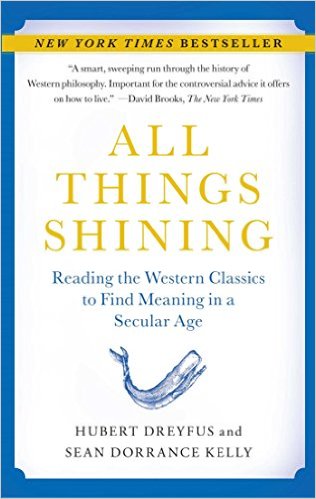
Whoosh!: The book doesn’t shine as much as the film, but it’s encouraging that something like it can be a bestseller.
SR: You’ve hit on many aspects of my use of the term “folk.” For me, as a folk musician (something I’ve been doing since the age of 5), the usage begins in relation folk music, especially the somatic pre-melodic root of music, the thing about it that makes people dance. Even toddlers will respond to a rhythm with dance. In this sense, the “folk” is something anterior to practices, but those practices all rely on the folk as a condition. I try to treat this in two ways in the book. First, I assert from the outset that “art precedes metaphysics,” which is a perhaps too neat way to try and capture what the “folk” in folk phenomenology is about. Another way, more specific to your question, is in chapter four where I point to baby-talk and jazz improvisation on guitar as identical examples of study on two ends of the human developmental spectrum. I would call the practices you refer to “study,” rooted in the saturation of the folk principle that this phenomenology tries to reduce into. But you’re right about the film’s superiority as a medium, and I did compose a folk album of music in live soundscapes to accompany and, as you put it, “go beyond” the book—but it is lagging behind the book a little bit.
[Click below to read the rest of the interview]
Previous Post

October 14, 2015
Theology Between Art and the Body Lecture Tomorrow
Next Post

October 16, 2015 Family Synod Conflict Is Not What You Think It Is . . .
Browse Our Archives
Select a Category #WhyRemainCatholic Abortion Advent Anti-Catholicism Arts Atheism Beauty Benedict XVI Bible Book Review Catholic Cinema Comedy Cosmos: A Space-Time Odyssey Czesław Miłosz Dariusz Karłowicz Devil Easter Eastern Orthodoxy Economics Environment Family Famous Atheists Who Weren't Atheists Guest Post Hans Urs von Balthasar HHS Mandate History Imagination Interview Islam Jean-Luc Marion John Paul II Judaism Just War Lent Literature Little Sisters of the Poor Liturgy Martyrdom Music News Paganism Patristics Phenomenology Philosophy Pierre Hadot Poetry Poland Pop Culture Pope Francis Poverty Prayer Protestantism Rabelais Race Remi Brague Rene Girard Russia Sam Rocha Science & Religion SCOTUS Secularization Sexual Abuse Sexuality Silence Solidarity Stratford Caldecott Synod14 Terrorism Top 10 Uncategorized Walker Percy War Weakened Edition World War II World Youth Day WYD Krakow
Select a Month July 2017 June 2017 May 2017 April 2017 March 2017 February 2017 January 2017 December 2016 October 2016 September 2016 August 2016 July 2016 June 2016 May 2016 April 2016 March 2016 February 2016 January 2016 December 2015 November 2015 October 2015 September 2015 August 2015 July 2015 June 2015 May 2015 April 2015 March 2015 February 2015 January 2015 December 2014 November 2014 October 2014 September 2014 August 2014 July 2014 May 2014 April 2014 March 2014 February 2014 January 2014 December 2013 November 2013 October 2013 September 2013 August 2013 July 2013 June 2013 May 2013
Follow Us!
TAKE THE
Religious Wisdom Quiz
According to Jeremiah 31:31, what did God promise to make with His people?
Select your answer to see how you score.
A new kingdom A new temple A new law A new covenant
Related posts from Cosmos The In Lost

Where Does the Body of Christ Go After...

How is Classical Philosophy is Like War?

Why Does the World's Leading Philosopher Remain a...

Post-Execution Church: Rise Up from the Electric Chair!
TRENDING AT PATHEOS Catholic

The Parable Of The Sower And The Word...
One of Christ’s most famous parables is that of the sower who...

Rejecting Doom: Christian Hope And Human Action
Christianity is a religion of hope. We are to have hope and...

Why I Choose the Eucharist Over the Sermon
Choose the Eucharist, Not the Sermon What are we supposed to get...

5 Design Elements Found in Spiritually Rooted Homes
Putting Spirituality Into Home Decor Our homes are more than our living...

Credo: A Story of God Told with the...
About 10 years ago, I began to imagine a personal "Credo" that...

The Anatomy of Divine Revelation in Catholic Thought
The claim that God has made Himself known to human beings is...
view all Catholic blogs
Ad-Free & Subscriber Log-In Subscription Support
- About Us
- 2026 Calendar
- Videos
- Podcasts
- Library of World Religions
- Faith In Media Tracker
- Advertise With Us
- Write for Us
- Privacy Policy
- Terms of Service
- Do Not Sell My Data
- Contact Us
- Radiant Digital
- Manage Newsletter Subscriptions
- Unsubscribe From Notifications
- Sitemap
Copyright 2008-2026, Patheos. All rights reserved.
Subscription Support Ad-Free & Subscriber Log-In
Follow Patheos