
BuddhistCatholicContemplativeEvangelicalGeneral ChristianHinduJewishLatter-day SaintMuslimNew VisionsProgressive Christian
Beliefs
- Buddhist
- Catholic
- Contemplative
- Evangelical
- General Christian
- Hindu
- Jewish
- Latter-day Saint
- More Voices
- Muslim
- New Visions
- Pagan
- Progressive Christian
Topics
- Religion News
- Food and Religion
- Sports and Religion
- Religious Art
- Religious Music and Entertainment
- Religious Events
- History and Religion
- Style and Religion
- Politics and Religion
- Women in Religion
- Recreation Outdoors and Religion
- Business Finance and Religion
- Careers Workplace and Religion
- Education and Religion
- Family Parenting and Religion
- Health Fitness and Religion
- Home and Religion
- Relationships and Religion
- Technology and Religion
- Travel and Religion
Columnists
- Buddhist Columnists
- Business Finance and Religion Columnists
- Careers Workplace and Religion Columnists
- Catholic Columnists
- Contemplative Columnists
- Education and Religion Columnists
- Evangelists Columnists
- Family Parenting and Religion Columnists
- General Christian Columnists
- Health Fitness and Religion Columnists
- Hindu Columnists
- History and Religion Columnists
- Home and Religion Columnists
- Jewish Columnists
- More Voices Columnists
- Latter Day Columnists
- Muslim Columnists
- New Visions Columnists
- Nonreligious Columnists
- Pagan Columnists
- Politics and Religion Columnists
- Progressive Columnists
- Recreation Outdoors and Religion Columnists
- Relationships and Religion Columnists
- Religion News Columnists
- Religious Art Columnists
- Religious Events Columnists
- Religious Music and Entertainment Columnists
- Sports and Religion Columnists
- Style and Religion Columnists
- Technology and Religion Columnists
- Travel and Religion Columnists
- Women in Religion Columnists
Resource Library
- 2026 Calendar
- Library of World Religions
- The 100 Most Holy Places on Earth
- Patheos Answers
- Podcasts
- Videos
- Faith Leaders Database
- Anglican Episcopalian
- Bahai
- Baptist
- Buddhism
- Christianity
- Confucianism
- Eastern Orthodoxy
- Hinduism
- Holiness and Pentecostal
- ISKCON
- Islam
- Judaism
- Lutheran
- Methodist
- The Church of Jesus Christ of Latter-day Saints
- New Age
- Paganism
- Presbytarian and Reformed
- Protestantism
- Religion Behind the Scenes
- Roman Catholic
- Scientology
- Shia Islam
- Sikhism
- Sufism
- Sunni Islam
- Taoism
- Zen
- See all religions
Research Tools
 Ad-Free & Subscriber Log-In Subscription Support
Ad-Free & Subscriber Log-In Subscription Support
Follow Patheos 

- Trending:
- Forgiveness
- |
- Marriage
- |
- Consciousness
- |
- Death Penalty
- |
- Election
- |
- Halloween
 Cosmos The In Lost
- Home
- Catholic
- No Bible? Fine. No Liturgy? No Christianity.
No Bible? Fine. No Liturgy? No Christianity.
Last updated on: October 11, 2015 at 7:05 pm by Artur Rosman
No Bible? Fine. No Liturgy? No Christianity. 2015-10-11T19:05:18-07:00 Artur Rosman
Patheos Explore the world's faith through different perspectives on religion and spirituality! Patheos has the views of the prevalent religions and spiritualities of the world.
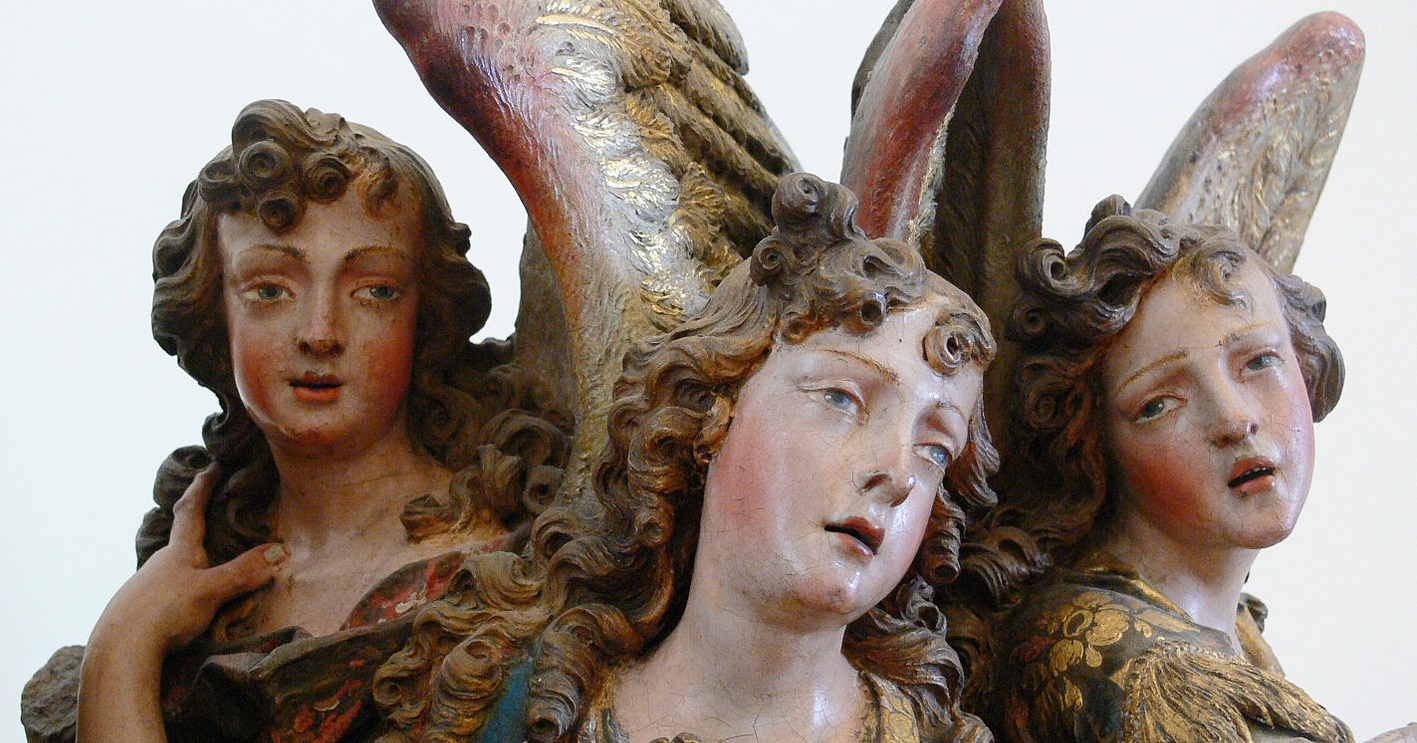
Choirs of angels sing around the throne (António Ferreira (?): Angels playing the organ and singing, terracotta, 1780; Source: Wikimedia Commons, photo by Andreas Praefcke, PD-Old-100).
For some of you the sentiments of the title for this piece might be as crooked as a Frank Gehry building.
Yet, there are historical and theological nuggets of wisdom hidden there.
Admittedly, it is another opportunity to scandalize our Protestant brethren and the bibliolatrous tendencies of American Catholics. As far as the latter go, I’m thinking those paragons of Evangelical Catholicism who might freak out upon reading this title and reassert that “CATHOLICS DO READ THE BIBLE! [yeah right],” or recommend that Catholics should be trained to prooftext like fundamentalists (because Jesus loves this more than people). But what about all those stereotypical illiterate medieval peasants? Were they Christians?
The sentiments of the title are actually stolen from Martin Mosebach’s The Heresy of Formlessness. He lays them out more even-handedly thus:
Some Catholics, who enjoy being provocative, say that the Christian religion could manage without the Bible sooner than without the liturgy. What do they mean by saying this?
I do, in fact, enjoy the provocative.
According to Mosebach, this provocative formulation rubs the following sentiments against the grain:
In the centuries following the Secularization, Jesus attracted much admiration and sympathy from philosophical and philanthropic writers and those in the Enlightenment tradition. Even avowed atheists saw Jesus as a great teacher of humanity, a new Socrates, a new Buddha. “I bow before him as the divine revelation of morality’s highest principle”, Goethe said to Eckermann. (This dictum should not be used to pigeonhole Goethe as a representative of Enlightenment thought: I quote it only as a particularly clear example of an attitude that has persisted to our time.) Accordingly we read in Goethe’s novel Wilhelm Meisters Wanderjahre: “Thus, for the noble part of mankind, the way he (Jesus) lived is even more instructive and fruitful than his death.”
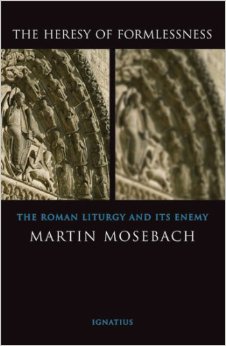
Shape up or ship out.
Mosebach notes there isn’t anything unique in the teachings recounted in the Gospels:
Seen as the founder of a religion, Jesus Christ characteristically taught nothing new and certainly no new morality. Nor is this contradicted by the oft-quoted Sermon on the Mount, for it does not deal with moral laws. “Blessed are the poor in spirit–blessed are you who hunger–blessed are you who weep now– blessed are you when men hate you”–these are not moral laws. They are a portrayal and the invocation of a new creation. He who weeps now will laugh–in a new world and once he has “put on Christ”, as Paul says. It does not say, “Blessed are the righteous,” but “Blessed are those who hunger for righteousness”, that is, those who have a sense of the world’s fallen-ness and their own failings and who yearn for healing.
What really counts is the physicality of the resurrection, and, only the liturgy really captures that:
The early Christians knew that the Christian message was Jesus himself. The essence of the Gospels’ new, more profound, and more compelling picture of God was that God had become flesh, present among us, in the God-man. The apostles were clearly aware that they could not hold on to their faith without the physical presence of Jesus, and so, as he left them, Jesus promised that they would never have to do without this presence. “I am with you to the end of days.” The promise of the Paraclete is the assurance that the soul’s connection with its Creator will not be broken, that God’s Spirit is present in his Church; but above all it shows the way in which the physical presence of the Son of God will be continued–in a changed mode–even after he disappears from the visible world; namely, through the action of the Holy Spirit in the liturgy.
We should also remember that not only the early Christians did fine without a New Testament, but the patriarchs of the Old Testament also did fine without the Hebrew Scriptures, which were only later compiled and redacted. What they did have was Temple liturgy.
Given how important physical and visible witness is to Christianity I find it disappointing that Rod Dreher has not responded to my questions about the efficacy of martyrdom in our time.
You might also want to distract yourself with No Devil, No God.
Please make some burnt offerings through the PayPal button on my homepage. Many thanks for your help so far.
Previous Post
October 8, 2015
Cradle Catholic Open Letter: Stop Protestant-splaining #Synod15!
Next Post

October 10, 2015 Reprint of the Year: Bloy's The Woman Who Was Poor
Browse Our Archives
Select a Category #WhyRemainCatholic Abortion Advent Anti-Catholicism Arts Atheism Beauty Benedict XVI Bible Book Review Catholic Cinema Comedy Cosmos: A Space-Time Odyssey Czesław Miłosz Dariusz Karłowicz Devil Easter Eastern Orthodoxy Economics Environment Family Famous Atheists Who Weren't Atheists Guest Post Hans Urs von Balthasar HHS Mandate History Imagination Interview Islam Jean-Luc Marion John Paul II Judaism Just War Lent Literature Little Sisters of the Poor Liturgy Martyrdom Music News Paganism Patristics Phenomenology Philosophy Pierre Hadot Poetry Poland Pop Culture Pope Francis Poverty Prayer Protestantism Rabelais Race Remi Brague Rene Girard Russia Sam Rocha Science & Religion SCOTUS Secularization Sexual Abuse Sexuality Silence Solidarity Stratford Caldecott Synod14 Terrorism Top 10 Uncategorized Walker Percy War Weakened Edition World War II World Youth Day WYD Krakow
Select a Month July 2017 June 2017 May 2017 April 2017 March 2017 February 2017 January 2017 December 2016 October 2016 September 2016 August 2016 July 2016 June 2016 May 2016 April 2016 March 2016 February 2016 January 2016 December 2015 November 2015 October 2015 September 2015 August 2015 July 2015 June 2015 May 2015 April 2015 March 2015 February 2015 January 2015 December 2014 November 2014 October 2014 September 2014 August 2014 July 2014 May 2014 April 2014 March 2014 February 2014 January 2014 December 2013 November 2013 October 2013 September 2013 August 2013 July 2013 June 2013 May 2013
Follow Us!
TAKE THE
Religious Wisdom Quiz
What does the name "Samuel" mean?
Select your answer to see how you score.
The Lord saves God has heard Chosen one God is my judge
Related posts from Cosmos The In Lost

The Surprising Anti-Capitalist Logic Behind the Catholic Church's...

How is Classical Philosophy is Like War?

Why Does the World's Leading Philosopher Remain a...

Biblical Authority After Babel Cannot Be Built Upon...
TRENDING AT PATHEOS Catholic

Creation, Preservation, and Teleology in Catholic Theology
As I write this, it is very early Monday morning. Like millions...

The Parable Of The Sower And The Word...
One of Christ’s most famous parables is that of the sower who...

Rejecting Doom: Christian Hope And Human Action
Christianity is a religion of hope. We are to have hope and...

Why I Choose the Eucharist Over the Sermon
Choose the Eucharist, Not the Sermon What are we supposed to get...

5 Design Elements Found in Spiritually Rooted Homes
Putting Spirituality Into Home Decor Our homes are more than our living...

Credo: A Story of God Told with the...
About 10 years ago, I began to imagine a personal "Credo" that...
view all Catholic blogs
Ad-Free & Subscriber Log-In Subscription Support
- About Us
- 2026 Calendar
- Videos
- Podcasts
- Library of World Religions
- Faith In Media Tracker
- Advertise With Us
- Write for Us
- Privacy Policy
- Terms of Service
- Do Not Sell My Data
- Contact Us
- Radiant Digital
- Manage Newsletter Subscriptions
- Unsubscribe From Notifications
- Sitemap
Copyright 2008-2026, Patheos. All rights reserved.
Subscription Support Ad-Free & Subscriber Log-In
Follow Patheos