
BuddhistCatholicContemplativeEvangelicalGeneral ChristianHinduJewishLatter-day SaintMuslimNew VisionsProgressive Christian
Beliefs
- Buddhist
- Catholic
- Contemplative
- Evangelical
- General Christian
- Hindu
- Jewish
- Latter-day Saint
- More Voices
- Muslim
- New Visions
- Pagan
- Progressive Christian
Topics
- Religion News
- Food and Religion
- Sports and Religion
- Religious Art
- Religious Music and Entertainment
- Religious Events
- History and Religion
- Style and Religion
- Politics and Religion
- Women in Religion
- Recreation Outdoors and Religion
- Business Finance and Religion
- Careers Workplace and Religion
- Education and Religion
- Family Parenting and Religion
- Health Fitness and Religion
- Home and Religion
- Relationships and Religion
- Technology and Religion
- Travel and Religion
Columnists
- Buddhist Columnists
- Business Finance and Religion Columnists
- Careers Workplace and Religion Columnists
- Catholic Columnists
- Contemplative Columnists
- Education and Religion Columnists
- Evangelists Columnists
- Family Parenting and Religion Columnists
- General Christian Columnists
- Health Fitness and Religion Columnists
- Hindu Columnists
- History and Religion Columnists
- Home and Religion Columnists
- Jewish Columnists
- More Voices Columnists
- Latter Day Columnists
- Muslim Columnists
- New Visions Columnists
- Nonreligious Columnists
- Pagan Columnists
- Politics and Religion Columnists
- Progressive Columnists
- Recreation Outdoors and Religion Columnists
- Relationships and Religion Columnists
- Religion News Columnists
- Religious Art Columnists
- Religious Events Columnists
- Religious Music and Entertainment Columnists
- Sports and Religion Columnists
- Style and Religion Columnists
- Technology and Religion Columnists
- Travel and Religion Columnists
- Women in Religion Columnists
Resource Library
- 2026 Calendar
- Library of World Religions
- The 100 Most Holy Places on Earth
- Patheos Answers
- Podcasts
- Videos
- Faith Leaders Database
- Anglican Episcopalian
- Bahai
- Baptist
- Buddhism
- Christianity
- Confucianism
- Eastern Orthodoxy
- Hinduism
- Holiness and Pentecostal
- ISKCON
- Islam
- Judaism
- Lutheran
- Methodist
- The Church of Jesus Christ of Latter-day Saints
- New Age
- Paganism
- Presbytarian and Reformed
- Protestantism
- Religion Behind the Scenes
- Roman Catholic
- Scientology
- Shia Islam
- Sikhism
- Sufism
- Sunni Islam
- Taoism
- Zen
- See all religions
Research Tools
 Ad-Free & Subscriber Log-In Subscription Support
Ad-Free & Subscriber Log-In Subscription Support
Follow Patheos 

- Trending:
- Forgiveness
- |
- Marriage
- |
- Consciousness
- |
- Death Penalty
- |
- Election
- |
- Halloween
 Cosmos The In Lost
- Home
- Catholic
- Newton’s Apple and Other Myths About Science
Newton’s Apple and Other Myths About Science
Last updated on: October 1, 2015 at 11:34 am by Artur Rosman
Newton’s Apple and Other Myths About Science 2015-10-01T11:34:39-07:00 Artur Rosman
Patheos Explore the world's faith through different perspectives on religion and spirituality! Patheos has the views of the prevalent religions and spiritualities of the world.
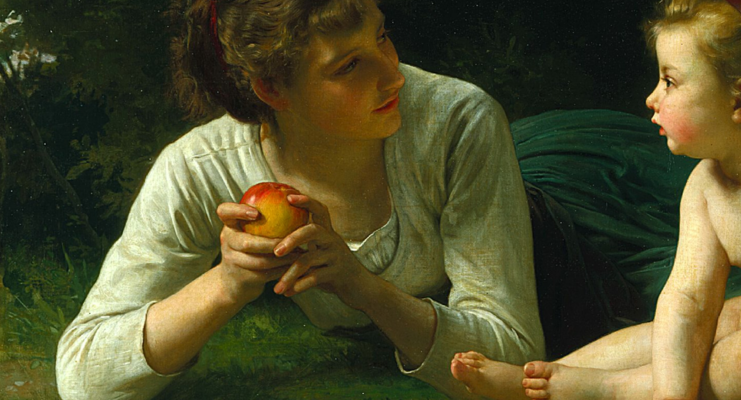
People have been known to cook myths about science with apples as well (William Adolphe Bouguereau, Temptation, 1880; Source: Wikimedia Commons, PD-Old-100).
The intersection of science and religion is a frequent topic on this blog. The relationship between these regions of human life are both more and less troubling than what we suppose.
First, they are much less troubling than what we might suppose because there is an immense space of complex intellectual dialogue between science and religion. Second, they are much more troubling than we might suppose because certain strains of scientific-based belief have their own superstitions such as crazy creation myths and erroneously canonized martyrs like Hypatia. Finally, there is a zone of ambivalence, such as the historical fact that the words science and religion, and what we assign to them as their proper roles in real life, are a very recent creations–the ancients and medievals knew them not.
One of the scholars responsible for mapping the interaction between these two, not necessarily separate, zones of science and religion is Ronald Numbers. His essay collection Galileo Goes to Jail and Other Myths About Science and Religion is one of the standard texts I recommend to my readers in my (nearly) exhaustive list of books on what science and religion are saying to each other these days.
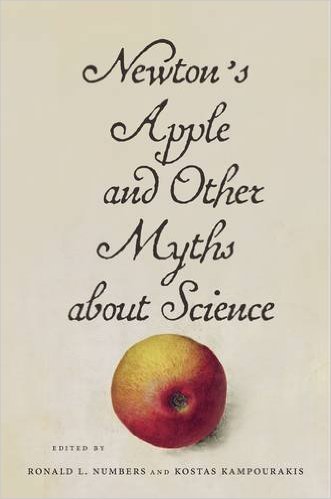
How do you like them covers?
It was a pleasant surprise to discover Numbers has a new essay collection, Newton’s Apple and Other Myths About Science, while I was leafing through the Harvard University Press catalog yesterday.
I never suspected the apple story might be a fabrication since public school teachers mindlessly drilled it into my mind every chance they had:
A falling apple inspired Isaac Newton’s insight into the law of gravity―or so the story goes. Is it true? Perhaps not. But the more intriguing question is why such stories endure as explanations of how science happens. Newton’s Apple and Other Myths about Science brushes away popular misconceptions to provide a clearer picture of great scientific breakthroughs from ancient times to the present.
The apple is not the only science fairy tale we generally believe because authorities tell us to believe them:
Among the myths refuted in this volume is the idea that no science was done in the Dark Ages, that alchemy and astrology were purely superstitious pursuits, that fear of public reaction alone led Darwin to delay publishing his theory of evolution, and that Gregor Mendel was far ahead of his time as a pioneer of genetics. Several twentieth-century myths about particle physics, Einstein’s theory of relativity, and more are discredited here as well. In addition, a number of broad generalizations about science go under the microscope of history: the notion that religion impeded science, that scientists typically adhere to a codified “scientific method,” and that a bright line can be drawn between legitimate science and pseudoscience.
Who knew general knowledge is poisoned by so much superstition?
Then again, most of us aren’t aware that we are going through a Second Scientific Revolution, or what its consequences might be for theology.
Science also likes its myths nice and sweet. Have a nice day. Sorry for breaking your deeply cherished myths:
https://www.youtube.com/watch?v=UXE1C–WezU
While you’re at it read more about the Second Scientific Revolution‘s promise for theology, or look through a whole library of the finest books on science and religion.
Please be great and donate (through the PayPal button on my homepage). I’m walking an financial tightrope because rent time is here.
newton's apple and other myths about science
Previous Post

September 30, 2015
15 Books I'd Ban for Banned Books Week
Next Post

October 4, 2015 Cosmos: Weakened Edition,1
Browse Our Archives
Select a Category #WhyRemainCatholic Abortion Advent Anti-Catholicism Arts Atheism Beauty Benedict XVI Bible Book Review Catholic Cinema Comedy Cosmos: A Space-Time Odyssey Czesław Miłosz Dariusz Karłowicz Devil Easter Eastern Orthodoxy Economics Environment Family Famous Atheists Who Weren't Atheists Guest Post Hans Urs von Balthasar HHS Mandate History Imagination Interview Islam Jean-Luc Marion John Paul II Judaism Just War Lent Literature Little Sisters of the Poor Liturgy Martyrdom Music News Paganism Patristics Phenomenology Philosophy Pierre Hadot Poetry Poland Pop Culture Pope Francis Poverty Prayer Protestantism Rabelais Race Remi Brague Rene Girard Russia Sam Rocha Science & Religion SCOTUS Secularization Sexual Abuse Sexuality Silence Solidarity Stratford Caldecott Synod14 Terrorism Top 10 Uncategorized Walker Percy War Weakened Edition World War II World Youth Day WYD Krakow
Select a Month July 2017 June 2017 May 2017 April 2017 March 2017 February 2017 January 2017 December 2016 October 2016 September 2016 August 2016 July 2016 June 2016 May 2016 April 2016 March 2016 February 2016 January 2016 December 2015 November 2015 October 2015 September 2015 August 2015 July 2015 June 2015 May 2015 April 2015 March 2015 February 2015 January 2015 December 2014 November 2014 October 2014 September 2014 August 2014 July 2014 May 2014 April 2014 March 2014 February 2014 January 2014 December 2013 November 2013 October 2013 September 2013 August 2013 July 2013 June 2013 May 2013
Follow Us!
TAKE THE
Religious Wisdom Quiz
Who prayed in the lions' den every day?
Select your answer to see how you score.
David Daniel Solomon Paul
Related posts from Cosmos The In Lost

The Surprising Anti-Capitalist Logic Behind the Catholic Church's...

Biblical Authority After Babel Cannot Be Built Upon...

2 Reasons Why the March for Science is...
Liberal Theologian's Lenient Easter Sermon Makes a Mockery...
TRENDING AT PATHEOS Catholic

The Parable Of The Sower And The Word...
One of Christ’s most famous parables is that of the sower who...

Rejecting Doom: Christian Hope And Human Action
Christianity is a religion of hope. We are to have hope and...

Why I Choose the Eucharist Over the Sermon
Choose the Eucharist, Not the Sermon What are we supposed to get...

5 Design Elements Found in Spiritually Rooted Homes
Putting Spirituality Into Home Decor Our homes are more than our living...

Credo: A Story of God Told with the...
About 10 years ago, I began to imagine a personal "Credo" that...

The Anatomy of Divine Revelation in Catholic Thought
The claim that God has made Himself known to human beings is...
view all Catholic blogs
Ad-Free & Subscriber Log-In Subscription Support
- About Us
- 2026 Calendar
- Videos
- Podcasts
- Library of World Religions
- Faith In Media Tracker
- Advertise With Us
- Write for Us
- Privacy Policy
- Terms of Service
- Do Not Sell My Data
- Contact Us
- Radiant Digital
- Manage Newsletter Subscriptions
- Unsubscribe From Notifications
- Sitemap
Copyright 2008-2026, Patheos. All rights reserved.
Subscription Support Ad-Free & Subscriber Log-In
Follow Patheos