
BuddhistCatholicContemplativeEvangelicalGeneral ChristianHinduJewishLatter-day SaintMuslimNew VisionsProgressive Christian
Beliefs
- Buddhist
- Catholic
- Contemplative
- Evangelical
- General Christian
- Hindu
- Jewish
- Latter-day Saint
- More Voices
- Muslim
- New Visions
- Pagan
- Progressive Christian
Topics
- Religion News
- Food and Religion
- Sports and Religion
- Religious Art
- Religious Music and Entertainment
- Religious Events
- History and Religion
- Style and Religion
- Politics and Religion
- Women in Religion
- Recreation Outdoors and Religion
- Business Finance and Religion
- Careers Workplace and Religion
- Education and Religion
- Family Parenting and Religion
- Health Fitness and Religion
- Home and Religion
- Relationships and Religion
- Technology and Religion
- Travel and Religion
Columnists
- Buddhist Columnists
- Business Finance and Religion Columnists
- Careers Workplace and Religion Columnists
- Catholic Columnists
- Contemplative Columnists
- Education and Religion Columnists
- Evangelists Columnists
- Family Parenting and Religion Columnists
- General Christian Columnists
- Health Fitness and Religion Columnists
- Hindu Columnists
- History and Religion Columnists
- Home and Religion Columnists
- Jewish Columnists
- More Voices Columnists
- Latter Day Columnists
- Muslim Columnists
- New Visions Columnists
- Nonreligious Columnists
- Pagan Columnists
- Politics and Religion Columnists
- Progressive Columnists
- Recreation Outdoors and Religion Columnists
- Relationships and Religion Columnists
- Religion News Columnists
- Religious Art Columnists
- Religious Events Columnists
- Religious Music and Entertainment Columnists
- Sports and Religion Columnists
- Style and Religion Columnists
- Technology and Religion Columnists
- Travel and Religion Columnists
- Women in Religion Columnists
Resource Library
- 2026 Calendar
- Library of World Religions
- The 100 Most Holy Places on Earth
- Patheos Answers
- Podcasts
- Videos
- Faith Leaders Database
- Anglican Episcopalian
- Bahai
- Baptist
- Buddhism
- Christianity
- Confucianism
- Eastern Orthodoxy
- Hinduism
- Holiness and Pentecostal
- ISKCON
- Islam
- Judaism
- Lutheran
- Methodist
- The Church of Jesus Christ of Latter-day Saints
- New Age
- Paganism
- Presbytarian and Reformed
- Protestantism
- Religion Behind the Scenes
- Roman Catholic
- Scientology
- Shia Islam
- Sikhism
- Sufism
- Sunni Islam
- Taoism
- Zen
- See all religions
Research Tools
 Ad-Free & Subscriber Log-In Subscription Support
Ad-Free & Subscriber Log-In Subscription Support
Follow Patheos 

- Trending:
- Forgiveness
- |
- Marriage
- |
- Consciousness
- |
- Death Penalty
- |
- Election
- |
- Halloween
 Cosmos The In Lost
- Home
- Catholic
- Why is THIS Pope Francis’s Hardest American Saying?
Why is THIS Pope Francis’s Hardest American Saying?
Last updated on: September 29, 2015 at 2:29 pm by Artur Rosman
Why is THIS Pope Francis’s Hardest American Saying? 2015-09-29T14:29:15-07:00 Artur Rosman
Patheos Explore the world's faith through different perspectives on religion and spirituality! Patheos has the views of the prevalent religions and spiritualities of the world.
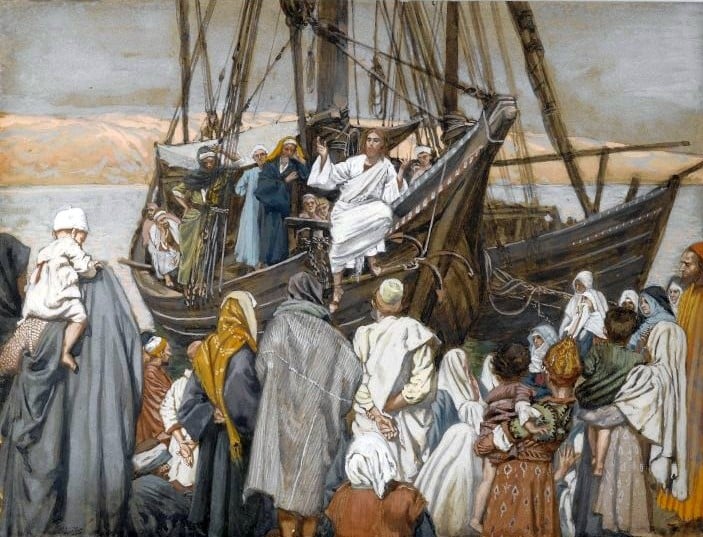
I’ve never seen a painting of Jesus preaching on a ship. This overrode all my other criteria for a cover image to this post. Perhaps Jesus says, “If this ship harm ye, cut off its mast”? (James Tissot, Jesus Preaching on a Ship, c. 1894; Source: Wikimedia Commons, PD-Old-100).
The roundups of the papal visit are making the rounds everywhere. There’s much to celebrate, it seems much more to criticize (if you come from some Catholic circles), and too much material to read (most folks will TL;DR punt on this).
However the calculus comes out on the final analysis of the visit to America–and I’ll let someone else crunch the numbers–I’d like to stick, following Adorno, to the negative, the condemnatory, the judgmental, and harsh.
Don’t worry, it’s all in line with the spirit of the liturgy.
If you thought the second reading was harsh last weekend, leaving the congregation wondering why they didn’t leave, then the Gospel was like a mallet striking a melon, or . . . a knife gouging out an eye, an axe chopping off an arm and a leg (Mark 9) . . . then here’s my unscientific roundup of the pope’s hard sayings.
First of all, there was the pope on abortion. He was harsh enough in his statements on the topic to satisfy the cravings of one-issue “culture of life” believers. Why? Planned Parenthood got enough of the message to cry “Damn your eyes!” to the pope.
The pope also walked the tightrope in his condemnation of American warmongering, just as John Paul II and Benedict XVI did:
A delicate balance is required to combat violence perpetrated in the name of a religion, an ideology or an economic system, while also safeguarding religious freedom, intellectual freedom and individual freedoms. But there is another temptation which we must especially guard against: the simplistic reductionism which sees only good or evil; or, if you will, the righteous and sinners. The contemporary world, with its open wounds which affect so many of our brothers and sisters, demands that we confront every form of polarization which would divide it into these two camps. We know that in the attempt to be freed of the enemy without, we can be tempted to feed the enemy within. To imitate the hatred and violence of tyrants and murderers is the best way to take their place. That is something which you, as a people, reject.
We, as a desert-storming, waterboarding, and Afghanistan-crushing people reject all this . . . Wink, wink, nudge, nudge, that’s Jesuit-sly dear pope!
The passage above is a wonderful example of Kierkegaardian indirect communication that escapes mimetic rivalries with those one criticizes, very much like what celebrate Catholic anthropologist Rene Girard constantly talks about. Note how the pope even uses the Girardian language of imitation, scapegoating, and revenge there; I’d be surprised if he hasn’t read him.
However, in my eyes, these two statements don’t win the prize. It’s what Pope Francis said in his sermon occasioned by the canonization of Junipero Serra (something that will require more commentary later) that disturbed me to my core:
Rejoice in the Lord always! I say it again, rejoice! These are striking words, words which impact our lives. Paul tells us to rejoice; he practically orders us to rejoice. This command resonates with the desire we all have for a fulfilling life, a meaningful life, a joyful life. It is as if Paul could hear what each one of us is thinking in his or her heart and to voice what we are feeling, what we are experiencing. Something deep within us invites us to rejoice and tells us not to settle for placebos which always keep us comfortable.
When Walker Percy praises depression as the only sane response to our crazy times, the pope’s sentiment seems 1 Cor 1:23 nuts. How am I to rejoice when I’m in between jobs with a family to support?
I’m frequently more on board with Joseph Brodsky when he says this in his poem “Letter to an Archaeologist” (from the collection To Urania):
Citizen, enemy, mama’s boy, sucker, utter
garbage, panhandler, swine, refujew, verrucht;
a scalp so often scalded with boiling water
that the puny brain feels completely cooked.
Yes, we have dwelt here: in this concrete, brick, wooden
rubble which you now arrive to sift.
All our wires were crossed, barbed, tangled, or interwoven.
Also: we didn’t love our women, but they conceived.
Sharp is the sound of pickax that hurts dead iron;
still, it’s gentler than what we’ve been told or have said ourselves.
Stranger! move carefully through our carrion:
what seems carrion to you is freedom to our cells.
Leave our names alone. Don’t reconstruct those vowels,
consonants, and so forth: they won’t resemble larks
but a demented bloodhound whose maw devours
its own traces, feces, and barks, and barks.
But I get it, there’s a reason why St. Paul “practically orders us to rejoice.”
Still, this is a very hard saying!
You might want to read about Alasdair MacIntyre’s equally nutty views on the revelatory power of disability.
See also whether Rene Girard agrees that Christianity is a myth.
Times is hard. Please donate if you can through my homepage PayPal button.
Previous Post

September 28, 2015
A Book to Pick Up, Read, & Survive (Even When You Don't Thrive)
Next Post

September 30, 2015 15 Books I'd Ban for Banned Books Week
Browse Our Archives
Select a Category #WhyRemainCatholic Abortion Advent Anti-Catholicism Arts Atheism Beauty Benedict XVI Bible Book Review Catholic Cinema Comedy Cosmos: A Space-Time Odyssey Czesław Miłosz Dariusz Karłowicz Devil Easter Eastern Orthodoxy Economics Environment Family Famous Atheists Who Weren't Atheists Guest Post Hans Urs von Balthasar HHS Mandate History Imagination Interview Islam Jean-Luc Marion John Paul II Judaism Just War Lent Literature Little Sisters of the Poor Liturgy Martyrdom Music News Paganism Patristics Phenomenology Philosophy Pierre Hadot Poetry Poland Pop Culture Pope Francis Poverty Prayer Protestantism Rabelais Race Remi Brague Rene Girard Russia Sam Rocha Science & Religion SCOTUS Secularization Sexual Abuse Sexuality Silence Solidarity Stratford Caldecott Synod14 Terrorism Top 10 Uncategorized Walker Percy War Weakened Edition World War II World Youth Day WYD Krakow
Select a Month July 2017 June 2017 May 2017 April 2017 March 2017 February 2017 January 2017 December 2016 October 2016 September 2016 August 2016 July 2016 June 2016 May 2016 April 2016 March 2016 February 2016 January 2016 December 2015 November 2015 October 2015 September 2015 August 2015 July 2015 June 2015 May 2015 April 2015 March 2015 February 2015 January 2015 December 2014 November 2014 October 2014 September 2014 August 2014 July 2014 May 2014 April 2014 March 2014 February 2014 January 2014 December 2013 November 2013 October 2013 September 2013 August 2013 July 2013 June 2013 May 2013
Follow Us!
TAKE THE
Religious Wisdom Quiz
What did Isaiah say about Egypt's future in his oracles?
Select your answer to see how you score.
It would conquer Israel It would rule Persia It would prosper It would be conquered
Related posts from Cosmos The In Lost

The Surprising Anti-Capitalist Logic Behind the Catholic Church's...

How is Classical Philosophy is Like War?

Why Does the World's Leading Philosopher Remain a...

Leading Historian Made the Analogy Between the Refugee...
TRENDING AT PATHEOS Catholic

The Parable Of The Sower And The Word...
One of Christ’s most famous parables is that of the sower who...

Rejecting Doom: Christian Hope And Human Action
Christianity is a religion of hope. We are to have hope and...

Why I Choose the Eucharist Over the Sermon
Choose the Eucharist, Not the Sermon What are we supposed to get...

5 Design Elements Found in Spiritually Rooted Homes
Putting Spirituality Into Home Decor Our homes are more than our living...

Credo: A Story of God Told with the...
About 10 years ago, I began to imagine a personal "Credo" that...

The Anatomy of Divine Revelation in Catholic Thought
The claim that God has made Himself known to human beings is...
view all Catholic blogs
Ad-Free & Subscriber Log-In Subscription Support
- About Us
- 2026 Calendar
- Videos
- Podcasts
- Library of World Religions
- Faith In Media Tracker
- Advertise With Us
- Write for Us
- Privacy Policy
- Terms of Service
- Do Not Sell My Data
- Contact Us
- Radiant Digital
- Manage Newsletter Subscriptions
- Unsubscribe From Notifications
- Sitemap
Copyright 2008-2026, Patheos. All rights reserved.
Subscription Support Ad-Free & Subscriber Log-In
Follow Patheos