
BuddhistCatholicContemplativeEvangelicalGeneral ChristianHinduJewishLatter-day SaintMuslimNew VisionsProgressive Christian
Beliefs
- Buddhist
- Catholic
- Contemplative
- Evangelical
- General Christian
- Hindu
- Jewish
- Latter-day Saint
- More Voices
- Muslim
- New Visions
- Pagan
- Progressive Christian
Topics
- Religion News
- Food and Religion
- Sports and Religion
- Religious Art
- Religious Music and Entertainment
- Religious Events
- History and Religion
- Style and Religion
- Politics and Religion
- Women in Religion
- Recreation Outdoors and Religion
- Business Finance and Religion
- Careers Workplace and Religion
- Education and Religion
- Family Parenting and Religion
- Health Fitness and Religion
- Home and Religion
- Relationships and Religion
- Technology and Religion
- Travel and Religion
Columnists
- Buddhist Columnists
- Business Finance and Religion Columnists
- Careers Workplace and Religion Columnists
- Catholic Columnists
- Contemplative Columnists
- Education and Religion Columnists
- Evangelists Columnists
- Family Parenting and Religion Columnists
- General Christian Columnists
- Health Fitness and Religion Columnists
- Hindu Columnists
- History and Religion Columnists
- Home and Religion Columnists
- Jewish Columnists
- More Voices Columnists
- Latter Day Columnists
- Muslim Columnists
- New Visions Columnists
- Nonreligious Columnists
- Pagan Columnists
- Politics and Religion Columnists
- Progressive Columnists
- Recreation Outdoors and Religion Columnists
- Relationships and Religion Columnists
- Religion News Columnists
- Religious Art Columnists
- Religious Events Columnists
- Religious Music and Entertainment Columnists
- Sports and Religion Columnists
- Style and Religion Columnists
- Technology and Religion Columnists
- Travel and Religion Columnists
- Women in Religion Columnists
Resource Library
- 2026 Calendar
- Library of World Religions
- The 100 Most Holy Places on Earth
- Patheos Answers
- Podcasts
- Videos
- Faith Leaders Database
- Anglican Episcopalian
- Bahai
- Baptist
- Buddhism
- Christianity
- Confucianism
- Eastern Orthodoxy
- Hinduism
- Holiness and Pentecostal
- ISKCON
- Islam
- Judaism
- Lutheran
- Methodist
- The Church of Jesus Christ of Latter-day Saints
- New Age
- Paganism
- Presbytarian and Reformed
- Protestantism
- Religion Behind the Scenes
- Roman Catholic
- Scientology
- Shia Islam
- Sikhism
- Sufism
- Sunni Islam
- Taoism
- Zen
- See all religions
Research Tools
 Ad-Free & Subscriber Log-In Subscription Support
Ad-Free & Subscriber Log-In Subscription Support
Follow Patheos 

- Trending:
- Forgiveness
- |
- Marriage
- |
- Consciousness
- |
- Death Penalty
- |
- Election
- |
- Halloween
 Cosmos The In Lost
- Home
- Catholic
- The Bothersome Man’s Search for Meaning
The Bothersome Man’s Search for Meaning
Last updated on: September 30, 2015 at 7:34 pm by Artur Rosman
The Bothersome Man’s Search for Meaning 2015-09-30T19:34:34-07:00 Artur Rosman
Patheos Explore the world's faith through different perspectives on religion and spirituality! Patheos has the views of the prevalent religions and spiritualities of the world.
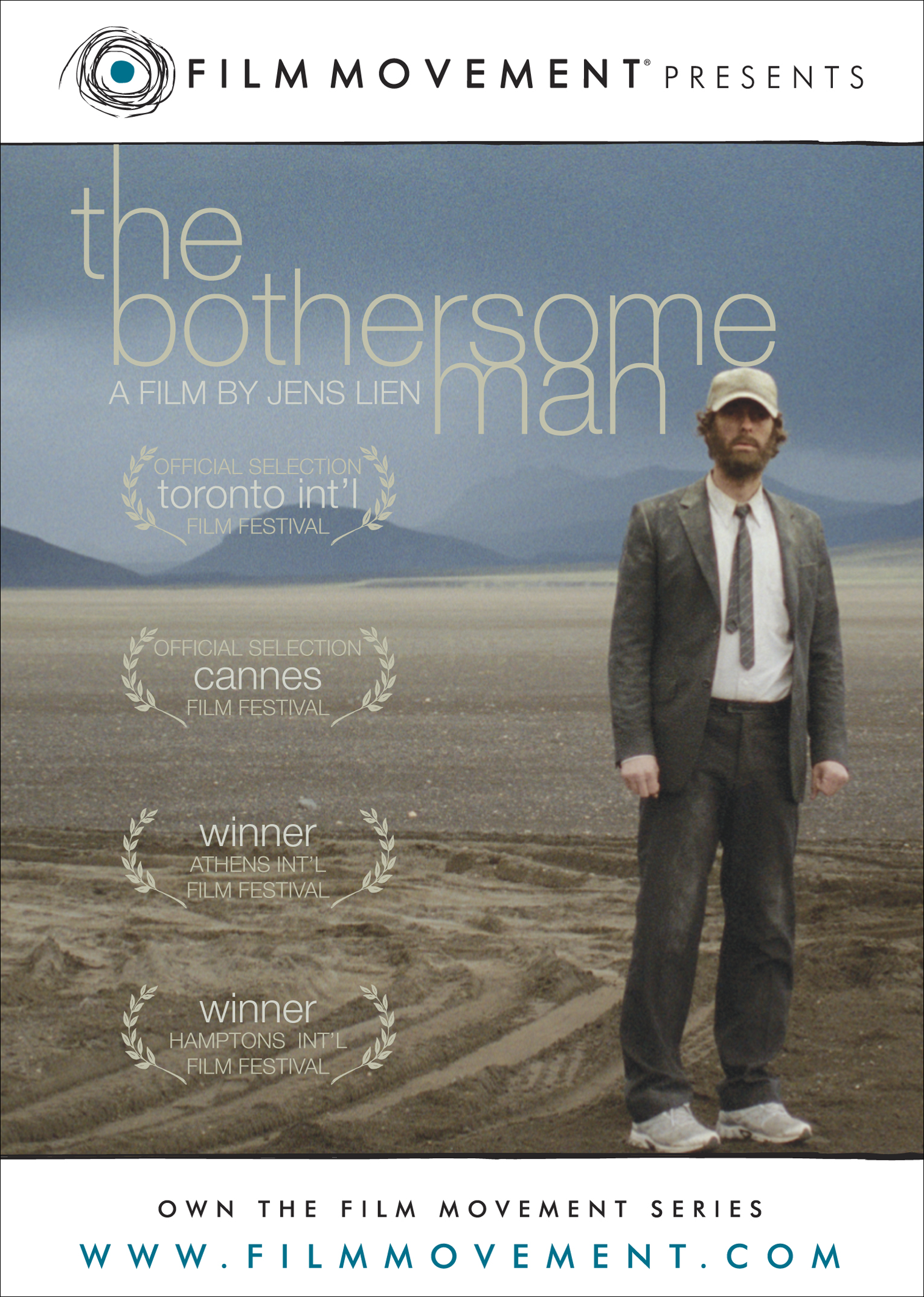
No, The Bothersome Man is nothing like Forrest Gump.
Books are not only bibliography fodder. They are also fodder for life. Sometimes books even give life as the word miraculously becomes flesh.
I can think of several times when I’ve run up against the wall and a book has saved me. Off the top of my head I can think of Czeslaw Milosz’s The Land of Ulro, Hans Urs von Balthasar’s Mysterium Paschale, Simone Weil’s Gravity and Grace, Thomas Mann’s The Magic Mountain, Marilynne Robinson’s Gilead, Ernest Becker’s The Denial of Death, Nietzsche’s The Gay Science, and Walker Percy’s The Second Coming. More recently, starting on Karl Barth’s The Epistle to the Romans continues to help me tread water during all kinds of storms.
Reading is not a spectator sport. Reading is a survival tactic.
If you know anything about these books, then you’re aware they’re not straightforwardly cheerful reads, instead, they are hopeful reads (in a complicated way).
I think whenever I hit tough times I tend to instinctively follow Walker Percy’s advice from Lost in the Cosmos: If you find yourself in a difficult and depressing situation you should not reach for comedies, because the distance between what they portray and your own reality will only make you hopeless. Instead, reach for Camus or Bergman, because they will give you a sense of uplifting communion in misery.
A story in Business Insider, of all places, reminded me how much I also owe to my reading of Viktor Frankl’s Man’s Search for Meaning. That book dropped into my lap during some difficult times and boy did it put things into perspective and I’ve found that other people who’ve read it usually have a similar response to it. This has to do with the book’s genesis. It is a combination of concentration camp memoir and a psychological-existential guidebook. Or rather, it is a psychological-existential guidebook because its insights were first discovered by the author in a Nazi concentration camp–as a prisoner.
It is difficult to do the book’s content justice in a short blog post. However, kudos to the BI writer for picking out one of the most important passages from Man’s Search for Meaning:
This uniqueness and singleness which distinguishes each individual and gives a meaning to his existence has a bearing on creative work as much as it does on human love. When the impossibility of replacing a person is realized, it allows the responsibility which a man has for his existence and its continuance to appear in all its magnitude. A man who becomes conscious of the responsibility he bears toward a human being who affectionately waits for him, or to an unfinished work, will never be able to throw away his life. He knows the “why” for his existence, and will be able to bear almost any “how.”
All of this is tied up with hope and ultimately survival. In the opening pages of the book Frankl talks about how he could tell from the faces of fellow camp inmates whether they would survive. If he could see hope on their faces he knew they had a chance of survival. If any signs of despair made themselves apparent Frankl knew these people would wither away without the precious resource of meaning in an environment that could not be endured if considered totally meaningless.
While trying to find the BI article again in order to write this post I ran across another related article. It appears Man’s Search for Meaning is headed for the silver screen. This makes me slightly depressed, because I don’t see how, or why, the book should be made into a movie. I can only see Hollywood making total schlock out of it.
I might also be biased, because, as luck would have it, last night I unwittingly chose to watch the cinematic embodiment of Frankl’s philosophy in the Norwegian film The Bothersome Man. This film starts out with the inexplicable suicide of what seems to be a handsome and successful Andreas. The screen goes black, then he is transported into the moonscapes of the Norwegian countryside and ends up in an antiseptic looking city.
In this semblance of an afterlife he is immediately provided with everything a man might desire: home, job, friendly coworkers, girlfriend, mistress, and so on. Everything is geared to satisfy nearly all of his desires immediately, more often than not, before he asks. It is the Hallmark edition of heaven. There is one exception: None of this satisfies his desire for meaning. He begins to realize the food tastes all the same, then he starts noticing the superficiality of the relationships he has formed, and his work doesn’t make sense even if it pays well.
Nothing seems to be faithful to flesh and blood reality in the paradise of The Bothersome Man and therefore everything stands in the way of Andreas forging a meaningful narrative for his (after-)life. Despair overtakes him once he realizes this and he begins an amusingly (darkly) comic search for ways to dig himself out of his predicament. Even total annihilation after death would be preferable to such a life.
In the end, it becomes apparent that man cannot forgo his bothersome search for meaning. Without a “why” there is no “how.”
I should add: Movies also save us.
You might not be aware that Frankl’s wife was Catholic and he (himself Jewish) had at least one audience with Pius XII. The two men liked each other. Frankl even wrote some books bordering upon theology such as The Unconscious God.
I know it’s getting bothersome, but please donate some funds if you enjoy reading these posts through the button on this blog’s homepage. Feel free to donate in order to spite me as well–I won’t object.
In return I offer you this additional rare footage of Frankl lecturing on the meaning of life:
Previous Post

September 20, 2015
The Blood of St. Januarius Boils Over Every September

Browse Our Archives
Select a Category #WhyRemainCatholic Abortion Advent Anti-Catholicism Arts Atheism Beauty Benedict XVI Bible Book Review Catholic Cinema Comedy Cosmos: A Space-Time Odyssey Czesław Miłosz Dariusz Karłowicz Devil Easter Eastern Orthodoxy Economics Environment Family Famous Atheists Who Weren't Atheists Guest Post Hans Urs von Balthasar HHS Mandate History Imagination Interview Islam Jean-Luc Marion John Paul II Judaism Just War Lent Literature Little Sisters of the Poor Liturgy Martyrdom Music News Paganism Patristics Phenomenology Philosophy Pierre Hadot Poetry Poland Pop Culture Pope Francis Poverty Prayer Protestantism Rabelais Race Remi Brague Rene Girard Russia Sam Rocha Science & Religion SCOTUS Secularization Sexual Abuse Sexuality Silence Solidarity Stratford Caldecott Synod14 Terrorism Top 10 Uncategorized Walker Percy War Weakened Edition World War II World Youth Day WYD Krakow
Select a Month July 2017 June 2017 May 2017 April 2017 March 2017 February 2017 January 2017 December 2016 October 2016 September 2016 August 2016 July 2016 June 2016 May 2016 April 2016 March 2016 February 2016 January 2016 December 2015 November 2015 October 2015 September 2015 August 2015 July 2015 June 2015 May 2015 April 2015 March 2015 February 2015 January 2015 December 2014 November 2014 October 2014 September 2014 August 2014 July 2014 May 2014 April 2014 March 2014 February 2014 January 2014 December 2013 November 2013 October 2013 September 2013 August 2013 July 2013 June 2013 May 2013
Follow Us!
TAKE THE
Religious Wisdom Quiz
What river did John baptize Jesus in?
Select your answer to see how you score.
Red Sea Tigris River Jordan River Nile River
Related posts from Cosmos The In Lost

How is Classical Philosophy is Like War?

Why Does the World's Leading Philosopher Remain a...


Oscar Best Picture Nominee "Arrival" and the Bearable...
TRENDING AT PATHEOS Catholic

Rejecting Doom: Christian Hope And Human Action
Christianity is a religion of hope. We are to have hope and...

It’s What Comes From Within Which Matters
One of the most difficult things for us to understand is why...

Why I Choose the Eucharist Over the Sermon
Choose the Eucharist, Not the Sermon What are we supposed to get...

5 Design Elements Found in Spiritually Rooted Homes
Putting Spirituality Into Home Decor Our homes are more than our living...

Credo: A Story of God Told with the...
About 10 years ago, I began to imagine a personal "Credo" that...

The Anatomy of Divine Revelation in Catholic Thought
The claim that God has made Himself known to human beings is...
view all Catholic blogs
Ad-Free & Subscriber Log-In Subscription Support
- About Us
- 2026 Calendar
- Videos
- Podcasts
- Library of World Religions
- Faith In Media Tracker
- Advertise With Us
- Write for Us
- Privacy Policy
- Terms of Service
- Do Not Sell My Data
- Contact Us
- Radiant Digital
- Manage Newsletter Subscriptions
- Unsubscribe From Notifications
- Sitemap
Copyright 2008-2026, Patheos. All rights reserved.
Subscription Support Ad-Free & Subscriber Log-In
Follow Patheos