
BuddhistCatholicContemplativeEvangelicalGeneral ChristianHinduJewishLatter-day SaintMuslimNew VisionsProgressive Christian
Beliefs
- Buddhist
- Catholic
- Contemplative
- Evangelical
- General Christian
- Hindu
- Jewish
- Latter-day Saint
- More Voices
- Muslim
- New Visions
- Pagan
- Progressive Christian
Topics
- Religion News
- Food and Religion
- Sports and Religion
- Religious Art
- Religious Music and Entertainment
- Religious Events
- History and Religion
- Style and Religion
- Politics and Religion
- Women in Religion
- Recreation Outdoors and Religion
- Business Finance and Religion
- Careers Workplace and Religion
- Education and Religion
- Family Parenting and Religion
- Health Fitness and Religion
- Home and Religion
- Relationships and Religion
- Technology and Religion
- Travel and Religion
Columnists
- Buddhist Columnists
- Business Finance and Religion Columnists
- Careers Workplace and Religion Columnists
- Catholic Columnists
- Contemplative Columnists
- Education and Religion Columnists
- Evangelists Columnists
- Family Parenting and Religion Columnists
- General Christian Columnists
- Health Fitness and Religion Columnists
- Hindu Columnists
- History and Religion Columnists
- Home and Religion Columnists
- Jewish Columnists
- More Voices Columnists
- Latter Day Columnists
- Muslim Columnists
- New Visions Columnists
- Nonreligious Columnists
- Pagan Columnists
- Politics and Religion Columnists
- Progressive Columnists
- Recreation Outdoors and Religion Columnists
- Relationships and Religion Columnists
- Religion News Columnists
- Religious Art Columnists
- Religious Events Columnists
- Religious Music and Entertainment Columnists
- Sports and Religion Columnists
- Style and Religion Columnists
- Technology and Religion Columnists
- Travel and Religion Columnists
- Women in Religion Columnists
Resource Library
- 2026 Calendar
- Library of World Religions
- The 100 Most Holy Places on Earth
- Patheos Answers
- Podcasts
- Videos
- Faith Leaders Database
- Anglican Episcopalian
- Bahai
- Baptist
- Buddhism
- Christianity
- Confucianism
- Eastern Orthodoxy
- Hinduism
- Holiness and Pentecostal
- ISKCON
- Islam
- Judaism
- Lutheran
- Methodist
- The Church of Jesus Christ of Latter-day Saints
- New Age
- Paganism
- Presbytarian and Reformed
- Protestantism
- Religion Behind the Scenes
- Roman Catholic
- Scientology
- Shia Islam
- Sikhism
- Sufism
- Sunni Islam
- Taoism
- Zen
- See all religions
Research Tools
 Ad-Free & Subscriber Log-In Subscription Support
Ad-Free & Subscriber Log-In Subscription Support
Follow Patheos 

- Trending:
- Forgiveness
- |
- Marriage
- |
- Consciousness
- |
- Death Penalty
- |
- Election
- |
- Halloween
 Cosmos The In Lost
- Home
- Catholic
- The Blood of St. Januarius Boils Over Every September
The Blood of St. Januarius Boils Over Every September
Last updated on: September 23, 2015 at 3:18 pm by Artur Rosman
The Blood of St. Januarius Boils Over Every September 2015-09-23T15:18:41-07:00 Artur Rosman
Patheos Explore the world's faith through different perspectives on religion and spirituality! Patheos has the views of the prevalent religions and spiritualities of the world.
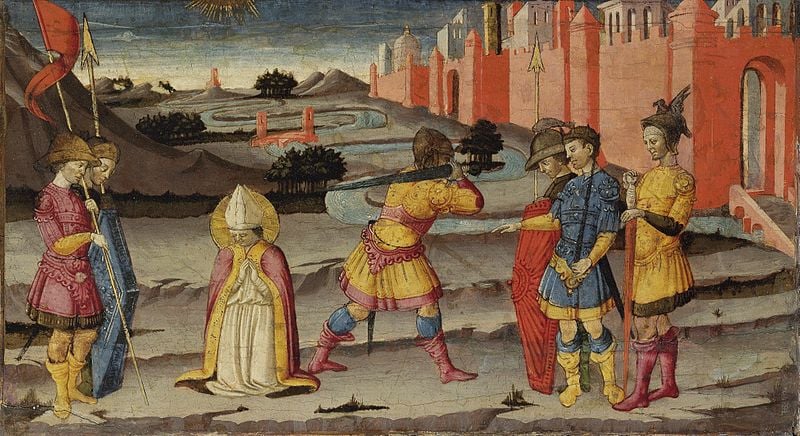
Don’t lose your head. The blood of St. Januarius liquefies every September 19th (Neri di Bicci, Martyrdom of St. Januarius, 15th C.; Source: Wikimedia Commons, PD-Old-100).
Catholicism is a strange religion, perhaps the most worldly of them all, if you believe theologian Larry Chapp (who still owes me a bottle of bourbon). There is quite a lot of anthropocentrism there too, since, as you might remember, God became man. Czeslaw Milosz sums it up compactly in his Visions from San Francisco Bay:
Milosz puts Catholicism in a late modern context through his perch on Berkeley’s Grizzly Peak.
All humanity, past and present, is, in truth, a Church persisting outside ordinary space and time, a Church opposed to the necessity built into the universe. Catholicism is the most anthropocentric of religions and, in some sense, through its own excess of divine humanity, it resists the exact sciences which annihilate the individual. Thus, paradoxically, it is less susceptible than other religions to the disintegrative influence of science and technology. In Catholicism, even Heaven and Earth, the Descent and the Ascension of God are not like relations between worlds but like those between human forms.

You might not remember that every altar in Catholic-dom contains a relic. One of the most celebrated ones is in Naples: the blood of St. Januarius.
I first heard about the patron Saint of Naples in one of Gustaw Herling’s magical historical vignettes in Volcano and Miracle. Herling was a Pole who lived out the better part of his life in Naples after marrying one of Benedetto Croce’s daughters, or granddaughter. He also spent some time in the Gulags (wrote a renowned witness of his time there) and generally was fascinated by the ambivalence of the sacred. I couldn’t find my English copy of Volcano and Miracle so here’s my quick translation from the Polish of the opening lines of his vignette on St. Januarius (San Gennaro), whose feast is in September:
For Herling the presence of the divine sometimes blows up in our faces.
For some time the miracle of St. Januarius, the patron and protector of Naples, has lost much of its old splendor. In olden times the liquefaction of the coagulated blood of the martyr in two ampules every September 19th, on the anniversary of his martyrdom, was the axis upon which the Neapolitan year revolved: a bad sign or warning if the miracle was preceded by long propitiation rituals; a good sign and proof of the Saint’s favor, if the prayers and invocations were effective quickly.

Eeeh! St. Januarius has forged an American presence in New Yawk.
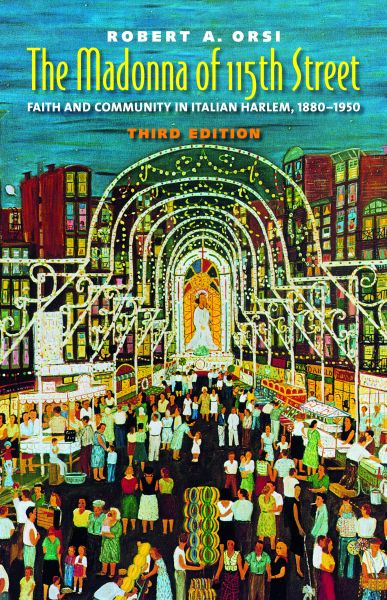
If I remember correctly, the St. Januarius festivities in New York might be the longest continuously running public religious festival in the United States, or at least New York for sure. If you’re curious, the public and private affection for the saint in New York is captured in Robert Orsi’s classic of religious sociology The Madonna of 115th Street: Faith and Community in Italian Harlem. More significantly, this year’s Grand Marshall was none other than the great Tony Danza.
The blood doesn’t only liquefy on the 19th of September. Like all blood, it’s fickle. Sometimes it gives special favors to popes, but not too often. Did you know that Francis was the first pope to melt the heart juice of Januarius since Pius IX in 1848? So no shame on John Paul II and Benedict XVI for not making the blood flow.
The video of this unusual event can be found below. What’s more, the Neapolitans, in classic Catholic bombast, kitsch, whatever you want to call it, even installed a video stream to follow the blood flow this year.
For more Catholic incarnational strangeness see my pieces on the following topic: the bones of St. Valentine; on Mary’s hymen and Christ’s foreskin(s); the celebrations surrounding St. Puke (not to be confused with Barf from Spaceballs); and the latest news on the authenticity of the Shroud of Turin.
On a more serious note, I’ve also written about why recent neuroscientific discoveries are favorable to a decidedly analogical Catholic imagination. You might also want to consider whether Christianity is a myth with Rene Girard.
Please propitiate the wrath of the job market by donating a few bucks through the PayPal donation button on the homepage of this blog. Rent time is coming cruelly close.
Previous Post
September 19, 2015
1 Thing 2 Remember When Catholic Fox Anchor Tells Pope "Stay Home"
Next Post

September 21, 2015 The Bothersome Man's Search for Meaning
Browse Our Archives
Select a Category #WhyRemainCatholic Abortion Advent Anti-Catholicism Arts Atheism Beauty Benedict XVI Bible Book Review Catholic Cinema Comedy Cosmos: A Space-Time Odyssey Czesław Miłosz Dariusz Karłowicz Devil Easter Eastern Orthodoxy Economics Environment Family Famous Atheists Who Weren't Atheists Guest Post Hans Urs von Balthasar HHS Mandate History Imagination Interview Islam Jean-Luc Marion John Paul II Judaism Just War Lent Literature Little Sisters of the Poor Liturgy Martyrdom Music News Paganism Patristics Phenomenology Philosophy Pierre Hadot Poetry Poland Pop Culture Pope Francis Poverty Prayer Protestantism Rabelais Race Remi Brague Rene Girard Russia Sam Rocha Science & Religion SCOTUS Secularization Sexual Abuse Sexuality Silence Solidarity Stratford Caldecott Synod14 Terrorism Top 10 Uncategorized Walker Percy War Weakened Edition World War II World Youth Day WYD Krakow
Select a Month July 2017 June 2017 May 2017 April 2017 March 2017 February 2017 January 2017 December 2016 October 2016 September 2016 August 2016 July 2016 June 2016 May 2016 April 2016 March 2016 February 2016 January 2016 December 2015 November 2015 October 2015 September 2015 August 2015 July 2015 June 2015 May 2015 April 2015 March 2015 February 2015 January 2015 December 2014 November 2014 October 2014 September 2014 August 2014 July 2014 May 2014 April 2014 March 2014 February 2014 January 2014 December 2013 November 2013 October 2013 September 2013 August 2013 July 2013 June 2013 May 2013
Follow Us!
TAKE THE
Religious Wisdom Quiz
A Samaritan stopped to help a wounded man after a priest and a Levite passed by. Where was the man traveling from and to?
Select your answer to see how you score.
From Galilee to Judea From Jerusalem to Jericho From Samaria to Nazareth From Bethany to Jerusalem
Related posts from Cosmos The In Lost

The Surprising Anti-Capitalist Logic Behind the Catholic Church's...

The Holy Family as an Icon of World...

Where Does the Body of Christ Go After...

How is Classical Philosophy is Like War?
TRENDING AT PATHEOS Catholic

Creation, Preservation, and Teleology in Catholic Theology
As I write this, it is very early Monday morning. Like millions...

The Parable Of The Sower And The Word...
One of Christ’s most famous parables is that of the sower who...

Rejecting Doom: Christian Hope And Human Action
Christianity is a religion of hope. We are to have hope and...

Why I Choose the Eucharist Over the Sermon
Choose the Eucharist, Not the Sermon What are we supposed to get...

5 Design Elements Found in Spiritually Rooted Homes
Putting Spirituality Into Home Decor Our homes are more than our living...

Credo: A Story of God Told with the...
About 10 years ago, I began to imagine a personal "Credo" that...
view all Catholic blogs
Ad-Free & Subscriber Log-In Subscription Support
- About Us
- 2026 Calendar
- Videos
- Podcasts
- Library of World Religions
- Faith In Media Tracker
- Advertise With Us
- Write for Us
- Privacy Policy
- Terms of Service
- Do Not Sell My Data
- Contact Us
- Radiant Digital
- Manage Newsletter Subscriptions
- Unsubscribe From Notifications
- Sitemap
Copyright 2008-2026, Patheos. All rights reserved.
Subscription Support Ad-Free & Subscriber Log-In
Follow Patheos