
BuddhistCatholicContemplativeEvangelicalGeneral ChristianHinduJewishLatter-day SaintMuslimNew VisionsProgressive Christian
Beliefs
- Buddhist
- Catholic
- Contemplative
- Evangelical
- General Christian
- Hindu
- Jewish
- Latter-day Saint
- More Voices
- Muslim
- New Visions
- Pagan
- Progressive Christian
Topics
- Religion News
- Food and Religion
- Sports and Religion
- Religious Art
- Religious Music and Entertainment
- Religious Events
- History and Religion
- Style and Religion
- Politics and Religion
- Women in Religion
- Recreation Outdoors and Religion
- Business Finance and Religion
- Careers Workplace and Religion
- Education and Religion
- Family Parenting and Religion
- Health Fitness and Religion
- Home and Religion
- Relationships and Religion
- Technology and Religion
- Travel and Religion
Columnists
- Buddhist Columnists
- Business Finance and Religion Columnists
- Careers Workplace and Religion Columnists
- Catholic Columnists
- Contemplative Columnists
- Education and Religion Columnists
- Evangelists Columnists
- Family Parenting and Religion Columnists
- General Christian Columnists
- Health Fitness and Religion Columnists
- Hindu Columnists
- History and Religion Columnists
- Home and Religion Columnists
- Jewish Columnists
- More Voices Columnists
- Latter Day Columnists
- Muslim Columnists
- New Visions Columnists
- Nonreligious Columnists
- Pagan Columnists
- Politics and Religion Columnists
- Progressive Columnists
- Recreation Outdoors and Religion Columnists
- Relationships and Religion Columnists
- Religion News Columnists
- Religious Art Columnists
- Religious Events Columnists
- Religious Music and Entertainment Columnists
- Sports and Religion Columnists
- Style and Religion Columnists
- Technology and Religion Columnists
- Travel and Religion Columnists
- Women in Religion Columnists
Resource Library
- 2026 Calendar
- Library of World Religions
- The 100 Most Holy Places on Earth
- Patheos Answers
- Podcasts
- Videos
- Faith Leaders Database
- Anglican Episcopalian
- Bahai
- Baptist
- Buddhism
- Christianity
- Confucianism
- Eastern Orthodoxy
- Hinduism
- Holiness and Pentecostal
- ISKCON
- Islam
- Judaism
- Lutheran
- Methodist
- The Church of Jesus Christ of Latter-day Saints
- New Age
- Paganism
- Presbytarian and Reformed
- Protestantism
- Religion Behind the Scenes
- Roman Catholic
- Scientology
- Shia Islam
- Sikhism
- Sufism
- Sunni Islam
- Taoism
- Zen
- See all religions
Research Tools
 Ad-Free & Subscriber Log-In Subscription Support
Ad-Free & Subscriber Log-In Subscription Support
Follow Patheos 

- Trending:
- Forgiveness
- |
- Marriage
- |
- Consciousness
- |
- Death Penalty
- |
- Election
- |
- Halloween
 Cosmos The In Lost
- Home
- Catholic
- Anatheism: The Hospitality Before Theism and Atheism
Anatheism: The Hospitality Before Theism and Atheism
Last updated on: September 21, 2015 at 6:35 am by Artur Rosman
Anatheism: The Hospitality Before Theism and Atheism 2015-09-21T06:35:39-07:00 Artur Rosman
Patheos Explore the world's faith through different perspectives on religion and spirituality! Patheos has the views of the prevalent religions and spiritualities of the world.
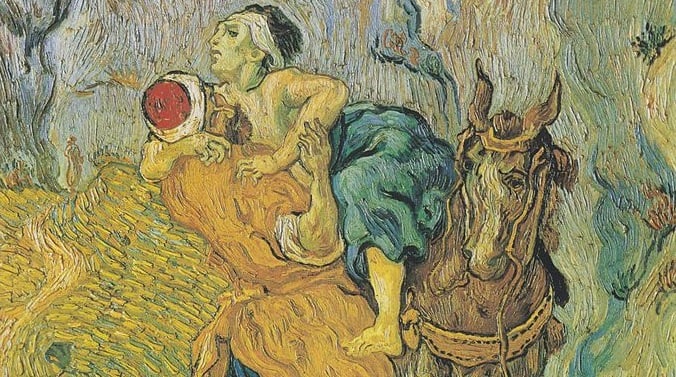
Hospitality is at the root of the biblical vision of the world (Van Gogh, The Good Samaritan (after Delacroix), 1890; Source: Wikimedia Commons, PD-Old-100).
I confess that my post on the White House guest list was a failed experiment in reader response akin to what Colbert used to do on Comedy Central.
I wanted to see how many readers would find the title enough of a stumbling block to ignore the contents. Alternatively, I was curious how many readers would use their initial response to propel them into reading the post.
A lot of people got stuck on the wording of the title, rather than who it was addressed to. This was, to say the least, disappointing. Yet, it also was an auto-judgement the readers brought upon themselves in relation to those they might disagree with, epistemological strangers, if you will. It really rankles me how much some Catholics get bent into a pretzel over sexual ethics as if they were a sin bigger than greed (think of all the businessmen who get invited to such events!).
To continue in the confessional mode . . . The post was a setup for talking about Richard Kearney’s Anatheism: Returning to God After God. The author explains the title concept thus:
So how, in sum, does anatheism differ from atheism? This is a key question for the deliberations that follow. But let me offer this preliminary conjecture: anatheism differs from dogmatic atheism in that is resists absolutist positions against the divine, just as it differs from the absolutist position of dogmatic theism for the divine. It is a movement—not a state—that refuses all absolute talk about the absolute, negative or positive; for it acknowledges that the absolute can is never be understood absolutely by any single person or religion. Anatheism acknowledges the emancipatory force of critical atheism as an integral part of theism, understood as a second faith beyond faith. And it also respects agnostic atheism that remains just that–agnosis, not knowing–choosing not to make the second move of faith. What anatheism opposes is militant antitheism, which–as in the Reign of Terror or Stalinist persecutions–is just as pernicious as triumphant theism.
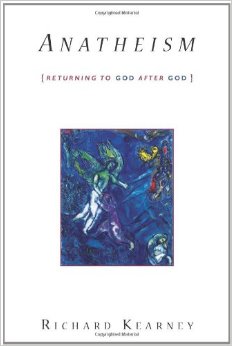
This is a rare book that gets at real life issue in a way few academic books do.
In other words, anatheism is the moment of decision for either a defensive or hospitable response toward the Stranger, the Wholly Other, who approaches us, whether human or Divine, although they are frequently intermixed. To illustrate that moment Kearney gives three examples from the life of Abraham where he is forced to respond freely to an oncoming Guest. First is his positive response of hospitality to strange three men (angels or robbers?) that is rewarded with a promise of fertility to aged Sarah. However, this extraordinary act of hospitality is then followed by rejection of the foreigner when Abraham drives out his foreign wife, Hagar, along with their child. These moments of unambiguous choice are then followed by the contradictions of Abraham having to discern what God wants him to do with Isaac. He first hears the call of bloody sacrifice and in fear and trembling attempts to follow it only to discover a different, more profound, rejection of human sacrifice (such sacrifice was not uncommon among ancient peoples).
According to Kearney, the last episode has a lot more in common with our daily experience of discernment:
Anatheism is a freedom of belief that precedes the choice between theism and atheism as much as it follows in its wake. The choice of faith is never taken once and for all. It needs to be repeated again and again–every time we speak in the name of God or ask God why he has abandoned us. Anatheism performs a drama of decision whenever humans encounter the stranger, who, like Rilke’s statue, whispers, “Change your life!” And every moment is a portal through which this stranger may enter.
This is the choice Abraham also faced when called out of Ur to be a stranger among strangers. Can you imagine the sorts of threat leaving home and continually being at the mercy of strangers might have posed to him? He had to discern the nature of this call and what it really demanded of him. This is how the journey of biblical faith began, both as a threat and as a promise from a stranger God who commanded Abraham to go out and expose his very life to the mercy of other strangers. It is very much the life through death of one’s expectations that I talked about in my post on shadow work and dying in the current contract economy.
By the way, the Vatican has pushed back against the guest list and it’s also been noted that the thing will be attended by thousands of other people. The initial reports made it sound like an intimate meeting. This is something Kearney discusses in Anatheism as well. He argues that unlimited hospitality is perhaps only practiced by God. We humans are finite and some people who might pose as guests might turn out to be threats to our lives or otherwise. Unfortunately, we need to make a discernment about the threat someone posing as a guest presents and act accordingly in order to protect ourselves, our neighbors, and guests who might arrive later. Fr. Jozef Tischner, the chaplain of solidarity and phenomenologist extraordinaire, called it the “unfortunate gift of freedom.”
In our increasingly liquid times it still remains that blessed is he who is not offended by the Stranger–even when it is an atheist, or from the other side, the believer. The stories of pure evil among believers from atheists and vice versa are getting about as boring as conspiracy theories about this White House. They only play into the worst human inclinations.
So where are we headin’? County road or Armageddon?
You might also be interested in looking at a collaborative video interview with Kearney on why he remains Catholic that was shot for Cosmos earlier this year.
As always, please consider donating via the Paypal button on my homepage even if I am a stranger to you. I’m in between jobs and we’re stuck going to foodbanks and asking for rent assistance. I pray we survive thanks to the kindness of strangers.
Previous Post

September 16, 2015
Zygmunt Bauman: From Liquid Modernity to Theology
Next Post

September 19, 2015 1 Thing 2 Remember When Catholic Fox Anchor Tells Pope "Stay Home"
Browse Our Archives
Select a Category #WhyRemainCatholic Abortion Advent Anti-Catholicism Arts Atheism Beauty Benedict XVI Bible Book Review Catholic Cinema Comedy Cosmos: A Space-Time Odyssey Czesław Miłosz Dariusz Karłowicz Devil Easter Eastern Orthodoxy Economics Environment Family Famous Atheists Who Weren't Atheists Guest Post Hans Urs von Balthasar HHS Mandate History Imagination Interview Islam Jean-Luc Marion John Paul II Judaism Just War Lent Literature Little Sisters of the Poor Liturgy Martyrdom Music News Paganism Patristics Phenomenology Philosophy Pierre Hadot Poetry Poland Pop Culture Pope Francis Poverty Prayer Protestantism Rabelais Race Remi Brague Rene Girard Russia Sam Rocha Science & Religion SCOTUS Secularization Sexual Abuse Sexuality Silence Solidarity Stratford Caldecott Synod14 Terrorism Top 10 Uncategorized Walker Percy War Weakened Edition World War II World Youth Day WYD Krakow
Select a Month July 2017 June 2017 May 2017 April 2017 March 2017 February 2017 January 2017 December 2016 October 2016 September 2016 August 2016 July 2016 June 2016 May 2016 April 2016 March 2016 February 2016 January 2016 December 2015 November 2015 October 2015 September 2015 August 2015 July 2015 June 2015 May 2015 April 2015 March 2015 February 2015 January 2015 December 2014 November 2014 October 2014 September 2014 August 2014 July 2014 May 2014 April 2014 March 2014 February 2014 January 2014 December 2013 November 2013 October 2013 September 2013 August 2013 July 2013 June 2013 May 2013
Follow Us!
TAKE THE
Religious Wisdom Quiz
What did Jesus say about judging people?
Select your answer to see how you score.
Judge fairly Judge not Judge justly Judge yourself only
Related posts from Cosmos The In Lost

Where Does the Body of Christ Go After...

How is Classical Philosophy is Like War?

Why Does the World's Leading Philosopher Remain a...

Atheists Have "National Day of Reason," But American...
TRENDING AT PATHEOS Catholic

Creation, Preservation, and Teleology in Catholic Theology
As I write this, it is very early Monday morning. Like millions...

The Parable Of The Sower And The Word...
One of Christ’s most famous parables is that of the sower who...

Rejecting Doom: Christian Hope And Human Action
Christianity is a religion of hope. We are to have hope and...

Why I Choose the Eucharist Over the Sermon
Choose the Eucharist, Not the Sermon What are we supposed to get...

5 Design Elements Found in Spiritually Rooted Homes
Putting Spirituality Into Home Decor Our homes are more than our living...

Credo: A Story of God Told with the...
About 10 years ago, I began to imagine a personal "Credo" that...
view all Catholic blogs
Ad-Free & Subscriber Log-In Subscription Support
- About Us
- 2026 Calendar
- Videos
- Podcasts
- Library of World Religions
- Faith In Media Tracker
- Advertise With Us
- Write for Us
- Privacy Policy
- Terms of Service
- Do Not Sell My Data
- Contact Us
- Radiant Digital
- Manage Newsletter Subscriptions
- Unsubscribe From Notifications
- Sitemap
Copyright 2008-2026, Patheos. All rights reserved.
Subscription Support Ad-Free & Subscriber Log-In
Follow Patheos