
BuddhistCatholicContemplativeEvangelicalGeneral ChristianHinduJewishLatter-day SaintMuslimNew VisionsProgressive Christian
Beliefs
- Buddhist
- Catholic
- Contemplative
- Evangelical
- General Christian
- Hindu
- Jewish
- Latter-day Saint
- More Voices
- Muslim
- New Visions
- Pagan
- Progressive Christian
Topics
- Religion News
- Food and Religion
- Sports and Religion
- Religious Art
- Religious Music and Entertainment
- Religious Events
- History and Religion
- Style and Religion
- Politics and Religion
- Women in Religion
- Recreation Outdoors and Religion
- Business Finance and Religion
- Careers Workplace and Religion
- Education and Religion
- Family Parenting and Religion
- Health Fitness and Religion
- Home and Religion
- Relationships and Religion
- Technology and Religion
- Travel and Religion
Columnists
- Buddhist Columnists
- Business Finance and Religion Columnists
- Careers Workplace and Religion Columnists
- Catholic Columnists
- Contemplative Columnists
- Education and Religion Columnists
- Evangelists Columnists
- Family Parenting and Religion Columnists
- General Christian Columnists
- Health Fitness and Religion Columnists
- Hindu Columnists
- History and Religion Columnists
- Home and Religion Columnists
- Jewish Columnists
- More Voices Columnists
- Latter Day Columnists
- Muslim Columnists
- New Visions Columnists
- Nonreligious Columnists
- Pagan Columnists
- Politics and Religion Columnists
- Progressive Columnists
- Recreation Outdoors and Religion Columnists
- Relationships and Religion Columnists
- Religion News Columnists
- Religious Art Columnists
- Religious Events Columnists
- Religious Music and Entertainment Columnists
- Sports and Religion Columnists
- Style and Religion Columnists
- Technology and Religion Columnists
- Travel and Religion Columnists
- Women in Religion Columnists
Resource Library
- 2026 Calendar
- Library of World Religions
- The 100 Most Holy Places on Earth
- Patheos Answers
- Podcasts
- Videos
- Faith Leaders Database
- Anglican Episcopalian
- Bahai
- Baptist
- Buddhism
- Christianity
- Confucianism
- Eastern Orthodoxy
- Hinduism
- Holiness and Pentecostal
- ISKCON
- Islam
- Judaism
- Lutheran
- Methodist
- The Church of Jesus Christ of Latter-day Saints
- New Age
- Paganism
- Presbytarian and Reformed
- Protestantism
- Religion Behind the Scenes
- Roman Catholic
- Scientology
- Shia Islam
- Sikhism
- Sufism
- Sunni Islam
- Taoism
- Zen
- See all religions
Research Tools
 Ad-Free & Subscriber Log-In Subscription Support
Ad-Free & Subscriber Log-In Subscription Support
Follow Patheos 

- Trending:
- Forgiveness
- |
- Marriage
- |
- Consciousness
- |
- Death Penalty
- |
- Election
- |
- Halloween
 Cosmos The In Lost
- Home
- Catholic
- Negative Certainties Trump Scientific Facts Daily
Negative Certainties Trump Scientific Facts Daily
Last updated on: August 19, 2015 at 1:33 pm by Artur Rosman
Negative Certainties Trump Scientific Facts Daily 2015-08-19T13:33:47-07:00 Artur Rosman
Patheos Explore the world's faith through different perspectives on religion and spirituality! Patheos has the views of the prevalent religions and spiritualities of the world.
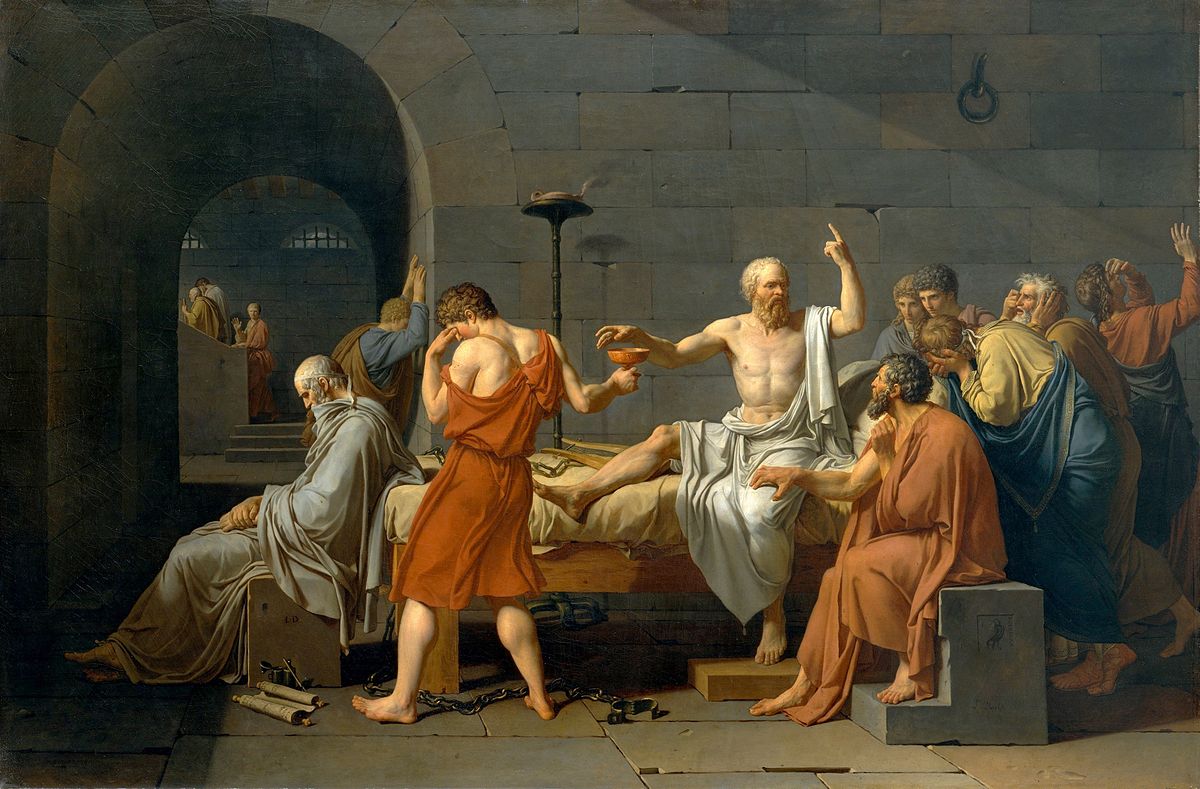
(Jean-Louis David, The Death of Socrates, 1787; Source: Wikimedia Commons, PD-Old-100).
It is easy enough to debunk the mythical origins of science in the Greek and Roman world. That much is obvious.
The idolization of “scientific facts” is a little bit more difficult. Modern philosophy and science tend to privilege positive and predicative knowledge as if it is the only type of certain knowledge available to us.
Earlier epochs were much more appreciative of the plurality of knowledge than we.
However, a forthcoming book from the University of Chicago Press is about to push the certainty of uncertainty back into the limelight. Socrates and the wisdom of knowing what you don’t and can’t know is about to make a comeback.
Now, the University of Chicago Press has previously surfaced on this blog as a leading publisher of Catholic-interest books. Therefore it’s only natural I keep coming back to their publications.
In fact, a portion of my review of Chicago’s The Territories of Science and Religion–entitled The Mythical Origins of Science–is now excerpted in Amazon’s “editorial reviews.” I’m also starting up an interview with Jeffrey Kosky, author of Arts of Wonder (published in the excellent UCP Religion and Postmodernism series).
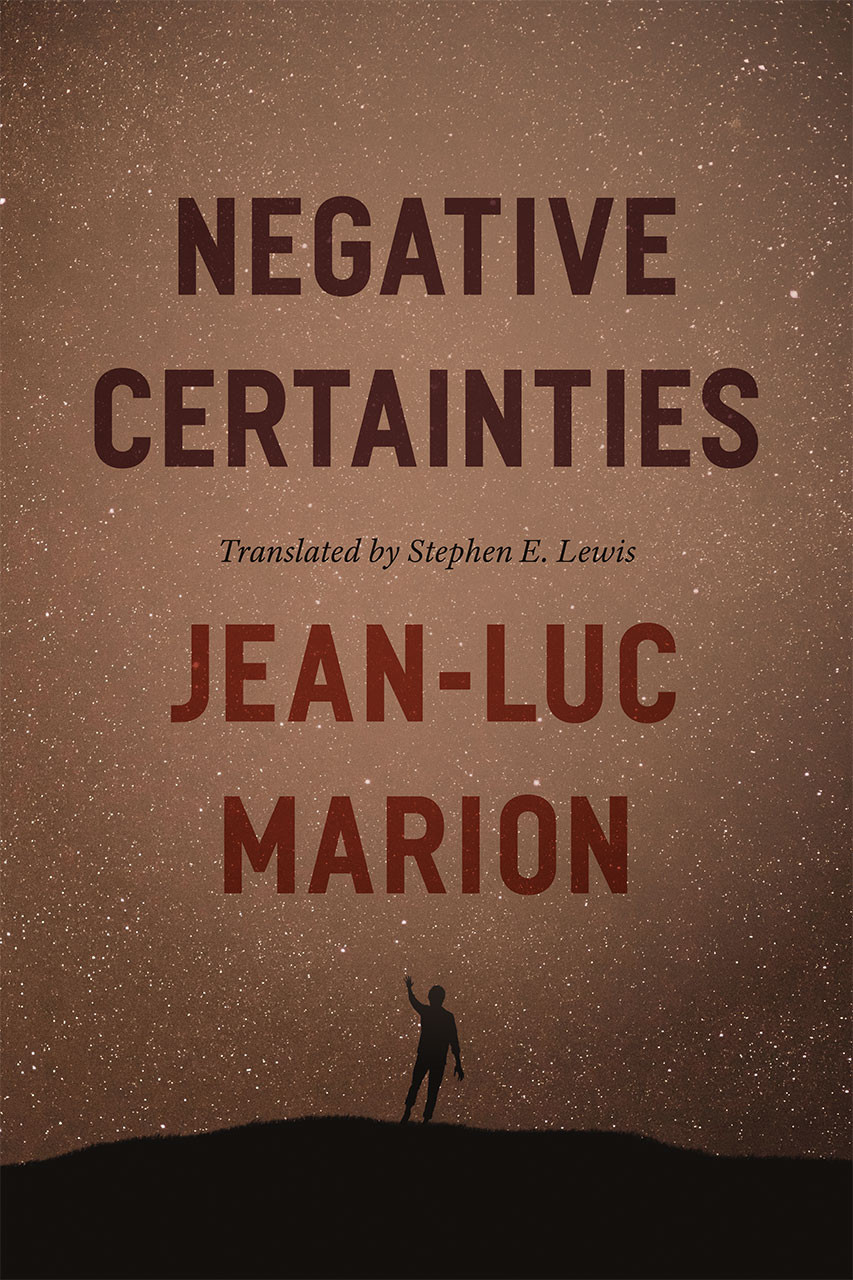 The debut of Jean-Luc Marion’s Negative Certainties on September 4th is their next big event. To see what this has to do with Socrates take a look at what the publisher blurbs says:
In Negative Certainties, renowned philosopher Jean-Luc Marion challenges some of the most fundamental assumptions we have developed about knowledge: that it is categorical, predicative, and positive. Following Descartes, Kant, and Heidegger, he looks toward our finitude and the limits of our reason. He asks an astonishingly simple—but profoundly provocative—question in order to open up an entirely new way of thinking about knowledge: Isn’t our uncertainty, our finitude and rational limitations, one of the few things we can be certain about?
Marion shows how the assumption of knowledge as positive demands a reductive epistemology that disregards immeasurable or disorderly phenomena. He shows that we have experiences every day that have no identifiable causes or predictable reasons, and that these constitute a very real knowledge—a knowledge of the limits of what can be known. Establishing this “negative certainty,” Marion applies it to four aporias, or issues of certain uncertainty: the definition of man; the nature of God; the unconditionality of the gift; and the unpredictability of events. Translated for the first time into English, Negative Certainties is an invigorating work of epistemological inquiry that will take a central place in Marion’s oeuvre.
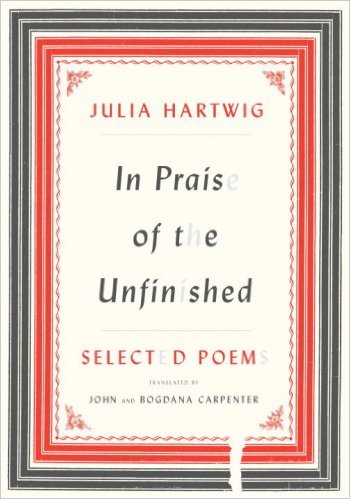
This blurb also resonates with a book I’ve been reading during the bumper-to-bumper portions of my commute: Polish poet Julia Hartwig’s In Praise of the Unfinished.
Her poetry collection’s cover communicates the immeasurability and disorderliness of reality, it’s negative certainty, with the way it treats the lettering of the title. Some of the letters fade out completely, yet you are able to make out its message of praising limitations anyway.
You can get a sense for what “negative certainty” is by reading the following poems from the collection:
IT COMES UNINVITED
That moment when reason understands it was
cheated.
When inflicted harm appears in full clarity, and
there is no justification for it.
When a writer throws the picture of his master
from his desk.
When love and attachment realize they haven’t
met the trial of time.
When we remain alone, completely alone, with a
chill in our heart.
But are we more unhappy than those who con-
tinue to stand by their old choice, only so they don’t
reject their past life?
 Next, predicative and positive categories chafe in A CONFESSION:
–Don’t call me as a witness. I won’t be of any
use.
I don’t trust the testimony of my eyes, my thought
loses its thread and, fearing the worst, doesn’t dare
reach the end. I do not know who I am.What is the value of a being whose testimony is so
frail and uncertain?–Don’t complain. For only you, among the different
species, know the dignity of your weakness, and
despite everything, you labor to the bitter end against
your own disbelief, ready to sacrifice your own frailty
for an illusory brotherhood.
Freedom, the category that has come to define modern humanity, is questioned in YET WE DESIRE IT ABOVE ALL
Freedom does not mean happiness right away
the free world hides more traps than tyranny
mastiffs let loose from chains passions exceeding the horizon
steps entangled in the ropes of old bonds
that try to pull tight again.
Freedom both for scoundrels and those
who sacrificed themselves for it . . .
I think now you can see why Hartwig was:
Hailed by Czeslaw Milosz as “the grande dame of Polish poetry” and named “one of the foremost Polish poets of the twentieth century” by Ryszard Kapuscinski, Julia Hartwig has long been considered the gold standard of poetry in her native Poland. With this career-spanning collection, we finally have a book of her work in English.
The positive knowledge you can take away from this post is that poetry and philosophy work in tandem.
Much of everything else we take for granted, that things that matter the most actually–God, man, gift, and events–in life are certainly shrouded in uncertainty. Or, as Wittgenstein said:
We feel that even when all possible scientific questions have been answered, the problems of life remain completely untouched.
And thus, Socrates, who disdained the natural philosophy of his time, because of its inability to answer life-questions, gets his revenge.
See also: Walker Percy on the ideology of scientific facts.
Remember to drop a coin in my PayPal donation fountain if you plan on coming back to read more in the future.
Previous Post
August 17, 2015
The Newest News on the Authenticity of the Shroud of Turin
Next Post
August 20, 2015 God? Not Available Right Now!
Browse Our Archives
Select a Category #WhyRemainCatholic Abortion Advent Anti-Catholicism Arts Atheism Beauty Benedict XVI Bible Book Review Catholic Cinema Comedy Cosmos: A Space-Time Odyssey Czesław Miłosz Dariusz Karłowicz Devil Easter Eastern Orthodoxy Economics Environment Family Famous Atheists Who Weren't Atheists Guest Post Hans Urs von Balthasar HHS Mandate History Imagination Interview Islam Jean-Luc Marion John Paul II Judaism Just War Lent Literature Little Sisters of the Poor Liturgy Martyrdom Music News Paganism Patristics Phenomenology Philosophy Pierre Hadot Poetry Poland Pop Culture Pope Francis Poverty Prayer Protestantism Rabelais Race Remi Brague Rene Girard Russia Sam Rocha Science & Religion SCOTUS Secularization Sexual Abuse Sexuality Silence Solidarity Stratford Caldecott Synod14 Terrorism Top 10 Uncategorized Walker Percy War Weakened Edition World War II World Youth Day WYD Krakow
Select a Month July 2017 June 2017 May 2017 April 2017 March 2017 February 2017 January 2017 December 2016 October 2016 September 2016 August 2016 July 2016 June 2016 May 2016 April 2016 March 2016 February 2016 January 2016 December 2015 November 2015 October 2015 September 2015 August 2015 July 2015 June 2015 May 2015 April 2015 March 2015 February 2015 January 2015 December 2014 November 2014 October 2014 September 2014 August 2014 July 2014 May 2014 April 2014 March 2014 February 2014 January 2014 December 2013 November 2013 October 2013 September 2013 August 2013 July 2013 June 2013 May 2013
Follow Us!
TAKE THE
Religious Wisdom Quiz
Which prophet's visions include "Gog and Magog"?
Select your answer to see how you score.
Micah Daniel Ezekiel Amos
Related posts from Cosmos The In Lost

Where Does the Body of Christ Go After...

How is Classical Philosophy is Like War?

Why Does the World's Leading Philosopher Remain a...

2 Reasons Why the March for Science is...
TRENDING AT PATHEOS Catholic

Rejecting Doom: Christian Hope And Human Action
Christianity is a religion of hope. We are to have hope and...

It’s What Comes From Within Which Matters
One of the most difficult things for us to understand is why...

Why I Choose the Eucharist Over the Sermon
Choose the Eucharist, Not the Sermon What are we supposed to get...

5 Design Elements Found in Spiritually Rooted Homes
Putting Spirituality Into Home Decor Our homes are more than our living...

Credo: A Story of God Told with the...
About 10 years ago, I began to imagine a personal "Credo" that...

The Anatomy of Divine Revelation in Catholic Thought
The claim that God has made Himself known to human beings is...
view all Catholic blogs
Ad-Free & Subscriber Log-In Subscription Support
- About Us
- 2026 Calendar
- Videos
- Podcasts
- Library of World Religions
- Faith In Media Tracker
- Advertise With Us
- Write for Us
- Privacy Policy
- Terms of Service
- Do Not Sell My Data
- Contact Us
- Radiant Digital
- Manage Newsletter Subscriptions
- Unsubscribe From Notifications
- Sitemap
Copyright 2008-2026, Patheos. All rights reserved.
Subscription Support Ad-Free & Subscriber Log-In
Follow Patheos