
BuddhistCatholicContemplativeEvangelicalGeneral ChristianHinduJewishLatter-day SaintMuslimNew VisionsProgressive Christian
Beliefs
- Buddhist
- Catholic
- Contemplative
- Evangelical
- General Christian
- Hindu
- Jewish
- Latter-day Saint
- More Voices
- Muslim
- New Visions
- Pagan
- Progressive Christian
Topics
- Religion News
- Food and Religion
- Sports and Religion
- Religious Art
- Religious Music and Entertainment
- Religious Events
- History and Religion
- Style and Religion
- Politics and Religion
- Women in Religion
- Recreation Outdoors and Religion
- Business Finance and Religion
- Careers Workplace and Religion
- Education and Religion
- Family Parenting and Religion
- Health Fitness and Religion
- Home and Religion
- Relationships and Religion
- Technology and Religion
- Travel and Religion
Columnists
- Buddhist Columnists
- Business Finance and Religion Columnists
- Careers Workplace and Religion Columnists
- Catholic Columnists
- Contemplative Columnists
- Education and Religion Columnists
- Evangelists Columnists
- Family Parenting and Religion Columnists
- General Christian Columnists
- Health Fitness and Religion Columnists
- Hindu Columnists
- History and Religion Columnists
- Home and Religion Columnists
- Jewish Columnists
- More Voices Columnists
- Latter Day Columnists
- Muslim Columnists
- New Visions Columnists
- Nonreligious Columnists
- Pagan Columnists
- Politics and Religion Columnists
- Progressive Columnists
- Recreation Outdoors and Religion Columnists
- Relationships and Religion Columnists
- Religion News Columnists
- Religious Art Columnists
- Religious Events Columnists
- Religious Music and Entertainment Columnists
- Sports and Religion Columnists
- Style and Religion Columnists
- Technology and Religion Columnists
- Travel and Religion Columnists
- Women in Religion Columnists
Resource Library
- 2026 Calendar
- Library of World Religions
- The 100 Most Holy Places on Earth
- Patheos Answers
- Podcasts
- Videos
- Faith Leaders Database
- Anglican Episcopalian
- Bahai
- Baptist
- Buddhism
- Christianity
- Confucianism
- Eastern Orthodoxy
- Hinduism
- Holiness and Pentecostal
- ISKCON
- Islam
- Judaism
- Lutheran
- Methodist
- The Church of Jesus Christ of Latter-day Saints
- New Age
- Paganism
- Presbytarian and Reformed
- Protestantism
- Religion Behind the Scenes
- Roman Catholic
- Scientology
- Shia Islam
- Sikhism
- Sufism
- Sunni Islam
- Taoism
- Zen
- See all religions
Research Tools
 Ad-Free & Subscriber Log-In Subscription Support
Ad-Free & Subscriber Log-In Subscription Support
Follow Patheos 

- Trending:
- Forgiveness
- |
- Marriage
- |
- Consciousness
- |
- Death Penalty
- |
- Election
- |
- Halloween
 Cosmos The In Lost
- Home
- Catholic
- Threatening Naturalism’s Universal Authority
Threatening Naturalism’s Universal Authority
Last updated on: September 27, 2015 at 9:20 pm by Artur Rosman
Threatening Naturalism’s Universal Authority 2015-09-27T21:20:37-07:00 Artur Rosman
Patheos Explore the world's faith through different perspectives on religion and spirituality! Patheos has the views of the prevalent religions and spiritualities of the world.
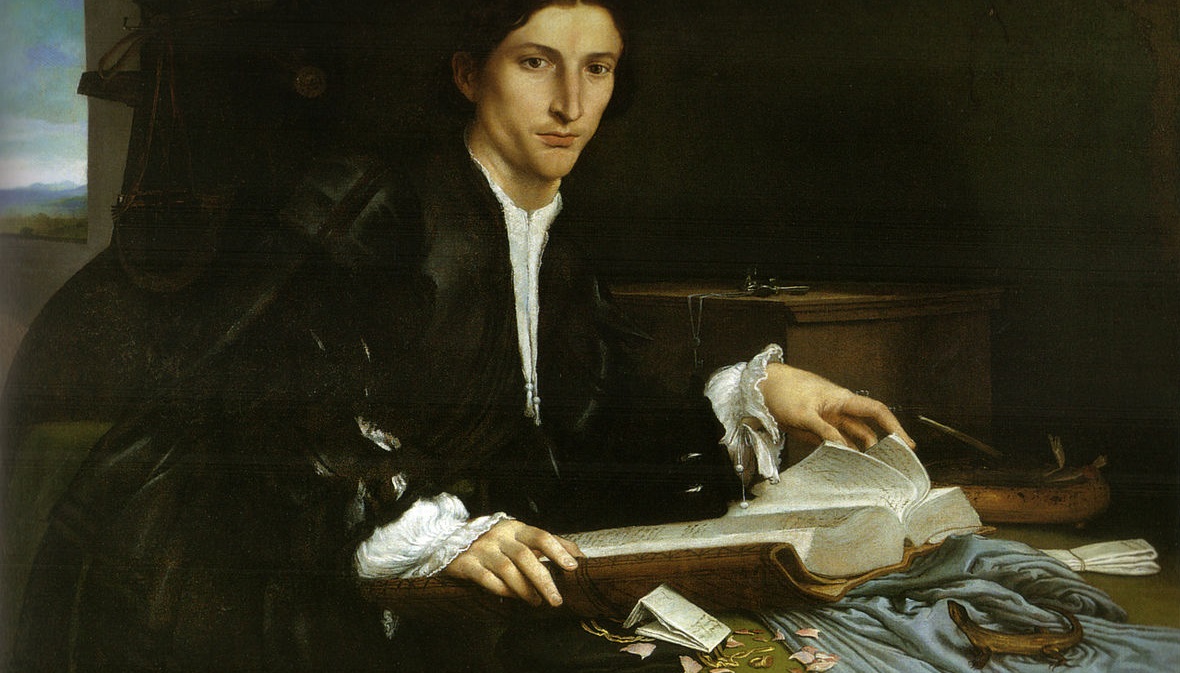
Monocausal naturalism leads into the void, or at least to that screensaver mode look (Lorenzo Lotto, Gentleman in His Study, 1530; Source: Wikimedia Commons, PD-Old-100, also featured on the cover of Minding the Modern).
Thomas Pfau is the Alice Mary Baldwin Professor of English and professor of German at Duke University, with a secondary appointment on the Duke Divinity School faculty. He is the author and editor of a number of books, including Romantic Moods: Paranoia, Trauma, and Melancholy, 1790–1840 and Wordsworth’s Profession.
This is the first part of my interview with him about his most recent, and much discussed, book Minding the Modern. The second part of the interview is now up online (No Theology, No Phenomenology of the Person?).
Syndicate Theology is hosting a symposium on Minding the Modern starting 9/28/15.
Artur Rosman: Minding the Modern starts with a searing critique of what the humanities have become: propagators of pseudo-scientific methods that reduce texts, and ultimately persons, into mindless robots. Do you see the humanities anywhere moving beyond nominalism into a mode of education that fosters the flourishing of the whole person? Why does such a change in trends seem so utopian?
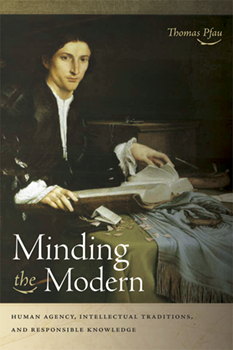
Stanley Hauerwas says, “Minding the Modern is comparable to Alasdair MacIntyre’s Whose Justice? Which Rationality? and Charles Taylor’s A Secular Age . . . an immensely important book that hopefully will be read widely and across the disciplines.”
Thomas Pfau: I might slightly quibble with the phrasing of your question. Minding the Modern does not take issue with what you term “propagators of pseudo-scientific methods.” Rather, my concern is with the importation of bona fide scientific methods and their underlying, mono-causal conception of what it means to have “explained” something into the realm of humanistic inquiry. As I see it, the issue is not that there is a type of science-based enquiry trying to “reduce texts and … persons into mindless robots.” To put it that way would be to give the matter a conspiratorial slant that I don’t think is called for.
Instead, my argument has to do with the way that modern scientific methods, which in their proper domain have proven enormously fruitful in advancing our understanding of nature, end up painting a dangerously reductive and ultimately irresponsible picture of human agency and personhood. They do so by positing from the outset what, in fact, is thoroughly question-begging: viz., 1) that the human person is a phenomenon entirely on a par with other entities or “objects” found in nature, 2) that it is compatible with the same protocol of detached and value-neutral inquiry used in the hard sciences; and 3) that it can be exhaustively captured by hypotheses based on input/output ratios, empirical observation, and quantifiable verification just like any other phenomenon engaged by experimental inquiry.
As I argue, this way of framing things fundamentally obscures core features that define human agency and that impinge on how we ought to go about understanding it. Above all, to apply to interpretive, humanistic inquiry a scientific model developed by Descartes, Newton, Leibniz, and some contemporaries is to lose sight of the fact that human beings are inherently self-interpreting, that they have (and are continually evolving) an image of themselves in the world and of the world as something that is itself captured as an image. Hence my opening three chapters draw on the phenomenological tradition (Husserl, Heidegger, Gadamer) for which, as I argue later on, Coleridge and Newman should be seen as important precursors. I regard phenomenology (and a philosophical hermeneutics grounded in it) as a crucial counterweight to deterministic and reductionist models when it comes to understanding human agency, action, and meaning.
As for your question whether I see the humanities extricate themselves from the enduring spell of nominalism, I am admittedly not very hopeful that this will come to pass. Though there are some sectors within higher education that have retained sufficient integrity and independence of thought to resist, too many factors seem to discourage any such expectations. For one thing, the flow of grant money is almost entirely geared toward reinforcing reductionist, mono-causal explanatory schemes, also in the humanities, as the only valid mode of inquiry and socially relevant cognition. Driven by what Raymond Tallis has aptly termed “science envy,” many young and impressionable scholars are content to follow the (often unsubtle) hints of administrators and agencies offering grants aimed at putting the humanities on a scientific footing. To the extent that this happens, we do indeed produce a pseudo-scientific culture.
Then there is the frantic preoccupation with the sheer “novelty” of research. Humanistic inquiry, I maintain, cannot flourish without drawing — respectfully, mindfully, and productively — on a host of precursors. Yet in contemporary academia, and in the United States in particular, there is a widespread assumption that to know only means to discover what has not been known before, and that to discover means to discredit or simply ignore what has come before. My own concern with the vitality and richness of intellectual and aesthetic traditions, and with the specter of a pervasive, self-induced conceptual amnesia of sorts, means to oppose this Lady Gaga school of higher learning that has enthralled a lot of scholars. A particularly unfortunate effect, which can indeed be linked to late-Scholastic Nominalism, is that treating all inquiry as a sui generis project and conceiving of advanced inquiry as a conquest of the wholly unique and unprecedented will prevent scholars from productively engaging one another. The more individual scholars pursue hyper-specialized studies, and do so with the proprietary zeal so characteristic of modern professional culture, knowledge will cease to forge, let alone enrich us as a community of knowledge.
Previous Post

August 12, 2015
Pope Francis Gets Boost from Leading Cultural Marxist Publisher!
Next Post
August 14, 2015 No Theology, No Phenomenology of the Person?
Browse Our Archives
Select a Category #WhyRemainCatholic Abortion Advent Anti-Catholicism Arts Atheism Beauty Benedict XVI Bible Book Review Catholic Cinema Comedy Cosmos: A Space-Time Odyssey Czesław Miłosz Dariusz Karłowicz Devil Easter Eastern Orthodoxy Economics Environment Family Famous Atheists Who Weren't Atheists Guest Post Hans Urs von Balthasar HHS Mandate History Imagination Interview Islam Jean-Luc Marion John Paul II Judaism Just War Lent Literature Little Sisters of the Poor Liturgy Martyrdom Music News Paganism Patristics Phenomenology Philosophy Pierre Hadot Poetry Poland Pop Culture Pope Francis Poverty Prayer Protestantism Rabelais Race Remi Brague Rene Girard Russia Sam Rocha Science & Religion SCOTUS Secularization Sexual Abuse Sexuality Silence Solidarity Stratford Caldecott Synod14 Terrorism Top 10 Uncategorized Walker Percy War Weakened Edition World War II World Youth Day WYD Krakow
Select a Month July 2017 June 2017 May 2017 April 2017 March 2017 February 2017 January 2017 December 2016 October 2016 September 2016 August 2016 July 2016 June 2016 May 2016 April 2016 March 2016 February 2016 January 2016 December 2015 November 2015 October 2015 September 2015 August 2015 July 2015 June 2015 May 2015 April 2015 March 2015 February 2015 January 2015 December 2014 November 2014 October 2014 September 2014 August 2014 July 2014 May 2014 April 2014 March 2014 February 2014 January 2014 December 2013 November 2013 October 2013 September 2013 August 2013 July 2013 June 2013 May 2013
Follow Us!
TAKE THE
Religious Wisdom Quiz
What did the wise men follow to find Jesus?
Select your answer to see how you score.
An angel A prophet A star A map
Related posts from Cosmos The In Lost

The Surprising Anti-Capitalist Logic Behind the Catholic Church's...

The Holy Family as an Icon of World...

Where Does the Body of Christ Go After...

How is Classical Philosophy is Like War?
TRENDING AT PATHEOS Catholic

Rejecting Doom: Christian Hope And Human Action
Christianity is a religion of hope. We are to have hope and...

It’s What Comes From Within Which Matters
One of the most difficult things for us to understand is why...

Why I Choose the Eucharist Over the Sermon
Choose the Eucharist, Not the Sermon What are we supposed to get...

5 Design Elements Found in Spiritually Rooted Homes
Putting Spirituality Into Home Decor Our homes are more than our living...

Credo: A Story of God Told with the...
About 10 years ago, I began to imagine a personal "Credo" that...

The Anatomy of Divine Revelation in Catholic Thought
The claim that God has made Himself known to human beings is...
view all Catholic blogs
Ad-Free & Subscriber Log-In Subscription Support
- About Us
- 2026 Calendar
- Videos
- Podcasts
- Library of World Religions
- Faith In Media Tracker
- Advertise With Us
- Write for Us
- Privacy Policy
- Terms of Service
- Do Not Sell My Data
- Contact Us
- Radiant Digital
- Manage Newsletter Subscriptions
- Unsubscribe From Notifications
- Sitemap
Copyright 2008-2026, Patheos. All rights reserved.
Subscription Support Ad-Free & Subscriber Log-In
Follow Patheos