
BuddhistCatholicContemplativeEvangelicalGeneral ChristianHinduJewishLatter-day SaintMuslimNew VisionsProgressive Christian
Beliefs
- Buddhist
- Catholic
- Contemplative
- Evangelical
- General Christian
- Hindu
- Jewish
- Latter-day Saint
- More Voices
- Muslim
- New Visions
- Pagan
- Progressive Christian
Topics
- Religion News
- Food and Religion
- Sports and Religion
- Religious Art
- Religious Music and Entertainment
- Religious Events
- History and Religion
- Style and Religion
- Politics and Religion
- Women in Religion
- Recreation Outdoors and Religion
- Business Finance and Religion
- Careers Workplace and Religion
- Education and Religion
- Family Parenting and Religion
- Health Fitness and Religion
- Home and Religion
- Relationships and Religion
- Technology and Religion
- Travel and Religion
Columnists
- Buddhist Columnists
- Business Finance and Religion Columnists
- Careers Workplace and Religion Columnists
- Catholic Columnists
- Contemplative Columnists
- Education and Religion Columnists
- Evangelists Columnists
- Family Parenting and Religion Columnists
- General Christian Columnists
- Health Fitness and Religion Columnists
- Hindu Columnists
- History and Religion Columnists
- Home and Religion Columnists
- Jewish Columnists
- More Voices Columnists
- Latter Day Columnists
- Muslim Columnists
- New Visions Columnists
- Nonreligious Columnists
- Pagan Columnists
- Politics and Religion Columnists
- Progressive Columnists
- Recreation Outdoors and Religion Columnists
- Relationships and Religion Columnists
- Religion News Columnists
- Religious Art Columnists
- Religious Events Columnists
- Religious Music and Entertainment Columnists
- Sports and Religion Columnists
- Style and Religion Columnists
- Technology and Religion Columnists
- Travel and Religion Columnists
- Women in Religion Columnists
Resource Library
- 2026 Calendar
- Library of World Religions
- The 100 Most Holy Places on Earth
- Patheos Answers
- Podcasts
- Videos
- Faith Leaders Database
- Anglican Episcopalian
- Bahai
- Baptist
- Buddhism
- Christianity
- Confucianism
- Eastern Orthodoxy
- Hinduism
- Holiness and Pentecostal
- ISKCON
- Islam
- Judaism
- Lutheran
- Methodist
- The Church of Jesus Christ of Latter-day Saints
- New Age
- Paganism
- Presbytarian and Reformed
- Protestantism
- Religion Behind the Scenes
- Roman Catholic
- Scientology
- Shia Islam
- Sikhism
- Sufism
- Sunni Islam
- Taoism
- Zen
- See all religions
Research Tools
 Ad-Free & Subscriber Log-In Subscription Support
Ad-Free & Subscriber Log-In Subscription Support
Follow Patheos 

- Trending:
- Forgiveness
- |
- Marriage
- |
- Consciousness
- |
- Death Penalty
- |
- Election
- |
- Halloween
 Cosmos The In Lost
- Home
- Catholic
- Is Christianity Secularization’s Best Hope?
Is Christianity Secularization’s Best Hope?
Last updated on: July 2, 2015 at 1:29 pm by Artur Rosman
Is Christianity Secularization’s Best Hope? 2015-07-02T13:29:28-07:00 Artur Rosman
Patheos Explore the world's faith through different perspectives on religion and spirituality! Patheos has the views of the prevalent religions and spiritualities of the world.
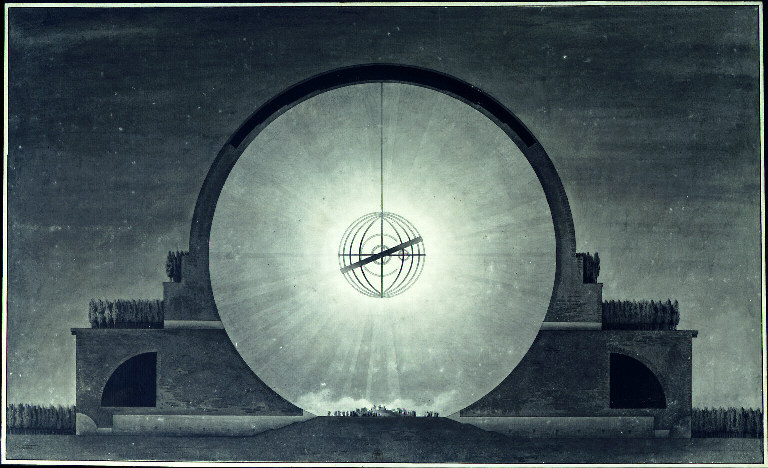
Pregnant Connection: Newton secularized the universe through his theories, but spent the vast majority of his time doing theology (Boullée, Cénotaphe à Newton, 1784; Source: Wikimedia Commons, PD-Old-100).
Savage Memory is an equally disturbing and humanizing documentary portrait of Bronislaw Malinowski, the Polish pioneer of modern anthropology. You might know Malinowski from used bookstore blushing perusals of titillating titles such as The Sexual Life of Savages and Magic, Science, and Religion. They are the intellectual’s equivalent of looking at dirty mags at the gas station–not that intellectuals aren’t ever caught doing the latter.
The documentary, directed by Malinowski’s grandson, mainly focuses upon the family fallout of the Great Man’s life. The side entertainment is the rubble he left behind for anthropology after his A Diary in the Strict Sense of the Term was published posthumously and against his wishes. The diary presents a severely conflicted man, depressed, megalomaniac, frequently racist, a womanizer, and always full of doubts. It put his brand of anthropology, unique in its insistence on living for extended periods with the peoples who are studied, into a crisis it has not fully recovered from.
There is one class of Malinowski’s doubts that really interest me for the purposes of this post. These are his doubts about polytheism’s ability to withstand the secularizing effects of Christianity upon the Trobriand islanders he studied.
Writing in the early 20th century he worried about what would happen to the ritual sexual promiscuity and the ancestor spirits of the islanders. He was convinced that Christianity would wipe them both out. He was right. His grandson’s trip to the island a hundred years later is proof. Nearly 100% of the Islanders were Christians and their magic, spirits, and sexual practices were only remembered by a handful of elders on the verge of death.
The study of the secularizing power of Christianity is nothing new. It’s covered in widely circulated and discussed books such as Marcel Gauchet’s The Disenchantment of the World, Gianni Vattimo’s Belief, and Jean-Luc Nancy’s Dis-Enclosure*: The Deconstruction of Christianity*.
Savage Memory hit me harder with the secularizing connection, because neither Malinowski, nor his grandson, made academic careers out of their field-tested theory of Christian secularization. In fact, they don’t seem to be aware of the importance of the claims they’re making. That sort of disinterestedness seems more authentic to me than the more abstract arguments of thinkers such as Gauchet and Nancy.
I also tend to trust the arguments of historians when it comes to probing the historical causation of secularization by Christianity. Guy Stroumsa’s The End of Sacrifice is an excellent book in this genre [I’ll get back to it with a full-blown book review in the near future]. Stroumsa meticulously goes through the evidence of how both Judaism and Christianity (a branch of Judaism after all) desacralized the pagan world, so much so, as is well known, these groups were considered to be atheist by their pagan contemporaries. Given our contemporary concern with the environment, the end of animal sacrifice with the coming of Christianity is of particular interest. Animal sacrifices were the center of pre-Judaic civic religions and to a great extent, even of Second Temple worship. Christianity’s insistence upon the once-and-for-all nature of Christ’s sacrifice, and the destruction of the Temple, almost totally eradicated the practice. Their effect was so swift that pagan Neo-Platonist philosophers admired these two groups for their salutary spiritualizing and civilizing influence. This was a radical break with the past.
What is worth thinking about is whether the demythologization of sex, sacrifice, violence and a whole slew of other things can be maintained if Christianity and Judaism succumb to the secularizing process they kick-started. My guess is that they cannot be maintained because these destructive forces are recurring problems of the human condition. Liturgical practice has the potential to prime us out of these tendencies, to be agnostic or atheist about them, by directing us toward an alternative vision of the world not dominated by them. This is what’s called the Kingdom of God.
Paradoxically, I believe that secularization–the marginalization of the powers and principalities–can only be maintained by through imagining, practicing, and desiring the Kingdom. I suppose that’s another version of the Catholic both/and. Both religion and secularization because they are, contrary to popular beliefs, twins.
That’s what the field data seems to suggest. Who am I to argue with its aporias and paradoxes?
For more on how liturgies do their demythologizing work on us look here.
I’m broke, still actively looking for work. Please donate here (Paypal button on the right side of the page, scroll down a bit).

Browse Our Archives
Select a Category #WhyRemainCatholic Abortion Advent Anti-Catholicism Arts Atheism Beauty Benedict XVI Bible Book Review Catholic Cinema Comedy Cosmos: A Space-Time Odyssey Czesław Miłosz Dariusz Karłowicz Devil Easter Eastern Orthodoxy Economics Environment Family Famous Atheists Who Weren't Atheists Guest Post Hans Urs von Balthasar HHS Mandate History Imagination Interview Islam Jean-Luc Marion John Paul II Judaism Just War Lent Literature Little Sisters of the Poor Liturgy Martyrdom Music News Paganism Patristics Phenomenology Philosophy Pierre Hadot Poetry Poland Pop Culture Pope Francis Poverty Prayer Protestantism Rabelais Race Remi Brague Rene Girard Russia Sam Rocha Science & Religion SCOTUS Secularization Sexual Abuse Sexuality Silence Solidarity Stratford Caldecott Synod14 Terrorism Top 10 Uncategorized Walker Percy War Weakened Edition World War II World Youth Day WYD Krakow
Select a Month July 2017 June 2017 May 2017 April 2017 March 2017 February 2017 January 2017 December 2016 October 2016 September 2016 August 2016 July 2016 June 2016 May 2016 April 2016 March 2016 February 2016 January 2016 December 2015 November 2015 October 2015 September 2015 August 2015 July 2015 June 2015 May 2015 April 2015 March 2015 February 2015 January 2015 December 2014 November 2014 October 2014 September 2014 August 2014 July 2014 May 2014 April 2014 March 2014 February 2014 January 2014 December 2013 November 2013 October 2013 September 2013 August 2013 July 2013 June 2013 May 2013
Follow Us!
TAKE THE
Religious Wisdom Quiz
Which book in the New Testament is the shortest?
Select your answer to see how you score.
Philemon Jude 3 John 2 John
Related posts from Cosmos The In Lost

The Surprising Anti-Capitalist Logic Behind the Catholic Church's...

The Holy Family as an Icon of World...
Western Civ Doesn't Need Tenured Radicals to Ruin...

Post-Execution Church: Rise Up from the Electric Chair!
TRENDING AT PATHEOS Catholic

Rejecting Doom: Christian Hope And Human Action
Christianity is a religion of hope. We are to have hope and...

It’s What Comes From Within Which Matters
One of the most difficult things for us to understand is why...

Why I Choose the Eucharist Over the Sermon
Choose the Eucharist, Not the Sermon What are we supposed to get...

5 Design Elements Found in Spiritually Rooted Homes
Putting Spirituality Into Home Decor Our homes are more than our living...

Credo: A Story of God Told with the...
About 10 years ago, I began to imagine a personal "Credo" that...

The Anatomy of Divine Revelation in Catholic Thought
The claim that God has made Himself known to human beings is...
view all Catholic blogs
Ad-Free & Subscriber Log-In Subscription Support
- About Us
- 2026 Calendar
- Videos
- Podcasts
- Library of World Religions
- Faith In Media Tracker
- Advertise With Us
- Write for Us
- Privacy Policy
- Terms of Service
- Do Not Sell My Data
- Contact Us
- Radiant Digital
- Manage Newsletter Subscriptions
- Unsubscribe From Notifications
- Sitemap
Copyright 2008-2026, Patheos. All rights reserved.
Subscription Support Ad-Free & Subscriber Log-In
Follow Patheos