
BuddhistCatholicContemplativeEvangelicalGeneral ChristianHinduJewishLatter-day SaintMuslimNew VisionsProgressive Christian
Beliefs
- Buddhist
- Catholic
- Contemplative
- Evangelical
- General Christian
- Hindu
- Jewish
- Latter-day Saint
- More Voices
- Muslim
- New Visions
- Pagan
- Progressive Christian
Topics
- Religion News
- Food and Religion
- Sports and Religion
- Religious Art
- Religious Music and Entertainment
- Religious Events
- History and Religion
- Style and Religion
- Politics and Religion
- Women in Religion
- Recreation Outdoors and Religion
- Business Finance and Religion
- Careers Workplace and Religion
- Education and Religion
- Family Parenting and Religion
- Health Fitness and Religion
- Home and Religion
- Relationships and Religion
- Technology and Religion
- Travel and Religion
Columnists
- Buddhist Columnists
- Business Finance and Religion Columnists
- Careers Workplace and Religion Columnists
- Catholic Columnists
- Contemplative Columnists
- Education and Religion Columnists
- Evangelists Columnists
- Family Parenting and Religion Columnists
- General Christian Columnists
- Health Fitness and Religion Columnists
- Hindu Columnists
- History and Religion Columnists
- Home and Religion Columnists
- Jewish Columnists
- More Voices Columnists
- Latter Day Columnists
- Muslim Columnists
- New Visions Columnists
- Nonreligious Columnists
- Pagan Columnists
- Politics and Religion Columnists
- Progressive Columnists
- Recreation Outdoors and Religion Columnists
- Relationships and Religion Columnists
- Religion News Columnists
- Religious Art Columnists
- Religious Events Columnists
- Religious Music and Entertainment Columnists
- Sports and Religion Columnists
- Style and Religion Columnists
- Technology and Religion Columnists
- Travel and Religion Columnists
- Women in Religion Columnists
Resource Library
- 2026 Calendar
- Library of World Religions
- The 100 Most Holy Places on Earth
- Patheos Answers
- Podcasts
- Videos
- Faith Leaders Database
- Anglican Episcopalian
- Bahai
- Baptist
- Buddhism
- Christianity
- Confucianism
- Eastern Orthodoxy
- Hinduism
- Holiness and Pentecostal
- ISKCON
- Islam
- Judaism
- Lutheran
- Methodist
- The Church of Jesus Christ of Latter-day Saints
- New Age
- Paganism
- Presbytarian and Reformed
- Protestantism
- Religion Behind the Scenes
- Roman Catholic
- Scientology
- Shia Islam
- Sikhism
- Sufism
- Sunni Islam
- Taoism
- Zen
- See all religions
Research Tools
 Ad-Free & Subscriber Log-In Subscription Support
Ad-Free & Subscriber Log-In Subscription Support
Follow Patheos 

- Trending:
- Forgiveness
- |
- Marriage
- |
- Consciousness
- |
- Death Penalty
- |
- Election
- |
- Halloween
 Cosmos The In Lost
- Home
- Catholic
- Previewing Laudato Si’: Anthony Annett on Integral Ecology
Previewing Laudato Si’: Anthony Annett on Integral Ecology
Last updated on: June 17, 2015 at 2:21 pm by Artur Rosman
Previewing Laudato Si’: Anthony Annett on Integral Ecology 2015-06-17T14:21:53-07:00 Artur Rosman
Patheos Explore the world's faith through different perspectives on religion and spirituality! Patheos has the views of the prevalent religions and spiritualities of the world.
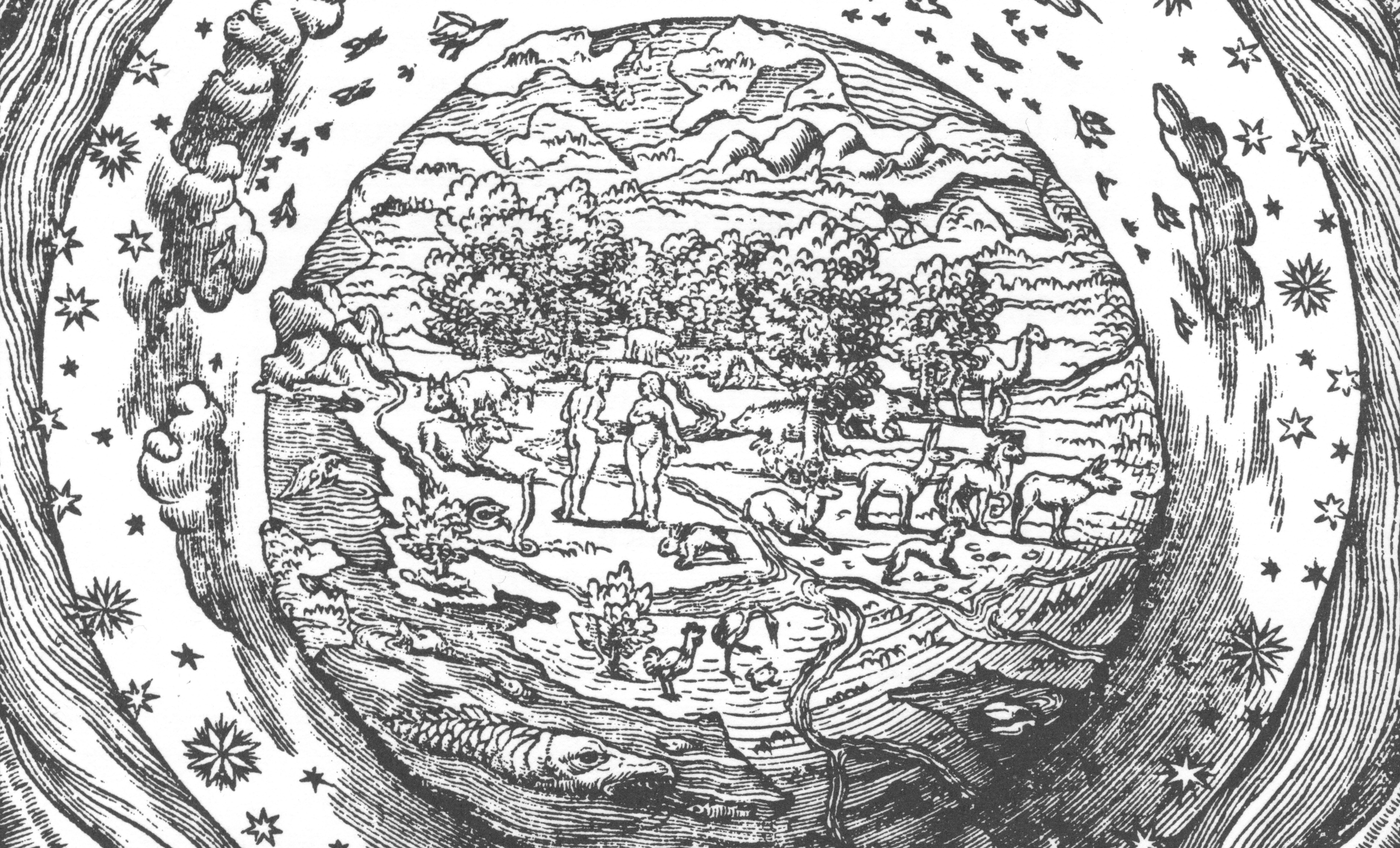
Integral ecology places humans within their full context (Luther Bible, Heaven and Earth, 1545; Source: Wikimedia Commons, PD-Old-100).
Anthony Annett is a climate change and sustainable development advisor at the Earth Institute (Columbia University) and in this position is affiliated with Religions for Peace. He is a frequent contributor to Commonweal and has published a programmatic essay on an economy of inclusion in Radically Catholic in the Age of Francis.
The contents of this interview respect the Vatican embargo on discussing the contents of the encyclical until they are officially published on Thursday.
The interview began last week and finished yesterday as the encyclical draft was leaked. The flow of the Q&A might reflect this. ====================================================
Artur Rosman: What is the nature of your involvement with the Catholic side of environmental protection?
Tony Annett: There’s nothing mysterious about that. I work jointly with the Earth Institute at Columbia University and the NGO “Religions for Peace” on the moral and religious dimensions of climate change and sustainable development. At its core, the idea of sustainable development is about getting beyond mere accumulation (as in GDP) and also addressing social inclusion and environmental sustainability. It is really about creating the conditions for human flourishing – of those alive today, no matter where they live, and those not yet born. So the values of sustainable development cohere with the values of the major religious traditions, and we need to draw out that connection.
This is an extremely important year for sustainable development. There will be 3 major conferences. Leaders will meet in Addis Ababa in July to discuss financing issues. In September, 193 countries will formally adopt the new Sustainable Development Goals. And in December, leaders flock to Paris for the last real chance to come to agreement on reducing carbon emissions and keeping the increase to global temperature to 2 degrees Celsius over pre-industrial levels (any warming after that, and all hell could break loose).
In all of this, the pending encyclical by Pope Francis could not be more timely. It is expected to draw a connection between the well-being of the planet and the well-being of people, especially the excluded – the poor, the vulnerable, indigenous peoples, and the unborn. It is expected to have a huge influence all across they world, and not only among Catholics.
Last April, in anticipation of the encyclical, I helped organize an event at the Vatican entitled “Protect the earth, dignify humanity: the moral dimensions of climate change and sustainable development“. It was co-sponsored by the Pontifical Academy of Sciences/ Social Sciences, and the two groups with which I am affiliated – the UN Sustainable Development Solutions Network (housed at the Earth Institute) and Religions for Peace. It brought together some of the world’s leading climate scientists, development practitioners, and representatives of the world’s major religious traditions (Catholic, Orthodox, Protestant, Jewish, Muslim, Buddhist, Hindu, and Sikh). It was opened by Ban Ki Moon, and attended by the presidents of Italy and Ecuador. The end result was a declaration that affirmed the science and also the moral imperative of taking action to reduce carbon emissions.
So that’s kind of what I have been doing!
Previous Post

June 15, 2015
Draft of Pope Francis' /Laudato Si/ Encyclical Leaked Today
Next Post
June 17, 2015 Playing Mad Libs with Laudato Si' & the Politics of Identity
Browse Our Archives
Select a Category #WhyRemainCatholic Abortion Advent Anti-Catholicism Arts Atheism Beauty Benedict XVI Bible Book Review Catholic Cinema Comedy Cosmos: A Space-Time Odyssey Czesław Miłosz Dariusz Karłowicz Devil Easter Eastern Orthodoxy Economics Environment Family Famous Atheists Who Weren't Atheists Guest Post Hans Urs von Balthasar HHS Mandate History Imagination Interview Islam Jean-Luc Marion John Paul II Judaism Just War Lent Literature Little Sisters of the Poor Liturgy Martyrdom Music News Paganism Patristics Phenomenology Philosophy Pierre Hadot Poetry Poland Pop Culture Pope Francis Poverty Prayer Protestantism Rabelais Race Remi Brague Rene Girard Russia Sam Rocha Science & Religion SCOTUS Secularization Sexual Abuse Sexuality Silence Solidarity Stratford Caldecott Synod14 Terrorism Top 10 Uncategorized Walker Percy War Weakened Edition World War II World Youth Day WYD Krakow
Select a Month July 2017 June 2017 May 2017 April 2017 March 2017 February 2017 January 2017 December 2016 October 2016 September 2016 August 2016 July 2016 June 2016 May 2016 April 2016 March 2016 February 2016 January 2016 December 2015 November 2015 October 2015 September 2015 August 2015 July 2015 June 2015 May 2015 April 2015 March 2015 February 2015 January 2015 December 2014 November 2014 October 2014 September 2014 August 2014 July 2014 May 2014 April 2014 March 2014 February 2014 January 2014 December 2013 November 2013 October 2013 September 2013 August 2013 July 2013 June 2013 May 2013
Follow Us!
TAKE THE
Religious Wisdom Quiz
What did Isaiah say about Egypt's future in his oracles?
Select your answer to see how you score.
It would conquer Israel It would rule Persia It would prosper It would be conquered
Related posts from Cosmos The In Lost

The Surprising Anti-Capitalist Logic Behind the Catholic Church's...

What is the Source of Our Culture of...

How is Classical Philosophy is Like War?

Why Does the World's Leading Philosopher Remain a...
TRENDING AT PATHEOS Catholic

The Parable Of The Sower And The Word...
One of Christ’s most famous parables is that of the sower who...

Rejecting Doom: Christian Hope And Human Action
Christianity is a religion of hope. We are to have hope and...

Why I Choose the Eucharist Over the Sermon
Choose the Eucharist, Not the Sermon What are we supposed to get...

5 Design Elements Found in Spiritually Rooted Homes
Putting Spirituality Into Home Decor Our homes are more than our living...

Credo: A Story of God Told with the...
About 10 years ago, I began to imagine a personal "Credo" that...

The Anatomy of Divine Revelation in Catholic Thought
The claim that God has made Himself known to human beings is...
view all Catholic blogs
Ad-Free & Subscriber Log-In Subscription Support
- About Us
- 2026 Calendar
- Videos
- Podcasts
- Library of World Religions
- Faith In Media Tracker
- Advertise With Us
- Write for Us
- Privacy Policy
- Terms of Service
- Do Not Sell My Data
- Contact Us
- Radiant Digital
- Manage Newsletter Subscriptions
- Unsubscribe From Notifications
- Sitemap
Copyright 2008-2026, Patheos. All rights reserved.
Subscription Support Ad-Free & Subscriber Log-In
Follow Patheos