
BuddhistCatholicContemplativeEvangelicalGeneral ChristianHinduJewishLatter-day SaintMuslimNew VisionsProgressive Christian
Beliefs
- Buddhist
- Catholic
- Contemplative
- Evangelical
- General Christian
- Hindu
- Jewish
- Latter-day Saint
- More Voices
- Muslim
- New Visions
- Pagan
- Progressive Christian
Topics
- Religion News
- Food and Religion
- Sports and Religion
- Religious Art
- Religious Music and Entertainment
- Religious Events
- History and Religion
- Style and Religion
- Politics and Religion
- Women in Religion
- Recreation Outdoors and Religion
- Business Finance and Religion
- Careers Workplace and Religion
- Education and Religion
- Family Parenting and Religion
- Health Fitness and Religion
- Home and Religion
- Relationships and Religion
- Technology and Religion
- Travel and Religion
Columnists
- Buddhist Columnists
- Business Finance and Religion Columnists
- Careers Workplace and Religion Columnists
- Catholic Columnists
- Contemplative Columnists
- Education and Religion Columnists
- Evangelists Columnists
- Family Parenting and Religion Columnists
- General Christian Columnists
- Health Fitness and Religion Columnists
- Hindu Columnists
- History and Religion Columnists
- Home and Religion Columnists
- Jewish Columnists
- More Voices Columnists
- Latter Day Columnists
- Muslim Columnists
- New Visions Columnists
- Nonreligious Columnists
- Pagan Columnists
- Politics and Religion Columnists
- Progressive Columnists
- Recreation Outdoors and Religion Columnists
- Relationships and Religion Columnists
- Religion News Columnists
- Religious Art Columnists
- Religious Events Columnists
- Religious Music and Entertainment Columnists
- Sports and Religion Columnists
- Style and Religion Columnists
- Technology and Religion Columnists
- Travel and Religion Columnists
- Women in Religion Columnists
Resource Library
- 2026 Calendar
- Library of World Religions
- The 100 Most Holy Places on Earth
- Patheos Answers
- Podcasts
- Videos
- Faith Leaders Database
- Anglican Episcopalian
- Bahai
- Baptist
- Buddhism
- Christianity
- Confucianism
- Eastern Orthodoxy
- Hinduism
- Holiness and Pentecostal
- ISKCON
- Islam
- Judaism
- Lutheran
- Methodist
- The Church of Jesus Christ of Latter-day Saints
- New Age
- Paganism
- Presbytarian and Reformed
- Protestantism
- Religion Behind the Scenes
- Roman Catholic
- Scientology
- Shia Islam
- Sikhism
- Sufism
- Sunni Islam
- Taoism
- Zen
- See all religions
Research Tools
 Ad-Free & Subscriber Log-In Subscription Support
Ad-Free & Subscriber Log-In Subscription Support
Follow Patheos 

- Trending:
- Forgiveness
- |
- Marriage
- |
- Consciousness
- |
- Death Penalty
- |
- Election
- |
- Halloween
 Cosmos The In Lost
- Home
- Catholic
- René Girard: Is Christianity a Myth?
René Girard: Is Christianity a Myth?
Last updated on: May 22, 2015 at 1:28 pm by Artur Rosman
René Girard: Is Christianity a Myth? 2015-05-22T13:28:42-07:00 Artur Rosman
Patheos Explore the world's faith through different perspectives on religion and spirituality! Patheos has the views of the prevalent religions and spiritualities of the world.
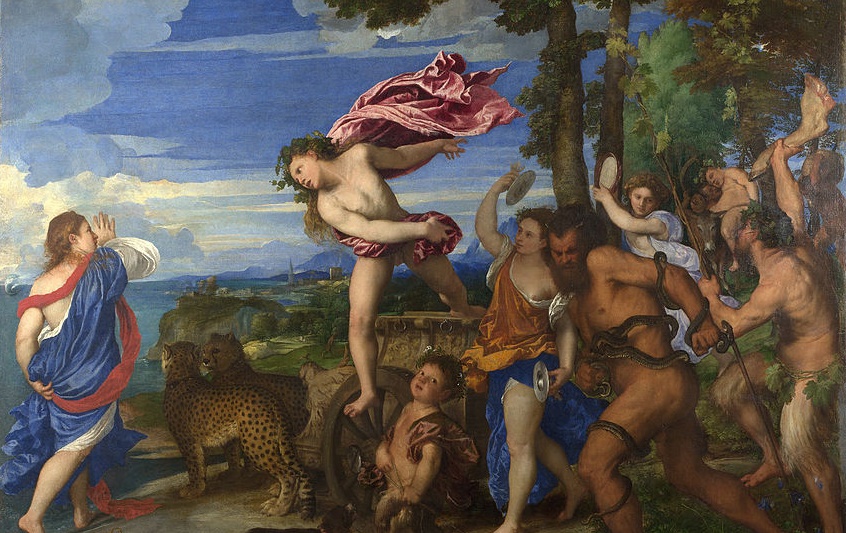
There’s no need to be ashamed of the many similarities between the Gospels and myths, but it’s important to remember the one key difference, says Girard (Titian, Bacchus and Ariadne, 1523; Source: Wikimedia Commons, PD-Old-100).
I spent an afternoon, and the better part of the evening, in the ER yesterday. The whole episode started with an episode of internal bleeding first observed on the porcelain throne. I’ll spare you the details.
All I’ll say is that the bleeding hidden within my innards since Goodness knows when escaped the probing of the doctors. I’ll need to go back for further testing.

Girard’s book exposes the cracks in all your most cherished beliefs about myth. There, there.
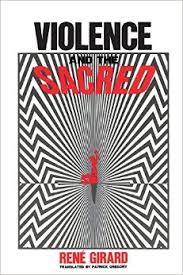
Now, Rene Girard caused a furor when his probing book-length interview, Things Hidden Since the Foundation of the World, was published in France. In it he outed himself as a (GASP!) Catholic Christian. He lost a big chunk of the readership he gained with the publishing of Deceit, Desire, and the Novel, where he first articulated his theory of desire, and then capped it off with Violence and the Sacred, which ties mimetic desire to his theory of scapegoating (thereby articulating what’s been called the first truly secular account of religion).
What exactly does Girard mean by mimesis? There’s a great article he wrote for First Things entitled “Are the Gospels Mythical?” Here’s how he summarizes it:
The traditional English translation of stumbling block is far superior to timid recent translations, for the Greek skandalon designates an unavoidable obstacle that somehow becomes more attractive (as well as repulsive) each time we stumble against it. The first time Jesus predicts his violent death (Matthew 16:21–23), his resignation appalls Peter, who tries to instill some worldly ambition in his master: Instead of imitating Jesus, Peter wants Jesus to imitate him. If two [people] imitate each other’s desire, they both desire the same object. And if they cannot share this object, they will compete for it, each becoming simultaneously a model and an obstacle to the other. The competing desires intensify as model and obstacle reinforce each other, and an escalation of mimetic rivalry follows; admiration gives way to indignation, jealousy, envy, hatred, and, at last, violence and vengeance.
Rivalries and their scandals lead to scapegoating and the temporary peace that follows upon it:
Since most human beings do not follow Jesus, scandals must happen (Matthew 18:7), proliferating in ways that ought to endanger the collective survival of the human race—for once we understand the terrifying power of escalating mimetic desire, no society seems capable of standing against it. And yet, though many societies perish, new societies manage to be born, and quite a few established societies manage to find ways to survive or regenerate. Some counterforce must be at work, not powerful enough to terminate scandals once and for all, and yet sufficient to moderate their impact and keep them under some control.
Girard’s Violence and the Sacred wins the prize for the loudest cover ever. Scapegoating screams out for justice.
This counterforce is, I believe, the mythological scapegoat—the sacrificial victim of myth. When scandals proliferate, human beings become so obsessed with their rivals that they lose sight of the objects for which they compete and begin to focus angrily on one another. As the borrowing of the model’s object shifts to the borrowing of the rival’s hatred, acquisitive mimesis turns into a mimesis of antagonists. More and more individuals polarize against fewer and fewer enemies until, in the end, only one is left. Because everyone believes in the guilt of the last victim, they all turn against him”and since that victim is now isolated and helpless, they can do so with no danger of retaliation. As a result, no enemy remains for anybody in the community. Scandals evaporate and peace returns—for a while.
Christianity is not mythological, because the death of Jesus exposes the mythological mechanism of violence:
Instead of blaming victimization on the victims, the Gospels blame it on the victimizers. What the myths systematically hide, the Bible reveals.
This difference is not merely “moralistic” (as Nietzsche believed) or a matter of subjective choice; it is a question of truth. When the Bible and the Gospels say that the victims should have been spared, they do not merely “take pity” on them. They puncture the illusion of the unanimous victimization that foundational myths use as a crisis-solving and reordering device of human communities. . .
. . . In the Byzantine Empire, I understand, the Oedipus tragedy was read as an analogue of the Christian Passion. If true, those early anthropologists were approaching the right problem from the wrong end. Their reduction of the Gospels to an ordinary myth snuffed the evangelical light with mythology.

Deceit, Desire, and the Novel is also a great entryway into modern literature.
The Resurrection is essential for this vindication of victims, which debunks ancient (and modern) scapegoat myths:
The true Resurrection is based not on the mythical lie of the guilty victim who deserves to die, but on the rectification of that lie, which comes from the true God and which reopens channels of communication mankind itself had closed through self-imprisonment in its own violent cultures. Divine grace alone can explain why, after the Resurrection, the disciples could become a dissenting minority in an ocean of victimization—could understand then what they had misunderstood earlier: the innocence not of Jesus alone but of all victims of all Passion-like murders since the foundation of the world.
Therefore, if you dare to dig into the evidence a bit, you’ll see that Christianity tells pretty much the same story as other myths, but with one crucial difference. Yet, this one crucial (pardon the pun) difference means that Christianity is not mythological.
If this has piqued your interest then here’s Girard explaining some of this on video:
https://www.youtube.com/watch?v=9Uo3THEzEtc
I have also written on Girard’s unique views on the source of anorexia and the problems legalizing euthanasia will inevitably cause.
things hidden since the foundation of the world
Previous Post
May 21, 2015
Francis, Break My Church Like the Eucharist
Next Post

May 23, 2015 In Monologue: Did You Notice Atheists Don't Have No Songs?
Browse Our Archives
Select a Category #WhyRemainCatholic Abortion Advent Anti-Catholicism Arts Atheism Beauty Benedict XVI Bible Book Review Catholic Cinema Comedy Cosmos: A Space-Time Odyssey Czesław Miłosz Dariusz Karłowicz Devil Easter Eastern Orthodoxy Economics Environment Family Famous Atheists Who Weren't Atheists Guest Post Hans Urs von Balthasar HHS Mandate History Imagination Interview Islam Jean-Luc Marion John Paul II Judaism Just War Lent Literature Little Sisters of the Poor Liturgy Martyrdom Music News Paganism Patristics Phenomenology Philosophy Pierre Hadot Poetry Poland Pop Culture Pope Francis Poverty Prayer Protestantism Rabelais Race Remi Brague Rene Girard Russia Sam Rocha Science & Religion SCOTUS Secularization Sexual Abuse Sexuality Silence Solidarity Stratford Caldecott Synod14 Terrorism Top 10 Uncategorized Walker Percy War Weakened Edition World War II World Youth Day WYD Krakow
Select a Month July 2017 June 2017 May 2017 April 2017 March 2017 February 2017 January 2017 December 2016 October 2016 September 2016 August 2016 July 2016 June 2016 May 2016 April 2016 March 2016 February 2016 January 2016 December 2015 November 2015 October 2015 September 2015 August 2015 July 2015 June 2015 May 2015 April 2015 March 2015 February 2015 January 2015 December 2014 November 2014 October 2014 September 2014 August 2014 July 2014 May 2014 April 2014 March 2014 February 2014 January 2014 December 2013 November 2013 October 2013 September 2013 August 2013 July 2013 June 2013 May 2013
Follow Us!
TAKE THE
Religious Wisdom Quiz
Which empire destroyed the First Temple in Jerusalem?
Select your answer to see how you score.
Assyrian Empire Babylonian Empire Persian Empire Roman Empire
Related posts from Cosmos The In Lost

The Surprising Anti-Capitalist Logic Behind the Catholic Church's...

How is Classical Philosophy is Like War?

Why Does the World's Leading Philosopher Remain a...

Post-Execution Church: Rise Up from the Electric Chair!
TRENDING AT PATHEOS Catholic

Creation, Preservation, and Teleology in Catholic Theology
As I write this, it is very early Monday morning. Like millions...

The Parable Of The Sower And The Word...
One of Christ’s most famous parables is that of the sower who...

Rejecting Doom: Christian Hope And Human Action
Christianity is a religion of hope. We are to have hope and...

Why I Choose the Eucharist Over the Sermon
Choose the Eucharist, Not the Sermon What are we supposed to get...

5 Design Elements Found in Spiritually Rooted Homes
Putting Spirituality Into Home Decor Our homes are more than our living...

Credo: A Story of God Told with the...
About 10 years ago, I began to imagine a personal "Credo" that...
view all Catholic blogs
Ad-Free & Subscriber Log-In Subscription Support
- About Us
- 2026 Calendar
- Videos
- Podcasts
- Library of World Religions
- Faith In Media Tracker
- Advertise With Us
- Write for Us
- Privacy Policy
- Terms of Service
- Do Not Sell My Data
- Contact Us
- Radiant Digital
- Manage Newsletter Subscriptions
- Unsubscribe From Notifications
- Sitemap
Copyright 2008-2026, Patheos. All rights reserved.
Subscription Support Ad-Free & Subscriber Log-In
Follow Patheos