
BuddhistCatholicContemplativeEvangelicalGeneral ChristianHinduJewishLatter-day SaintMuslimNew VisionsProgressive Christian
Beliefs
- Buddhist
- Catholic
- Contemplative
- Evangelical
- General Christian
- Hindu
- Jewish
- Latter-day Saint
- More Voices
- Muslim
- New Visions
- Pagan
- Progressive Christian
Topics
- Religion News
- Food and Religion
- Sports and Religion
- Religious Art
- Religious Music and Entertainment
- Religious Events
- History and Religion
- Style and Religion
- Politics and Religion
- Women in Religion
- Recreation Outdoors and Religion
- Business Finance and Religion
- Careers Workplace and Religion
- Education and Religion
- Family Parenting and Religion
- Health Fitness and Religion
- Home and Religion
- Relationships and Religion
- Technology and Religion
- Travel and Religion
Columnists
- Buddhist Columnists
- Business Finance and Religion Columnists
- Careers Workplace and Religion Columnists
- Catholic Columnists
- Contemplative Columnists
- Education and Religion Columnists
- Evangelists Columnists
- Family Parenting and Religion Columnists
- General Christian Columnists
- Health Fitness and Religion Columnists
- Hindu Columnists
- History and Religion Columnists
- Home and Religion Columnists
- Jewish Columnists
- More Voices Columnists
- Latter Day Columnists
- Muslim Columnists
- New Visions Columnists
- Nonreligious Columnists
- Pagan Columnists
- Politics and Religion Columnists
- Progressive Columnists
- Recreation Outdoors and Religion Columnists
- Relationships and Religion Columnists
- Religion News Columnists
- Religious Art Columnists
- Religious Events Columnists
- Religious Music and Entertainment Columnists
- Sports and Religion Columnists
- Style and Religion Columnists
- Technology and Religion Columnists
- Travel and Religion Columnists
- Women in Religion Columnists
Resource Library
- 2026 Calendar
- Library of World Religions
- The 100 Most Holy Places on Earth
- Patheos Answers
- Podcasts
- Videos
- Faith Leaders Database
- Anglican Episcopalian
- Bahai
- Baptist
- Buddhism
- Christianity
- Confucianism
- Eastern Orthodoxy
- Hinduism
- Holiness and Pentecostal
- ISKCON
- Islam
- Judaism
- Lutheran
- Methodist
- The Church of Jesus Christ of Latter-day Saints
- New Age
- Paganism
- Presbytarian and Reformed
- Protestantism
- Religion Behind the Scenes
- Roman Catholic
- Scientology
- Shia Islam
- Sikhism
- Sufism
- Sunni Islam
- Taoism
- Zen
- See all religions
Research Tools
 Ad-Free & Subscriber Log-In Subscription Support
Ad-Free & Subscriber Log-In Subscription Support
Follow Patheos 

- Trending:
- Forgiveness
- |
- Marriage
- |
- Consciousness
- |
- Death Penalty
- |
- Election
- |
- Halloween
 Cosmos The In Lost
- Home
- Catholic
- Stanley Hauerwas Contra the Bad Idea of Religious Toleration
Stanley Hauerwas Contra the Bad Idea of Religious Toleration
Last updated on: April 30, 2015 at 1:24 pm by Artur Rosman
Stanley Hauerwas Contra the Bad Idea of Religious Toleration 2015-04-30T13:24:19-07:00 Artur Rosman
Patheos Explore the world's faith through different perspectives on religion and spirituality! Patheos has the views of the prevalent religions and spiritualities of the world.
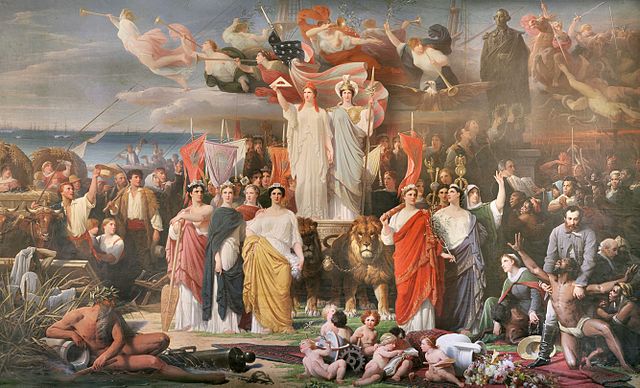
American Caesar tolerates you, but is that a performance Christians should put on? (Adolphe Yvon, Genius of America, 1870; Source Wikimedia Commons, PD-Old-100)
As Americans we are enjoined to religious tolerance as if it were the 11th commandment. Catholic arguments against changing the definition of marriage sometimes use religious tolerance to argue for retaining distinctively Christian practices of marriage as the law of the land. But is this an effective strategy?
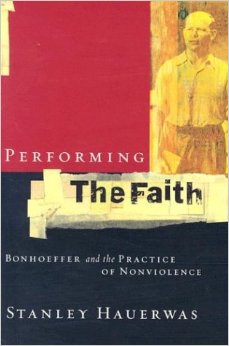
Forget Tolerance: What’s your performance record?
If we’re not tolerant, then we’re not playing nice. However, nice is not a theological category. What’s really hiding behind this American commandment?
In the video below Hauerwas argues “Tolerance is always a position for those who are in power.” In other words, it is a position takes on a perspective of demeaning condescension toward those who are outside the mainstream. It is a power-play, and therefore, when practiced, it is yet another sign of the Nietzschean “Death of God” as explained by Krzysztof Michalski in this post (also Hauerwas-related).
What would a Christian-Catholic, instead of liberal or American, grammar look like instead? Hauerwas says, “Christians don’t need to be tolerant, they need to be humble.” In other words, what Hauerwas calls performing the faith should make people wonder about Christianity and attract them.
Unfortunately, a reader points out that the Hauerwas anecdote about cursing and the library is not literally true, as in it did not happen. Although, Hauerwas thinks it should have happened.
Anyway, here’s the Hauerwas fireside chat:
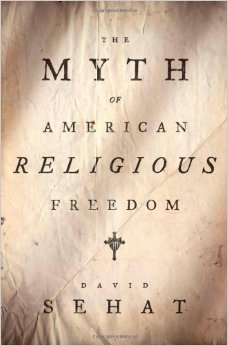
For more in depth scholarship on this specific topic you might want to see The Myth of American Religious Freedom:
In the battles over religion and politics in America, both liberals and conservatives often appeal to history. Liberals claim that the Founders separated church and state. But for much of American history, David Sehat writes, Protestant Christianity was intimately intertwined with the state. Yet the past was not the Christian utopia that conservatives imagine either. Instead, a Protestant moral establishment prevailed, using government power to punish free thinkers and religious dissidents.
Sometimes a little demythologizing is a very good thing indeed.
In The Myth of American Religious Freedom, Sehat provides an eye-opening history of religion in public life, overturning our most cherished myths. Originally, the First Amendment applied only to the federal government, which had limited authority. The Protestant moral establishment ruled on the state level. Using moral laws to uphold religious power, religious partisans enforced a moral and religious orthodoxy against Catholics, Jews, Mormons, agnostics, and others. Not until 1940 did the U.S. Supreme Court extend the First Amendment to the states. As the Supreme Court began to dismantle the connections between religion and government, Sehat argues, religious conservatives mobilized to maintain their power and began the culture wars of the last fifty years. To trace the rise and fall of this Protestant establishment, Sehat focuses on a series of dissenters–abolitionist William Lloyd Garrison, suffragist Elizabeth Cady Stanton, socialist Eugene V. Debs, and many others.
Shattering myths held by both the left and right, David Sehat forces us to rethink some of our most deeply held beliefs. By showing the bad history used on both sides, he denies partisans a safe refuge with the Founders.
You might also want to take a look at my TOP10 world politics and religion book list.


Browse Our Archives
Select a Category #WhyRemainCatholic Abortion Advent Anti-Catholicism Arts Atheism Beauty Benedict XVI Bible Book Review Catholic Cinema Comedy Cosmos: A Space-Time Odyssey Czesław Miłosz Dariusz Karłowicz Devil Easter Eastern Orthodoxy Economics Environment Family Famous Atheists Who Weren't Atheists Guest Post Hans Urs von Balthasar HHS Mandate History Imagination Interview Islam Jean-Luc Marion John Paul II Judaism Just War Lent Literature Little Sisters of the Poor Liturgy Martyrdom Music News Paganism Patristics Phenomenology Philosophy Pierre Hadot Poetry Poland Pop Culture Pope Francis Poverty Prayer Protestantism Rabelais Race Remi Brague Rene Girard Russia Sam Rocha Science & Religion SCOTUS Secularization Sexual Abuse Sexuality Silence Solidarity Stratford Caldecott Synod14 Terrorism Top 10 Uncategorized Walker Percy War Weakened Edition World War II World Youth Day WYD Krakow
Select a Month July 2017 June 2017 May 2017 April 2017 March 2017 February 2017 January 2017 December 2016 October 2016 September 2016 August 2016 July 2016 June 2016 May 2016 April 2016 March 2016 February 2016 January 2016 December 2015 November 2015 October 2015 September 2015 August 2015 July 2015 June 2015 May 2015 April 2015 March 2015 February 2015 January 2015 December 2014 November 2014 October 2014 September 2014 August 2014 July 2014 May 2014 April 2014 March 2014 February 2014 January 2014 December 2013 November 2013 October 2013 September 2013 August 2013 July 2013 June 2013 May 2013
Follow Us!
TAKE THE
Religious Wisdom Quiz
Who was Saul's son?
Select your answer to see how you score.
Jonathan Absalom Samuel David
Related posts from Cosmos The In Lost

The Surprising Anti-Capitalist Logic Behind the Catholic Church's...

The Holy Family as an Icon of World...

Biblical Authority After Babel Cannot Be Built Upon...
Western Civ Doesn't Need Tenured Radicals to Ruin...
TRENDING AT PATHEOS Catholic

Creation, Preservation, and Teleology in Catholic Theology
As I write this, it is very early Monday morning. Like millions...

The Parable Of The Sower And The Word...
One of Christ’s most famous parables is that of the sower who...

Rejecting Doom: Christian Hope And Human Action
Christianity is a religion of hope. We are to have hope and...

Why I Choose the Eucharist Over the Sermon
Choose the Eucharist, Not the Sermon What are we supposed to get...

5 Design Elements Found in Spiritually Rooted Homes
Putting Spirituality Into Home Decor Our homes are more than our living...

Credo: A Story of God Told with the...
About 10 years ago, I began to imagine a personal "Credo" that...
view all Catholic blogs
Ad-Free & Subscriber Log-In Subscription Support
- About Us
- 2026 Calendar
- Videos
- Podcasts
- Library of World Religions
- Faith In Media Tracker
- Advertise With Us
- Write for Us
- Privacy Policy
- Terms of Service
- Do Not Sell My Data
- Contact Us
- Radiant Digital
- Manage Newsletter Subscriptions
- Unsubscribe From Notifications
- Sitemap
Copyright 2008-2026, Patheos. All rights reserved.
Subscription Support Ad-Free & Subscriber Log-In
Follow Patheos