
BuddhistCatholicContemplativeEvangelicalGeneral ChristianHinduJewishLatter-day SaintMuslimNew VisionsProgressive Christian
Beliefs
- Buddhist
- Catholic
- Contemplative
- Evangelical
- General Christian
- Hindu
- Jewish
- Latter-day Saint
- More Voices
- Muslim
- New Visions
- Pagan
- Progressive Christian
Topics
- Religion News
- Food and Religion
- Sports and Religion
- Religious Art
- Religious Music and Entertainment
- Religious Events
- History and Religion
- Style and Religion
- Politics and Religion
- Women in Religion
- Recreation Outdoors and Religion
- Business Finance and Religion
- Careers Workplace and Religion
- Education and Religion
- Family Parenting and Religion
- Health Fitness and Religion
- Home and Religion
- Relationships and Religion
- Technology and Religion
- Travel and Religion
Columnists
- Buddhist Columnists
- Business Finance and Religion Columnists
- Careers Workplace and Religion Columnists
- Catholic Columnists
- Contemplative Columnists
- Education and Religion Columnists
- Evangelists Columnists
- Family Parenting and Religion Columnists
- General Christian Columnists
- Health Fitness and Religion Columnists
- Hindu Columnists
- History and Religion Columnists
- Home and Religion Columnists
- Jewish Columnists
- More Voices Columnists
- Latter Day Columnists
- Muslim Columnists
- New Visions Columnists
- Nonreligious Columnists
- Pagan Columnists
- Politics and Religion Columnists
- Progressive Columnists
- Recreation Outdoors and Religion Columnists
- Relationships and Religion Columnists
- Religion News Columnists
- Religious Art Columnists
- Religious Events Columnists
- Religious Music and Entertainment Columnists
- Sports and Religion Columnists
- Style and Religion Columnists
- Technology and Religion Columnists
- Travel and Religion Columnists
- Women in Religion Columnists
Resource Library
- 2026 Calendar
- Library of World Religions
- The 100 Most Holy Places on Earth
- Patheos Answers
- Podcasts
- Videos
- Faith Leaders Database
- Anglican Episcopalian
- Bahai
- Baptist
- Buddhism
- Christianity
- Confucianism
- Eastern Orthodoxy
- Hinduism
- Holiness and Pentecostal
- ISKCON
- Islam
- Judaism
- Lutheran
- Methodist
- The Church of Jesus Christ of Latter-day Saints
- New Age
- Paganism
- Presbytarian and Reformed
- Protestantism
- Religion Behind the Scenes
- Roman Catholic
- Scientology
- Shia Islam
- Sikhism
- Sufism
- Sunni Islam
- Taoism
- Zen
- See all religions
Research Tools
 Ad-Free & Subscriber Log-In Subscription Support
Ad-Free & Subscriber Log-In Subscription Support
Follow Patheos 

- Trending:
- Forgiveness
- |
- Marriage
- |
- Consciousness
- |
- Death Penalty
- |
- Election
- |
- Halloween
 Cosmos The In Lost
- Home
- Catholic
- Worstward Ho(pe): Christ and Apollo and Moving!
Worstward Ho(pe): Christ and Apollo and Moving!
Last updated on: April 8, 2015 at 9:53 pm by Artur Rosman
Worstward Ho(pe): Christ and Apollo and Moving! 2015-04-08T21:53:13-07:00 Artur Rosman
Patheos Explore the world's faith through different perspectives on religion and spirituality! Patheos has the views of the prevalent religions and spiritualities of the world.
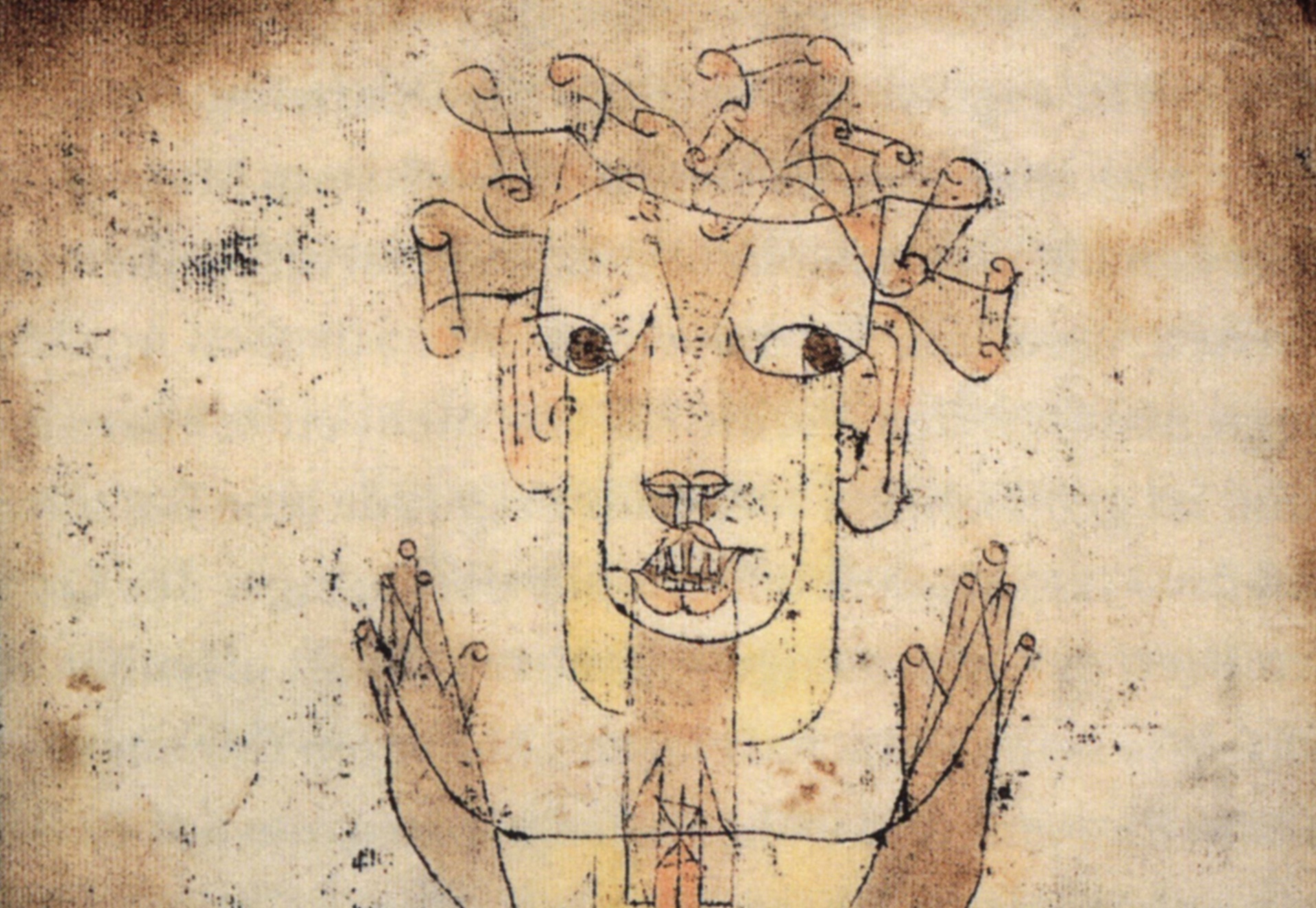
What Walter Benjamin said about this painting equally applies to unpacking: “This is how one pictures the angel of history. His face is turned toward the past. Where we perceive a chain of events, he sees one single catastrophe which keeps piling wreckage upon wreckage and hurls it in front of his feet.” (Paul Klee, Angelus Novus, 1920; Source: Wikimedia Commons, PD-Old-70, PD-USA, registered before 1923)
I firmly believe that moving is the process of rearranging old constellations of junk into new constellations of junk.
We recently moved into a new apartment, again.
The euphoria of packing everything up was followed by the letdown of having to unpack it and is now limping into the valley of the shadow of death (or debt, if you want to pry into my finances).
I’ve found the noonday demon whispering to me, saying, “How will you ever get all of this in order?” Order is the one thing I desire more than anything right now. I want it now, but it’s not happening.
I’m stuck with a Sisyphean task of unpacking boxes and moving things into other boxes. I keep desiring and imagining the end of these labors. Sometimes these daydreams sap my energy so much that I sit around and write blogs entries about the situation instead of getting a handle on it.
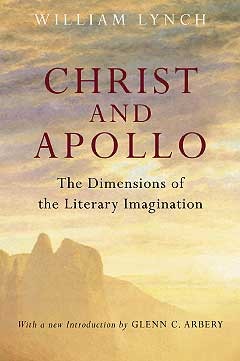
Lynch gives you measured hope.
In the midst of all this I’ve been thinking about William F. Lynch’s Christ and Apollo: The Dimensions of the Literary Imagination. Not in the least because I cannot find the book on my shelves. I don’t know whether that’s because it’s hidden somewhere in the wholly new book arrangement, or if the book is actually somewhere in the 26 five-gallon boxes stored in my friend’s backyard forty miles from here.
Anyway, the title Christ and Apollo is a distinction between two opposed types. For Lynch Apollo is the image of the perennial human temptation of a Titanism that would like to resolve everything in one fell swoop (as such it is ultimately an image of despair). On the other hand, Christ is the image of hope because he humbly deigns to remain within human limitations (think: kenosis) thereby not succumbing to despair.
I wasn’t able to find a searchable online edition of Lynch’s book either on Amazon or Google Books. I take this to be a sign that the work of this mid-century Jesuit literary critic (there’s a piece about the Catholic imagination’s dominance of American criticism during that period waiting to be written) has sadly fallen out of general circulation.
I couldn’t find anything in those reliable sources from Lynch’s Images of Hope: Imagination as a Healer of the Hopeless either.
I lowered my expectations and found something on one of those omnibus quote depots that looks like it could’ve come from Images of Hope. I cannot vouch for the authenticity of this quote, however, it is definitely in the spirit of William F. Lynch, SJ:
One of the best safeguards of our hopes, I have suggested, is to be able to mark off the areas of hopelessness and to acknowledge them, to face them directly, not with despair but with the creative intent of keeping them from polluting all the areas of possibility.
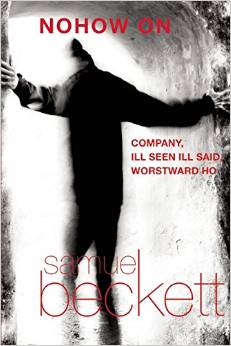
I find Beckett Ho-larious.
There is a profound sanity in these words. Now I have to go back to unpacking. Before I do that the words of Samuel Beckett’s novel Worstward Ho reverberate in my mind with a strange kind of hope, but a human hope, inseminated with possibility nonetheless:
All of old. Nothing else ever. Ever tried. Ever failed. No matter. Try again. Fail again. Fail better.
Beckett is frequently understood as a mad prophet of despair, but there is actually a profound theology of human finitude lurking within many of his works.
In the end I think Giles Fraser (author of the great contrarian book Redeeming Nietzsche: On the Piety of Unbelief) is onto something when he says that Christianity, when properly understood, is a religion of losers, a religion, as Dariusz Karlowicz argues, of Holy Saturday as much as Resurrection Sunday. Here’s Fraser from an excellent piece he recently penned for The Guardian:
Nietzsche trolled and corduroyed!
For if the core of the Christian message – death first, then resurrection – is so existentially full-on that nobody can possibly endure it, then a church that successfully proclaims that message is likely to be empty and not full. Which is also why, quite possibly, a successful priest ought to be hated rather than feted. For here, as elsewhere in the Christian story, success and failure are inverted. The first will be last and the last first. The rich are cast down and the poor are exulted. The true king is crowned with mockery and thorns not with gold and ermine.
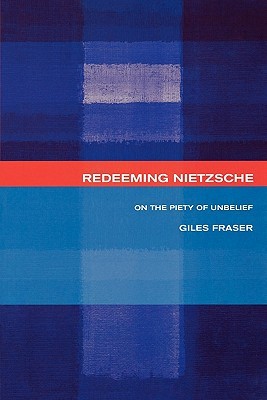
People have and continue to endure it: It’s called everyday life. That’s merely Christian realism and acknowledgment of the limitations of incarnate life.
To top it all off, I wrote most of this post in a fit of hypoglycemia (Type 1 . . . I didn’t ruin myself), i.e., with the juice of life running low, close to running out. I couldn’t have done it without it.
===========================================
This song takes on a new dimension in light of Fraser’s words:
Look here for more on the Catholic imagination, my favorite literary works, and Nietzsche.
Previous Post

April 7, 2015
Religion is at Once Theoretical and Practical
Next Post

April 9, 2015 So You Think Moses Can't Liturgical Dance? Forget #SalonChristianitySecrets!
Browse Our Archives
Select a Category #WhyRemainCatholic Abortion Advent Anti-Catholicism Arts Atheism Beauty Benedict XVI Bible Book Review Catholic Cinema Comedy Cosmos: A Space-Time Odyssey Czesław Miłosz Dariusz Karłowicz Devil Easter Eastern Orthodoxy Economics Environment Family Famous Atheists Who Weren't Atheists Guest Post Hans Urs von Balthasar HHS Mandate History Imagination Interview Islam Jean-Luc Marion John Paul II Judaism Just War Lent Literature Little Sisters of the Poor Liturgy Martyrdom Music News Paganism Patristics Phenomenology Philosophy Pierre Hadot Poetry Poland Pop Culture Pope Francis Poverty Prayer Protestantism Rabelais Race Remi Brague Rene Girard Russia Sam Rocha Science & Religion SCOTUS Secularization Sexual Abuse Sexuality Silence Solidarity Stratford Caldecott Synod14 Terrorism Top 10 Uncategorized Walker Percy War Weakened Edition World War II World Youth Day WYD Krakow
Select a Month July 2017 June 2017 May 2017 April 2017 March 2017 February 2017 January 2017 December 2016 October 2016 September 2016 August 2016 July 2016 June 2016 May 2016 April 2016 March 2016 February 2016 January 2016 December 2015 November 2015 October 2015 September 2015 August 2015 July 2015 June 2015 May 2015 April 2015 March 2015 February 2015 January 2015 December 2014 November 2014 October 2014 September 2014 August 2014 July 2014 May 2014 April 2014 March 2014 February 2014 January 2014 December 2013 November 2013 October 2013 September 2013 August 2013 July 2013 June 2013 May 2013
Follow Us!
TAKE THE
Religious Wisdom Quiz
Who fell from a window and died while Paul was preaching, then was raised back to life?
Select your answer to see how you score.
Timothy Eutychus Erastus Tychicus
Related posts from Cosmos The In Lost

The Surprising Anti-Capitalist Logic Behind the Catholic Church's...

How is Classical Philosophy is Like War?

Why Does the World's Leading Philosopher Remain a...

Atheists Have "National Day of Reason," But American...
TRENDING AT PATHEOS Catholic

The Parable Of The Sower And The Word...
One of Christ’s most famous parables is that of the sower who...

Rejecting Doom: Christian Hope And Human Action
Christianity is a religion of hope. We are to have hope and...

Why I Choose the Eucharist Over the Sermon
Choose the Eucharist, Not the Sermon What are we supposed to get...

5 Design Elements Found in Spiritually Rooted Homes
Putting Spirituality Into Home Decor Our homes are more than our living...

Credo: A Story of God Told with the...
About 10 years ago, I began to imagine a personal "Credo" that...

The Anatomy of Divine Revelation in Catholic Thought
The claim that God has made Himself known to human beings is...
view all Catholic blogs
Ad-Free & Subscriber Log-In Subscription Support
- About Us
- 2026 Calendar
- Videos
- Podcasts
- Library of World Religions
- Faith In Media Tracker
- Advertise With Us
- Write for Us
- Privacy Policy
- Terms of Service
- Do Not Sell My Data
- Contact Us
- Radiant Digital
- Manage Newsletter Subscriptions
- Unsubscribe From Notifications
- Sitemap
Copyright 2008-2026, Patheos. All rights reserved.
Subscription Support Ad-Free & Subscriber Log-In
Follow Patheos