
BuddhistCatholicContemplativeEvangelicalGeneral ChristianHinduJewishLatter-day SaintMuslimNew VisionsProgressive Christian
Beliefs
- Buddhist
- Catholic
- Contemplative
- Evangelical
- General Christian
- Hindu
- Jewish
- Latter-day Saint
- More Voices
- Muslim
- New Visions
- Pagan
- Progressive Christian
Topics
- Religion News
- Food and Religion
- Sports and Religion
- Religious Art
- Religious Music and Entertainment
- Religious Events
- History and Religion
- Style and Religion
- Politics and Religion
- Women in Religion
- Recreation Outdoors and Religion
- Business Finance and Religion
- Careers Workplace and Religion
- Education and Religion
- Family Parenting and Religion
- Health Fitness and Religion
- Home and Religion
- Relationships and Religion
- Technology and Religion
- Travel and Religion
Columnists
- Buddhist Columnists
- Business Finance and Religion Columnists
- Careers Workplace and Religion Columnists
- Catholic Columnists
- Contemplative Columnists
- Education and Religion Columnists
- Evangelists Columnists
- Family Parenting and Religion Columnists
- General Christian Columnists
- Health Fitness and Religion Columnists
- Hindu Columnists
- History and Religion Columnists
- Home and Religion Columnists
- Jewish Columnists
- More Voices Columnists
- Latter Day Columnists
- Muslim Columnists
- New Visions Columnists
- Nonreligious Columnists
- Pagan Columnists
- Politics and Religion Columnists
- Progressive Columnists
- Recreation Outdoors and Religion Columnists
- Relationships and Religion Columnists
- Religion News Columnists
- Religious Art Columnists
- Religious Events Columnists
- Religious Music and Entertainment Columnists
- Sports and Religion Columnists
- Style and Religion Columnists
- Technology and Religion Columnists
- Travel and Religion Columnists
- Women in Religion Columnists
Resource Library
- 2026 Calendar
- Library of World Religions
- The 100 Most Holy Places on Earth
- Patheos Answers
- Podcasts
- Videos
- Faith Leaders Database
- Anglican Episcopalian
- Bahai
- Baptist
- Buddhism
- Christianity
- Confucianism
- Eastern Orthodoxy
- Hinduism
- Holiness and Pentecostal
- ISKCON
- Islam
- Judaism
- Lutheran
- Methodist
- The Church of Jesus Christ of Latter-day Saints
- New Age
- Paganism
- Presbytarian and Reformed
- Protestantism
- Religion Behind the Scenes
- Roman Catholic
- Scientology
- Shia Islam
- Sikhism
- Sufism
- Sunni Islam
- Taoism
- Zen
- See all religions
Research Tools
 Ad-Free & Subscriber Log-In Subscription Support
Ad-Free & Subscriber Log-In Subscription Support
Follow Patheos 

- Trending:
- Forgiveness
- |
- Marriage
- |
- Consciousness
- |
- Death Penalty
- |
- Election
- |
- Halloween
 Cosmos The In Lost
- Home
- Catholic
- Millionaire Migrants, Broke Postdocs
Millionaire Migrants, Broke Postdocs
Last updated on: March 30, 2015 at 8:51 am by Artur Rosman
Millionaire Migrants, Broke Postdocs 2015-03-30T08:51:03-07:00 Artur Rosman
Patheos Explore the world's faith through different perspectives on religion and spirituality! Patheos has the views of the prevalent religions and spiritualities of the world.
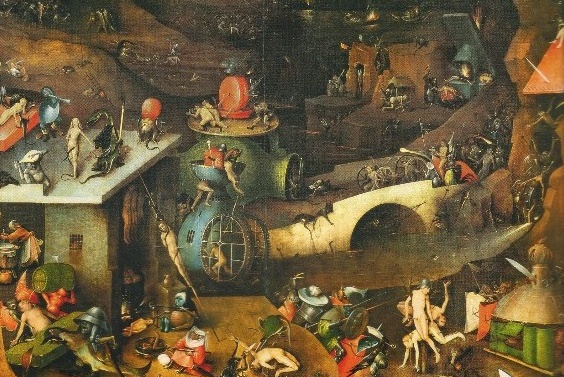
Postdoc housing in its full glory. (Hieronymus Bosch, The Final Judgment, circa 1482; Source: Wikimedia Commons, PD-Old-100)
This is a guest post by Dr. Justin Tse of the Comparative Religion Department at the University of Washington. I am on the postdoc market myself and hope to avoid some of the problems he describes below:
===================
Two of my journalist colleagues in Vancouver may have broken the Internet in Vancouver and Hong Kong. I am not a journalist. However, as an academic, I get the occasional interview from journalists, and I have learned that what it means to be a ‘colleague’ with a journalist is that they ask you difficult questions and you tell the truth to earn their respect. Fudge the facts, and die.
My two journalist colleagues, Ian Young and Douglas Todd, have both interviewed me before, and thankfully, I told the truth. I told Douglas Todd, the Vancouver Sun’s spirituality and diversity columnist, the truth about Chinese Christians and Chinese celebrating Christmas in global cities. After earning my street cred with the South China Morning Post’s Ian Young on youth who transition to adulthood between Vancouver and Hong Kong, I told so many truths to the South China Morning Post’s Ian Young about Chinese Christians opposing a transgender school policy that it almost got us both drawn and quartered, but that didn’t stop him from covering a talk I did at Regent College on Hong Kong’s ‘evangelical public sphere.’
Now, they are on the case again. Both of them have recently caused stirs about unaffordable housing in global cities (see here, here, and here). This is, of course, a topic that has to get you going on a blog like Artur’s where the man himself was almost torn to pieces for suggesting that Catholic parishes should help out with daycare. Yes, I was the one who wrote that Ignatian rebuttal back in He-Who-Shall-Not-Be-Named’s face.
But the real reason I’m writing this is because Douglas Todd and Ian Young have been recommending the work of my doctoral supervisor, David Ley, for the general public to read. Now, I have been warned that it’s a faux pas to toot your own supervisor’s horn in public. But for crying out loud, this is a blog dedicated to Rabelaisian Catholicism. Surely, I get a free pass for vulgarity.
So here goes.
In Millionnaire Migrants: Trans-Pacific Life Lines, Ley discusses the everyday lives of migrants from Hong Kong, Taiwan, and South Korea to Vancouver, where they have bought into Vancouver’s international property market, lived their lives between Asia and North America in split family arrangements, and attempted to build a new civil society in Vancouver. It’s fascinating, but the real reason that Young and Todd have been promoting Ley’s work is because Young has recently been going after an academic pundit, Tsur Somerville, who pontificates on the news about the no-correlation between immigration and the madness of Vancouver’s property market, where a two-bedroom house is known to cost a million dollars on a strong Canadian dollar. It turns out, Young reveals, that Somerville has done virtually no peer-reviewed academic research on the topic, and his academic institution is funded by property developers. In contrast, Young and Todd both say that Ley, a ‘meticulous’ geographer (in Todd’s words), gets no funding and little media air time, but has a book that contests the facts. This story has quite literally broken the Internet in Vancouver: Twitter is both ablaze with the story.
In the spirit of the preferential option for the poor, I recommend that you buy Ley’s book off of Artur’s site in the hope of tapping into this very important debate on affordable housing in global cities and giving Artur an extra financial boost while you’re at it. It’s important. If Ley is writing about ‘millionaire migrants,’ then buying his book here will also help out a broke postdoc. After all, it’s Lent. That’s why I’m not putting it on my own blog, Religion Ethnicity Wired. This post is written as a guest post on my friend Artur’s blog because it’s the right thing to do, especially if you believe that a guy who is as meticulous as Artur will be rightly recognized for his contributions to the theologization of literary scholarship.
Meanwhile, here are some other books on migration to Vancouver and its notoriously crazy property market that you can buy. For the record, no one is paying me to say any of this – not Artur, nor David Ley, not Ian Yougn, not Douglas Todd. It’s Lent, and as an answer to that 2003 mother of all romantic comedies Love Actually, Lent is the time when you really tell the truth.
Kris Olds, Globalization and Urban Change: Capital, Culture, and Pacific Rim Mega-Projects
Olds is a master of telling stories. His stories are about big urban spectacles designed to attract global investment. In this book, he tells two of those stories. The first is about how Hong Kong tycoon Li Ka-shing used family connections to buy up the former Expo ’86 lands in Vancouver’s False Creek and transform it into a condo landscape. The second is about Pudong New Area in Shanghai, a big urban project used to showcase Shanghai’s influence in the global economy. If you want to learn more about urban spectacle, buy this book.
Aihwa Ong, Flexible Citizenship: The Cultural Logics of Transnationality
This is a classic in transnational studies. It’s about the calculations of some diasporic Chinese families to split their families across various regions of the world in order to participate in what Marxist geographer David Harvey calls ‘flexible accumulation,’ the conditions of circulating capital in an era of economic globalization. It’s a theory book, and a good one too, because it posits that ‘Chineseness’ is sometimes just a name-it-and-claim-it ideology that helps some people split their families, get their cash, and laugh all the way to the bank. It’s a fun book to read alongside David Ley too. Ley really likes Ong, but in the 1970s and 1980s, he was David Harvey’s nemesis – and that’s all I’m going to say about what I have to say in Syndicate Theology’s upcoming forum on Harvey’s new book, Seventeen Contradictions and the End of Capitalism.
By the way, if you like Ong’s Flexible Citizenship, you should consider getting the edited prequel with Donald Nonini called Ungrounded Empires: The Cultural Politics of Modern Chinese Transnationalism.
Gary Hamilton, Cosmopolitian Capitalists: Hong Kong and the Chinese Diaspora at the End of the Twentieth Century
This is an edited collection of essays about the implications of the 1997 handover in Hong Kong for the Chinese diaspora. It’s a great introductory book for anyone who needs to understand the background to all of this ‘flexible citizenship,’ ‘ungrounded empires,’ ‘mega-urban projects,’ and international property market business. Some of the authors we’ve discussed here are in it too.
Katharyne Mitchell, Crossing the Neoliberal Line: Pacific Rim Migration and the Metropolis
When I first got into grad school, David Ley handed me two books: Kay Anderson’s Vancouver’s Chinatown and this book here by University of Washington geographer Katharyne Mitchell. In some ways, these are the books that marked my graduate education from the beginning – Anderson’s was much more historical, but Mitchell’s is a theoretical tour de force. Seeking to add nuance to the Fukuyaman ‘end of history’ thesis, Mitchell explores what happened in Vancouver when Hong Kong Chinese migrants brought their own brand of Hong Kong capitalism to bear on Vancouver’s property market. One of the key questions that she asks is whether it was racist for some people to want to stop this kind of migration and property speculation. That question continues to plague Vancouver’s public sphere.
Johanna Waters, Education, Migration, and Cultural Capital in the Chinese Diaspora: Transnational Students Between Hong Kong and Canada
Jo Waters is my intellectual older sister – another student of David Ley’s. This book is her masterful account of how some transnational families calculated that it would be a good idea for their kids to gain residency in Vancouver, get accepted into university, and then return to East Asia with the cultural capital by which they’d be able to get top jobs faster. She does it sensitively, attentive to the personhoods of the people that she is interviewing and implicitly critiquing. Indeed, this is a hallmark of some of the best geographical research out there – it’s not all just theory, and it’s not all critique, because at the end of the day, it’s about people as persons who are exercising agency in ways that they think best. Read it: it’s a very human account of personal calculations for the sake of capital.
—
Artur also tells me that Seattle is having similar issues with an international property market and the University of Washington’s international student initiatives. I’ll have to plead the Fifth on this one – my research is really on religion, and I haven’t yet looked into the same housing issues in Seattle. But this makes me curious. Perhaps – perhaps – I’ll do a bit of digging here too because of this story.
preferential option for the poor
Previous Post
March 28, 2015
See and Taste the Lord is Good: Ocular Communion as Real Communion
Next Post

March 31, 2015 Rahner's Biblical Notion of Anonymous Christianity During Holy Week
Browse Our Archives
Select a Category #WhyRemainCatholic Abortion Advent Anti-Catholicism Arts Atheism Beauty Benedict XVI Bible Book Review Catholic Cinema Comedy Cosmos: A Space-Time Odyssey Czesław Miłosz Dariusz Karłowicz Devil Easter Eastern Orthodoxy Economics Environment Family Famous Atheists Who Weren't Atheists Guest Post Hans Urs von Balthasar HHS Mandate History Imagination Interview Islam Jean-Luc Marion John Paul II Judaism Just War Lent Literature Little Sisters of the Poor Liturgy Martyrdom Music News Paganism Patristics Phenomenology Philosophy Pierre Hadot Poetry Poland Pop Culture Pope Francis Poverty Prayer Protestantism Rabelais Race Remi Brague Rene Girard Russia Sam Rocha Science & Religion SCOTUS Secularization Sexual Abuse Sexuality Silence Solidarity Stratford Caldecott Synod14 Terrorism Top 10 Uncategorized Walker Percy War Weakened Edition World War II World Youth Day WYD Krakow
Select a Month July 2017 June 2017 May 2017 April 2017 March 2017 February 2017 January 2017 December 2016 October 2016 September 2016 August 2016 July 2016 June 2016 May 2016 April 2016 March 2016 February 2016 January 2016 December 2015 November 2015 October 2015 September 2015 August 2015 July 2015 June 2015 May 2015 April 2015 March 2015 February 2015 January 2015 December 2014 November 2014 October 2014 September 2014 August 2014 July 2014 May 2014 April 2014 March 2014 February 2014 January 2014 December 2013 November 2013 October 2013 September 2013 August 2013 July 2013 June 2013 May 2013
Follow Us!
TAKE THE
Religious Wisdom Quiz
True or False: Moses was hidden in a basket among the reeds of the Nile River as a baby.
Select your answer to see how you score.
TRUE FALSE
Related posts from Cosmos The In Lost
The Powerful Catholic Case for a Preferential Option...

Those Christians Who Think there is an Atheist...
Mini TOP10: Books on Vatican Relations with China...

Disproportionate Influence: Catholicism and the #HongKongProtests
TRENDING AT PATHEOS Catholic

Rejecting Doom: Christian Hope And Human Action
Christianity is a religion of hope. We are to have hope and...

It’s What Comes From Within Which Matters
One of the most difficult things for us to understand is why...

Why I Choose the Eucharist Over the Sermon
Choose the Eucharist, Not the Sermon What are we supposed to get...

5 Design Elements Found in Spiritually Rooted Homes
Putting Spirituality Into Home Decor Our homes are more than our living...

Credo: A Story of God Told with the...
About 10 years ago, I began to imagine a personal "Credo" that...

The Anatomy of Divine Revelation in Catholic Thought
The claim that God has made Himself known to human beings is...
view all Catholic blogs
Ad-Free & Subscriber Log-In Subscription Support
- About Us
- 2026 Calendar
- Videos
- Podcasts
- Library of World Religions
- Faith In Media Tracker
- Advertise With Us
- Write for Us
- Privacy Policy
- Terms of Service
- Do Not Sell My Data
- Contact Us
- Radiant Digital
- Manage Newsletter Subscriptions
- Unsubscribe From Notifications
- Sitemap
Copyright 2008-2026, Patheos. All rights reserved.
Subscription Support Ad-Free & Subscriber Log-In
Follow Patheos