
BuddhistCatholicContemplativeEvangelicalGeneral ChristianHinduJewishLatter-day SaintMuslimNew VisionsProgressive Christian
Beliefs
- Buddhist
- Catholic
- Contemplative
- Evangelical
- General Christian
- Hindu
- Jewish
- Latter-day Saint
- More Voices
- Muslim
- New Visions
- Pagan
- Progressive Christian
Topics
- Religion News
- Food and Religion
- Sports and Religion
- Religious Art
- Religious Music and Entertainment
- Religious Events
- History and Religion
- Style and Religion
- Politics and Religion
- Women in Religion
- Recreation Outdoors and Religion
- Business Finance and Religion
- Careers Workplace and Religion
- Education and Religion
- Family Parenting and Religion
- Health Fitness and Religion
- Home and Religion
- Relationships and Religion
- Technology and Religion
- Travel and Religion
Columnists
- Buddhist Columnists
- Business Finance and Religion Columnists
- Careers Workplace and Religion Columnists
- Catholic Columnists
- Contemplative Columnists
- Education and Religion Columnists
- Evangelists Columnists
- Family Parenting and Religion Columnists
- General Christian Columnists
- Health Fitness and Religion Columnists
- Hindu Columnists
- History and Religion Columnists
- Home and Religion Columnists
- Jewish Columnists
- More Voices Columnists
- Latter Day Columnists
- Muslim Columnists
- New Visions Columnists
- Nonreligious Columnists
- Pagan Columnists
- Politics and Religion Columnists
- Progressive Columnists
- Recreation Outdoors and Religion Columnists
- Relationships and Religion Columnists
- Religion News Columnists
- Religious Art Columnists
- Religious Events Columnists
- Religious Music and Entertainment Columnists
- Sports and Religion Columnists
- Style and Religion Columnists
- Technology and Religion Columnists
- Travel and Religion Columnists
- Women in Religion Columnists
Resource Library
- 2026 Calendar
- Library of World Religions
- The 100 Most Holy Places on Earth
- Patheos Answers
- Podcasts
- Videos
- Faith Leaders Database
- Anglican Episcopalian
- Bahai
- Baptist
- Buddhism
- Christianity
- Confucianism
- Eastern Orthodoxy
- Hinduism
- Holiness and Pentecostal
- ISKCON
- Islam
- Judaism
- Lutheran
- Methodist
- The Church of Jesus Christ of Latter-day Saints
- New Age
- Paganism
- Presbytarian and Reformed
- Protestantism
- Religion Behind the Scenes
- Roman Catholic
- Scientology
- Shia Islam
- Sikhism
- Sufism
- Sunni Islam
- Taoism
- Zen
- See all religions
Research Tools
 Ad-Free & Subscriber Log-In Subscription Support
Ad-Free & Subscriber Log-In Subscription Support
Follow Patheos 

- Trending:
- Forgiveness
- |
- Marriage
- |
- Consciousness
- |
- Death Penalty
- |
- Election
- |
- Halloween
 Cosmos The In Lost
- Home
- Catholic
- See and Taste the Lord is Good: Ocular Communion as Real Communion
See and Taste the Lord is Good: Ocular Communion as Real Communion
Last updated on: March 28, 2015 at 11:47 am by Artur Rosman
See and Taste the Lord is Good: Ocular Communion as Real Communion 2015-03-28T11:47:07-07:00 Artur Rosman
Patheos Explore the world's faith through different perspectives on religion and spirituality! Patheos has the views of the prevalent religions and spiritualities of the world.
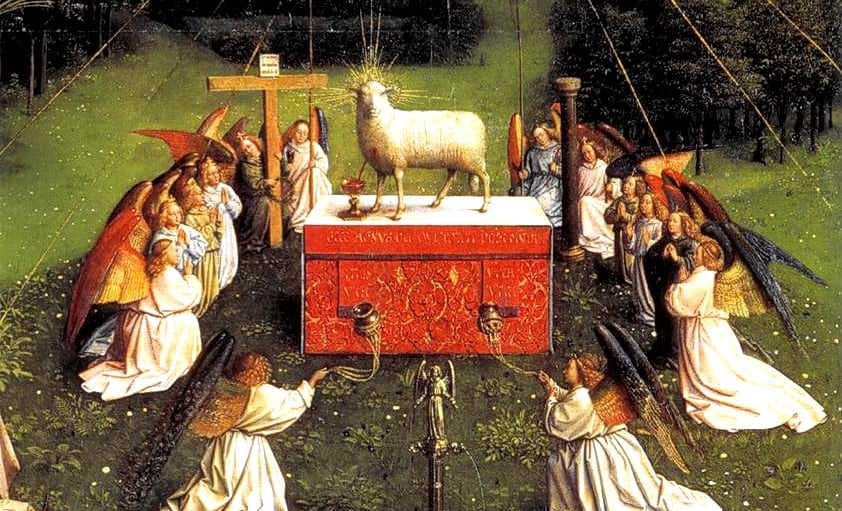
The Ghent Altarpiece has everybody looking on and nobody ingesting. (Jan van Eyck, The Mystic Lamb, 1432; Source: Wikimedia Commons, PD-Old-100)
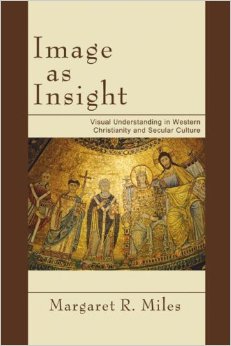
Yesterday’s post on the curious practice of ocular communion included a brief citation that Ann Astell excerpted in her Eating Beauty. That brief citation from Image as Insight: Visual Understanding in Western Christianity and Secular Culture caused the most consternation, because it argued that in medieval practice and popular piety (lex orandi, lex credendi?) ocular communion was considered to be real communion, even superior to ingesting the Eucharist.
Here is a much fuller bite of Image as Insight to give you a taste for these practices:
The engagement of vision in worship and piety, trained for centuries by instruction and practice, was experientially validated for medieval people by its results in increase love and piety. It was also . . . supported by an ancient theory of physical vision that described vision as occurring when a quasi-physical ray is projected from the eye of the viewer to touch its object. An impression of the object, in turn, travels back along the visual ray to be imprinted on the soul and preserved in the memory. In this theory, as we have seen, the viewer is active, both initiating and completing the act of vision in a stored memory of the object.
Well, doesn’t this sound weird to our modern tastes?
Vision was thus the strongest possible access to an object of devotion. The culmination of the late-medieval mass was the elevation of the consecrated bread so that it could be seen by the congregation, a practice introduced in the thirteenth century. The sight of the host, the touching of the body of Christ by the visual ray of the worshipper, was thought to have a salvific effect. A sermon on the mass by the late-thirteenth-century German preacher Berthold of Regensburg describes what occurs as the worshipper gazes on the elevated host: “See the Son of God who, for your sakes, shows his wounds to the heavenly Father; see the Son of God who, for your sakes, was thus lifted on the cross; see the Son of God who will come to judge the living and the dead.” Since the wine, the blood of Christ could not actually be touched by sight, the practice of elevating the chalice was begun at a much later date, and even then out of formal rather then devotional requirements.
Understood in the context of medieval popular visual theory, the insistence of medieval worshippers on contact by sight strikes one less as “superstitious” and misplaced seriousness than as a desire by the worshipper to place himself or herself in the most immediate and strong contact with the object of devotion. Viewing the consecrated bread with concentrated attention was considered of equal or superior value to ingesting it, and medieval congregations were often urged by their priests to communicate “spiritually,” that is, visually, rather than physically. Vision was considered a fully satisfactory manner of communicating, so that people frequently left the church after the elevation.
Therefore the so-called “spiritual communion” was considered to be real Communion, even superior to ingesting the Host. At the same time it was considered to be something like ingesting the host–with the eyes! If not that, then at the very least touching the host with the eyes as one might with the hands.
Does this mean that just looking could singe your entire being?
Image as Insight is published by Wipf and Stock, which publishes a large selection of Catholic-interest books (See: my TOP10 list of their great Catholic books)
Previous Post
March 27, 2015
Hand? Mouth? What About the Third Way of Receiving Communion?
Next Post

March 30, 2015 Millionaire Migrants, Broke Postdocs
Browse Our Archives
Select a Category #WhyRemainCatholic Abortion Advent Anti-Catholicism Arts Atheism Beauty Benedict XVI Bible Book Review Catholic Cinema Comedy Cosmos: A Space-Time Odyssey Czesław Miłosz Dariusz Karłowicz Devil Easter Eastern Orthodoxy Economics Environment Family Famous Atheists Who Weren't Atheists Guest Post Hans Urs von Balthasar HHS Mandate History Imagination Interview Islam Jean-Luc Marion John Paul II Judaism Just War Lent Literature Little Sisters of the Poor Liturgy Martyrdom Music News Paganism Patristics Phenomenology Philosophy Pierre Hadot Poetry Poland Pop Culture Pope Francis Poverty Prayer Protestantism Rabelais Race Remi Brague Rene Girard Russia Sam Rocha Science & Religion SCOTUS Secularization Sexual Abuse Sexuality Silence Solidarity Stratford Caldecott Synod14 Terrorism Top 10 Uncategorized Walker Percy War Weakened Edition World War II World Youth Day WYD Krakow
Select a Month July 2017 June 2017 May 2017 April 2017 March 2017 February 2017 January 2017 December 2016 October 2016 September 2016 August 2016 July 2016 June 2016 May 2016 April 2016 March 2016 February 2016 January 2016 December 2015 November 2015 October 2015 September 2015 August 2015 July 2015 June 2015 May 2015 April 2015 March 2015 February 2015 January 2015 December 2014 November 2014 October 2014 September 2014 August 2014 July 2014 May 2014 April 2014 March 2014 February 2014 January 2014 December 2013 November 2013 October 2013 September 2013 August 2013 July 2013 June 2013 May 2013
Follow Us!
TAKE THE
Religious Wisdom Quiz
Who said, "My Lord and my God!"?
Select your answer to see how you score.
Thomas Paul John Peter
Related posts from Cosmos The In Lost

The Surprising Anti-Capitalist Logic Behind the Catholic Church's...

The Holy Family as an Icon of World...

How is Classical Philosophy is Like War?

Why Does the World's Leading Philosopher Remain a...
TRENDING AT PATHEOS Catholic

Creation, Preservation, and Teleology in Catholic Theology
As I write this, it is very early Monday morning. Like millions...

The Parable Of The Sower And The Word...
One of Christ’s most famous parables is that of the sower who...

Rejecting Doom: Christian Hope And Human Action
Christianity is a religion of hope. We are to have hope and...

Why I Choose the Eucharist Over the Sermon
Choose the Eucharist, Not the Sermon What are we supposed to get...

5 Design Elements Found in Spiritually Rooted Homes
Putting Spirituality Into Home Decor Our homes are more than our living...

Credo: A Story of God Told with the...
About 10 years ago, I began to imagine a personal "Credo" that...
view all Catholic blogs
Ad-Free & Subscriber Log-In Subscription Support
- About Us
- 2026 Calendar
- Videos
- Podcasts
- Library of World Religions
- Faith In Media Tracker
- Advertise With Us
- Write for Us
- Privacy Policy
- Terms of Service
- Do Not Sell My Data
- Contact Us
- Radiant Digital
- Manage Newsletter Subscriptions
- Unsubscribe From Notifications
- Sitemap
Copyright 2008-2026, Patheos. All rights reserved.
Subscription Support Ad-Free & Subscriber Log-In
Follow Patheos