
BuddhistCatholicContemplativeEvangelicalGeneral ChristianHinduJewishLatter-day SaintMuslimNew VisionsProgressive Christian
Beliefs
- Buddhist
- Catholic
- Contemplative
- Evangelical
- General Christian
- Hindu
- Jewish
- Latter-day Saint
- More Voices
- Muslim
- New Visions
- Pagan
- Progressive Christian
Topics
- Religion News
- Food and Religion
- Sports and Religion
- Religious Art
- Religious Music and Entertainment
- Religious Events
- History and Religion
- Style and Religion
- Politics and Religion
- Women in Religion
- Recreation Outdoors and Religion
- Business Finance and Religion
- Careers Workplace and Religion
- Education and Religion
- Family Parenting and Religion
- Health Fitness and Religion
- Home and Religion
- Relationships and Religion
- Technology and Religion
- Travel and Religion
Columnists
- Buddhist Columnists
- Business Finance and Religion Columnists
- Careers Workplace and Religion Columnists
- Catholic Columnists
- Contemplative Columnists
- Education and Religion Columnists
- Evangelists Columnists
- Family Parenting and Religion Columnists
- General Christian Columnists
- Health Fitness and Religion Columnists
- Hindu Columnists
- History and Religion Columnists
- Home and Religion Columnists
- Jewish Columnists
- More Voices Columnists
- Latter Day Columnists
- Muslim Columnists
- New Visions Columnists
- Nonreligious Columnists
- Pagan Columnists
- Politics and Religion Columnists
- Progressive Columnists
- Recreation Outdoors and Religion Columnists
- Relationships and Religion Columnists
- Religion News Columnists
- Religious Art Columnists
- Religious Events Columnists
- Religious Music and Entertainment Columnists
- Sports and Religion Columnists
- Style and Religion Columnists
- Technology and Religion Columnists
- Travel and Religion Columnists
- Women in Religion Columnists
Resource Library
- 2026 Calendar
- Library of World Religions
- The 100 Most Holy Places on Earth
- Patheos Answers
- Podcasts
- Videos
- Faith Leaders Database
- Anglican Episcopalian
- Bahai
- Baptist
- Buddhism
- Christianity
- Confucianism
- Eastern Orthodoxy
- Hinduism
- Holiness and Pentecostal
- ISKCON
- Islam
- Judaism
- Lutheran
- Methodist
- The Church of Jesus Christ of Latter-day Saints
- New Age
- Paganism
- Presbytarian and Reformed
- Protestantism
- Religion Behind the Scenes
- Roman Catholic
- Scientology
- Shia Islam
- Sikhism
- Sufism
- Sunni Islam
- Taoism
- Zen
- See all religions
Research Tools
 Ad-Free & Subscriber Log-In Subscription Support
Ad-Free & Subscriber Log-In Subscription Support
Follow Patheos 

- Trending:
- Forgiveness
- |
- Marriage
- |
- Consciousness
- |
- Death Penalty
- |
- Election
- |
- Halloween
 Cosmos The In Lost
- Home
- Catholic
- Hand? Mouth? What About the Third Way of Receiving Communion?
Hand? Mouth? What About the Third Way of Receiving Communion?
Last updated on: March 28, 2015 at 10:59 am by Artur Rosman
Hand? Mouth? What About the Third Way of Receiving Communion? 2015-03-28T10:59:25-07:00 Artur Rosman
Patheos Explore the world's faith through different perspectives on religion and spirituality! Patheos has the views of the prevalent religions and spiritualities of the world.
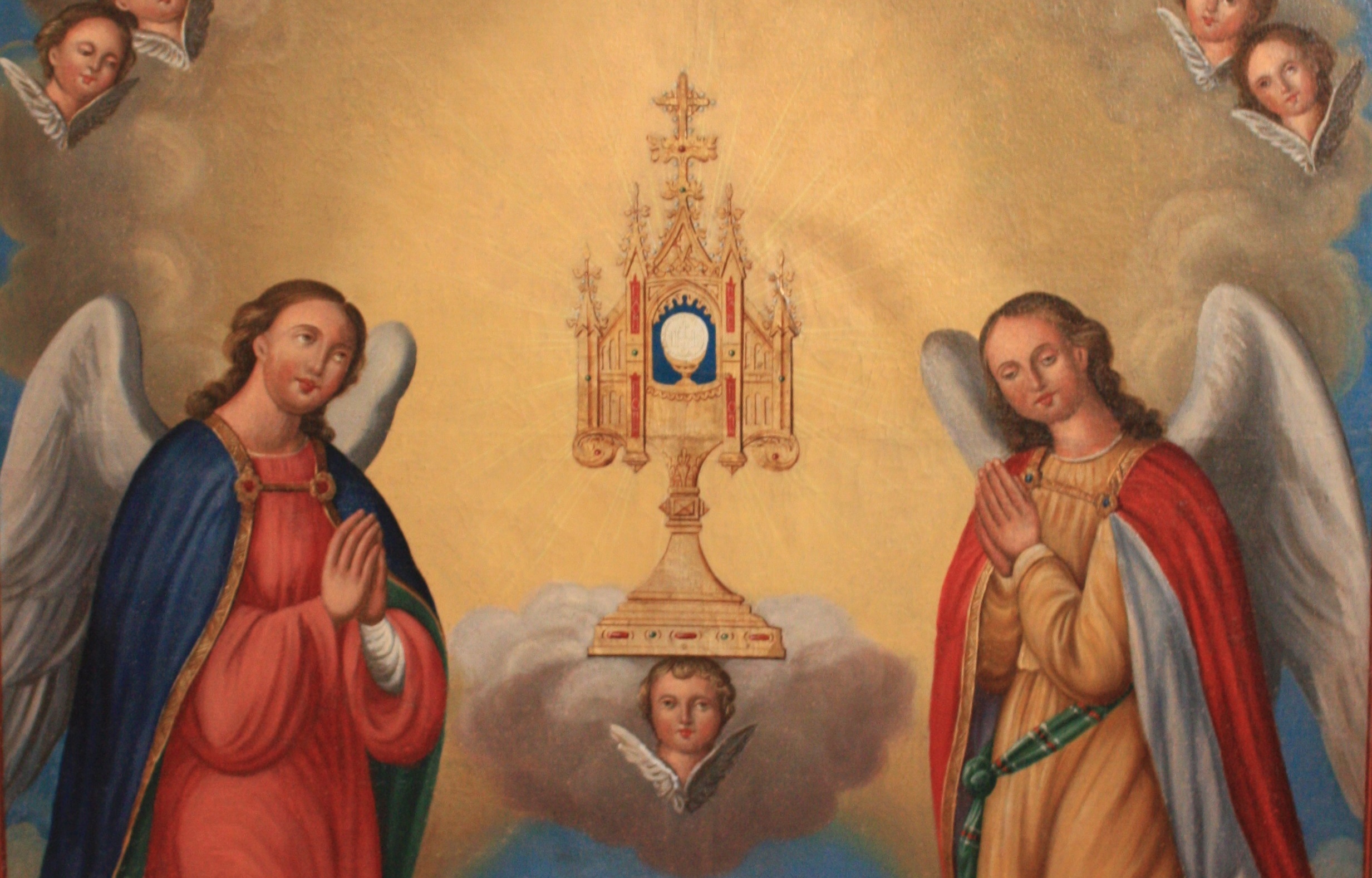
Eucharistic adoration is real communion (Parish church “Saint Martin” in Diex in the community of Diex – Devotional picture; Source: Wikimedia Commons, PD)
There are way too many silly debates on how to take Communion. Being a contrarian at heart I like to receive it in a way that the priest does not prefer. Receiving communion is the main point, not the manner, and to be honest most of them don’t care. I do admire Katrina R. Fernandez for taking her stand for communion in the mouth during her grandmother’s funeral. And if some of you think this is impious and I’m in the saying things in the wrong spirit when it comes to the Mysteries then you have Jesus on your side (breaking the Sabbath) and his followers such as St. Paul (Council of Jerusalem) who never disturbed established ecclesiastical norms.
But did you know that beyond these there is a fairly ancient alternative way of receiving the Host?
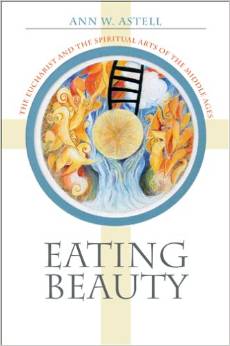
In Eating Beauty: The Eucharist and the Spiritual Arts of the Middle Ages Ann W. Astell takes our discussion of eating from yesterday to a new plane:
Eating is more mysterious than what we can conceive in our modern philosophies.
The medieval practice of spiritual Communion confirms the association of sight with the apprehension of beauty. A devout, intent gazing upon the consecrated Host at its elevation during Mass was often regarded as a substitute for the sacramental consumption of the Eucharist. Even to begin to answer the question “why” is, however, already to deconstruct the simple, aesthetic binary that separates looking from eating: the higher senses of sight and hear from the lower bestial senses of touch, taste, and smell. Understood in the context of medieval popular visual theory and piety, to see the Host was to touch it. One could eat it, touch it, taste it, with one’s eyes. Gazing upon the Host in adoration meant a real physical contact with it, a touch, as light rays emanating from the Host beamed into the eye of the adorer; and vice versa, as rays from the from the beholder’s eye extended themselves in a line of vision to the Host. Touch (in Latin, tangere, tactum), the basic sense of contact with the world was held to be the “common term or proportion” of the other senses, Thomas Ryba explains, “making them all a species of Touch.” As a form of touch, “vision was thus the strongest possible access to [the] object of devotion,” Margaret R. Miles asserts. “It was considered a fully satisfactory way of communicating, so that people frequently left the church after the elevation.”
In his The Call and the Response Jean-Louis Chretien explains the primacy of the sense of touch and its roots in the beginnings of Western philosophy:
Or: on the mystery of the senses.
The most fundamental and universal of all the senses is the sense of touch. Coextensive for Aristotle with animal life, it appears and disappears with it. While touch is separable from the other senses, since it does not require them whereas they require it, the sense of touch is inseparable from life itself: no animal is deprived of touch without also being deprived of life. Every animated body is tactile, from bodies most deeply immersed in stupor to those that display the vigilance of mind at the skin’s surface. The first evidence of soul is the sense of touch. Moreover from the start, the exercise of touch is indistinguishable from the experience of touch, since touch delivers us to the world through a unique act of presence: in order to see one must be visible, yet seeing is not immediately to be seen by what I see. The same holds true of the other senses, whereas to touch is immediately to be touched by what I touch–to experience one’s own tangibility prior to any reflexivity. Whatever I contact by means of touch comes into contact with me.

Why not try this out even with your non-Catholic friends? Isn’t the practice of visual Communion interesting in how it might potentially lead to something like open communion. It seems like most of you probably know about baptism by desire, so why would this seem so unusual? God seems to break through confessional boundaries by the sacraments offered within those confessional boundaries. Granted, all of this presupposes a Catholic medieval ontology. After all, Catholic means universal (after all: extra ecclesiam nulla sallus). The older understanding that precedes the concepts of discrete religions would see those who do not formally belong to Catholicism not as non-believers, but as heretics, meaning, in a way, one of our wayward own.
So, perhaps when you invite your non-Catholic friends to Eucharistic adoration you invite them to participate in the sacraments and simultaneously effect a baptism by desire?
[The discussion started here is continued in the post See and Taste the Lord is Good]
For more interesting theological insights see my TOP10 Theology Books of the Last 10 Years (That I’ve Read).
Previous Post
March 26, 2015
Daily Life in the Time of Jesus: Locust Eating 101
Next Post
March 28, 2015 See and Taste the Lord is Good: Ocular Communion as Real Communion
Browse Our Archives
Select a Category #WhyRemainCatholic Abortion Advent Anti-Catholicism Arts Atheism Beauty Benedict XVI Bible Book Review Catholic Cinema Comedy Cosmos: A Space-Time Odyssey Czesław Miłosz Dariusz Karłowicz Devil Easter Eastern Orthodoxy Economics Environment Family Famous Atheists Who Weren't Atheists Guest Post Hans Urs von Balthasar HHS Mandate History Imagination Interview Islam Jean-Luc Marion John Paul II Judaism Just War Lent Literature Little Sisters of the Poor Liturgy Martyrdom Music News Paganism Patristics Phenomenology Philosophy Pierre Hadot Poetry Poland Pop Culture Pope Francis Poverty Prayer Protestantism Rabelais Race Remi Brague Rene Girard Russia Sam Rocha Science & Religion SCOTUS Secularization Sexual Abuse Sexuality Silence Solidarity Stratford Caldecott Synod14 Terrorism Top 10 Uncategorized Walker Percy War Weakened Edition World War II World Youth Day WYD Krakow
Select a Month July 2017 June 2017 May 2017 April 2017 March 2017 February 2017 January 2017 December 2016 October 2016 September 2016 August 2016 July 2016 June 2016 May 2016 April 2016 March 2016 February 2016 January 2016 December 2015 November 2015 October 2015 September 2015 August 2015 July 2015 June 2015 May 2015 April 2015 March 2015 February 2015 January 2015 December 2014 November 2014 October 2014 September 2014 August 2014 July 2014 May 2014 April 2014 March 2014 February 2014 January 2014 December 2013 November 2013 October 2013 September 2013 August 2013 July 2013 June 2013 May 2013
Follow Us!
TAKE THE
Religious Wisdom Quiz
Which New Testament book quotes Psalm 110 to describe Jesus as the eternal High Priest?
Select your answer to see how you score.
Romans Hebrews Acts Revelation
Related posts from Cosmos The In Lost

The Surprising Anti-Capitalist Logic Behind the Catholic Church's...

Where Does the Body of Christ Go After...

How is Classical Philosophy is Like War?

Why Does the World's Leading Philosopher Remain a...
TRENDING AT PATHEOS Catholic

Creation, Preservation, and Teleology in Catholic Theology
As I write this, it is very early Monday morning. Like millions...

The Parable Of The Sower And The Word...
One of Christ’s most famous parables is that of the sower who...

Rejecting Doom: Christian Hope And Human Action
Christianity is a religion of hope. We are to have hope and...

Why I Choose the Eucharist Over the Sermon
Choose the Eucharist, Not the Sermon What are we supposed to get...

5 Design Elements Found in Spiritually Rooted Homes
Putting Spirituality Into Home Decor Our homes are more than our living...

Credo: A Story of God Told with the...
About 10 years ago, I began to imagine a personal "Credo" that...
view all Catholic blogs
Ad-Free & Subscriber Log-In Subscription Support
- About Us
- 2026 Calendar
- Videos
- Podcasts
- Library of World Religions
- Faith In Media Tracker
- Advertise With Us
- Write for Us
- Privacy Policy
- Terms of Service
- Do Not Sell My Data
- Contact Us
- Radiant Digital
- Manage Newsletter Subscriptions
- Unsubscribe From Notifications
- Sitemap
Copyright 2008-2026, Patheos. All rights reserved.
Subscription Support Ad-Free & Subscriber Log-In
Follow Patheos