
BuddhistCatholicContemplativeEvangelicalGeneral ChristianHinduJewishLatter-day SaintMuslimNew VisionsProgressive Christian
Beliefs
- Buddhist
- Catholic
- Contemplative
- Evangelical
- General Christian
- Hindu
- Jewish
- Latter-day Saint
- More Voices
- Muslim
- New Visions
- Pagan
- Progressive Christian
Topics
- Religion News
- Food and Religion
- Sports and Religion
- Religious Art
- Religious Music and Entertainment
- Religious Events
- History and Religion
- Style and Religion
- Politics and Religion
- Women in Religion
- Recreation Outdoors and Religion
- Business Finance and Religion
- Careers Workplace and Religion
- Education and Religion
- Family Parenting and Religion
- Health Fitness and Religion
- Home and Religion
- Relationships and Religion
- Technology and Religion
- Travel and Religion
Columnists
- Buddhist Columnists
- Business Finance and Religion Columnists
- Careers Workplace and Religion Columnists
- Catholic Columnists
- Contemplative Columnists
- Education and Religion Columnists
- Evangelists Columnists
- Family Parenting and Religion Columnists
- General Christian Columnists
- Health Fitness and Religion Columnists
- Hindu Columnists
- History and Religion Columnists
- Home and Religion Columnists
- Jewish Columnists
- More Voices Columnists
- Latter Day Columnists
- Muslim Columnists
- New Visions Columnists
- Nonreligious Columnists
- Pagan Columnists
- Politics and Religion Columnists
- Progressive Columnists
- Recreation Outdoors and Religion Columnists
- Relationships and Religion Columnists
- Religion News Columnists
- Religious Art Columnists
- Religious Events Columnists
- Religious Music and Entertainment Columnists
- Sports and Religion Columnists
- Style and Religion Columnists
- Technology and Religion Columnists
- Travel and Religion Columnists
- Women in Religion Columnists
Resource Library
- 2026 Calendar
- Library of World Religions
- The 100 Most Holy Places on Earth
- Patheos Answers
- Podcasts
- Videos
- Faith Leaders Database
- Anglican Episcopalian
- Bahai
- Baptist
- Buddhism
- Christianity
- Confucianism
- Eastern Orthodoxy
- Hinduism
- Holiness and Pentecostal
- ISKCON
- Islam
- Judaism
- Lutheran
- Methodist
- The Church of Jesus Christ of Latter-day Saints
- New Age
- Paganism
- Presbytarian and Reformed
- Protestantism
- Religion Behind the Scenes
- Roman Catholic
- Scientology
- Shia Islam
- Sikhism
- Sufism
- Sunni Islam
- Taoism
- Zen
- See all religions
Research Tools
 Ad-Free & Subscriber Log-In Subscription Support
Ad-Free & Subscriber Log-In Subscription Support
Follow Patheos 

- Trending:
- Forgiveness
- |
- Marriage
- |
- Consciousness
- |
- Death Penalty
- |
- Election
- |
- Halloween
 Cosmos The In Lost
- Home
- Catholic
- Nietzsche Says Christianity Produces Weaklings. Kolakowski Agrees.
Nietzsche Says Christianity Produces Weaklings. Kolakowski Agrees.
Last updated on: March 4, 2015 at 12:55 pm by Artur Rosman
Nietzsche Says Christianity Produces Weaklings. Kolakowski Agrees. 2015-03-04T12:55:25-07:00 Artur Rosman
Patheos Explore the world's faith through different perspectives on religion and spirituality! Patheos has the views of the prevalent religions and spiritualities of the world.
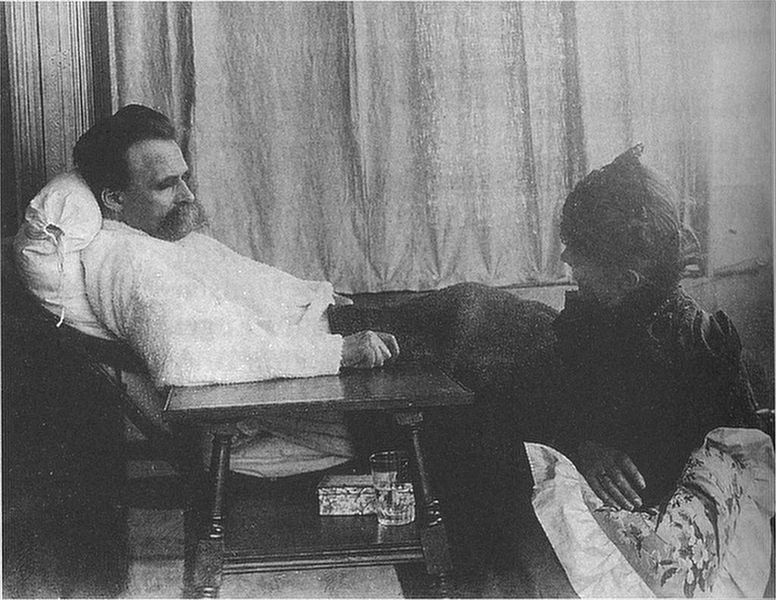
Nietzsche in 1899, Weakness catches up with all of us. (Source: Hans Olde, Sick NIetzsche Photo Series, 1899; Wikimedia Commons, PD-Old-100
Nietzsche’s Antichrist is on my all time favorite novels for a particular reason. His writing cannot always be taken as pure philosophy since many of the things he says are fictitious. The genre of fiction deflects much more of the interpretive task onto its readers than philosophy. On the other hand, philosophers tend to speak with authority, because they want their readers to believe what they say in some way corresponds to the way things are. Fiction, on the other hand, allows us to think about counterfactuals, about how things could be.
For example, Nietzsche says in his Antichrist:
Christianity remains to this day the greatest misfortune of humanity.
The following is the reason why:
Yes, weakness is a central Christian value.
The Christian movement, as a European movement, was from the start no more than a general uprising of all sorts of outcast and refuse elements (— who now, under cover of Christianity, aspire to power)—It does not represent the decay of a race; it represents, on the contrary, a conglomeration of decadence products from all directions, crowding together and seeking one another out. It was not, as has been thought, the corruption of antiquity, of noble antiquity, which made Christianity possible; one cannot too sharply challenge the learned imbecility which today maintains that theory. At the time when the sick and rotten Chandala classes in the whole imperium were Christianized, the contrary type, the nobility, reached its finest and ripest development. The majority became master; democracy, with its Christian instincts, triumphed… Christianity was not “national”, it was not based on race—it appealed to all the varieties of men disinherited by life, it had its allies everywhere. Christianity has the rancour of the sick at its very core—the instinct against the healthy, against health. Everything that is well— constituted, proud, gallant and, above all, beautiful gives offence to its ears and eyes. Again I remind you of Paul’s priceless saying: “And God hath chosen the weak things of the world, the foolish things of the world, the base things of the world, and things which are despised”:[1 Corinthians 1:27-28.] this was the formula; in hoc signo the decadence triumphed.—God on the cross—is man always to miss the frightful inner significance of this symbol?—Everything that suffers, everything that hangs on the cross, is divine… We all hang on the cross, consequently we are divine… We alone are divine… Christianity was thus a victory: a nobler attitude of mind was destroyed by it.
There seems to be quite a bit of hyperbole going on over here. Yet, it does seem to hit the core of Christianity. Kolakowski puts this radical change in the perspective of the problem of evil and the arguments for the existence of God plus how they play themselves out in secularism in his Freedom, Fame, Lying and Betrayal:
Suffering has always existed, but it seems only now to have become such an obvious and compelling argument against God. It is hard to say whether this is because there is more of it now than there was before. Perhaps we just feel it more: certainly we tend to feel, nowadays, that all suffering is unfair. This, however, is the result rather than the cause of our unbelief.

Kolakowski’s unorthodox essays on sundry subjects are not as breezy as their cover.
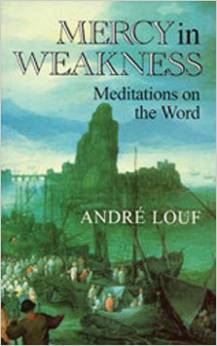
In his great Lenten preparation reflections, which I’ve written about before, Archbishop Sartain places weakness right in the middle of faith when he quotes Abbot Andre Louf’s Mercy in Weakness:
It is not the person who knows and is able to do things, who judges and condemns who practices faith. By believing a human being yields and surrenders, lowers his arms and drops his weapons; with his whole body and all his possessions he delivers himself up to love.
I can’t think of anything more challenging than this, especially in a time when I am as weak as I am. It is something I would like to throw off and struggle against. Why can’t I finally have some more control over my life? I’m just as ashamed of such a state of affairs as Nietzsche.
Yet, agnostics such as the philosopher Terry Eagleton and the Nobelist novelist J.M. Coetzee also both see this turn toward weakness as a strength, even as an extremely ruthless demand, of Christianity against the worldviews of antiquity and modernity.
Nietzsche in turn, depending on what day you catch him, also harbored positive appraisals of the Christian transvaluation of all values. Like a good novelist he reflected the polyphony of opinion for his readers. For example, here he is in The Gay Science (not a neuroscience fuelled gender studies manifesto!) presenting a heavily Arian (no, not in that sense, but in this one!) appraisal of Christianity:
Speaking in a parable.–A Jesus Christ was possible only in a Jewish landscape–I mean one over which the gloomy and sublime thunder cloud of the wrathful Yahweh was brooding continually. Only here was the rare and sudden piercing of the gruesome and perpetual general day-night by a single ray of the sun experienced as if it were a miracle of “love” and the ray of unmerited “grace.” Only here could Jesus dream of his rainbow and his ladder to heaven on which God descended to man. Everywhere else good weather and sunshine were considered the rule and everyday occurrences.
This seems a little bit too far the other way toward Jesus Christ, Superstar. But then I would argue that deep down there’s always a pious Nietzsche hiding from sight, ashamed of his dependence and disability.
To be honest: Christianity doesn’t produce weaklings; it finds us as we are.
Wouldn’t it be great if it was all glorious like this?
See my TOP10 novels list for Nietzsche and other great reads you’ve probably never heard of. There’s also a similar list of philosophy books if you have a weakness for books.
Previous Post

March 3, 2015
Even Demons Believe: Converting the World Will NOT Make Everyone Holy
Next Post

March 5, 2015 11 Most Important Critiques of Modernity According to Thomas Pfau
Browse Our Archives
Select a Category #WhyRemainCatholic Abortion Advent Anti-Catholicism Arts Atheism Beauty Benedict XVI Bible Book Review Catholic Cinema Comedy Cosmos: A Space-Time Odyssey Czesław Miłosz Dariusz Karłowicz Devil Easter Eastern Orthodoxy Economics Environment Family Famous Atheists Who Weren't Atheists Guest Post Hans Urs von Balthasar HHS Mandate History Imagination Interview Islam Jean-Luc Marion John Paul II Judaism Just War Lent Literature Little Sisters of the Poor Liturgy Martyrdom Music News Paganism Patristics Phenomenology Philosophy Pierre Hadot Poetry Poland Pop Culture Pope Francis Poverty Prayer Protestantism Rabelais Race Remi Brague Rene Girard Russia Sam Rocha Science & Religion SCOTUS Secularization Sexual Abuse Sexuality Silence Solidarity Stratford Caldecott Synod14 Terrorism Top 10 Uncategorized Walker Percy War Weakened Edition World War II World Youth Day WYD Krakow
Select a Month July 2017 June 2017 May 2017 April 2017 March 2017 February 2017 January 2017 December 2016 October 2016 September 2016 August 2016 July 2016 June 2016 May 2016 April 2016 March 2016 February 2016 January 2016 December 2015 November 2015 October 2015 September 2015 August 2015 July 2015 June 2015 May 2015 April 2015 March 2015 February 2015 January 2015 December 2014 November 2014 October 2014 September 2014 August 2014 July 2014 May 2014 April 2014 March 2014 February 2014 January 2014 December 2013 November 2013 October 2013 September 2013 August 2013 July 2013 June 2013 May 2013
Follow Us!
TAKE THE
Religious Wisdom Quiz
What did Daniel’s vision of the ram and the goat represent?
Select your answer to see how you score.
The Medo-Persian and Greek Empires The battle of good and evil The fall of Jerusalem The end of the world
Related posts from Cosmos The In Lost

The Surprising Anti-Capitalist Logic Behind the Catholic Church's...

What is the Source of Our Culture of...

The Holy Family as an Icon of World...

How is Classical Philosophy is Like War?
TRENDING AT PATHEOS Catholic

The Parable Of The Sower And The Word...
One of Christ’s most famous parables is that of the sower who...

Rejecting Doom: Christian Hope And Human Action
Christianity is a religion of hope. We are to have hope and...

Why I Choose the Eucharist Over the Sermon
Choose the Eucharist, Not the Sermon What are we supposed to get...

5 Design Elements Found in Spiritually Rooted Homes
Putting Spirituality Into Home Decor Our homes are more than our living...

Credo: A Story of God Told with the...
About 10 years ago, I began to imagine a personal "Credo" that...

The Anatomy of Divine Revelation in Catholic Thought
The claim that God has made Himself known to human beings is...
view all Catholic blogs
Ad-Free & Subscriber Log-In Subscription Support
- About Us
- 2026 Calendar
- Videos
- Podcasts
- Library of World Religions
- Faith In Media Tracker
- Advertise With Us
- Write for Us
- Privacy Policy
- Terms of Service
- Do Not Sell My Data
- Contact Us
- Radiant Digital
- Manage Newsletter Subscriptions
- Unsubscribe From Notifications
- Sitemap
Copyright 2008-2026, Patheos. All rights reserved.
Subscription Support Ad-Free & Subscriber Log-In
Follow Patheos