
BuddhistCatholicContemplativeEvangelicalGeneral ChristianHinduJewishLatter-day SaintMuslimNew VisionsProgressive Christian
Beliefs
- Buddhist
- Catholic
- Contemplative
- Evangelical
- General Christian
- Hindu
- Jewish
- Latter-day Saint
- More Voices
- Muslim
- New Visions
- Pagan
- Progressive Christian
Topics
- Religion News
- Food and Religion
- Sports and Religion
- Religious Art
- Religious Music and Entertainment
- Religious Events
- History and Religion
- Style and Religion
- Politics and Religion
- Women in Religion
- Recreation Outdoors and Religion
- Business Finance and Religion
- Careers Workplace and Religion
- Education and Religion
- Family Parenting and Religion
- Health Fitness and Religion
- Home and Religion
- Relationships and Religion
- Technology and Religion
- Travel and Religion
Columnists
- Buddhist Columnists
- Business Finance and Religion Columnists
- Careers Workplace and Religion Columnists
- Catholic Columnists
- Contemplative Columnists
- Education and Religion Columnists
- Evangelists Columnists
- Family Parenting and Religion Columnists
- General Christian Columnists
- Health Fitness and Religion Columnists
- Hindu Columnists
- History and Religion Columnists
- Home and Religion Columnists
- Jewish Columnists
- More Voices Columnists
- Latter Day Columnists
- Muslim Columnists
- New Visions Columnists
- Nonreligious Columnists
- Pagan Columnists
- Politics and Religion Columnists
- Progressive Columnists
- Recreation Outdoors and Religion Columnists
- Relationships and Religion Columnists
- Religion News Columnists
- Religious Art Columnists
- Religious Events Columnists
- Religious Music and Entertainment Columnists
- Sports and Religion Columnists
- Style and Religion Columnists
- Technology and Religion Columnists
- Travel and Religion Columnists
- Women in Religion Columnists
Resource Library
- 2026 Calendar
- Library of World Religions
- The 100 Most Holy Places on Earth
- Patheos Answers
- Podcasts
- Videos
- Faith Leaders Database
- Anglican Episcopalian
- Bahai
- Baptist
- Buddhism
- Christianity
- Confucianism
- Eastern Orthodoxy
- Hinduism
- Holiness and Pentecostal
- ISKCON
- Islam
- Judaism
- Lutheran
- Methodist
- The Church of Jesus Christ of Latter-day Saints
- New Age
- Paganism
- Presbytarian and Reformed
- Protestantism
- Religion Behind the Scenes
- Roman Catholic
- Scientology
- Shia Islam
- Sikhism
- Sufism
- Sunni Islam
- Taoism
- Zen
- See all religions
Research Tools
 Ad-Free & Subscriber Log-In Subscription Support
Ad-Free & Subscriber Log-In Subscription Support
Follow Patheos 

- Trending:
- Forgiveness
- |
- Marriage
- |
- Consciousness
- |
- Death Penalty
- |
- Election
- |
- Halloween
 Cosmos The In Lost
- Home
- Catholic
- The West Was Never Western: Creative Plagiarism, Rome, Tracing
The West Was Never Western: Creative Plagiarism, Rome, Tracing
Last updated on: February 27, 2015 at 2:09 pm by Artur Rosman
The West Was Never Western: Creative Plagiarism, Rome, Tracing 2015-02-27T14:09:46-07:00 Artur Rosman
Patheos Explore the world's faith through different perspectives on religion and spirituality! Patheos has the views of the prevalent religions and spiritualities of the world.
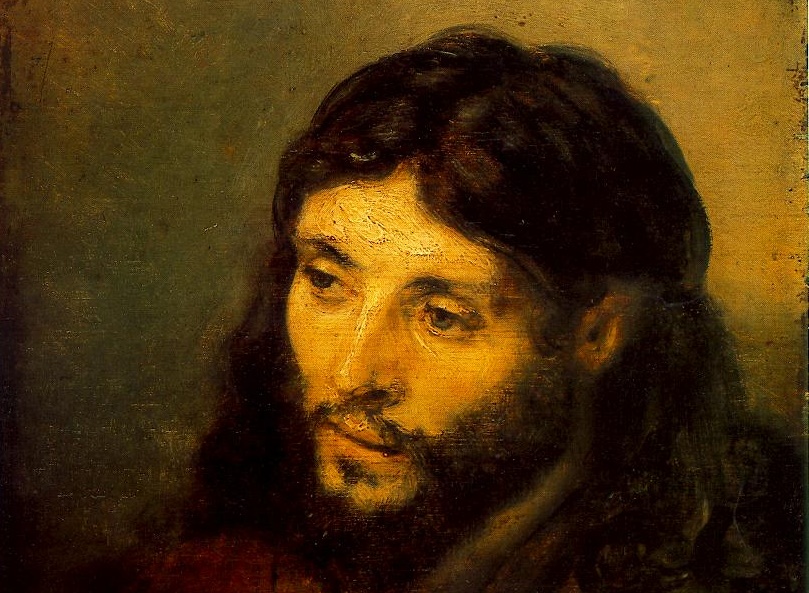
Jesus and his very Jewish religion was not born in London, Berlin, Paris, or Rome–the first three were backwaters during his time anyway. (Rembrandt, Young Jew as Jesus, 1648; Source: Wikimedia Commons, PD-Old-100)
I was recently reminded of a quip in Woody Allen’s Annie Hall. His character says:
I was thrown out of college for cheating on the metaphysics exam; I looked into the soul of the boy sitting next to me.
I believe this episode of copying is fruitful for thinking about what so-called Western culture really is and is not.
The quip came back to me yesterday during Sam Rocha‘s Catholic Philosophy 101 lecture at the University of Washington’s Newman Center (part 2 comes next Wednesday 7PM) when religion scholar and Far East expert Justin Tse said “YESSS!” loudly and slammed down his fist.
Tse in turn reminded me of an episode Chesterton recounts. According to G.K. Aquinas was always digesting problems wherever he went; he never stopped thinking. One such episode involved a serious breach of etiquette. In the middle of dinner with the French king Aquinas said, “That’ll take care of the Albigensians!,” and slammed down his fist down on the dinner table sending plates flying. Nobody does that to the king, except for Aquinas. The king didn’t lose his cool and asked for someone to bring writing implements for the theologian.
The connection between these two events is somewhat odd, because it was occasioned by an anti-triumphalist statement made by Rocha. Sam was talking about Catholics coming out of their ghetto of fear: fear of postmodernism, fear of relativism, fear of the modern world, fear of people who think otherwise than they do. Sam gave Aquinas as a counterexample.
Aquinas bravely went against the established canons of his time by adopting not only Aristotle, but also some of the arguments of Jewish and Muslim thinkers who preserved Aristotle then transmitted him to back to the West after he mostly disappeared from the scene sometime in late antiquity.
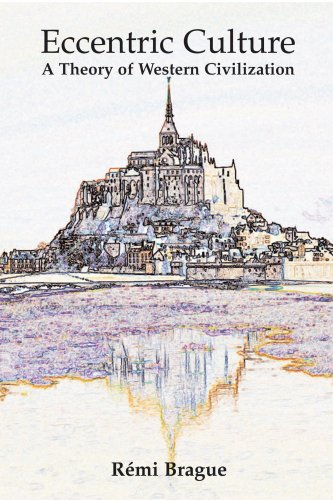
According to Brague the West does not so much invent as it reflects what is best in other cultures.
Rocha’s conclusion from this historical fact was: The West has never been Western.
I believe he is correct.
His insight goes way beyond the one historical moment. Nearly all the cornerstones of what we think of as Western culture are borrowings from other, non-European cultures. Europe is a culture of creative plagiarism.
According to both Plato (think: Egyptians) and Walter Burkert’s The Orientalizing Revolution, Greek philosophy is a borrowing, rather than something that miraculously appeared in Greece without precedent. It should be much more obvious that the Judeo-Christian religious foundation of the West did not originate in the West.
The book on all of this has, of course, already been written. Remi Brague lays out the non-Western sources of religion, philosophy, and many other inventions we think of as uniquely Western in his Eccentric Culture: A Theory of Western Civilization. Brauge’s argument is that the core of the Western tradition lies in its continued borrowing and reshaping of non-Western traditions. In other words, the West is most West when it borrows from the non-Western. He calls this creative plagiarism “Roman” and its manifestations “Romanity.” Here is why:
To say that we are Roman is entirely the contrary of identifying ourselves with a prestigious ancestor. It is rather a divestiture, not a claim. It is to recognize that fundamentally we have invented nothing, but simply that we learned how to transmit a current come from higher up, without interrupting it, and all the while placing ourselves back in it.
This work of recognizing the higher and transmitting it is also internal, as when the Romans borrowed the borrowed concepts of Greece. This work of transmission and translation continues to this day in, for example, in Eastern Europe. If we look at only Poland then writers such as Czeslaw Milosz, Jozef Tischner, Gustaw Herling, Krzysztof Michalski, and Zbigniew Herbert made some of the most profound recent contributions to sifting through what is highest in Western culture while keeping a critically appreciative eye on the Russian East.
The “creative plagiarist” label for the West is not an insult. There is a certain humility in recognizing what is higher and adopting it.
Doesn’t Paul use the language of adoption to speak of our relationship with God? There is also a Trinitarian analogy here. I’m thinking of an argument Joseph Ratzinger makes, I believe in his Introduction to Christianity. He says something to the effect that the Fathers used and advanced Greek philosophy during the Trinitarian debates by positing “relation” as a substance, a kind of “substantive relation” as an ontological given; just as the persons of the Trinity are defined by their relations, so is the rest of reality. In other words, “No man is an island.”
I believe this is also part of what I mean as I’ve been groping towards while developing the concept of a messy and impure Rabelaisian Catholicism. Perhaps there are still things to learn from Islamic cultures, as some argued in the 19th century?
In other ways, although he would surely dispute this since he saw himself as working against the grain of Western thinking, the philosophy of the Other developed by Levinas in influential texts such as Otherwise than Being and Totality and Infinity is a classically Western form of thinking. I owe this last connection to Thomas Pfau’s pathbreaking work Minding the Modern. OK, now we’ve come full circle.
In conclusion, against Chasing Amy, I’d like to say there’s much to be said for tracing:
If you want to explore more about the relationship between philosophy and theology see the TOP10 list of my favorite philosophy books, my report on the return of religion to French philosophy, and my essay on St. Socrates and the Church Fathers.


Browse Our Archives
Select a Category #WhyRemainCatholic Abortion Advent Anti-Catholicism Arts Atheism Beauty Benedict XVI Bible Book Review Catholic Cinema Comedy Cosmos: A Space-Time Odyssey Czesław Miłosz Dariusz Karłowicz Devil Easter Eastern Orthodoxy Economics Environment Family Famous Atheists Who Weren't Atheists Guest Post Hans Urs von Balthasar HHS Mandate History Imagination Interview Islam Jean-Luc Marion John Paul II Judaism Just War Lent Literature Little Sisters of the Poor Liturgy Martyrdom Music News Paganism Patristics Phenomenology Philosophy Pierre Hadot Poetry Poland Pop Culture Pope Francis Poverty Prayer Protestantism Rabelais Race Remi Brague Rene Girard Russia Sam Rocha Science & Religion SCOTUS Secularization Sexual Abuse Sexuality Silence Solidarity Stratford Caldecott Synod14 Terrorism Top 10 Uncategorized Walker Percy War Weakened Edition World War II World Youth Day WYD Krakow
Select a Month July 2017 June 2017 May 2017 April 2017 March 2017 February 2017 January 2017 December 2016 October 2016 September 2016 August 2016 July 2016 June 2016 May 2016 April 2016 March 2016 February 2016 January 2016 December 2015 November 2015 October 2015 September 2015 August 2015 July 2015 June 2015 May 2015 April 2015 March 2015 February 2015 January 2015 December 2014 November 2014 October 2014 September 2014 August 2014 July 2014 May 2014 April 2014 March 2014 February 2014 January 2014 December 2013 November 2013 October 2013 September 2013 August 2013 July 2013 June 2013 May 2013
Follow Us!
TAKE THE
Religious Wisdom Quiz
Which prophet's visions include "Gog and Magog"?
Select your answer to see how you score.
Micah Daniel Ezekiel Amos
Related posts from Cosmos The In Lost

The Surprising Anti-Capitalist Logic Behind the Catholic Church's...

The Holy Family as an Icon of World...

How is Classical Philosophy is Like War?

Why Does the World's Leading Philosopher Remain a...
TRENDING AT PATHEOS Catholic

Rejecting Doom: Christian Hope And Human Action
Christianity is a religion of hope. We are to have hope and...

It’s What Comes From Within Which Matters
One of the most difficult things for us to understand is why...

Why I Choose the Eucharist Over the Sermon
Choose the Eucharist, Not the Sermon What are we supposed to get...

5 Design Elements Found in Spiritually Rooted Homes
Putting Spirituality Into Home Decor Our homes are more than our living...

Credo: A Story of God Told with the...
About 10 years ago, I began to imagine a personal "Credo" that...

The Anatomy of Divine Revelation in Catholic Thought
The claim that God has made Himself known to human beings is...
view all Catholic blogs
Ad-Free & Subscriber Log-In Subscription Support
- About Us
- 2026 Calendar
- Videos
- Podcasts
- Library of World Religions
- Faith In Media Tracker
- Advertise With Us
- Write for Us
- Privacy Policy
- Terms of Service
- Do Not Sell My Data
- Contact Us
- Radiant Digital
- Manage Newsletter Subscriptions
- Unsubscribe From Notifications
- Sitemap
Copyright 2008-2026, Patheos. All rights reserved.
Subscription Support Ad-Free & Subscriber Log-In
Follow Patheos