
BuddhistCatholicContemplativeEvangelicalGeneral ChristianHinduJewishLatter-day SaintMuslimNew VisionsProgressive Christian
Beliefs
- Buddhist
- Catholic
- Contemplative
- Evangelical
- General Christian
- Hindu
- Jewish
- Latter-day Saint
- More Voices
- Muslim
- New Visions
- Pagan
- Progressive Christian
Topics
- Religion News
- Food and Religion
- Sports and Religion
- Religious Art
- Religious Music and Entertainment
- Religious Events
- History and Religion
- Style and Religion
- Politics and Religion
- Women in Religion
- Recreation Outdoors and Religion
- Business Finance and Religion
- Careers Workplace and Religion
- Education and Religion
- Family Parenting and Religion
- Health Fitness and Religion
- Home and Religion
- Relationships and Religion
- Technology and Religion
- Travel and Religion
Columnists
- Buddhist Columnists
- Business Finance and Religion Columnists
- Careers Workplace and Religion Columnists
- Catholic Columnists
- Contemplative Columnists
- Education and Religion Columnists
- Evangelists Columnists
- Family Parenting and Religion Columnists
- General Christian Columnists
- Health Fitness and Religion Columnists
- Hindu Columnists
- History and Religion Columnists
- Home and Religion Columnists
- Jewish Columnists
- More Voices Columnists
- Latter Day Columnists
- Muslim Columnists
- New Visions Columnists
- Nonreligious Columnists
- Pagan Columnists
- Politics and Religion Columnists
- Progressive Columnists
- Recreation Outdoors and Religion Columnists
- Relationships and Religion Columnists
- Religion News Columnists
- Religious Art Columnists
- Religious Events Columnists
- Religious Music and Entertainment Columnists
- Sports and Religion Columnists
- Style and Religion Columnists
- Technology and Religion Columnists
- Travel and Religion Columnists
- Women in Religion Columnists
Resource Library
- 2026 Calendar
- Library of World Religions
- The 100 Most Holy Places on Earth
- Patheos Answers
- Podcasts
- Videos
- Faith Leaders Database
- Anglican Episcopalian
- Bahai
- Baptist
- Buddhism
- Christianity
- Confucianism
- Eastern Orthodoxy
- Hinduism
- Holiness and Pentecostal
- ISKCON
- Islam
- Judaism
- Lutheran
- Methodist
- The Church of Jesus Christ of Latter-day Saints
- New Age
- Paganism
- Presbytarian and Reformed
- Protestantism
- Religion Behind the Scenes
- Roman Catholic
- Scientology
- Shia Islam
- Sikhism
- Sufism
- Sunni Islam
- Taoism
- Zen
- See all religions
Research Tools
 Ad-Free & Subscriber Log-In Subscription Support
Ad-Free & Subscriber Log-In Subscription Support
Follow Patheos 

- Trending:
- Forgiveness
- |
- Marriage
- |
- Consciousness
- |
- Death Penalty
- |
- Election
- |
- Halloween
 Cosmos The In Lost
- Home
- Catholic
- Carnival is Getting off the Ground: Stoop Down & Meet St. Puke!
Carnival is Getting off the Ground: Stoop Down & Meet St. Puke!
Last updated on: February 13, 2015 at 3:32 pm by Artur Rosman
Carnival is Getting off the Ground: Stoop Down & Meet St. Puke! 2015-02-13T15:32:38-07:00 Artur Rosman
Patheos Explore the world's faith through different perspectives on religion and spirituality! Patheos has the views of the prevalent religions and spiritualities of the world.
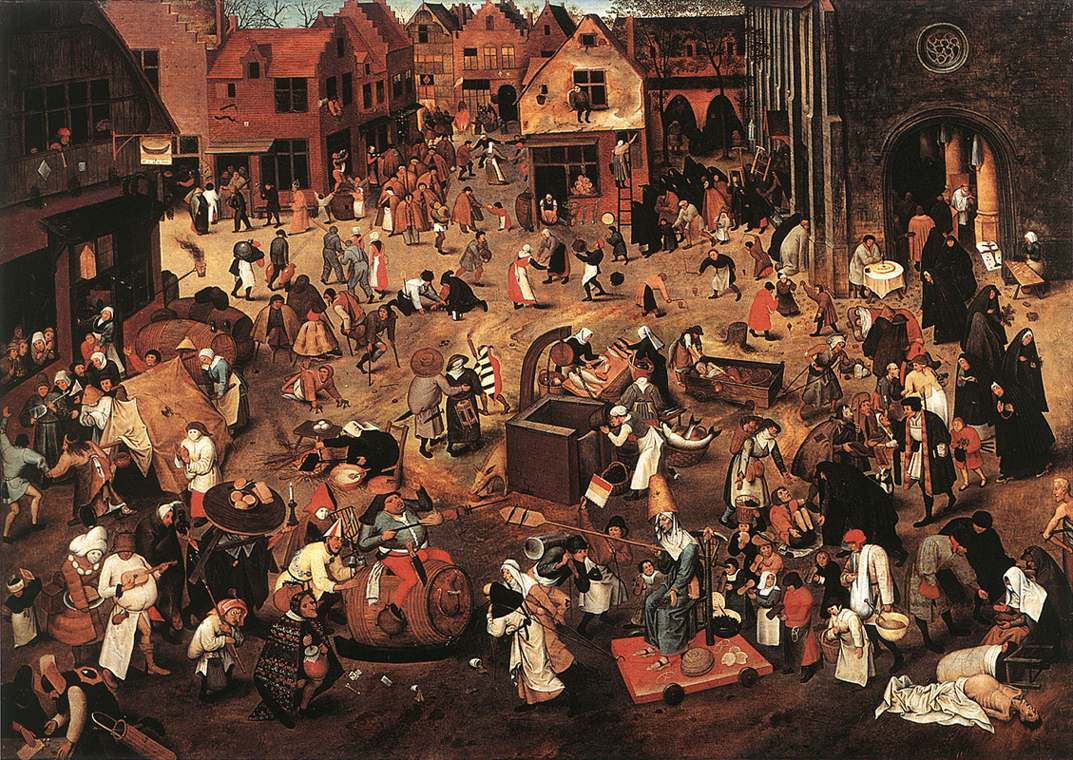
“The Fight Between Carnival and Lent” by Pieter Breugel (1559) [Source: Wikimedia Commons, PD-Old-100], or, what John Bossy calls “Traditional Christianity“
I’ve been catching up on reading of late. It’s part of my effort to deepen my understanding of what a Catholic imagination means in comparison with a Protestant imagination as they attempt to image God, cosmos, and woman in their distinct, but complimentary ways.
Before I get to the juicy stuff I’d like to sing the praises of William Dyrness’s Reformed Theology and Visual Culture: The Protestant Imagination from Calvin to Edwards. His analysis overlaps with the analyses of Andrew Greeley and David Tracy, although he only concentrates upon the Protestant imagination. This is refreshing, because Catholics seem to have cornered the religious imagination book market.
Carnival ends in less than a week.
The only comparable thing I can think of in the Protestant tradition(s) is the great orgy of (mostly Calvinist?) image breaking. The strength of Dyrness’s book lies in his courage in not eliding what might seem like an embarrassing episode. This is how he breaks down the coherent theological logic of iconoclasm:
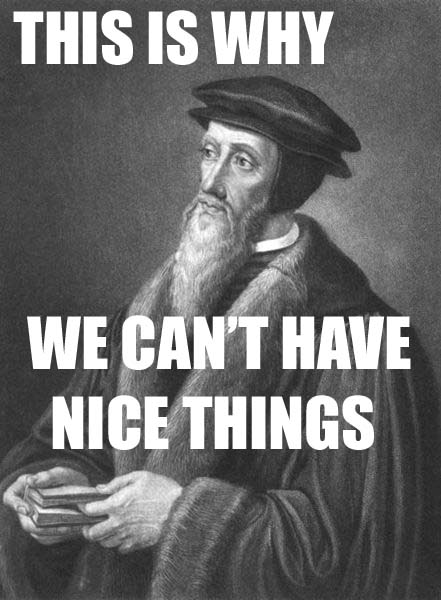
Dyrness says it’s because Calvinists take images as seriously as Catholics.
The Protestant suspicion toward images and the external mediation of grace connects with the ancient apophatic tradition [questionable] in the Church. Since God is separate from the world, and those created in the divine image have their eyesight so severely damaged, on must treat all human constructions of God with suspicion.
If one accepts this view of things, Calvin’s scruples would have been more realistic than Luther’s tolerance. For Calvin understood that in a sinful world patterns and practices often coalesce into particular images, and if health is to be restore, these images must not only be denounced but they must also be destroyed. For the reformers knew that much more was at stake than cultural products alone.
If there is one thing that I’ve learned from John Bossy’s rollicking and jolly history of Christianity in the West 1400-1700 is that Catholics tend to put on display the scandalous aspects of being human that might understandably offend (some? most?) Protestants. What’s fascinating is how Catholicism does this with the same intention of facing up to human sin as the Protestants:

John Bossy’s middle ages look like a tempting time.
Carnival normally occurred, and has continued to occur, as a series of three or six days ending on Shrove Tuesday or Mardi Gras. These were feast-days in that work was prohibited, the private became public, and communities functioned as a whole or through bodies specially created for the purpose. The object of the feast was to represent the workings of carnality in general and, out of the doings of the past year, to bring the corpus of sin to light, in order that it might be got rid of in time for Lent. Carnality was almost invariably embodied in a carnival figure who dominated the feast, was carried in procession during it, and tried, condemned, and executed (usually by burning) at the end of it. In these more formal proceedings the sevens sins were represented by Gluttony, just as abstinence from meat had come to represent the penitential asceticisms of Lent. Carnival was a fat man; during the feast it was obligatory to eat a great deal, especially fat things like pigs and pumpkins, and drink to match; in Nantes Shrove Tuesday was dedicated to St. Dégobillard (St. Vomit), whom one may think an appropriate patron for the whole feast.
For more on Carnival’s reversal of everyday order see Mikhail Bakhtin’s classic Rabelais and His World. He also talks about Carnival in his equally famous (and useful) Dostoevsky book on polyphony in the Russian’s novels:
Carnival is a pageant without footlights and without a division into performers and spectators. In carnival everyone is an active participant, everyone communes in the carnival act… The laws, prohibitions, and restrictions that determine the structure and order of ordinary, that is noncarnival, life are suspended during carnival: what is suspended first is hierarchical structure and all the forms of terror, reverence, piety, and etiquette connected with it… or any other form of inequality among people.
Here is a medieval Vespers sung by the Polish group Theater Węgajty to encourage you to nevertheless keep Lent asceticism in mind (for later, not just yet):
http://www.youtube.com/watch?v=R3WTht_KAlo
Before I go….
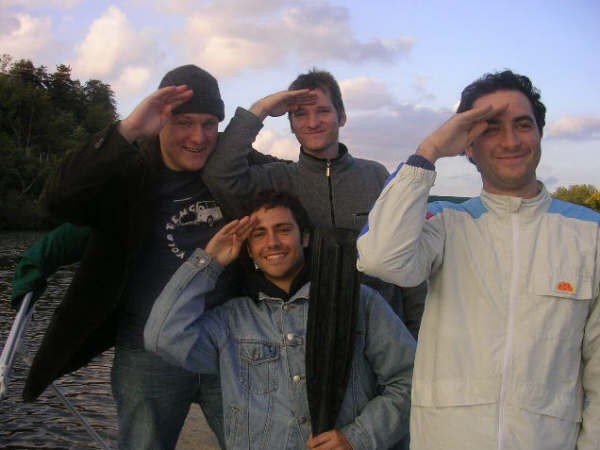
Here I am (upper left) severely hungover (bleargh!) with Italian and American friends on the Loire River in Nantes, site of the first modern genocide.
For more feasting see my Theology of Food Booklist.
Previous Post
February 12, 2015
The Catholic Valentine's Creepier than 50 Shades
Browse Our Archives
Select a Category #WhyRemainCatholic Abortion Advent Anti-Catholicism Arts Atheism Beauty Benedict XVI Bible Book Review Catholic Cinema Comedy Cosmos: A Space-Time Odyssey Czesław Miłosz Dariusz Karłowicz Devil Easter Eastern Orthodoxy Economics Environment Family Famous Atheists Who Weren't Atheists Guest Post Hans Urs von Balthasar HHS Mandate History Imagination Interview Islam Jean-Luc Marion John Paul II Judaism Just War Lent Literature Little Sisters of the Poor Liturgy Martyrdom Music News Paganism Patristics Phenomenology Philosophy Pierre Hadot Poetry Poland Pop Culture Pope Francis Poverty Prayer Protestantism Rabelais Race Remi Brague Rene Girard Russia Sam Rocha Science & Religion SCOTUS Secularization Sexual Abuse Sexuality Silence Solidarity Stratford Caldecott Synod14 Terrorism Top 10 Uncategorized Walker Percy War Weakened Edition World War II World Youth Day WYD Krakow
Select a Month July 2017 June 2017 May 2017 April 2017 March 2017 February 2017 January 2017 December 2016 October 2016 September 2016 August 2016 July 2016 June 2016 May 2016 April 2016 March 2016 February 2016 January 2016 December 2015 November 2015 October 2015 September 2015 August 2015 July 2015 June 2015 May 2015 April 2015 March 2015 February 2015 January 2015 December 2014 November 2014 October 2014 September 2014 August 2014 July 2014 May 2014 April 2014 March 2014 February 2014 January 2014 December 2013 November 2013 October 2013 September 2013 August 2013 July 2013 June 2013 May 2013
Follow Us!
TAKE THE
Religious Wisdom Quiz
What did Jesus use to heal a blind man in John 9?
Select your answer to see how you score.
Mud and saliva His robe Olive oil A fig leaf
Related posts from Cosmos The In Lost

The Surprising Anti-Capitalist Logic Behind the Catholic Church's...

The Holy Family as an Icon of World...

How is Classical Philosophy is Like War?

Why Does the World's Leading Philosopher Remain a...
TRENDING AT PATHEOS Catholic

Rejecting Doom: Christian Hope And Human Action
Christianity is a religion of hope. We are to have hope and...

It’s What Comes From Within Which Matters
One of the most difficult things for us to understand is why...

Why I Choose the Eucharist Over the Sermon
Choose the Eucharist, Not the Sermon What are we supposed to get...

5 Design Elements Found in Spiritually Rooted Homes
Putting Spirituality Into Home Decor Our homes are more than our living...

Credo: A Story of God Told with the...
About 10 years ago, I began to imagine a personal "Credo" that...

The Anatomy of Divine Revelation in Catholic Thought
The claim that God has made Himself known to human beings is...
view all Catholic blogs
Ad-Free & Subscriber Log-In Subscription Support
- About Us
- 2026 Calendar
- Videos
- Podcasts
- Library of World Religions
- Faith In Media Tracker
- Advertise With Us
- Write for Us
- Privacy Policy
- Terms of Service
- Do Not Sell My Data
- Contact Us
- Radiant Digital
- Manage Newsletter Subscriptions
- Unsubscribe From Notifications
- Sitemap
Copyright 2008-2026, Patheos. All rights reserved.
Subscription Support Ad-Free & Subscriber Log-In
Follow Patheos