
BuddhistCatholicContemplativeEvangelicalGeneral ChristianHinduJewishLatter-day SaintMuslimNew VisionsProgressive Christian
Beliefs
- Buddhist
- Catholic
- Contemplative
- Evangelical
- General Christian
- Hindu
- Jewish
- Latter-day Saint
- More Voices
- Muslim
- New Visions
- Pagan
- Progressive Christian
Topics
- Religion News
- Food and Religion
- Sports and Religion
- Religious Art
- Religious Music and Entertainment
- Religious Events
- History and Religion
- Style and Religion
- Politics and Religion
- Women in Religion
- Recreation Outdoors and Religion
- Business Finance and Religion
- Careers Workplace and Religion
- Education and Religion
- Family Parenting and Religion
- Health Fitness and Religion
- Home and Religion
- Relationships and Religion
- Technology and Religion
- Travel and Religion
Columnists
- Buddhist Columnists
- Business Finance and Religion Columnists
- Careers Workplace and Religion Columnists
- Catholic Columnists
- Contemplative Columnists
- Education and Religion Columnists
- Evangelists Columnists
- Family Parenting and Religion Columnists
- General Christian Columnists
- Health Fitness and Religion Columnists
- Hindu Columnists
- History and Religion Columnists
- Home and Religion Columnists
- Jewish Columnists
- More Voices Columnists
- Latter Day Columnists
- Muslim Columnists
- New Visions Columnists
- Nonreligious Columnists
- Pagan Columnists
- Politics and Religion Columnists
- Progressive Columnists
- Recreation Outdoors and Religion Columnists
- Relationships and Religion Columnists
- Religion News Columnists
- Religious Art Columnists
- Religious Events Columnists
- Religious Music and Entertainment Columnists
- Sports and Religion Columnists
- Style and Religion Columnists
- Technology and Religion Columnists
- Travel and Religion Columnists
- Women in Religion Columnists
Resource Library
- 2026 Calendar
- Library of World Religions
- The 100 Most Holy Places on Earth
- Patheos Answers
- Podcasts
- Videos
- Faith Leaders Database
- Anglican Episcopalian
- Bahai
- Baptist
- Buddhism
- Christianity
- Confucianism
- Eastern Orthodoxy
- Hinduism
- Holiness and Pentecostal
- ISKCON
- Islam
- Judaism
- Lutheran
- Methodist
- The Church of Jesus Christ of Latter-day Saints
- New Age
- Paganism
- Presbytarian and Reformed
- Protestantism
- Religion Behind the Scenes
- Roman Catholic
- Scientology
- Shia Islam
- Sikhism
- Sufism
- Sunni Islam
- Taoism
- Zen
- See all religions
Research Tools
 Ad-Free & Subscriber Log-In Subscription Support
Ad-Free & Subscriber Log-In Subscription Support
Follow Patheos 

- Trending:
- Forgiveness
- |
- Marriage
- |
- Consciousness
- |
- Death Penalty
- |
- Election
- |
- Halloween
 Cosmos The In Lost
- Home
- Catholic
- How Did Disappearing Middle Eastern Religions Survive in the First Place?
How Did Disappearing Middle Eastern Religions Survive in the First Place?
Last updated on: January 26, 2015 at 11:44 pm by Artur Rosman
How Did Disappearing Middle Eastern Religions Survive in the First Place? 2015-01-26T23:44:09-07:00 Artur Rosman
Patheos Explore the world's faith through different perspectives on religion and spirituality! Patheos has the views of the prevalent religions and spiritualities of the world.

Roll the gray areas of Kapuscinski’s life into your rolling papers and smoke them.
Gerard Russell’s Heirs to Forgotten Kingdoms: Journeys Into the Disappearing Religions of the Middle East should be on everyone’s reading list. Its discussion of Islam’s coexistence with ancient faiths gives us hints about our Jewish and Christian roots. It is a necessary corrective to the one-sided coverage of Islam in the media and among combox tyrants.
Russell is a bit like the recently deceased Polish eyewitness journalist and (time-) travel writer Ryszard Kapuscinski, author of Shah of Shahs (on events leading up to the Iranian Revolution), Imperium (on the state of Russia after the Soviet collapse), and The Emperor (on Ethiopian dictator Haile Selassie).
Russell has Kapuscinski’s eye for the surrealist detail, the grotesque regional quirk, and the banality of the humanity’s addiction to violence. He compliments all these foci with a real eye for the intricacies of religious practice and belief (in that order).
From the opening bell Russell’s book forces readers to change their hermeneutic frames with a counterfactual experiment:
Imagine that the worship of the goddess Aphrodite was still continuing on a remote Greek Island, that worshippers of Wotan and Thor had only just given up building longboats on the coasts of Scandinavia, or that followers of the god Mithras were still exchanging ceremonial handshakes in subterranean Roman chapels.
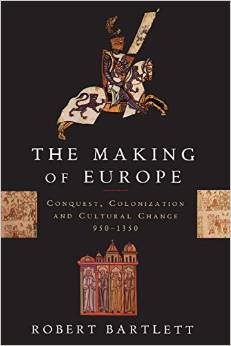
It’s easy to forget colonization is something Europe did primarily to itself.
This is difficult to imagine because proto-colonial Christian governments rooted out pagan religion or Christian theology effectively absorbed paganism into, and with the help of, its incarnational logic.
I was born in Warsaw, Poland and spent a part of my childhood there. However, my father comes from the Mazury region of Poland, formerly Prussia, formerly the realm of the Teutonic Knights. The Knights set out from their base in Malbork Castle to forcibly convert the last pagans of Europe in regions now mostly integrated into Lithuania.
The Polish defeat of the Knights in 1410 at Grunwald is still a major source of national pride. It is also a reminder of the violent colonial past of the region. Furthermore, it is a sore point for Germans. For example, Hitler saw his Polish campaign as avenging the 1410 defeat.
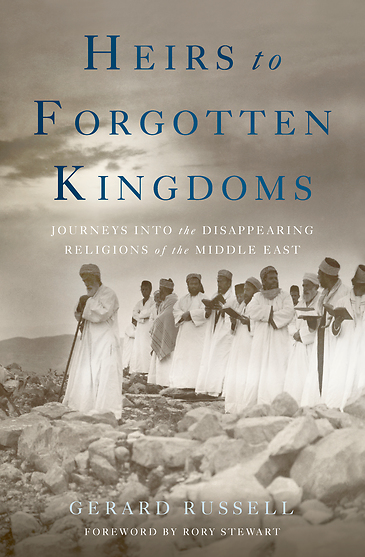
The Middle East’s ancient surviving religions provide hints to Jewish, Christian, and Muslim origins.
Now contrast this with the Russell’s presentation of his region of interest:
In the Middle East, in contrast to Europe, equally ancient religions survived–often in marches wildernesses, mountains, and other remote or impenetrable places, and sometimes under the veil of a strict code of secrecy.
Russell’s book then aims to answer the questions that arise from this state of things:
How did they survive so long under Muslim rule? Very often Islam is presented as an intolerant religion, and some of its followers regrettably want it to be so. The existence of the minority religions described in this book shows that image of intolerance untrue, for they survived under Islam, while no equivalent faith survived in Christian Europe. The reasons for this, though, are complex.
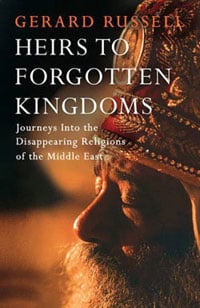
The recently much discussed Copts are not only the subject of the penultimate chapter of the book and also its European cover.
Some of the reasons Russell gives are:
1) The old religions of the Middles East were more advanced than European paganism and could outmaneuver their potential colonizers
2) Early Muslims were not systematic about eliminating religious minorities, and they had loopholes for “people of the book” and a vague catch-all category called the “Sabians”
3) Premodern Muslim governments were also too weak and divided to impose their religion.
This outline gives us a much more complex picture than the Islam is pure-and-simple violent meme.The question remains: Why are these religions disappearing now?
On a lighter side, the following Polish film trailer goes to show that even anti-colonial battles can be turned into capitalist kitsch:
For more on religion and world politics see my Top10 book list on the topic.
If you are interested in finding out more strange things about Poland you should look at my Catholiclandia series.
All my posts on Islam can be found here.
Previous Post

January 20, 2015
A Breakdown of the Conservative Catholic Hermeneutic of Contiguity?
Next Post

January 22, 2015 #Roe42: Abortion, Cognitive Bias & the Problem of Representation
Browse Our Archives
Select a Category #WhyRemainCatholic Abortion Advent Anti-Catholicism Arts Atheism Beauty Benedict XVI Bible Book Review Catholic Cinema Comedy Cosmos: A Space-Time Odyssey Czesław Miłosz Dariusz Karłowicz Devil Easter Eastern Orthodoxy Economics Environment Family Famous Atheists Who Weren't Atheists Guest Post Hans Urs von Balthasar HHS Mandate History Imagination Interview Islam Jean-Luc Marion John Paul II Judaism Just War Lent Literature Little Sisters of the Poor Liturgy Martyrdom Music News Paganism Patristics Phenomenology Philosophy Pierre Hadot Poetry Poland Pop Culture Pope Francis Poverty Prayer Protestantism Rabelais Race Remi Brague Rene Girard Russia Sam Rocha Science & Religion SCOTUS Secularization Sexual Abuse Sexuality Silence Solidarity Stratford Caldecott Synod14 Terrorism Top 10 Uncategorized Walker Percy War Weakened Edition World War II World Youth Day WYD Krakow
Select a Month July 2017 June 2017 May 2017 April 2017 March 2017 February 2017 January 2017 December 2016 October 2016 September 2016 August 2016 July 2016 June 2016 May 2016 April 2016 March 2016 February 2016 January 2016 December 2015 November 2015 October 2015 September 2015 August 2015 July 2015 June 2015 May 2015 April 2015 March 2015 February 2015 January 2015 December 2014 November 2014 October 2014 September 2014 August 2014 July 2014 May 2014 April 2014 March 2014 February 2014 January 2014 December 2013 November 2013 October 2013 September 2013 August 2013 July 2013 June 2013 May 2013
Follow Us!
TAKE THE
Religious Wisdom Quiz
What city was Jesus born in?
Select your answer to see how you score.
Bethlehem Nazareth Jerusalem Capernaum
Related posts from Cosmos The In Lost

The Surprising Anti-Capitalist Logic Behind the Catholic Church's...

The Holy Family as an Icon of World...

Biblical Authority After Babel Cannot Be Built Upon...
Western Civ Doesn't Need Tenured Radicals to Ruin...
TRENDING AT PATHEOS Catholic

Rejecting Doom: Christian Hope And Human Action
Christianity is a religion of hope. We are to have hope and...

It’s What Comes From Within Which Matters
One of the most difficult things for us to understand is why...

Why I Choose the Eucharist Over the Sermon
Choose the Eucharist, Not the Sermon What are we supposed to get...

5 Design Elements Found in Spiritually Rooted Homes
Putting Spirituality Into Home Decor Our homes are more than our living...

Credo: A Story of God Told with the...
About 10 years ago, I began to imagine a personal "Credo" that...

The Anatomy of Divine Revelation in Catholic Thought
The claim that God has made Himself known to human beings is...
view all Catholic blogs
Ad-Free & Subscriber Log-In Subscription Support
- About Us
- 2026 Calendar
- Videos
- Podcasts
- Library of World Religions
- Faith In Media Tracker
- Advertise With Us
- Write for Us
- Privacy Policy
- Terms of Service
- Do Not Sell My Data
- Contact Us
- Radiant Digital
- Manage Newsletter Subscriptions
- Unsubscribe From Notifications
- Sitemap
Copyright 2008-2026, Patheos. All rights reserved.
Subscription Support Ad-Free & Subscriber Log-In
Follow Patheos