
BuddhistCatholicContemplativeEvangelicalGeneral ChristianHinduJewishLatter-day SaintMuslimNew VisionsProgressive Christian
Beliefs
- Buddhist
- Catholic
- Contemplative
- Evangelical
- General Christian
- Hindu
- Jewish
- Latter-day Saint
- More Voices
- Muslim
- New Visions
- Pagan
- Progressive Christian
Topics
- Religion News
- Food and Religion
- Sports and Religion
- Religious Art
- Religious Music and Entertainment
- Religious Events
- History and Religion
- Style and Religion
- Politics and Religion
- Women in Religion
- Recreation Outdoors and Religion
- Business Finance and Religion
- Careers Workplace and Religion
- Education and Religion
- Family Parenting and Religion
- Health Fitness and Religion
- Home and Religion
- Relationships and Religion
- Technology and Religion
- Travel and Religion
Columnists
- Buddhist Columnists
- Business Finance and Religion Columnists
- Careers Workplace and Religion Columnists
- Catholic Columnists
- Contemplative Columnists
- Education and Religion Columnists
- Evangelists Columnists
- Family Parenting and Religion Columnists
- General Christian Columnists
- Health Fitness and Religion Columnists
- Hindu Columnists
- History and Religion Columnists
- Home and Religion Columnists
- Jewish Columnists
- More Voices Columnists
- Latter Day Columnists
- Muslim Columnists
- New Visions Columnists
- Nonreligious Columnists
- Pagan Columnists
- Politics and Religion Columnists
- Progressive Columnists
- Recreation Outdoors and Religion Columnists
- Relationships and Religion Columnists
- Religion News Columnists
- Religious Art Columnists
- Religious Events Columnists
- Religious Music and Entertainment Columnists
- Sports and Religion Columnists
- Style and Religion Columnists
- Technology and Religion Columnists
- Travel and Religion Columnists
- Women in Religion Columnists
Resource Library
- 2026 Calendar
- Library of World Religions
- The 100 Most Holy Places on Earth
- Patheos Answers
- Podcasts
- Videos
- Faith Leaders Database
- Anglican Episcopalian
- Bahai
- Baptist
- Buddhism
- Christianity
- Confucianism
- Eastern Orthodoxy
- Hinduism
- Holiness and Pentecostal
- ISKCON
- Islam
- Judaism
- Lutheran
- Methodist
- The Church of Jesus Christ of Latter-day Saints
- New Age
- Paganism
- Presbytarian and Reformed
- Protestantism
- Religion Behind the Scenes
- Roman Catholic
- Scientology
- Shia Islam
- Sikhism
- Sufism
- Sunni Islam
- Taoism
- Zen
- See all religions
Research Tools
 Ad-Free & Subscriber Log-In Subscription Support
Ad-Free & Subscriber Log-In Subscription Support
Follow Patheos 

- Trending:
- Forgiveness
- |
- Marriage
- |
- Consciousness
- |
- Death Penalty
- |
- Election
- |
- Halloween
 Cosmos The In Lost
- Home
- Catholic
- From Napoleon to Bin Laden: France and Modern Terrorism
From Napoleon to Bin Laden: France and Modern Terrorism
Last updated on: January 13, 2015 at 3:27 pm by Artur Rosman
From Napoleon to Bin Laden: France and Modern Terrorism 2015-01-13T15:27:37-07:00 Artur Rosman
Patheos Explore the world's faith through different perspectives on religion and spirituality! Patheos has the views of the prevalent religions and spiritualities of the world.
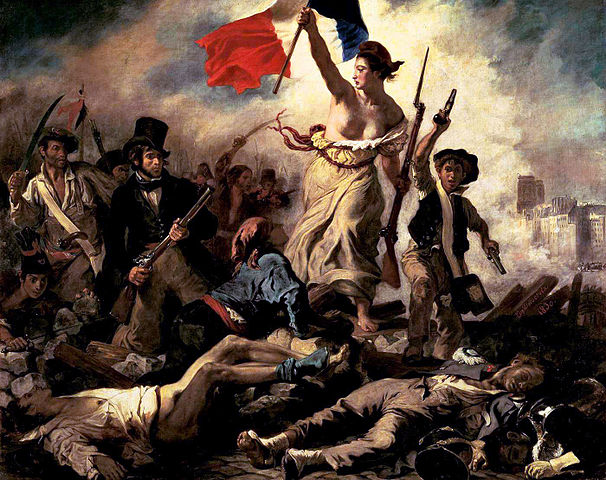
Knocking ’em down. We mistakenly stare at Liberty’s chest rather than what’s at her feet. (Eugene Delacroix, Liberty Leading the People, 1830; Source: Wikimedia Commons, PD-Old-100)
Like amber national anthems preserve monstrosities from the past. Frequently this past humbles the clean self-image of an age.
For example, read the following words from the French national anthem:
To arms, citizens / Form your battalions/ Let’s march, let’s march! / Let an impure blood / Water our furrows!
How odd is it that the Westerners who, according to Steven Pinker, are supposedly getting progressively less violent by listening to their better angels should still sing this in public. Aren’t they in the least bit embarrassed of their violent recent past? You know what’s even odder? That they should sing La Marseillaise in response to the Charlie Hebdo tragedy:
https://www.youtube.com/watch?v=EFWNtlf8zHA

France has a long and bloody history with Muslims.
The anthem is controversial enough to produce long debates on whether the lyrics I’ve cite above are racist. It is easy to forget how until very recently France had a fraught and violent relationship with its former colonies, nearly all Muslim majority regions like Algeria. The war continues on another front in the ghettoization of its Muslim population. This makes for terrorist breeding grounds.
These are important historical facts, however the connections with extremism roots go deeper and closer.
For example, Simon Schama in his canonical account Citizens: A Chronicle of the French Revolution demonstrates why French Revolutionary Terror did not develop in a vacuum:
If the intention of the riots and mass arming was not revolutionary, its consequences certainly were. Peasants and townsmen alike were vividly aware that some sort of boundary had been crossed when they burned manorial titles or took their knives to the pigeon coop. They reassured themselves that they were enacting a kind of primitive moral law authorized by the National Assembly and the King and which wholly superseded the institutions by which they had been held captive. But not far from the exhilaration of release was the apprehension of punishment. What if they had been led astray? Or what if the ministers who had separated the King from his loving people for so long should prevail again? In that case a terrible fate might yet befall them.
Chronicle of a death foretold.
One response to this kind of graphically imagined fear of death, as René Girard has seen in the case of antiquity, is to externalize the terror and project it onto some third party on whom the fear of death may be sacrificially concentrated. Put another way, individuals or groups held responsible for the danger in which communities find themselves are first separated from the host in which they are said to have grown powerful and then destroyed in acts that are simultaneously defiance and propitiation. France in 1789 supplied all kinds of scapegoats in this way – some imaginary, some real.
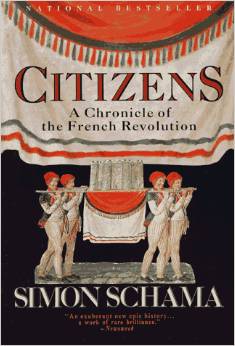
The scapegoating escalated during The Terror when upwards of 40,000 mostly innocent people were executed (of that about 40% by guillotine). In Battling to the End René Girard puts these events in historical perspective. According to him, they were a major historical break:
It’s big, REAL BIG.
The French Revolution was thus such a huge event that some of its consequences are still being played out in the escalation to the extremes, of which Clausewitz was one of the first great military analysts. Thus, terrorism would have its roots in the Revolutionary Wars, of which Napoleon’s ‘regular’ army was the ultimate transformation.

Girard then goes on to make an uncomfortable connection between the French Terror and Islamist Terrorism:
Robespierre reveals too much.
Humans are thus always immersed in order and disorder, in war and peace. It is becoming more and more difficult to draw a line between the two realities that, until the French Revolution, were codified and ritualized. There are no differences anymore. Reciprocal action is so amplified by globalization, the planetary reciprocity in which the slightest event can have repercussions on the other side of the globe, that violence is always a length ahead of our movements. Violence steals a march on politics, and technology escapes our control, as Heidegger showed. Therefore we have to study the conditions for this escalation to extremes from Napoleon to Bin Laden, in which attacking and defending have been promoted to the rank of the unique engine of history.
If this French connection seems unlikely take a look at the following Robespierre speech from Andrzej Wajda’s film Danton (based upon two remarkable plays by Stanislawa Przybyszewska that Herbert Blau made us read). Here’s what she has Robespierre say, although these could be his own historically recorded words, because the founding facts of modern history are actually this bloody:
For the country’s good we must be ruthless. We can’t afford to be just. We’d have to rule by terror. You know what that is? Terror is nothing but despair.
Like in Delacroix’s famous painting slogans of freedom usually have corpses at their feet, or, as they say, freedom isn’t free. Terrorism lies barely concealed at the foundations of the West’s great secular nations. Neither the Muslim world in particular, nor religious people in general, have a monopoly on violence.
If you’d like to explore more of the issues surrounding what I’ve written about here, check out my TOP10 Religion and World Politics List and my post on French philosophy.
Previous Post

January 10, 2015
Houellebecq: Charlie Hebdo Coverboy Maps Faith's Manifestations
Next Post
January 14, 2015 A French Genocide and Salvation Outside the State
Browse Our Archives
Select a Category #WhyRemainCatholic Abortion Advent Anti-Catholicism Arts Atheism Beauty Benedict XVI Bible Book Review Catholic Cinema Comedy Cosmos: A Space-Time Odyssey Czesław Miłosz Dariusz Karłowicz Devil Easter Eastern Orthodoxy Economics Environment Family Famous Atheists Who Weren't Atheists Guest Post Hans Urs von Balthasar HHS Mandate History Imagination Interview Islam Jean-Luc Marion John Paul II Judaism Just War Lent Literature Little Sisters of the Poor Liturgy Martyrdom Music News Paganism Patristics Phenomenology Philosophy Pierre Hadot Poetry Poland Pop Culture Pope Francis Poverty Prayer Protestantism Rabelais Race Remi Brague Rene Girard Russia Sam Rocha Science & Religion SCOTUS Secularization Sexual Abuse Sexuality Silence Solidarity Stratford Caldecott Synod14 Terrorism Top 10 Uncategorized Walker Percy War Weakened Edition World War II World Youth Day WYD Krakow
Select a Month July 2017 June 2017 May 2017 April 2017 March 2017 February 2017 January 2017 December 2016 October 2016 September 2016 August 2016 July 2016 June 2016 May 2016 April 2016 March 2016 February 2016 January 2016 December 2015 November 2015 October 2015 September 2015 August 2015 July 2015 June 2015 May 2015 April 2015 March 2015 February 2015 January 2015 December 2014 November 2014 October 2014 September 2014 August 2014 July 2014 May 2014 April 2014 March 2014 February 2014 January 2014 December 2013 November 2013 October 2013 September 2013 August 2013 July 2013 June 2013 May 2013
Follow Us!
TAKE THE
Religious Wisdom Quiz
Who was the mother of Samuel?
Select your answer to see how you score.
Deborah Mary Sarah Hannah
Related posts from Cosmos The In Lost

The Surprising Anti-Capitalist Logic Behind the Catholic Church's...

The Holy Family as an Icon of World...

How is Classical Philosophy is Like War?

Why Does the World's Leading Philosopher Remain a...
TRENDING AT PATHEOS Catholic

Creation, Preservation, and Teleology in Catholic Theology
As I write this, it is very early Monday morning. Like millions...

The Parable Of The Sower And The Word...
One of Christ’s most famous parables is that of the sower who...

Rejecting Doom: Christian Hope And Human Action
Christianity is a religion of hope. We are to have hope and...

Why I Choose the Eucharist Over the Sermon
Choose the Eucharist, Not the Sermon What are we supposed to get...

5 Design Elements Found in Spiritually Rooted Homes
Putting Spirituality Into Home Decor Our homes are more than our living...

Credo: A Story of God Told with the...
About 10 years ago, I began to imagine a personal "Credo" that...
view all Catholic blogs
Ad-Free & Subscriber Log-In Subscription Support
- About Us
- 2026 Calendar
- Videos
- Podcasts
- Library of World Religions
- Faith In Media Tracker
- Advertise With Us
- Write for Us
- Privacy Policy
- Terms of Service
- Do Not Sell My Data
- Contact Us
- Radiant Digital
- Manage Newsletter Subscriptions
- Unsubscribe From Notifications
- Sitemap
Copyright 2008-2026, Patheos. All rights reserved.
Subscription Support Ad-Free & Subscriber Log-In
Follow Patheos