
BuddhistCatholicContemplativeEvangelicalGeneral ChristianHinduJewishLatter-day SaintMuslimNew VisionsProgressive Christian
Beliefs
- Buddhist
- Catholic
- Contemplative
- Evangelical
- General Christian
- Hindu
- Jewish
- Latter-day Saint
- More Voices
- Muslim
- New Visions
- Pagan
- Progressive Christian
Topics
- Religion News
- Food and Religion
- Sports and Religion
- Religious Art
- Religious Music and Entertainment
- Religious Events
- History and Religion
- Style and Religion
- Politics and Religion
- Women in Religion
- Recreation Outdoors and Religion
- Business Finance and Religion
- Careers Workplace and Religion
- Education and Religion
- Family Parenting and Religion
- Health Fitness and Religion
- Home and Religion
- Relationships and Religion
- Technology and Religion
- Travel and Religion
Columnists
- Buddhist Columnists
- Business Finance and Religion Columnists
- Careers Workplace and Religion Columnists
- Catholic Columnists
- Contemplative Columnists
- Education and Religion Columnists
- Evangelists Columnists
- Family Parenting and Religion Columnists
- General Christian Columnists
- Health Fitness and Religion Columnists
- Hindu Columnists
- History and Religion Columnists
- Home and Religion Columnists
- Jewish Columnists
- More Voices Columnists
- Latter Day Columnists
- Muslim Columnists
- New Visions Columnists
- Nonreligious Columnists
- Pagan Columnists
- Politics and Religion Columnists
- Progressive Columnists
- Recreation Outdoors and Religion Columnists
- Relationships and Religion Columnists
- Religion News Columnists
- Religious Art Columnists
- Religious Events Columnists
- Religious Music and Entertainment Columnists
- Sports and Religion Columnists
- Style and Religion Columnists
- Technology and Religion Columnists
- Travel and Religion Columnists
- Women in Religion Columnists
Resource Library
- 2026 Calendar
- Library of World Religions
- The 100 Most Holy Places on Earth
- Patheos Answers
- Podcasts
- Videos
- Faith Leaders Database
- Anglican Episcopalian
- Bahai
- Baptist
- Buddhism
- Christianity
- Confucianism
- Eastern Orthodoxy
- Hinduism
- Holiness and Pentecostal
- ISKCON
- Islam
- Judaism
- Lutheran
- Methodist
- The Church of Jesus Christ of Latter-day Saints
- New Age
- Paganism
- Presbytarian and Reformed
- Protestantism
- Religion Behind the Scenes
- Roman Catholic
- Scientology
- Shia Islam
- Sikhism
- Sufism
- Sunni Islam
- Taoism
- Zen
- See all religions
Research Tools
 Ad-Free & Subscriber Log-In Subscription Support
Ad-Free & Subscriber Log-In Subscription Support
Follow Patheos 

- Trending:
- Forgiveness
- |
- Marriage
- |
- Consciousness
- |
- Death Penalty
- |
- Election
- |
- Halloween
 Cosmos The In Lost
- Home
- Catholic
- In the Beginning Was Poverty: Advent Should Rob You Blind
In the Beginning Was Poverty: Advent Should Rob You Blind
Last updated on: December 17, 2014 at 3:15 pm by Artur Rosman
In the Beginning Was Poverty: Advent Should Rob You Blind 2014-12-17T15:15:50-07:00 Artur Rosman
Patheos Explore the world's faith through different perspectives on religion and spirituality! Patheos has the views of the prevalent religions and spiritualities of the world.
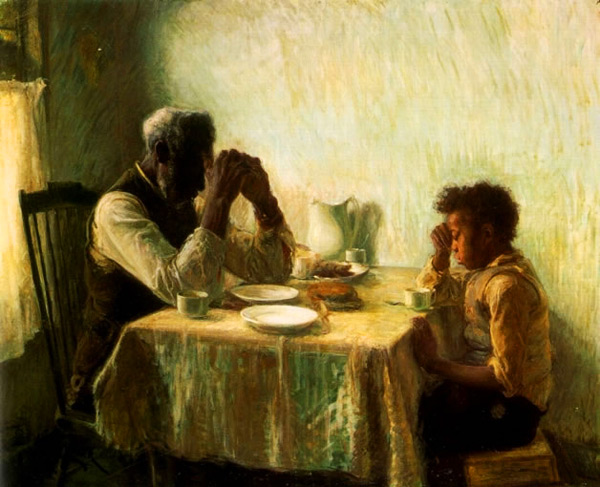
Praiseworthy Spiritual Opulence: Henry Ossawa Tanner, The Thankful Poor, 1894.
Why does the German church get a lot of grief for its spiritual opulence? Because it deserves it.
German Catholicism has a lot of money in its coffers thanks to unbroken economic prosperity since World War II. Yet, its membership is dwindling at Episcopalian rates.
If there is one voice in that ecclesial body crying for an interruption from God, then Johannes Baptist Metz is that voice. His name seems to have predestined him for this role.
When Metz mentions “spiritual opulence” in the following passage in Poverty of Spirit you now know what he is talking about:
Any possession or personal strength tempts us to a vain self-reliance, just as material wealth easily becomes a temptation to ‘spiritual opulence.’
Metz uses the phrase “self-reliance” from a favorite prophet of the Americans so we don’t get off scot-free either…
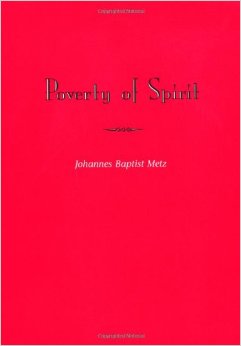
Do you really want to be close to God?
I haven’t had much time to follow the news, but I’m sure there is plenty of talk about putting Christ back in Christmas, but little talk about how Advent might impoverish us.
Metz’s little masterpiece The Advent of God runs against many of our contemporary illusions about Christmas. How much more do these words apply to the present virtual world of economic bubbles than they do to the analog-driven 70’s when he wrote them?
Here we are, safe and sound in our own age, a good distance away from God. In our hearts we do not feel any of the longing or expectancy that filled the hearts of the early Christians. They had looked into the human face of God, who is now part of the past for us, and they waited impatiently and restlessly for his return. But our 20th century Christianity, now a comfortable middle-class reality, no longer shares these feelings. The urgent commands of Paul’s eschatological morality no longer weigh down our existence. We have allocated the eschatological pronouncements of scripture to some future ‘final generation,’ which certainly is not our generation. ‘Let that generation worry about it!’
We moderns have created a myth for ourselves. First we have split up God’s coming into two distant episodes, relegating one to a distant date in the past and the other to an unforseeable future. Then we have provided ourselves with a profane, secularized in between period when we are free to run away from the pressing claims of God’s coming and to construct a new image of man for ourselves.
I sometimes wonder whether the anxieties and depressions people feel with increasing frequency during the holidays are the attempted (frequently aborted) Advent of something beyond us? What if they are a communication of sorts?
Here I’m reminded of a passage from Auden’s long poem The Sea and the Mirror:
But should you fail to keep your kingdom
And, like your father before you, come
Where thought accuses and feeling mocks,
Believe your pain; praise the scorching rocks
For their desiccation of your lust,
Thank the bitter treatment of the tide
For its dissolution of your pride,
That the whirlwind may arrange your will
And the deluge release it to find
The spring in the desert, the fruitful
Island in the sea, where flesh and mind
Are delivered from mistrust.
Finally, in this piece written in the utter destitution of a concentration camp we go from Alpha to Omega in the present:
Previous Post

December 16, 2014
Ruined by Books: TOP10 Catholic Studies Books
Next Post

December 18, 2014 Dare We Hope That All Dogs Go To Heaven?
Browse Our Archives
Select a Category #WhyRemainCatholic Abortion Advent Anti-Catholicism Arts Atheism Beauty Benedict XVI Bible Book Review Catholic Cinema Comedy Cosmos: A Space-Time Odyssey Czesław Miłosz Dariusz Karłowicz Devil Easter Eastern Orthodoxy Economics Environment Family Famous Atheists Who Weren't Atheists Guest Post Hans Urs von Balthasar HHS Mandate History Imagination Interview Islam Jean-Luc Marion John Paul II Judaism Just War Lent Literature Little Sisters of the Poor Liturgy Martyrdom Music News Paganism Patristics Phenomenology Philosophy Pierre Hadot Poetry Poland Pop Culture Pope Francis Poverty Prayer Protestantism Rabelais Race Remi Brague Rene Girard Russia Sam Rocha Science & Religion SCOTUS Secularization Sexual Abuse Sexuality Silence Solidarity Stratford Caldecott Synod14 Terrorism Top 10 Uncategorized Walker Percy War Weakened Edition World War II World Youth Day WYD Krakow
Select a Month July 2017 June 2017 May 2017 April 2017 March 2017 February 2017 January 2017 December 2016 October 2016 September 2016 August 2016 July 2016 June 2016 May 2016 April 2016 March 2016 February 2016 January 2016 December 2015 November 2015 October 2015 September 2015 August 2015 July 2015 June 2015 May 2015 April 2015 March 2015 February 2015 January 2015 December 2014 November 2014 October 2014 September 2014 August 2014 July 2014 May 2014 April 2014 March 2014 February 2014 January 2014 December 2013 November 2013 October 2013 September 2013 August 2013 July 2013 June 2013 May 2013
Follow Us!
TAKE THE
Religious Wisdom Quiz
Which Christian group is known for its liturgical calendar?
Select your answer to see how you score.
Baptists Methodists Anglicans Jehovah’s Witnesses
Related posts from Cosmos The In Lost

The Surprising Anti-Capitalist Logic Behind the Catholic Church's...

What is the Source of Our Culture of...

The Holy Family as an Icon of World...

How is Classical Philosophy is Like War?
TRENDING AT PATHEOS Catholic

The Parable Of The Sower And The Word...
One of Christ’s most famous parables is that of the sower who...

Rejecting Doom: Christian Hope And Human Action
Christianity is a religion of hope. We are to have hope and...

Why I Choose the Eucharist Over the Sermon
Choose the Eucharist, Not the Sermon What are we supposed to get...

5 Design Elements Found in Spiritually Rooted Homes
Putting Spirituality Into Home Decor Our homes are more than our living...

Credo: A Story of God Told with the...
About 10 years ago, I began to imagine a personal "Credo" that...

The Anatomy of Divine Revelation in Catholic Thought
The claim that God has made Himself known to human beings is...
view all Catholic blogs
Ad-Free & Subscriber Log-In Subscription Support
- About Us
- 2026 Calendar
- Videos
- Podcasts
- Library of World Religions
- Faith In Media Tracker
- Advertise With Us
- Write for Us
- Privacy Policy
- Terms of Service
- Do Not Sell My Data
- Contact Us
- Radiant Digital
- Manage Newsletter Subscriptions
- Unsubscribe From Notifications
- Sitemap
Copyright 2008-2026, Patheos. All rights reserved.
Subscription Support Ad-Free & Subscriber Log-In
Follow Patheos