
BuddhistCatholicContemplativeEvangelicalGeneral ChristianHinduJewishLatter-day SaintMuslimNew VisionsProgressive Christian
Beliefs
- Buddhist
- Catholic
- Contemplative
- Evangelical
- General Christian
- Hindu
- Jewish
- Latter-day Saint
- More Voices
- Muslim
- New Visions
- Pagan
- Progressive Christian
Topics
- Religion News
- Food and Religion
- Sports and Religion
- Religious Art
- Religious Music and Entertainment
- Religious Events
- History and Religion
- Style and Religion
- Politics and Religion
- Women in Religion
- Recreation Outdoors and Religion
- Business Finance and Religion
- Careers Workplace and Religion
- Education and Religion
- Family Parenting and Religion
- Health Fitness and Religion
- Home and Religion
- Relationships and Religion
- Technology and Religion
- Travel and Religion
Columnists
- Buddhist Columnists
- Business Finance and Religion Columnists
- Careers Workplace and Religion Columnists
- Catholic Columnists
- Contemplative Columnists
- Education and Religion Columnists
- Evangelists Columnists
- Family Parenting and Religion Columnists
- General Christian Columnists
- Health Fitness and Religion Columnists
- Hindu Columnists
- History and Religion Columnists
- Home and Religion Columnists
- Jewish Columnists
- More Voices Columnists
- Latter Day Columnists
- Muslim Columnists
- New Visions Columnists
- Nonreligious Columnists
- Pagan Columnists
- Politics and Religion Columnists
- Progressive Columnists
- Recreation Outdoors and Religion Columnists
- Relationships and Religion Columnists
- Religion News Columnists
- Religious Art Columnists
- Religious Events Columnists
- Religious Music and Entertainment Columnists
- Sports and Religion Columnists
- Style and Religion Columnists
- Technology and Religion Columnists
- Travel and Religion Columnists
- Women in Religion Columnists
Resource Library
- 2026 Calendar
- Library of World Religions
- The 100 Most Holy Places on Earth
- Patheos Answers
- Podcasts
- Videos
- Faith Leaders Database
- Anglican Episcopalian
- Bahai
- Baptist
- Buddhism
- Christianity
- Confucianism
- Eastern Orthodoxy
- Hinduism
- Holiness and Pentecostal
- ISKCON
- Islam
- Judaism
- Lutheran
- Methodist
- The Church of Jesus Christ of Latter-day Saints
- New Age
- Paganism
- Presbytarian and Reformed
- Protestantism
- Religion Behind the Scenes
- Roman Catholic
- Scientology
- Shia Islam
- Sikhism
- Sufism
- Sunni Islam
- Taoism
- Zen
- See all religions
Research Tools
 Ad-Free & Subscriber Log-In Subscription Support
Ad-Free & Subscriber Log-In Subscription Support
Follow Patheos 

- Trending:
- Forgiveness
- |
- Marriage
- |
- Consciousness
- |
- Death Penalty
- |
- Election
- |
- Halloween
 Cosmos The In Lost
- Home
- Catholic
- The Consequences of God’s Maternal Thinking for Theology
The Consequences of God’s Maternal Thinking for Theology
Last updated on: October 28, 2014 at 2:17 pm by Artur Rosman
The Consequences of God’s Maternal Thinking for Theology 2014-10-28T14:17:39-07:00 Artur Rosman
Patheos Explore the world's faith through different perspectives on religion and spirituality! Patheos has the views of the prevalent religions and spiritualities of the world.

Tarkovsky’s Nostalghia features a stunning scene on spirituality and motherhood. Scroll down below to watch it.
The feminist Sara Ruddick must be doing something right if both Alasdair MacIntyre and Janet Martin Soskice cite her as an influence. MacIntyre credits the feminist philosopher’s work in the field of disability studies at the start of Dependent Rational Animals. Soskice borrows Ruddick’s phenomenology of the parental gaze in Maternal Thinking for her writings on parenting and spirituality in The Kindness of God.
Here Soskice adopts Ruddick’s phenomenology of the parent’s gaze in order to make an analogy with the classical experience of mystical letting go:
The parents–or those who attend in love–undergo changes as well. The biological reciprocity between mother and child in early infancy is continued in innumerable small acts of watchfulness, many almost as involuntary as lactation: for instance, the scanning, native to parents of toddlers, of any new surroundings for steep steps, sharp, breakable, or swallowable objects. Parents do not always think too much about this, they simply do it as a few years further along in the child’s life they will not. Other acts of attentiveness require the disciplined and conscious exercise of humility. To attend to the child properly is also to employ the proper passivity of “letting the other be.” The love of the parent, at the best of times, holds the child up without holding them back, for they must grow, and the parents must in gradual but continuous steps “let” without ceasing to love unstintingly. By such means, the rational and spiritual strangely mixed with the visceral and instinctive, parents, at least once in a while, may be “unselved,” just as we may be “unselved” by the kesterl’s flight. The body then is not just or always the bastion of egocentrism. It may equally be the place of letting go.
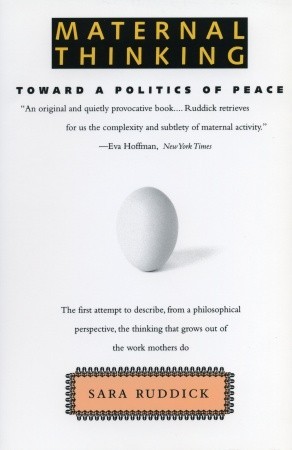
I find this to be a very egg-citing book, so do MacIntyre and Soskice.
Soskice goes even further a couple of paragraphs later by noting further analogies between maternal thinking (basically being a full-time parent, although women have traditionally fulfilled this role, hence the name) and the biblical narrative:
These points are not alien to Christian theology. After all, God is portrayed in the Bible as creating a universe that endures for a time but will end. God is represented as attending to a chosen people involved, at God’s behest, in seemingly ceaseless change. They are called out, established, exiled, freed. God is represented in the Prophetic writings as chivvying them along and unsettling their complacent accommodations. We seem far from Augustine’s tale of the traveler who turns his back on what is material and temporary in order to seek that which is spiritual and eternal; but maybe not. Augustine elsewhere tells another story of a journey, his own journey [with the help of his mother Monica], as recounted in the Confessions.
I wish I had more time to write about this, but I need to let go of blog writing a bit to attend to the girls and my job search. If I had the time I would comment on a Crisis Magazine article about “Sacrificing Religious Life on the Altar or Egalitarianism,” especially since that altar frequently is composed of family life. Maybe some other time? or maybe I will let it go? Yet I wonder, is not sacrifice something good in Christian theology? Maybe our times require a whole new notion of sacrifice, especially with the demographic winter looming sexlessly over later modern societies?
Maybe a maternally oriented spirituality it is much more ancient than we suppose as this divine clip from Tarkovsky’s Nostalghia suggests?
More excerpts from Soskice can be found in a post here. My post on the disintegration of the nuclear family here might also be of interest.
Previous Post

October 27, 2014
Mini TOP10: Books on Vatican Relations with China and Hong Kong
Next Post
October 29, 2014 The Church's Geopolitical Chess Strategy
Browse Our Archives
Select a Category #WhyRemainCatholic Abortion Advent Anti-Catholicism Arts Atheism Beauty Benedict XVI Bible Book Review Catholic Cinema Comedy Cosmos: A Space-Time Odyssey Czesław Miłosz Dariusz Karłowicz Devil Easter Eastern Orthodoxy Economics Environment Family Famous Atheists Who Weren't Atheists Guest Post Hans Urs von Balthasar HHS Mandate History Imagination Interview Islam Jean-Luc Marion John Paul II Judaism Just War Lent Literature Little Sisters of the Poor Liturgy Martyrdom Music News Paganism Patristics Phenomenology Philosophy Pierre Hadot Poetry Poland Pop Culture Pope Francis Poverty Prayer Protestantism Rabelais Race Remi Brague Rene Girard Russia Sam Rocha Science & Religion SCOTUS Secularization Sexual Abuse Sexuality Silence Solidarity Stratford Caldecott Synod14 Terrorism Top 10 Uncategorized Walker Percy War Weakened Edition World War II World Youth Day WYD Krakow
Select a Month July 2017 June 2017 May 2017 April 2017 March 2017 February 2017 January 2017 December 2016 October 2016 September 2016 August 2016 July 2016 June 2016 May 2016 April 2016 March 2016 February 2016 January 2016 December 2015 November 2015 October 2015 September 2015 August 2015 July 2015 June 2015 May 2015 April 2015 March 2015 February 2015 January 2015 December 2014 November 2014 October 2014 September 2014 August 2014 July 2014 May 2014 April 2014 March 2014 February 2014 January 2014 December 2013 November 2013 October 2013 September 2013 August 2013 July 2013 June 2013 May 2013
Follow Us!
TAKE THE
Religious Wisdom Quiz
What did Jesus do for Lazarus in Bethany?
Select your answer to see how you score.
Healed his blindness Raised him from the dead Fed him Turned him invisible
Related posts from Cosmos The In Lost

The Surprising Anti-Capitalist Logic Behind the Catholic Church's...


The Holy Family as an Icon of World...

How is Classical Philosophy is Like War?
TRENDING AT PATHEOS Catholic

Creation, Preservation, and Teleology in Catholic Theology
As I write this, it is very early Monday morning. Like millions...

The Parable Of The Sower And The Word...
One of Christ’s most famous parables is that of the sower who...

Rejecting Doom: Christian Hope And Human Action
Christianity is a religion of hope. We are to have hope and...

Why I Choose the Eucharist Over the Sermon
Choose the Eucharist, Not the Sermon What are we supposed to get...

5 Design Elements Found in Spiritually Rooted Homes
Putting Spirituality Into Home Decor Our homes are more than our living...

Credo: A Story of God Told with the...
About 10 years ago, I began to imagine a personal "Credo" that...
view all Catholic blogs
Ad-Free & Subscriber Log-In Subscription Support
- About Us
- 2026 Calendar
- Videos
- Podcasts
- Library of World Religions
- Faith In Media Tracker
- Advertise With Us
- Write for Us
- Privacy Policy
- Terms of Service
- Do Not Sell My Data
- Contact Us
- Radiant Digital
- Manage Newsletter Subscriptions
- Unsubscribe From Notifications
- Sitemap
Copyright 2008-2026, Patheos. All rights reserved.
Subscription Support Ad-Free & Subscriber Log-In
Follow Patheos