
BuddhistCatholicContemplativeEvangelicalGeneral ChristianHinduJewishLatter-day SaintMuslimNew VisionsProgressive Christian
Beliefs
- Buddhist
- Catholic
- Contemplative
- Evangelical
- General Christian
- Hindu
- Jewish
- Latter-day Saint
- More Voices
- Muslim
- New Visions
- Pagan
- Progressive Christian
Topics
- Religion News
- Food and Religion
- Sports and Religion
- Religious Art
- Religious Music and Entertainment
- Religious Events
- History and Religion
- Style and Religion
- Politics and Religion
- Women in Religion
- Recreation Outdoors and Religion
- Business Finance and Religion
- Careers Workplace and Religion
- Education and Religion
- Family Parenting and Religion
- Health Fitness and Religion
- Home and Religion
- Relationships and Religion
- Technology and Religion
- Travel and Religion
Columnists
- Buddhist Columnists
- Business Finance and Religion Columnists
- Careers Workplace and Religion Columnists
- Catholic Columnists
- Contemplative Columnists
- Education and Religion Columnists
- Evangelists Columnists
- Family Parenting and Religion Columnists
- General Christian Columnists
- Health Fitness and Religion Columnists
- Hindu Columnists
- History and Religion Columnists
- Home and Religion Columnists
- Jewish Columnists
- More Voices Columnists
- Latter Day Columnists
- Muslim Columnists
- New Visions Columnists
- Nonreligious Columnists
- Pagan Columnists
- Politics and Religion Columnists
- Progressive Columnists
- Recreation Outdoors and Religion Columnists
- Relationships and Religion Columnists
- Religion News Columnists
- Religious Art Columnists
- Religious Events Columnists
- Religious Music and Entertainment Columnists
- Sports and Religion Columnists
- Style and Religion Columnists
- Technology and Religion Columnists
- Travel and Religion Columnists
- Women in Religion Columnists
Resource Library
- 2026 Calendar
- Library of World Religions
- The 100 Most Holy Places on Earth
- Patheos Answers
- Podcasts
- Videos
- Faith Leaders Database
- Anglican Episcopalian
- Bahai
- Baptist
- Buddhism
- Christianity
- Confucianism
- Eastern Orthodoxy
- Hinduism
- Holiness and Pentecostal
- ISKCON
- Islam
- Judaism
- Lutheran
- Methodist
- The Church of Jesus Christ of Latter-day Saints
- New Age
- Paganism
- Presbytarian and Reformed
- Protestantism
- Religion Behind the Scenes
- Roman Catholic
- Scientology
- Shia Islam
- Sikhism
- Sufism
- Sunni Islam
- Taoism
- Zen
- See all religions
Research Tools
 Ad-Free & Subscriber Log-In Subscription Support
Ad-Free & Subscriber Log-In Subscription Support
Follow Patheos 

- Trending:
- Forgiveness
- |
- Marriage
- |
- Consciousness
- |
- Death Penalty
- |
- Election
- |
- Halloween
 Cosmos The In Lost
- Home
- Catholic
- Christ Is No Longer On Top
Christ Is No Longer On Top
Last updated on: September 3, 2014 at 1:54 pm by Artur Rosman
Christ Is No Longer On Top 2014-09-03T13:54:39-07:00 Artur Rosman
Patheos Explore the world's faith through different perspectives on religion and spirituality! Patheos has the views of the prevalent religions and spiritualities of the world.
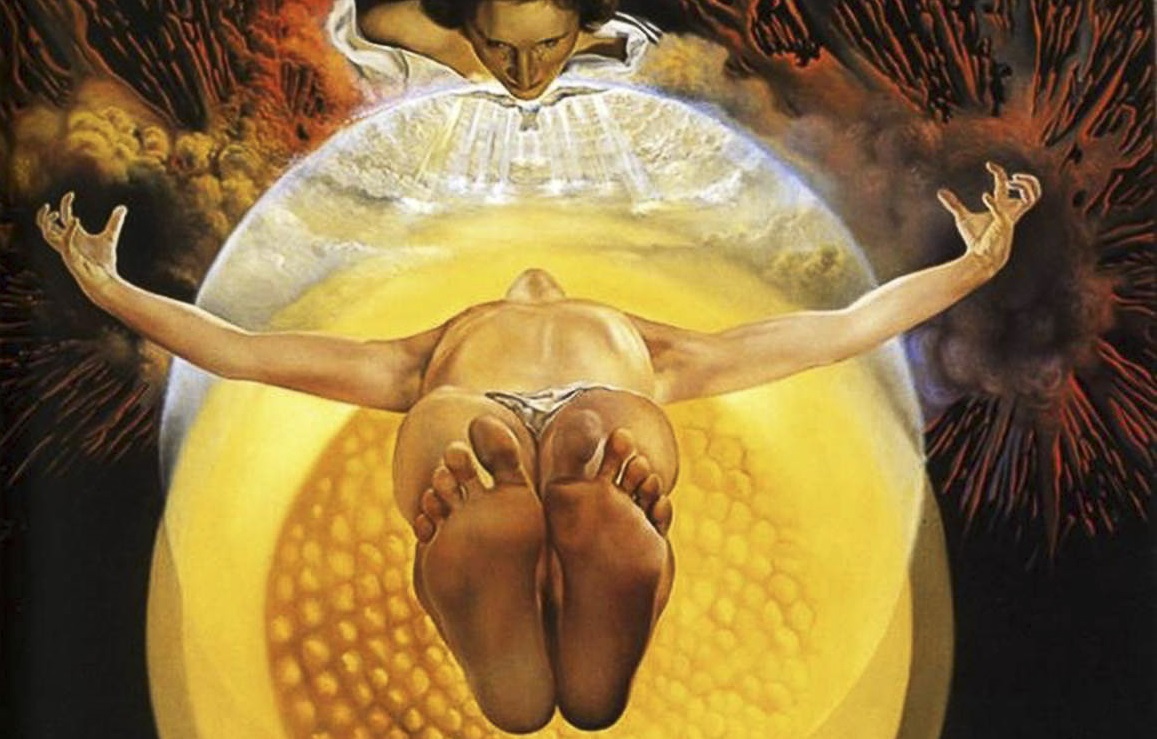
Thanks to Oliver Davies I imagine outstanding foot hygiene in heaven was a much more pressing theological issue for the medievals than it is for us. The upside is that you don’t have to worry about upskirting Christ every time you look at the starry skies above.
The reactions to yesterday’s intentionally provocative post on the centrality of the resurrection of the body were expected. Those who got the joke didn’t say too much. Those that didn’t get it were adamant about scoring points. The latter group was conspicuous for its inability to stretch their thinking beyond making obvious doctrinal affirmations–as if those are immediately self-explanatory.
If I may pull back the curtain on yesterday’s post, I’d like to tell you what that parable was all about. The main point I wanted to make in my theological/philosophical fragment indirectly was about homonyms. In my earlier post about Oliver Davies’ Theology of Transformation: Faith, Freedom, and the Christian Act I quoted the following in a larger chunk of text:
[After the first scientific revolution], matter was the domain of determinism and so a lack of freedom, while our subjectivity as mind was the privileged place of our freedom. We were free of the world by being in the deterministic world as self-aware subject who could exercise power over the world and its materiality through technology. According to this model, materiality as the field of determinism was either left behind by our spirit–through transcendence–or to be overcome by our spirit–through technology–in order that we (who are most properly spirit) should be free. Here there is a separation between who I am as spirit (or mind) and who I am as matter (or body).

“Hope is the shiny thing,” said Emily Dickinson (not really). No, not that Leary!
For the most part, we moderns think of the soul as being synonymous with the spirit/mind and separated from the body. This is a homonym (same word denoting different realities) of what Christian theology affirms in the general resurrection of the body, rather than the vague spiritualism implied in the liberation of the soul/mind/spirit from matter. In other words, Christianity doesn’t get you off the hook for your dirty feet by mystically melting them away in the hereafter–even if you might possibly be, in a way, free of them between the particular and general judgments.
I recently finished reading Jonathan Lear’s Radical Hope: Ethics in the Face of Cultural Devastation. This tightly packed little book poses the problem of what to do when the frames that informed the intellectual scaffolding of your worldview collapse like a box of matches. There is an interesting analogy between what Lear says, which I would like to pick up in more detail soon, and the lines of the argument that Oliver Davies makes.
The Davies book revolves around the problem of interpreting the Ascension of Our Lord, or what we affirm in the Creed when we say, “He ascended into heaven and is seated at the right hand of the Father” after the collapse of a pre-modern worldview.
What surprised me, although any reader of Dante’s Paradiso (granted, few get beyond Purgatorio) will be buffered a bit from the initial shock, is how literally Christians took this theological affirmation. They did so because it accorded with their metaphysical picturing of the world based upon the best quasi-scientific cosmology available to them:
Scriptural Christology presupposed the background of this ancient cosmology [the three-tiered cosmos]. Against such a setting it was possible for the Church to affirm the saving work of God in Jesus Christ through his resurrection and glorification within the created order. We often fail to understand today the extent to which heaven itself was understood to be within the created order [my emphasis] and to be intrinsically part of it. Heaven, like earth, was created (Gen 1.2) but it was also the very farthest limit of the material order, where space and time were closest to the presence of the Creator and so most directly shaped by his power. It was the point of intersection between what was visible and what was invisible. Heaven was far ‘above’ the earth in terms of its sublimity, but it was also far above the earth in terms of its physical location. It is this spatio-temporal dimension of the pre-modern heaven which set it decisively apart from anything we can imagine today. The medieval maps which showed heaven as a final ring surrounding the earth at a distance from it were accurate pictorial representations of how the pre-modern world understood the universe to be, with heaven as its ‘crown.’ Just how fundamental and unquestioned this was can be seen in the section of the Summa Theologiae of Thomas Aquinas where Thomas asks the question of where exactly the body of Christ now is? He understands that body to be at the very highest point of heaven ‘by place and dignity.’
There is nothing to be embarrassed by here even if the vast majority of us have trouble affirming that Christ is sitting at the top of the universe feet down pointing at us. Where would the top of the universe be anyway given our present state of knowledge?
The problem that Davies poses is how to affirm the Ascension of Our Lord after the collapse of the medieval cosmos without falling into the subjectivism of Bultmann in Jesus Christ and Mythology. He’s still working out his argument, so that’s yet another thing I’ll have to return to later… Suffice it to say that Davies is attempting to break out of the prison imposed upon theology by the turn to the subject and aims to show how theology can regain the cosmic mystery of Christ (and put some flesh on the soul) that permeated the writings of Aquinas and Maximus without relying upon their now outdated cosmology.
It’s an exciting project for me, because the Ascension and the right-side sitting has always stumped me; it is beyond my powers to imagine what that might mean in the world we now inhabit.
It might be meaningless for you to think of Jesus as sitting on high on top of the universe, but this might still take you higher for a few minutes:
Previous Post
September 2, 2014
FACT: Christians DON'T Believe in the Immortality of the Soul
Next Post
September 4, 2014 Nudus Nudum Christum Sequi: On Christ's Genitalia
Browse Our Archives
Select a Category #WhyRemainCatholic Abortion Advent Anti-Catholicism Arts Atheism Beauty Benedict XVI Bible Book Review Catholic Cinema Comedy Cosmos: A Space-Time Odyssey Czesław Miłosz Dariusz Karłowicz Devil Easter Eastern Orthodoxy Economics Environment Family Famous Atheists Who Weren't Atheists Guest Post Hans Urs von Balthasar HHS Mandate History Imagination Interview Islam Jean-Luc Marion John Paul II Judaism Just War Lent Literature Little Sisters of the Poor Liturgy Martyrdom Music News Paganism Patristics Phenomenology Philosophy Pierre Hadot Poetry Poland Pop Culture Pope Francis Poverty Prayer Protestantism Rabelais Race Remi Brague Rene Girard Russia Sam Rocha Science & Religion SCOTUS Secularization Sexual Abuse Sexuality Silence Solidarity Stratford Caldecott Synod14 Terrorism Top 10 Uncategorized Walker Percy War Weakened Edition World War II World Youth Day WYD Krakow
Select a Month July 2017 June 2017 May 2017 April 2017 March 2017 February 2017 January 2017 December 2016 October 2016 September 2016 August 2016 July 2016 June 2016 May 2016 April 2016 March 2016 February 2016 January 2016 December 2015 November 2015 October 2015 September 2015 August 2015 July 2015 June 2015 May 2015 April 2015 March 2015 February 2015 January 2015 December 2014 November 2014 October 2014 September 2014 August 2014 July 2014 May 2014 April 2014 March 2014 February 2014 January 2014 December 2013 November 2013 October 2013 September 2013 August 2013 July 2013 June 2013 May 2013
Follow Us!
TAKE THE
Religious Wisdom Quiz
How old was Abraham when he died?
Select your answer to see how you score.
200 years 175 years 125 years 150 years
Related posts from Cosmos The In Lost

The Surprising Anti-Capitalist Logic Behind the Catholic Church's...

Where Does the Body of Christ Go After...

How is Classical Philosophy is Like War?

Why Does the World's Leading Philosopher Remain a...
TRENDING AT PATHEOS Catholic

Rejecting Doom: Christian Hope And Human Action
Christianity is a religion of hope. We are to have hope and...

It’s What Comes From Within Which Matters
One of the most difficult things for us to understand is why...

Why I Choose the Eucharist Over the Sermon
Choose the Eucharist, Not the Sermon What are we supposed to get...

5 Design Elements Found in Spiritually Rooted Homes
Putting Spirituality Into Home Decor Our homes are more than our living...

Credo: A Story of God Told with the...
About 10 years ago, I began to imagine a personal "Credo" that...

The Anatomy of Divine Revelation in Catholic Thought
The claim that God has made Himself known to human beings is...
view all Catholic blogs
Ad-Free & Subscriber Log-In Subscription Support
- About Us
- 2026 Calendar
- Videos
- Podcasts
- Library of World Religions
- Faith In Media Tracker
- Advertise With Us
- Write for Us
- Privacy Policy
- Terms of Service
- Do Not Sell My Data
- Contact Us
- Radiant Digital
- Manage Newsletter Subscriptions
- Unsubscribe From Notifications
- Sitemap
Copyright 2008-2026, Patheos. All rights reserved.
Subscription Support Ad-Free & Subscriber Log-In
Follow Patheos