
BuddhistCatholicContemplativeEvangelicalGeneral ChristianHinduJewishLatter-day SaintMuslimNew VisionsProgressive Christian
Beliefs
- Buddhist
- Catholic
- Contemplative
- Evangelical
- General Christian
- Hindu
- Jewish
- Latter-day Saint
- More Voices
- Muslim
- New Visions
- Pagan
- Progressive Christian
Topics
- Religion News
- Food and Religion
- Sports and Religion
- Religious Art
- Religious Music and Entertainment
- Religious Events
- History and Religion
- Style and Religion
- Politics and Religion
- Women in Religion
- Recreation Outdoors and Religion
- Business Finance and Religion
- Careers Workplace and Religion
- Education and Religion
- Family Parenting and Religion
- Health Fitness and Religion
- Home and Religion
- Relationships and Religion
- Technology and Religion
- Travel and Religion
Columnists
- Buddhist Columnists
- Business Finance and Religion Columnists
- Careers Workplace and Religion Columnists
- Catholic Columnists
- Contemplative Columnists
- Education and Religion Columnists
- Evangelists Columnists
- Family Parenting and Religion Columnists
- General Christian Columnists
- Health Fitness and Religion Columnists
- Hindu Columnists
- History and Religion Columnists
- Home and Religion Columnists
- Jewish Columnists
- More Voices Columnists
- Latter Day Columnists
- Muslim Columnists
- New Visions Columnists
- Nonreligious Columnists
- Pagan Columnists
- Politics and Religion Columnists
- Progressive Columnists
- Recreation Outdoors and Religion Columnists
- Relationships and Religion Columnists
- Religion News Columnists
- Religious Art Columnists
- Religious Events Columnists
- Religious Music and Entertainment Columnists
- Sports and Religion Columnists
- Style and Religion Columnists
- Technology and Religion Columnists
- Travel and Religion Columnists
- Women in Religion Columnists
Resource Library
- 2026 Calendar
- Library of World Religions
- The 100 Most Holy Places on Earth
- Patheos Answers
- Podcasts
- Videos
- Faith Leaders Database
- Anglican Episcopalian
- Bahai
- Baptist
- Buddhism
- Christianity
- Confucianism
- Eastern Orthodoxy
- Hinduism
- Holiness and Pentecostal
- ISKCON
- Islam
- Judaism
- Lutheran
- Methodist
- The Church of Jesus Christ of Latter-day Saints
- New Age
- Paganism
- Presbytarian and Reformed
- Protestantism
- Religion Behind the Scenes
- Roman Catholic
- Scientology
- Shia Islam
- Sikhism
- Sufism
- Sunni Islam
- Taoism
- Zen
- See all religions
Research Tools
 Ad-Free & Subscriber Log-In Subscription Support
Follow Patheos 

- Trending:
- Advent
- |
- Forgiveness
- |
- Thanksgiving
- |
- Election
- |
- Seasonal Holidays
- |
- Marriage
 Cosmos The In Lost
- Home
- Catholic
- Our Second Scientific Revolution. What Can Theology Expect?
Our Second Scientific Revolution. What Can Theology Expect?
Last updated on: August 27, 2014 at 1:41 pm by Artur Rosman
Our Second Scientific Revolution. What Can Theology Expect? 2014-08-27T13:41:48-07:00 Artur Rosman
Patheos Explore the world's faith through different perspectives on religion and spirituality! Patheos has the views of the prevalent religions and spiritualities of the world.
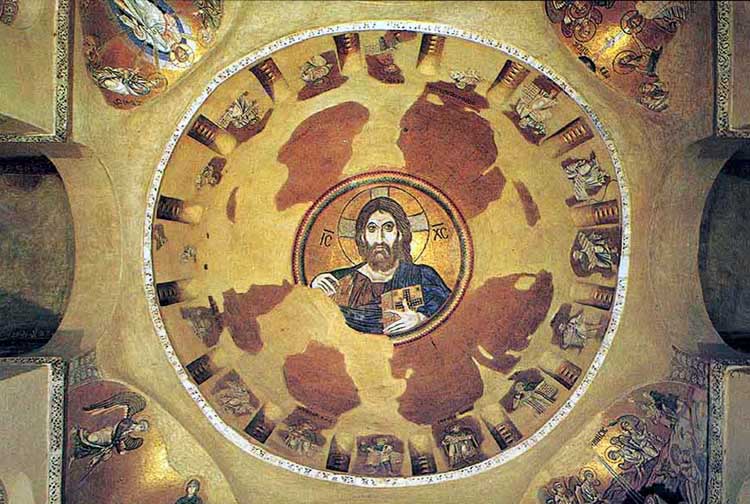
According to Oliver Davies, the image of Christ the Pantocrator has been obscured by the turn to the subject in modern philosophy and theology.
The intersection of religion, the imagination, and science is a constant preoccupation of mine.
I believe this topic first became an obsession upon reading Czeslaw Milosz‘s The Land of Ulro. The poet’s book is one of those weird works that is way ahead of its time. It goes beyond all the prescribed literary boundaries. After having read it four or five times I still can’t tell whether it’s autobiography, literary criticism, philosophy of science, history, anthropology, theology, and so on. It is all of those things, even if the religious element predominates.
The Land Land of Ulro documents, rather haphazardly, in a very poetic fashion, the breakdown of the Western religious imagination on the heels of the first scientific revolution. Why was the first revolution so deadly? Because its mechanistic ideology meant that religion was banished to the realm of the human mind, the only sphere of freedom remaining in a mechanistic universe. A totally uniform universe also greatly challenged the three-tiered vision of the universe consisting in hell, earth, and heaven. The retreat into the haven of the mind also forced a turn to the subject, who was subsequently, to use Charles Taylor‘s neologism, disincarnated from the rest of reality (and later to love than usual).
Then again, it hasn’t all been a loss. It’s easy to fall into default narratives of decline, especially for Christians, ever since the Reformers of the 16th century put so much emphasis has been upon the purity (yeah right, read Paul between the lines!) of Early Christian communities. Here is a summary of what Larry Chapp had to say about the significant gains for theology in the modern period in an earlier interview I conducted with him on Cosmos:
The rapid expansion of our understanding of the universe’s size, which, as Thomas O’Meara argues, has implications for the doctrine of Incarnation.
The naturalization of the cosmos, or what Karsten Harries has called the homogenization of space.
The development of evolutionary thought and how it requires us to rethink our categories of causality much in the same way as the homogenization of space does.
All of these taken together require a rethinking of how we theologically conceive order and hierarchy. Larry alludes to Whitehead’s suggestion in Adventures of Ideas that perhaps beauty can be best understood as the ordering of novelty.
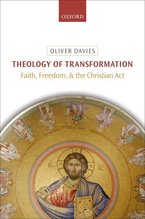
Davies onto something important here.
The Catholic theologian Oliver Davies, in his recent book, Theology of Transformation, builds a whole theology upon these insights and adds a new caveat. He believes that we are in the midst of a second scientific revolution. Here is what he thinks its hallmarks are and how they open up the door to an incarnationally-centered Christian imagination:
If the effects of the ‘first scientific revolution’ were to separate mind from matter, then the effects of the ‘second scientific revolution’ are to bring them back together again. For Newtonianism, matter was the domain of determinism and so a lack of freedom, while our subjectivity as mind was the privileged place of our freedom. We were free of the world by being in the deterministic world as self-aware subject who could exercise power over the world and its materiality through technology. According to this model, materiality as the field of determinism was either left behind by our spirit–through transcendence–or to be overcome by our spirit–through technology–in order that we (who are most properly spirit) should be free. Here there is a separation between who I am as spirit (or mind) and who I am as matter (or body). From a historical point of view, we can note also the extent to which the language of human spirit and divine Spirit have merged here, when each is defined as being in opposition to matter and the material.
But the effects of the scientific self-understanding which is emerging today are quite different. Here it is presupposed that we are materiality ‘all the way down.’ Neuroscience, genetics, and evolutionary biology show that mind and matter in us form a thoroughgoing continuity, each presupposing the other and each having causal effects upon the other within a continuum of human life as ‘intelligent embodiment’ in a material world. Quantum physics does so even more radically. Consequently, there is no point at which the mind can be ‘outside’ matter. We are free within materiality and not beyond it. Science is teaching us that we are both pure subjectivity and complex materiality at the same time. And in fact, there are no grounds for reducing one to the other (despite the best attempts of some). Our human truth, as ‘intelligent embodiment,’ is a paradoxical one and involves a simultaneity of matter and mind in us. We are not only in the world as subject but we are also far more of the world than we had thought. Indeed, we may need to think of ourselves even, first and foremost, as being world.
It is not difficult to see how Davies later makes the argument that our imagination of our place in the world, emerging from the second scientific revolution, is much better suited to the incarnational thrust of Christianity than the Manichean dualism of the first scientific revolution. The second revolution overcomes modernity’s pseudo-problem of connecting mind back to the world. It also opens up avenues for recovering a pre-modern cosmically-oriented Christianity (Think: Von Balthasar’s book on Maximus the Confessor).
Davies has started an exciting project in Theology of Transformation. I look forward to seeing how he develops these insights later in the book. I must say that this is one of the most exciting theology books I’ve read in a while and should probably be added to my list of TOP10 of theology books I’ve read in the last 10 years.
Admittedly, Theology of Transformation is a bit on the pricey side in its limited hardcover run, so you might want to explore the author’s other books on love/compassion, Meister Eckhart, and the Eucharist. All of them circle around some similar issues. Davies has his own (badly designed) website where you can learn more about his project. And if you want to explore similar avenues into the fruitful ongoing conversation between science and religion then look at this nearly comprehensive list of works in the field.
Previous Post

August 26, 2014
Patrick Deneen on Economic Two-Way Baloney
Next Post
August 28, 2014 The Call to Being Has Already Exiled You: Sam Rocha's Late to Love
Browse Our Archives
Select a Category #WhyRemainCatholic Abortion Advent Anti-Catholicism Arts Atheism Beauty Benedict XVI Bible Book Review Catholic Cinema Comedy Cosmos: A Space-Time Odyssey Czesław Miłosz Dariusz Karłowicz Devil Easter Eastern Orthodoxy Economics Environment Family Famous Atheists Who Weren't Atheists Guest Post Hans Urs von Balthasar HHS Mandate History Imagination Interview Islam Jean-Luc Marion John Paul II Judaism Just War Lent Literature Little Sisters of the Poor Liturgy Martyrdom Music News Paganism Patristics Phenomenology Philosophy Pierre Hadot Poetry Poland Pop Culture Pope Francis Poverty Prayer Protestantism Rabelais Race Remi Brague Rene Girard Russia Sam Rocha Science & Religion SCOTUS Secularization Sexual Abuse Sexuality Silence Solidarity Stratford Caldecott Synod14 Terrorism Top 10 Uncategorized Walker Percy War Weakened Edition World War II World Youth Day WYD Krakow
Select a Month July 2017 June 2017 May 2017 April 2017 March 2017 February 2017 January 2017 December 2016 October 2016 September 2016 August 2016 July 2016 June 2016 May 2016 April 2016 March 2016 February 2016 January 2016 December 2015 November 2015 October 2015 September 2015 August 2015 July 2015 June 2015 May 2015 April 2015 March 2015 February 2015 January 2015 December 2014 November 2014 October 2014 September 2014 August 2014 July 2014 May 2014 April 2014 March 2014 February 2014 January 2014 December 2013 November 2013 October 2013 September 2013 August 2013 July 2013 June 2013 May 2013
Follow Us!
TAKE THE
Religious Wisdom Quiz
What teaching is behind Jesus washing his disciples' feet?
Select your answer to see how you score.
Serve others Rule over them Never serve Seek power
Related posts from Cosmos The In Lost

The Surprising Anti-Capitalist Logic Behind the Catholic Church's...
Where Does the Body of Christ Go After...
How is Classical Philosophy is Like War?

Why Does the World's Leading Philosopher Remain a...
TRENDING AT PATHEOS Catholic

Bad Survey Questions Distort Eucharistic Theology
It seems to be the newest thing: someone conducts a bad survey...

If Baptism Washes Away Sin, Why Do Catholics...
The seven sacraments stand as the foundation of Catholic ecclesial life. The...

Far from promoting indifference, inaction, or quietism, Paul consistently tells us to...

The Power of Setting a Good Example
Remember last August when the Chicago White Sox hosted a "Pope Hat...

A Catholic Critique of Biblical Unitarianism
If the statistics are to be believed, Unitarianism is rising worldwide. Although...

How Grandma Tourism Helps Grandparents Live Their Vocation
Grandma, The New Travel Influencer What started as a nostalgia-inspired social media...
view all Catholic blogs
Ad-Free & Subscriber Log-In Subscription Support
- About Us
- 2026 Calendar
- Videos
- Podcasts
- Library of World Religions
- Faith In Media Tracker
- Advertise With Us
- Write for Us
- Privacy Policy
- Terms of Service
- Do Not Sell My Data
- Contact Us
- Radiant Digital
- Manage Newsletter Subscriptions
- Unsubscribe From Notifications
- Sitemap
Copyright 2008-2026, Patheos, part of the Radiant Digital network of media brands. All rights reserved.
Subscription Support Ad-Free & Subscriber Log-In
Follow Patheos