
BuddhistCatholicContemplativeEvangelicalGeneral ChristianHinduJewishLatter-day SaintMuslimNew VisionsProgressive Christian
Beliefs
- Buddhist
- Catholic
- Contemplative
- Evangelical
- General Christian
- Hindu
- Jewish
- Latter-day Saint
- More Voices
- Muslim
- New Visions
- Pagan
- Progressive Christian
Topics
- Religion News
- Food and Religion
- Sports and Religion
- Religious Art
- Religious Music and Entertainment
- Religious Events
- History and Religion
- Style and Religion
- Politics and Religion
- Women in Religion
- Recreation Outdoors and Religion
- Business Finance and Religion
- Careers Workplace and Religion
- Education and Religion
- Family Parenting and Religion
- Health Fitness and Religion
- Home and Religion
- Relationships and Religion
- Technology and Religion
- Travel and Religion
Columnists
- Buddhist Columnists
- Business Finance and Religion Columnists
- Careers Workplace and Religion Columnists
- Catholic Columnists
- Contemplative Columnists
- Education and Religion Columnists
- Evangelists Columnists
- Family Parenting and Religion Columnists
- General Christian Columnists
- Health Fitness and Religion Columnists
- Hindu Columnists
- History and Religion Columnists
- Home and Religion Columnists
- Jewish Columnists
- More Voices Columnists
- Latter Day Columnists
- Muslim Columnists
- New Visions Columnists
- Nonreligious Columnists
- Pagan Columnists
- Politics and Religion Columnists
- Progressive Columnists
- Recreation Outdoors and Religion Columnists
- Relationships and Religion Columnists
- Religion News Columnists
- Religious Art Columnists
- Religious Events Columnists
- Religious Music and Entertainment Columnists
- Sports and Religion Columnists
- Style and Religion Columnists
- Technology and Religion Columnists
- Travel and Religion Columnists
- Women in Religion Columnists
Resource Library
- 2026 Calendar
- Library of World Religions
- The 100 Most Holy Places on Earth
- Patheos Answers
- Podcasts
- Videos
- Faith Leaders Database
- Anglican Episcopalian
- Bahai
- Baptist
- Buddhism
- Christianity
- Confucianism
- Eastern Orthodoxy
- Hinduism
- Holiness and Pentecostal
- ISKCON
- Islam
- Judaism
- Lutheran
- Methodist
- The Church of Jesus Christ of Latter-day Saints
- New Age
- Paganism
- Presbytarian and Reformed
- Protestantism
- Religion Behind the Scenes
- Roman Catholic
- Scientology
- Shia Islam
- Sikhism
- Sufism
- Sunni Islam
- Taoism
- Zen
- See all religions
Research Tools
 Ad-Free & Subscriber Log-In Subscription Support
Ad-Free & Subscriber Log-In Subscription Support
Follow Patheos 

- Trending:
- Forgiveness
- |
- Marriage
- |
- Consciousness
- |
- Death Penalty
- |
- Election
- |
- Halloween
 Cosmos The In Lost
- Home
- Catholic
- Science Doesn't Think: Neil deGrasse Tyson Busts a Move on Philosophy
Science Doesn't Think: Neil deGrasse Tyson Busts a Move on Philosophy
Last updated on: May 7, 2014 at 9:41 am by Artur Rosman
Science Doesn't Think: Neil deGrasse Tyson Busts a Move on Philosophy 2014-05-07T09:41:10-07:00 Artur Rosman
Patheos Explore the world's faith through different perspectives on religion and spirituality! Patheos has the views of the prevalent religions and spiritualities of the world.

Blogging is a spiritual exercise.
There are so many temptations to keep writing my dissertation uninterrupted instead of blogging, but how can I give into them if someone on the internet is WRONG?!
Ascesis calls.
Ascesis: Pierre Hadot will tell you that Philosophy is a Way of Life. Following him, in a recent book, Jean-Yves Lacoste tells you that spiritual exercises (changing your life) have always been at the heart of philosophy. If I ever get around to pitching his books, which I’ve translated, you’ll hear Dariusz Karlowicz telling you the same instead of reading excerpts here.
Neil deGrasse Tyson (henceforth “NDGT“) has made plenty of mistakes you’d expect from a science geek who wades into writing a humanities essay thinking his pocket protector and calculator and Wikipedia will help him write something intelligent.
These folks are a joy to grade, lemme tell ya!
[This doesn’t pertain to all my science students. There are some notable exceptions. I wish I could give you an honor roll.]
Damon Linker reports NDGT’s latest sin against the life of the mind is epic, but in line with what I’ve experienced grading:
“Behold the spectacle of an otherwise intelligent man and gifted teacher sounding every bit as anti-intellectual as a corporate middle manager or used-car salesman. He proudly proclaims his irritation with ‘asking deep questions’ that lead to a ‘pointless delay in your progress’ in tackling ‘this whole big world of unknowns out there.’ When a scientist encounters someone inclined to think philosophically, his response should be to say, ‘I’m moving on, I’m leaving you behind, and you can’t even cross the street because you’re distracted by deep questions you’ve asked of yourself. I don’t have time for that.'”
Apparently the clip where NDGT makes this thoughtless comment has proven embarrassing enough that the link is dead (UPDATE: I’m told it now lives again. What science could have predicted that resurrection?).
As luck would have it, I recently read a really fascinating book on the subject of thinking, theology, philosophy, and (thoughtless) science. In From Theology to Theological Thinking Jean-Yves Lacoste comments on Heidegger’s pithy statement from What is Called Thinking? :
“Science does not think.”
I know, I know, you’re probably thinking that Heidegger does not think, but even a blind hog gets an acorn every once in a while… Anyway, here’s Lacoste throwing an acorn to the blind German hog. It sheds light on what science really does:
“In Heidegger, science is defined by a work, the mathematization of being in its totality, as such alone capable of making verification, control, and prediction reign. This, and only this, is science. Again, its work is ‘mental’: who would deny it? This work is equally heuristic. Science, not content merely to master, also does the work of discovery. But once these first truths are conceded, that which Heidegger’s formula tells us is still poorly understood. Science lives out of an ambition and a capacity: to structure mathematically everything that is. But, we ask, is this all there is to do in order to get to know the totality of being? The shortest phenomenological description (and, no doubt, descriptions other than the phenomenological) allows us to respond negatively. Not only is there a reality that is not mathematizable, or of which we would lose the exact sense if we want to submit it to mathematization, but also what we cannot mathematize is perhaps the most important.”
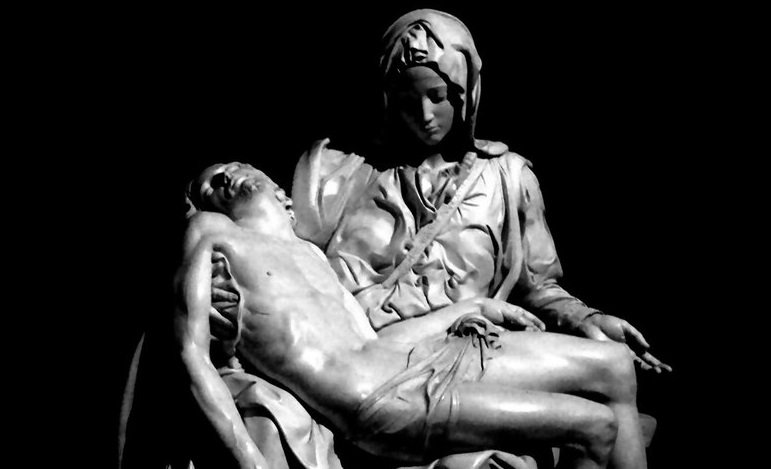
Good luck sticking this in your calculator.
Lacoste does not take the easy way out, as Jean-Luc Marion does in his achingly beautiful The Erotic Phenomenon, by talking about love. No, Lacoste instead gives you a striking example from the history of art:
“It is possible to articulate the Pietà of Michelangelo through equations. But having done this, we have rendered an account not of a work of art but of an object analogous to every other object. We have performed a mental work, just as the scientist specializing in meteorology performs a mental work… However the scientist describes in order to predict. To describe the statue mathematically, on the other hand, has no other end in sight than to demonstrate our mathematical competency–and the statue is merely the occasion to demonstrate it.”
Sounds a little masturbatory, doesn’t it? Math, doing math, for the sake of math. But between all the button pushing we miss the bust, or rather the statue, for the equation.
I don’t have time for that, because, as Wittgenstein famously said:
“We feel that even when all possible scientific questions have been answered, the problems of life remain completely untouched.”
So much for scientific imperialism, or what’s called scientism. What remains is forging my life by returning to my dissertation on Milosz.
Ain’t no calculator, ain’t no scientist, that’ll do that for me!
Meanwhile, you can amuse yourself with this 8-bit presentation of why Nietzsche thought science has always had a secret crush on theology. You don’t have to buy everything the atheist Nietzsche says, but there’s no reason why we can’t learn something new about theology from atheists. Beyond that, philosophy and theology have more than a crush on each other, they have a secret kinship, because much of what we consider to be the sole property of religion actually originated in philosophy, for example, practices of prayer.
neil de grasse tyson philosophy
Previous Post

May 1, 2014
Hans Urs von Balthasar and Weakness as Apologetic Form
Next Post
May 21, 2014 Saint Socrates: What Damon Linker Got Wrong About Philosophy
Browse Our Archives
Select a Category #WhyRemainCatholic Abortion Advent Anti-Catholicism Arts Atheism Beauty Benedict XVI Bible Book Review Catholic Cinema Comedy Cosmos: A Space-Time Odyssey Czesław Miłosz Dariusz Karłowicz Devil Easter Eastern Orthodoxy Economics Environment Family Famous Atheists Who Weren't Atheists Guest Post Hans Urs von Balthasar HHS Mandate History Imagination Interview Islam Jean-Luc Marion John Paul II Judaism Just War Lent Literature Little Sisters of the Poor Liturgy Martyrdom Music News Paganism Patristics Phenomenology Philosophy Pierre Hadot Poetry Poland Pop Culture Pope Francis Poverty Prayer Protestantism Rabelais Race Remi Brague Rene Girard Russia Sam Rocha Science & Religion SCOTUS Secularization Sexual Abuse Sexuality Silence Solidarity Stratford Caldecott Synod14 Terrorism Top 10 Uncategorized Walker Percy War Weakened Edition World War II World Youth Day WYD Krakow
Select a Month July 2017 June 2017 May 2017 April 2017 March 2017 February 2017 January 2017 December 2016 October 2016 September 2016 August 2016 July 2016 June 2016 May 2016 April 2016 March 2016 February 2016 January 2016 December 2015 November 2015 October 2015 September 2015 August 2015 July 2015 June 2015 May 2015 April 2015 March 2015 February 2015 January 2015 December 2014 November 2014 October 2014 September 2014 August 2014 July 2014 May 2014 April 2014 March 2014 February 2014 January 2014 December 2013 November 2013 October 2013 September 2013 August 2013 July 2013 June 2013 May 2013
Follow Us!
TAKE THE
Religious Wisdom Quiz
What animal did Balaam's donkey see that Balaam could not?
Select your answer to see how you score.
An angel A storm A lion A snake
Related posts from Cosmos The In Lost

The Surprising Anti-Capitalist Logic Behind the Catholic Church's...

How is Classical Philosophy is Like War?

Why Does the World's Leading Philosopher Remain a...

Biblical Authority After Babel Cannot Be Built Upon...
TRENDING AT PATHEOS Catholic

Rejecting Doom: Christian Hope And Human Action
Christianity is a religion of hope. We are to have hope and...

It’s What Comes From Within Which Matters
One of the most difficult things for us to understand is why...

Why I Choose the Eucharist Over the Sermon
Choose the Eucharist, Not the Sermon What are we supposed to get...

5 Design Elements Found in Spiritually Rooted Homes
Putting Spirituality Into Home Decor Our homes are more than our living...

Credo: A Story of God Told with the...
About 10 years ago, I began to imagine a personal "Credo" that...

The Anatomy of Divine Revelation in Catholic Thought
The claim that God has made Himself known to human beings is...
view all Catholic blogs
Ad-Free & Subscriber Log-In Subscription Support
- About Us
- 2026 Calendar
- Videos
- Podcasts
- Library of World Religions
- Faith In Media Tracker
- Advertise With Us
- Write for Us
- Privacy Policy
- Terms of Service
- Do Not Sell My Data
- Contact Us
- Radiant Digital
- Manage Newsletter Subscriptions
- Unsubscribe From Notifications
- Sitemap
Copyright 2008-2026, Patheos. All rights reserved.
Subscription Support Ad-Free & Subscriber Log-In
Follow Patheos