
BuddhistCatholicContemplativeEvangelicalGeneral ChristianHinduJewishLatter-day SaintMuslimNew VisionsProgressive Christian
Beliefs
- Buddhist
- Catholic
- Contemplative
- Evangelical
- General Christian
- Hindu
- Jewish
- Latter-day Saint
- More Voices
- Muslim
- New Visions
- Pagan
- Progressive Christian
Topics
- Religion News
- Food and Religion
- Sports and Religion
- Religious Art
- Religious Music and Entertainment
- Religious Events
- History and Religion
- Style and Religion
- Politics and Religion
- Women in Religion
- Recreation Outdoors and Religion
- Business Finance and Religion
- Careers Workplace and Religion
- Education and Religion
- Family Parenting and Religion
- Health Fitness and Religion
- Home and Religion
- Relationships and Religion
- Technology and Religion
- Travel and Religion
Columnists
- Buddhist Columnists
- Business Finance and Religion Columnists
- Careers Workplace and Religion Columnists
- Catholic Columnists
- Contemplative Columnists
- Education and Religion Columnists
- Evangelists Columnists
- Family Parenting and Religion Columnists
- General Christian Columnists
- Health Fitness and Religion Columnists
- Hindu Columnists
- History and Religion Columnists
- Home and Religion Columnists
- Jewish Columnists
- More Voices Columnists
- Latter Day Columnists
- Muslim Columnists
- New Visions Columnists
- Nonreligious Columnists
- Pagan Columnists
- Politics and Religion Columnists
- Progressive Columnists
- Recreation Outdoors and Religion Columnists
- Relationships and Religion Columnists
- Religion News Columnists
- Religious Art Columnists
- Religious Events Columnists
- Religious Music and Entertainment Columnists
- Sports and Religion Columnists
- Style and Religion Columnists
- Technology and Religion Columnists
- Travel and Religion Columnists
- Women in Religion Columnists
Resource Library
- 2026 Calendar
- Library of World Religions
- The 100 Most Holy Places on Earth
- Patheos Answers
- Podcasts
- Videos
- Faith Leaders Database
- Anglican Episcopalian
- Bahai
- Baptist
- Buddhism
- Christianity
- Confucianism
- Eastern Orthodoxy
- Hinduism
- Holiness and Pentecostal
- ISKCON
- Islam
- Judaism
- Lutheran
- Methodist
- The Church of Jesus Christ of Latter-day Saints
- New Age
- Paganism
- Presbytarian and Reformed
- Protestantism
- Religion Behind the Scenes
- Roman Catholic
- Scientology
- Shia Islam
- Sikhism
- Sufism
- Sunni Islam
- Taoism
- Zen
- See all religions
Research Tools
 Ad-Free & Subscriber Log-In Subscription Support
Ad-Free & Subscriber Log-In Subscription Support
Follow Patheos 

- Trending:
- Forgiveness
- |
- Marriage
- |
- Consciousness
- |
- Death Penalty
- |
- Election
- |
- Halloween
 Cosmos The In Lost
- Home
- Catholic
- No More Throne and Altar: St. JP2 on Inequality is the Root of Social Evil
No More Throne and Altar: St. JP2 on Inequality is the Root of Social Evil
Last updated on: August 19, 2014 at 8:21 am by Artur Rosman
No More Throne and Altar: St. JP2 on Inequality is the Root of Social Evil 2014-08-19T08:21:21-07:00 Artur Rosman
Patheos Explore the world's faith through different perspectives on religion and spirituality! Patheos has the views of the prevalent religions and spiritualities of the world.

Nothing new here, just Catholic Social Teaching.
Pope Francis caused a storm of controversy with the tweet, “Inequality is the root of social evil.”
This sent some scrambling to set up a genealogy. From the looks of it Thomas Piketty author of Capital in the 21st Century seems to be the prime suspect. I know next to nothing about this book, so all I can offer you is the following publisher blurb:
“What are the grand dynamics that drive the accumulation and distribution of capital? Questions about the long-term evolution of inequality, the concentration of wealth, and the prospects for economic growth lie at the heart of political economy. But satisfactory answers have been hard to find for lack of adequate data and clear guiding theories. In Capital in the Twenty-First Century, Thomas Piketty analyzes a unique collection of data from twenty countries, ranging as far back as the eighteenth century, to uncover key economic and social patterns. His findings will transform debate and set the agenda for the next generation of thought about wealth and inequality.
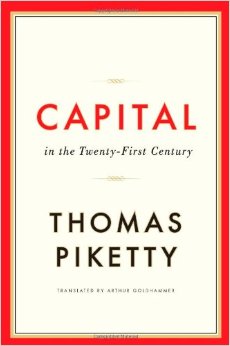
Did this author poison the pope’s feed?
Piketty shows that modern economic growth and the diffusion of knowledge have allowed us to avoid inequalities on the apocalyptic scale predicted by Karl Marx. But we have not modified the deep structures of capital and inequality as much as we thought in the optimistic decades following World War II. The main driver of inequality–the tendency of returns on capital to exceed the rate of economic growth–today threatens to generate extreme inequalities that stir discontent and undermine democratic values. But economic trends are not acts of God. Political action has curbed dangerous inequalities in the past, Piketty says, and may do so again.
A work of extraordinary ambition, originality, and rigor, Capital in the Twenty-First Century reorients our understanding of economic history and confronts us with sobering lessons for today.”
I’ll leave the conspiracy theorists to themselves, because the real culprit seems to be something as simple and traditional as Catholic Social Teaching. CST has been battling inequality since Rerum Novarum.
Today’s tweet should only be a surprise to those who have been spoon-fed (crack spoon) their CST from Novak, Weigel, Zmirak et al. But for those who’ve read a little CST the Neo-Con capitalist absolutism is merely another version of the throne and altar arrangement.
They agree to throw holy water on real-existing capitalism because it’s on the up and up and they don’t want to be left behind. The problem with these altar and throne arrangements is that they always inevitably come too late and embrace something that’s on the way out (like absolute monarchy or the nation-state in ages past). Throne and altar arrangements always make the Church look like a fool in the long run.
CST is so much ahead of the curve that I sometimes like to troll friends on facebook by quoting passages from Rerum Novarum and attributing them to Marx. This inevitably leads to at least one respectable academic soiling himself or herself about what jerks Marx and real-existing communism were.
Here’s a favorite passage of mine from Leo XIII (always get them, try this on your friends):

Schindler says remember your roots.
“47. Many excellent results will follow from this; and, first of all, property will certainly become more equitably divided. For, the result of civil change and revolution has been to divide cities into two classes separated by a wide chasm. On the one side there is the party which holds power because it holds wealth; which has in its grasp the whole of labor and trade; which manipulates for its own benefit and its own purposes all the sources of supply, and which is not without influence even in the administration of the commonwealth. On the other side there is the needy and powerless multitude, sick and sore in spirit and ever ready for disturbance. If working people can be encouraged to look forward to obtaining a share in the land, the consequence will be that the gulf between vast wealth and sheer poverty will be bridged over, and the respective classes will be brought nearer to one another.”
John Paul II continued the tradition of CST with the encyclical Centesimus Annus, written to celebrate the 100th anniversary of Rerum Novarum. Look at what he says below falls in line with Leo and Francis.
Let’s face it, CST is the real culprit in this tweet affair, and David L. Schindler is right in arguing that we’ve appropriated it mostly by ignoring it. I would like to advance the hypothesis that, out of pure ignorance, more Catholics are unfaithful to CST than they are unfaithful to the Church’s teaching on contraception.
Here is a fuller context for the passage quoted above in the banner for this post. It’s from Centesimus Annus:
“35. Here we find a wide range of opportunities for commitment and effort in the name of justice on the part of trade unions and other workers’ organizations. These defend workers’ rights and protect their interests as persons, while fulfilling a vital cultural role, so as to enable workers to participate more fully and honourably in the life of their nation and to assist them along the path of development.
In this sense, it is right to speak of a struggle against an economic system, if the latter is understood as a method of upholding the absolute predominance of capital, the possession of the means of production and of the land, in contrast to the free and personal nature of human work.73 In the struggle against such a system, what is being proposed as an alternative is not the socialist system, which in fact turns out to be State capitalism, but rather a society of free work, of enterprise and of participation. Such a society is not directed against the market, but demands that the market be appropriately controlled by the forces of society and by the State, so as to guarantee that the basic needs of the whole of society are satisfied.
The Church acknowledges the legitimate role of profit as an indication that a business is functioning well. When a firm makes a profit, this means that productive factors have been properly employed and corresponding human needs have been duly satisfied. But profitability is not the only indicator of a firm’s condition. It is possible for the financial accounts to be in order, and yet for the people — who make up the firm’s most valuable asset — to be humiliated and their dignity offended. Besides being morally inadmissible, this will eventually have negative repercussions on the firm’s economic efficiency. In fact, the purpose of a business firm is not simply to make a profit, but is to be found in its very existence as a community of persons who in various ways are endeavouring to satisfy their basic needs, and who form a particular group at the service of the whole of society. Profit is a regulator of the life of a business, but it is not the only one; other human and moral factors must also be considered which, in the long term, are at least equally important for the life of a business.
We have seen that it is unacceptable to say that the defeat of so-called ‘Real Socialism’ leaves capitalism as the only model of economic organization. It is necessary to break down the barriers and monopolies which leave so many countries on the margins of development, and to provide all individuals and nations with the basic conditions which will enable them to share in development. This goal calls for programmed and responsible efforts on the part of the entire international community. Stronger nations must offer weaker ones opportunities for taking their place in international life, and the latter must learn how to use these opportunities by making the necessary efforts and sacrifices and by ensuring political and economic stability, the certainty of better prospects for the future, the improvement of workers’ skills, and the training of competent business leaders who are conscious of their responsibilities.74“
Does this resemble anything we’ve inherited in the hell of inequality we’ve created here in the States and abroad? Heck, no.
Break down the barriers and monopolies indeed!
Weigel, Novak and Zmirak, quit with the holy water already.
Postscript: If you’re one of those people who annoyingly insists on a biblical warrant for this sort of thing, there’s yesterday’s first reading. The story of Ananias and Sapphira, also from Acts, adds some context and spice to the picture. Remember what happened to them?
http://www.eyeneer.com/embed/572
Previous Post

April 27, 2014
Ode for John Paul II by Czeslaw Milosz
Next Post
April 29, 2014 The Consequences of Real-Existing Capitalism for Fertility
Browse Our Archives
Select a Category #WhyRemainCatholic Abortion Advent Anti-Catholicism Arts Atheism Beauty Benedict XVI Bible Book Review Catholic Cinema Comedy Cosmos: A Space-Time Odyssey Czesław Miłosz Dariusz Karłowicz Devil Easter Eastern Orthodoxy Economics Environment Family Famous Atheists Who Weren't Atheists Guest Post Hans Urs von Balthasar HHS Mandate History Imagination Interview Islam Jean-Luc Marion John Paul II Judaism Just War Lent Literature Little Sisters of the Poor Liturgy Martyrdom Music News Paganism Patristics Phenomenology Philosophy Pierre Hadot Poetry Poland Pop Culture Pope Francis Poverty Prayer Protestantism Rabelais Race Remi Brague Rene Girard Russia Sam Rocha Science & Religion SCOTUS Secularization Sexual Abuse Sexuality Silence Solidarity Stratford Caldecott Synod14 Terrorism Top 10 Uncategorized Walker Percy War Weakened Edition World War II World Youth Day WYD Krakow
Select a Month July 2017 June 2017 May 2017 April 2017 March 2017 February 2017 January 2017 December 2016 October 2016 September 2016 August 2016 July 2016 June 2016 May 2016 April 2016 March 2016 February 2016 January 2016 December 2015 November 2015 October 2015 September 2015 August 2015 July 2015 June 2015 May 2015 April 2015 March 2015 February 2015 January 2015 December 2014 November 2014 October 2014 September 2014 August 2014 July 2014 May 2014 April 2014 March 2014 February 2014 January 2014 December 2013 November 2013 October 2013 September 2013 August 2013 July 2013 June 2013 May 2013
Follow Us!
TAKE THE
Religious Wisdom Quiz
Who was Rahab's great-great-grandson?
Select your answer to see how you score.
Jesse King David Solomon Boaz
Related posts from Cosmos The In Lost

The Surprising Anti-Capitalist Logic Behind the Catholic Church's...

What is the Source of Our Culture of...

Where Does the Body of Christ Go After...

How is Classical Philosophy is Like War?
TRENDING AT PATHEOS Catholic

Rejecting Doom: Christian Hope And Human Action
Christianity is a religion of hope. We are to have hope and...

It’s What Comes From Within Which Matters
One of the most difficult things for us to understand is why...

Why I Choose the Eucharist Over the Sermon
Choose the Eucharist, Not the Sermon What are we supposed to get...

5 Design Elements Found in Spiritually Rooted Homes
Putting Spirituality Into Home Decor Our homes are more than our living...

Credo: A Story of God Told with the...
About 10 years ago, I began to imagine a personal "Credo" that...

The Anatomy of Divine Revelation in Catholic Thought
The claim that God has made Himself known to human beings is...
view all Catholic blogs
Ad-Free & Subscriber Log-In Subscription Support
- About Us
- 2026 Calendar
- Videos
- Podcasts
- Library of World Religions
- Faith In Media Tracker
- Advertise With Us
- Write for Us
- Privacy Policy
- Terms of Service
- Do Not Sell My Data
- Contact Us
- Radiant Digital
- Manage Newsletter Subscriptions
- Unsubscribe From Notifications
- Sitemap
Copyright 2008-2026, Patheos. All rights reserved.
Subscription Support Ad-Free & Subscriber Log-In
Follow Patheos