
BuddhistCatholicContemplativeEvangelicalGeneral ChristianHinduJewishLatter-day SaintMuslimNew VisionsProgressive Christian
Beliefs
- Buddhist
- Catholic
- Contemplative
- Evangelical
- General Christian
- Hindu
- Jewish
- Latter-day Saint
- More Voices
- Muslim
- New Visions
- Pagan
- Progressive Christian
Topics
- Religion News
- Food and Religion
- Sports and Religion
- Religious Art
- Religious Music and Entertainment
- Religious Events
- History and Religion
- Style and Religion
- Politics and Religion
- Women in Religion
- Recreation Outdoors and Religion
- Business Finance and Religion
- Careers Workplace and Religion
- Education and Religion
- Family Parenting and Religion
- Health Fitness and Religion
- Home and Religion
- Relationships and Religion
- Technology and Religion
- Travel and Religion
Columnists
- Buddhist Columnists
- Business Finance and Religion Columnists
- Careers Workplace and Religion Columnists
- Catholic Columnists
- Contemplative Columnists
- Education and Religion Columnists
- Evangelists Columnists
- Family Parenting and Religion Columnists
- General Christian Columnists
- Health Fitness and Religion Columnists
- Hindu Columnists
- History and Religion Columnists
- Home and Religion Columnists
- Jewish Columnists
- More Voices Columnists
- Latter Day Columnists
- Muslim Columnists
- New Visions Columnists
- Nonreligious Columnists
- Pagan Columnists
- Politics and Religion Columnists
- Progressive Columnists
- Recreation Outdoors and Religion Columnists
- Relationships and Religion Columnists
- Religion News Columnists
- Religious Art Columnists
- Religious Events Columnists
- Religious Music and Entertainment Columnists
- Sports and Religion Columnists
- Style and Religion Columnists
- Technology and Religion Columnists
- Travel and Religion Columnists
- Women in Religion Columnists
Resource Library
- 2026 Calendar
- Library of World Religions
- The 100 Most Holy Places on Earth
- Patheos Answers
- Podcasts
- Videos
- Faith Leaders Database
- Anglican Episcopalian
- Bahai
- Baptist
- Buddhism
- Christianity
- Confucianism
- Eastern Orthodoxy
- Hinduism
- Holiness and Pentecostal
- ISKCON
- Islam
- Judaism
- Lutheran
- Methodist
- The Church of Jesus Christ of Latter-day Saints
- New Age
- Paganism
- Presbytarian and Reformed
- Protestantism
- Religion Behind the Scenes
- Roman Catholic
- Scientology
- Shia Islam
- Sikhism
- Sufism
- Sunni Islam
- Taoism
- Zen
- See all religions
Research Tools
 Ad-Free & Subscriber Log-In Subscription Support
Ad-Free & Subscriber Log-In Subscription Support
Follow Patheos 

- Trending:
- Forgiveness
- |
- Marriage
- |
- Consciousness
- |
- Death Penalty
- |
- Election
- |
- Halloween
 Cosmos The In Lost
- Home
- Catholic
- The Early Church's Choice Between Neoplatonism & Neoplatonism
The Early Church's Choice Between Neoplatonism & Neoplatonism
Last updated on: April 8, 2014 at 10:45 am by Artur Rosman
The Early Church's Choice Between Neoplatonism & Neoplatonism 2014-04-08T10:45:38-07:00 Artur Rosman
Patheos Explore the world's faith through different perspectives on religion and spirituality! Patheos has the views of the prevalent religions and spiritualities of the world.
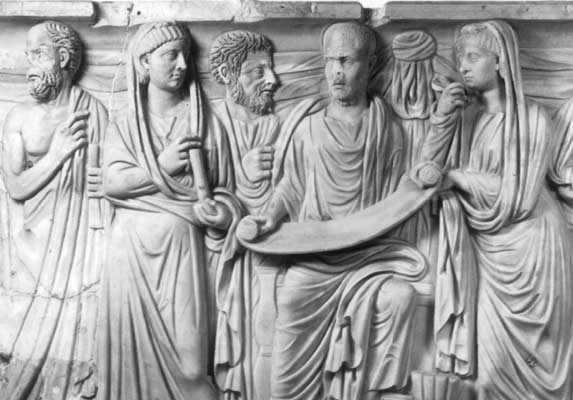
Plotinus with his disciples. Looks like an early Christian relief doesn’t it?
There is nothing to be embarrassed by the overlaps between Christianity and other world religions. This is a normal part of an eminently incarnational faith. I’ve already mentioned Christianity’s fruitful borrowings of the practice of prayer, pagan myths and rituals, plus, the Greek language and all its philosophical baggage (in the New Testament).
All of these are so much a part of Christianity that we forget that they did not originate with it. However, Christianity did combine them in a totally new way. Justin Martyr saw in this whole process a sign of the seminal engagement of God in all his creation and Christianity’s role as gathering up all of these signs.
Conversion makes all the difference.
Orphic cults and their Mithraic offshoots are one set of convergences that’s thrown about frequently. These have the following in common with Christianity: the sacrifice of a god, a banquet meal, and highly ritualized actions. These similarities are then somehow transubstantiated into the belief that Christianity was produced by Orphic religion.
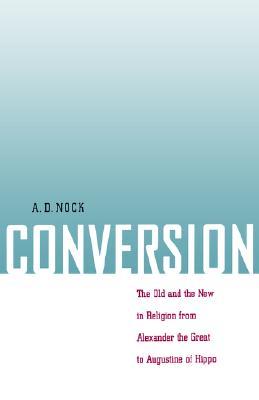
There’s one major problem. A.D. Nock, in his influential study Conversion: The Old and the New in Religion from Alexander the Great to Augustine of Hippo (boy that book needs to be read by more people!) shows how these mystery religions did not require a total transformation, were frequently practiced with other Roman religions, and were reserved mostly to the upper classes. In other words, they were more like really expensive window dressing, rather than an extremely costly transformation of one’s whole life within a community.
If we want to look for more substantial overlaps and influences between Christianity and pagan religion then we should look to the Neoplatonism of figures such as Emperor Julian the Apostate, Plotinus, and Iamblicbus. After all, the pagan religion Julian attempted to reinvigorate was Neoplatonism not something else.

In Sacred Games: A History of Christian Worship Bernhard Lang argues that, “When in late antiquity the religious elite of the Roman Empire rethought religion and ritual, the choice was not one between Mithraism and Christianity (as Ernest Renan suggested in the 19th century) but between pagan Neoplatonism and Neoplatonic Christianity.”
Here is the reason why in more detail:
“In the third century CE, under the leadership of Plotinus, Plato’s philosophy enjoyed a renaissance that was to continue throughout late antiquity. This school of thought had much in common with Christianity: it believed in one God (the “One”), in the necessity of ritual, and in the saving contact with deities that were distinct from the ineffable One and stood closer to humanity. Like Judaism and Christianity, it also had its sacred books–the writings of Plato, and, in its later phase, also the Chaldean Oracles. In fact, major early Christian theologians–Origen, Augustine, Pseudo-Dionysus–can at the same time be considered major representatives of the Neoplatonic school of thought.”
Actually, according to Lang, there is one unique liturgical element the Judeo-Christian tradition brought into the world. That would be the sermon (and along with it the sermon nap).
All joking aside, the Neoplatonist episode, and others from the history of the Early Church, demonstrate that Christianity has always appropriated the best of the religious and philosophical worlds that surround it. We often forget but this was also the case much later with Thomas Aquinas and his embrace, against some ecclesiastical currents of the time, of Aristotle. In the end there’s no reason why Christians and theologians should shun contemporary philosophical currents such as postmodernism, phenomenology, or modern scientific discoveries. History shows the Logos can gather all of them up.
Previous Post

April 2, 2014
John Paul II, the Artist in You, and Coleridge
Next Post
April 10, 2014 Why Be So Harsh on George Weigel? Because of What Weigel Said.
Browse Our Archives
Select a Category #WhyRemainCatholic Abortion Advent Anti-Catholicism Arts Atheism Beauty Benedict XVI Bible Book Review Catholic Cinema Comedy Cosmos: A Space-Time Odyssey Czesław Miłosz Dariusz Karłowicz Devil Easter Eastern Orthodoxy Economics Environment Family Famous Atheists Who Weren't Atheists Guest Post Hans Urs von Balthasar HHS Mandate History Imagination Interview Islam Jean-Luc Marion John Paul II Judaism Just War Lent Literature Little Sisters of the Poor Liturgy Martyrdom Music News Paganism Patristics Phenomenology Philosophy Pierre Hadot Poetry Poland Pop Culture Pope Francis Poverty Prayer Protestantism Rabelais Race Remi Brague Rene Girard Russia Sam Rocha Science & Religion SCOTUS Secularization Sexual Abuse Sexuality Silence Solidarity Stratford Caldecott Synod14 Terrorism Top 10 Uncategorized Walker Percy War Weakened Edition World War II World Youth Day WYD Krakow
Select a Month July 2017 June 2017 May 2017 April 2017 March 2017 February 2017 January 2017 December 2016 October 2016 September 2016 August 2016 July 2016 June 2016 May 2016 April 2016 March 2016 February 2016 January 2016 December 2015 November 2015 October 2015 September 2015 August 2015 July 2015 June 2015 May 2015 April 2015 March 2015 February 2015 January 2015 December 2014 November 2014 October 2014 September 2014 August 2014 July 2014 May 2014 April 2014 March 2014 February 2014 January 2014 December 2013 November 2013 October 2013 September 2013 August 2013 July 2013 June 2013 May 2013
Follow Us!
TAKE THE
Religious Wisdom Quiz
Which Psalm expresses confession: "Against you, you only, have I sinned"?
Select your answer to see how you score.
Psalm 73 Psalm 51 Psalm 24 Psalm 100
Related posts from Cosmos The In Lost

The Surprising Anti-Capitalist Logic Behind the Catholic Church's...

How is Classical Philosophy is Like War?

Why Does the World's Leading Philosopher Remain a...

Biblical Authority After Babel Cannot Be Built Upon...
TRENDING AT PATHEOS Catholic

Rejecting Doom: Christian Hope And Human Action
Christianity is a religion of hope. We are to have hope and...

It’s What Comes From Within Which Matters
One of the most difficult things for us to understand is why...

Why I Choose the Eucharist Over the Sermon
Choose the Eucharist, Not the Sermon What are we supposed to get...

5 Design Elements Found in Spiritually Rooted Homes
Putting Spirituality Into Home Decor Our homes are more than our living...

Credo: A Story of God Told with the...
About 10 years ago, I began to imagine a personal "Credo" that...

The Anatomy of Divine Revelation in Catholic Thought
The claim that God has made Himself known to human beings is...
view all Catholic blogs
Ad-Free & Subscriber Log-In Subscription Support
- About Us
- 2026 Calendar
- Videos
- Podcasts
- Library of World Religions
- Faith In Media Tracker
- Advertise With Us
- Write for Us
- Privacy Policy
- Terms of Service
- Do Not Sell My Data
- Contact Us
- Radiant Digital
- Manage Newsletter Subscriptions
- Unsubscribe From Notifications
- Sitemap
Copyright 2008-2026, Patheos. All rights reserved.
Subscription Support Ad-Free & Subscriber Log-In
Follow Patheos