
BuddhistCatholicContemplativeEvangelicalGeneral ChristianHinduJewishLatter-day SaintMuslimNew VisionsProgressive Christian
Beliefs
- Buddhist
- Catholic
- Contemplative
- Evangelical
- General Christian
- Hindu
- Jewish
- Latter-day Saint
- More Voices
- Muslim
- New Visions
- Pagan
- Progressive Christian
Topics
- Religion News
- Food and Religion
- Sports and Religion
- Religious Art
- Religious Music and Entertainment
- Religious Events
- History and Religion
- Style and Religion
- Politics and Religion
- Women in Religion
- Recreation Outdoors and Religion
- Business Finance and Religion
- Careers Workplace and Religion
- Education and Religion
- Family Parenting and Religion
- Health Fitness and Religion
- Home and Religion
- Relationships and Religion
- Technology and Religion
- Travel and Religion
Columnists
- Buddhist Columnists
- Business Finance and Religion Columnists
- Careers Workplace and Religion Columnists
- Catholic Columnists
- Contemplative Columnists
- Education and Religion Columnists
- Evangelists Columnists
- Family Parenting and Religion Columnists
- General Christian Columnists
- Health Fitness and Religion Columnists
- Hindu Columnists
- History and Religion Columnists
- Home and Religion Columnists
- Jewish Columnists
- More Voices Columnists
- Latter Day Columnists
- Muslim Columnists
- New Visions Columnists
- Nonreligious Columnists
- Pagan Columnists
- Politics and Religion Columnists
- Progressive Columnists
- Recreation Outdoors and Religion Columnists
- Relationships and Religion Columnists
- Religion News Columnists
- Religious Art Columnists
- Religious Events Columnists
- Religious Music and Entertainment Columnists
- Sports and Religion Columnists
- Style and Religion Columnists
- Technology and Religion Columnists
- Travel and Religion Columnists
- Women in Religion Columnists
Resource Library
- 2026 Calendar
- Library of World Religions
- The 100 Most Holy Places on Earth
- Patheos Answers
- Podcasts
- Videos
- Faith Leaders Database
- Anglican Episcopalian
- Bahai
- Baptist
- Buddhism
- Christianity
- Confucianism
- Eastern Orthodoxy
- Hinduism
- Holiness and Pentecostal
- ISKCON
- Islam
- Judaism
- Lutheran
- Methodist
- The Church of Jesus Christ of Latter-day Saints
- New Age
- Paganism
- Presbytarian and Reformed
- Protestantism
- Religion Behind the Scenes
- Roman Catholic
- Scientology
- Shia Islam
- Sikhism
- Sufism
- Sunni Islam
- Taoism
- Zen
- See all religions
Research Tools
 Ad-Free & Subscriber Log-In Subscription Support
Ad-Free & Subscriber Log-In Subscription Support
Follow Patheos 

- Trending:
- Forgiveness
- |
- Marriage
- |
- Consciousness
- |
- Death Penalty
- |
- Election
- |
- Halloween
 Cosmos The In Lost
- Home
- Catholic
- Bye-Bye Hypatia Science Martyr?
Bye-Bye Hypatia Science Martyr?
Last updated on: March 16, 2014 at 1:04 pm by Artur Rosman
Bye-Bye Hypatia Science Martyr? 2014-03-16T13:04:19-07:00 Artur Rosman
Patheos Explore the world's faith through different perspectives on religion and spirituality! Patheos has the views of the prevalent religions and spiritualities of the world.
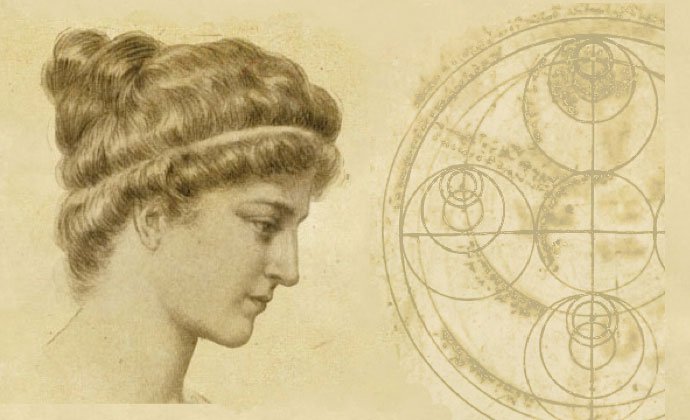
The sixty year old Hypatia definitely did not look like this. If you google her name you’ll find even more racy and inaccurate pictures.
Continuing in a demythologizing vein I’d like to debunk the picture of Hypatia of Alexandria as a science martyr to Christian prejudices against science. Beware! The history of Late Antiquity is more Byzantine than you suspected.
The myth of exclusively religious violence persists because the state and scientists need to cover their butts like in Cosmos.
The Giordano Bruno episode we discussed here in connection with its garbled presentation in the new Cosmos TV series shows the complexity of the issues behind the relationship behind science and religion. What we get from our retelling of the episode is a picture of a mentally unhinged man (Bruno) doing an early modern version of what in our time is called “suicide by cop.”
That the cop fired needs to be understood in its historical context of 16th century Europe with all its political instability. And yes political order hinged on religion, but no, that doesn’t make it more cruel than nukes, drones, and water-boarding, unless you buy into the tired myth of exclusively religious violence. The problem with seeing Bruno as a martyr of any kind lies in the traditional understandings of who counts as a martyr.
These go back to the invention of the notion of a martyr by Greek philosophical schools as they were later picked up by the Christian tradition before and after Constantine. I’ve written about this in connection with my translations of Dariusz Karlowicz’s books. They describe Christian adoption of the Greek philosophical tradition of philosophy as a way of life here, here, and here. One important element of this whole tradition was not seeking martyrdom actively by inciting civil authorities, if martyrdom would come, it would come without your own initiative. Actively taunting authorities who were in charge of keeping order during volatile times, like Bruno did, was closer to suicide than martyrdom.

Hypatia: political victim, but not a martyr.
If you have qualms about criticizing someone’s martyr-status, then let me disabuse you of them. You should know that the early Christians picked up their polemics against false martyrs from the Greek philosophers who invented them. If you don’t believe me, then read the Lives of Eminent Philosophers, volume I and volume II, by Diogenes Laertius for amusing debunkings of would-be-martyrs of rival philosophical schools.
That the Christian authorities weren’t always up to par ethically does not say anything intrinsic about Christians, but only demonstrates humans are (sometimes severely) fallen creatures and liable to mess up the lives of others. Universalizing the Galileo and Bruno episodes leads to total ignorance about the scientific research and tolerance in other parts of Christendom, or even just in the Rome of the time.
One early example of potentially horrible Christian leadership in action is connected to the life and murder of the beautiful young mathematician Hypatia of Alexandria (d. 415) by an angry anti-scientific Christian mob. Or at least that’s the standard story.
The reality, again, is even more complicated than the title of the Enlightenment era polemic that first advanced the case of her as a science “martyr.” This 1720 book’s title lends itself easily to a Freudian analysis of its author, Hypatia; or, The History of a Most Beautiful, Most Virtuous, Most Learned and in Every Way Accomplished Lady; Who Was Torn to Piece by the Clergy of Alexandria, to Gratify the Pride, Emulation, and Cuelty of the Archbishop, Commonly but Undeservedly Titled St. Cyril. Oy vey, the author, John Tolland, seemed to be up on something more than just science and putting down Christianity (wink, wink, nudge nudge).
The Polish scholar Maria Dzielska, in her recent book Hypatia of Alexandria, adds considerable, if still bloody, nuance to this whole story. First of all, Hypatia might have been most beautiful, although the state of medicine during the fifth century leads one to doubt that, but she definitely was not young clocking in at somewhere over 60 years old at the time of her death.

Besides being a clumsy politician “Cyril is, arguably, the most important patristic theologian ever to deal with the issues of Christology.”
She also was a most learned and accomplished person, however her prudence in choosing friends seems questionable. According to Dzielska, Hypatia was friends with both St. Cyril (obviously a churchman) and Orestes, an imperial prefect (also a Christian). This triangle led to a power play by Cyril who took advantage of his friendship with the pagan Hypatia to take down the prestige of Orestes (a Christian) down a notch. St. Cyril accused Hypatia of magic and witchcraft–the very sorts of accusations the Inquisition relentlessly debunked with its skepticism, helping to quell mob violence, centuries later–and somehow (the details are not entirely clear) incited mob violence against her.
This was obviously not anti-scientific mob violence, because Alexandria remained a Christian center of natural philosophy for many years later. One added twist to all this is that natural philosophy was not what we now recognize as science, because that emerged more than a millennium later during the 16th and 17th centuries. So much for Hypatia as a martyr for science.
One of the essays in Galileo Goes to Jail details how “natural philosophy” consisted of:
“…inherited beliefs about nature–about the origins and structure of the cosmos, the motions of celestial bodies, the nature of the elements, sickness and health, the explanation of dramatic natural phenomena (thunder, lightning, eclipses, the rainbow, and the like)–and [their] relationship to the gods.”
The author of that essay (the chapter titles always present a position that’s up for debunking), “That the Rise of Christianity Was Responsible for the Demise of Ancient Science,” then continues:
“These are the ingredients of what would develop later into modern science (some were already identical to their modern counterparts); and if we are interested in the origins of Western science they are what we must investigate.”
He then goes on to show that the propagation of this, strictly speaking pre-scientific, knowledge was promoted (not ignored or demoted) during late antiquity, the middle ages, and the early modern period by the notion of natural philosophy as a “handmaiden of theology.” This pre-scientific culture flourished thanks to the patronage of the Church, even if the emergence of science is not, as some have argued, an exclusively Christian accomplishment.
After all, as Karlowicz and others (i.e. Jaroslav Pelikan) have demonstrated, the early Church Fathers (not to mention the writers of the New Testament and everyone since) always borrowed, continued, and transformed the classical tradition in productive ways. But more about this soon.
Jesuit science is not an oxymoron.
In preparation for today’s episode of Cosmos (it will be streamed here), you should probably take a look at Maurice Finocchiaro’s chapter in Galileo Goes to Jail, and his book-length studies The Galileo Affair: A Documentary History and Retrying Galileo, 1633-1992. I have a hunch the myths that he was imprisoned and tortured might pop up. We’ll see.
Since Robert Bellarmine, SJ was involved in both the Bruno and Galileo affairs it might also make sense to eventually discuss the notion that Catholics in general, and the Jesuits in particular, contributed nothing to modern science. The essay collection Jesuit Science and the Republic of Letters is one place for you to get a head start before I tackle the issue directly later.
And if you don’t trust me on Hypatia, maybe you’ll trust an atheist?
http://www.youtube.com/watch?v=nMWGXt979yg
Previous Post

March 13, 2014
Lies, Damned Lies, and Cartoons: Cosmos on Giordano Bruno
Next Post
March 17, 2014 Larry Chapp: How Has Modern Science Shaped Theology?
Browse Our Archives
Select a Category #WhyRemainCatholic Abortion Advent Anti-Catholicism Arts Atheism Beauty Benedict XVI Bible Book Review Catholic Cinema Comedy Cosmos: A Space-Time Odyssey Czesław Miłosz Dariusz Karłowicz Devil Easter Eastern Orthodoxy Economics Environment Family Famous Atheists Who Weren't Atheists Guest Post Hans Urs von Balthasar HHS Mandate History Imagination Interview Islam Jean-Luc Marion John Paul II Judaism Just War Lent Literature Little Sisters of the Poor Liturgy Martyrdom Music News Paganism Patristics Phenomenology Philosophy Pierre Hadot Poetry Poland Pop Culture Pope Francis Poverty Prayer Protestantism Rabelais Race Remi Brague Rene Girard Russia Sam Rocha Science & Religion SCOTUS Secularization Sexual Abuse Sexuality Silence Solidarity Stratford Caldecott Synod14 Terrorism Top 10 Uncategorized Walker Percy War Weakened Edition World War II World Youth Day WYD Krakow
Select a Month July 2017 June 2017 May 2017 April 2017 March 2017 February 2017 January 2017 December 2016 October 2016 September 2016 August 2016 July 2016 June 2016 May 2016 April 2016 March 2016 February 2016 January 2016 December 2015 November 2015 October 2015 September 2015 August 2015 July 2015 June 2015 May 2015 April 2015 March 2015 February 2015 January 2015 December 2014 November 2014 October 2014 September 2014 August 2014 July 2014 May 2014 April 2014 March 2014 February 2014 January 2014 December 2013 November 2013 October 2013 September 2013 August 2013 July 2013 June 2013 May 2013
Follow Us!
TAKE THE
Religious Wisdom Quiz
Who said, "Though he slay me, yet will I hope in him"?
Select your answer to see how you score.
Peter Job David Isaiah
Related posts from Cosmos The In Lost

The Surprising Anti-Capitalist Logic Behind the Catholic Church's...

How is Classical Philosophy is Like War?

Why Does the World's Leading Philosopher Remain a...

2 Reasons Why the March for Science is...
TRENDING AT PATHEOS Catholic

Rejecting Doom: Christian Hope And Human Action
Christianity is a religion of hope. We are to have hope and...

It’s What Comes From Within Which Matters
One of the most difficult things for us to understand is why...

Why I Choose the Eucharist Over the Sermon
Choose the Eucharist, Not the Sermon What are we supposed to get...

5 Design Elements Found in Spiritually Rooted Homes
Putting Spirituality Into Home Decor Our homes are more than our living...

Credo: A Story of God Told with the...
About 10 years ago, I began to imagine a personal "Credo" that...

The Anatomy of Divine Revelation in Catholic Thought
The claim that God has made Himself known to human beings is...
view all Catholic blogs
Ad-Free & Subscriber Log-In Subscription Support
- About Us
- 2026 Calendar
- Videos
- Podcasts
- Library of World Religions
- Faith In Media Tracker
- Advertise With Us
- Write for Us
- Privacy Policy
- Terms of Service
- Do Not Sell My Data
- Contact Us
- Radiant Digital
- Manage Newsletter Subscriptions
- Unsubscribe From Notifications
- Sitemap
Copyright 2008-2026, Patheos. All rights reserved.
Subscription Support Ad-Free & Subscriber Log-In
Follow Patheos