
BuddhistCatholicContemplativeEvangelicalGeneral ChristianHinduJewishLatter-day SaintMuslimNew VisionsProgressive Christian
Beliefs
- Buddhist
- Catholic
- Contemplative
- Evangelical
- General Christian
- Hindu
- Jewish
- Latter-day Saint
- More Voices
- Muslim
- New Visions
- Pagan
- Progressive Christian
Topics
- Religion News
- Food and Religion
- Sports and Religion
- Religious Art
- Religious Music and Entertainment
- Religious Events
- History and Religion
- Style and Religion
- Politics and Religion
- Women in Religion
- Recreation Outdoors and Religion
- Business Finance and Religion
- Careers Workplace and Religion
- Education and Religion
- Family Parenting and Religion
- Health Fitness and Religion
- Home and Religion
- Relationships and Religion
- Technology and Religion
- Travel and Religion
Columnists
- Buddhist Columnists
- Business Finance and Religion Columnists
- Careers Workplace and Religion Columnists
- Catholic Columnists
- Contemplative Columnists
- Education and Religion Columnists
- Evangelists Columnists
- Family Parenting and Religion Columnists
- General Christian Columnists
- Health Fitness and Religion Columnists
- Hindu Columnists
- History and Religion Columnists
- Home and Religion Columnists
- Jewish Columnists
- More Voices Columnists
- Latter Day Columnists
- Muslim Columnists
- New Visions Columnists
- Nonreligious Columnists
- Pagan Columnists
- Politics and Religion Columnists
- Progressive Columnists
- Recreation Outdoors and Religion Columnists
- Relationships and Religion Columnists
- Religion News Columnists
- Religious Art Columnists
- Religious Events Columnists
- Religious Music and Entertainment Columnists
- Sports and Religion Columnists
- Style and Religion Columnists
- Technology and Religion Columnists
- Travel and Religion Columnists
- Women in Religion Columnists
Resource Library
- 2026 Calendar
- Library of World Religions
- The 100 Most Holy Places on Earth
- Patheos Answers
- Podcasts
- Videos
- Faith Leaders Database
- Anglican Episcopalian
- Bahai
- Baptist
- Buddhism
- Christianity
- Confucianism
- Eastern Orthodoxy
- Hinduism
- Holiness and Pentecostal
- ISKCON
- Islam
- Judaism
- Lutheran
- Methodist
- The Church of Jesus Christ of Latter-day Saints
- New Age
- Paganism
- Presbytarian and Reformed
- Protestantism
- Religion Behind the Scenes
- Roman Catholic
- Scientology
- Shia Islam
- Sikhism
- Sufism
- Sunni Islam
- Taoism
- Zen
- See all religions
Research Tools
 Ad-Free & Subscriber Log-In Subscription Support
Ad-Free & Subscriber Log-In Subscription Support
Follow Patheos 

- Trending:
- Forgiveness
- |
- Marriage
- |
- Consciousness
- |
- Death Penalty
- |
- Election
- |
- Halloween
 Cosmos The In Lost
- Home
- Catholic
- GOD HATES FLAGS: The Public Nature of Theology
GOD HATES FLAGS: The Public Nature of Theology
Last updated on: February 19, 2014 at 11:44 am by Artur Rosman
GOD HATES FLAGS: The Public Nature of Theology 2014-02-19T11:44:12-07:00 Artur Rosman
Patheos Explore the world's faith through different perspectives on religion and spirituality! Patheos has the views of the prevalent religions and spiritualities of the world.
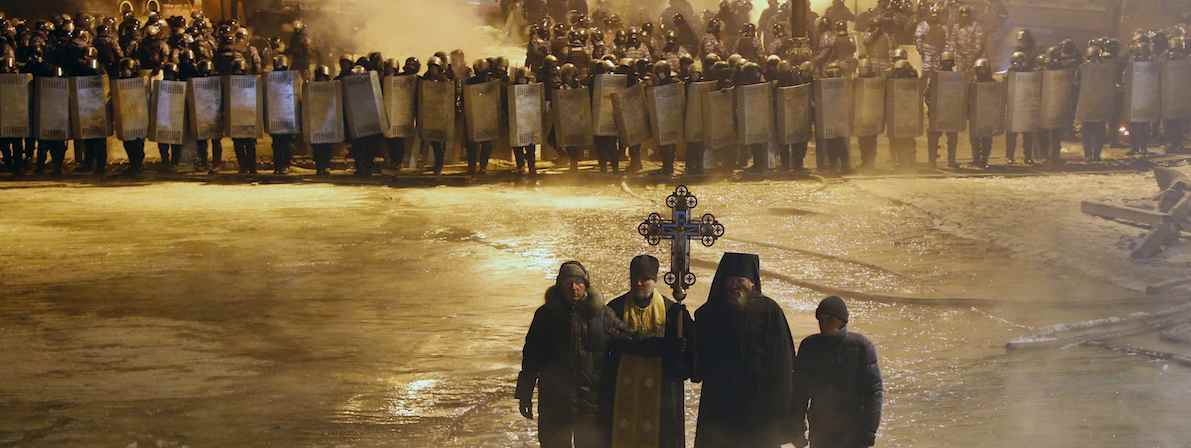
Ukrayina: Caught between the icon and the idol.
The protests in the Ukraine have taken a somewhat unexpected violent turn recently after the promise of peace, reports Timothy, author of Bloodlands. What do these recent events tell us about the Church and about what God thinks about flags?
Tim Kelleher’s recent analysis of these events, “Crucifixion in Kiev,” makes three very important points about their theological significance. He looks at the events with Western eyes:
“To Western eyes, these blokes, of long beard and foreign vestiture, might seem eccentric.Who are they, why is their presence tolerated, and what are those things they carry?
As for who, they are the sacerdotal face of Ukraine’s major churches in the Orthodox tradition.What we mostly see them carrying are icons, the sacred images intrinsic to the Orthodox liturgical witness. Why has everything to do with who and what. For in Slavic culture, religion — particularly the experience of Orthodoxy — does not dwell on one side of an imagined wall never prescribed in that fruit of Magna Carta which are the American founding documents.”
The first point: The most recent readings of the wall separating church and state are spurious at best. Mark Sehat, in The Myth of American Religious Freedom, takes that wall apart. He not only argues that the wall has always been porous, but also that Protestant groups have dominated the political agenda even after the disestablishment of their churches on the state level.
Justin Tse makes an interesting parallel argument in his posts about what he calls the unraveling of the Protestant Private Consensus. You can read more about this notion here. I’ll definitely return to the Private Consensus in the coming weeks, because Justin will publish a guest post tomorrow engaging my widely circulated post about the structures of Protestant and Catholic sex scandals.
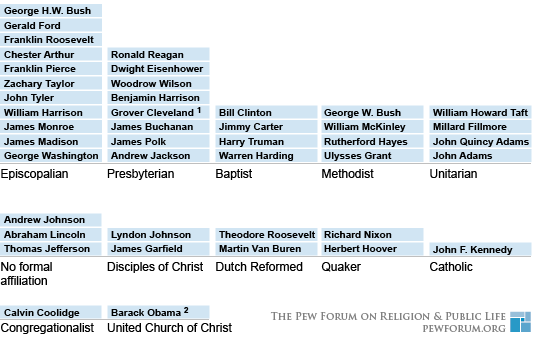
Take a look at this if you’re really curious about who’s in charge of this country, then read Sehat.
Second: The notion of a private theology is especially nonsensical, especially in liturgical traditions, even in countries hit as hard as the Ukraine by Soviet secularization efforts. Theology (like atheism or capitalism) makes claims upon one’s whole world. Scholars such as Brent Nongbri have even gone so far as taking apart the concept of “religion” understood as a private cleaving to religious sentiment that is cordoned off from the public square as a very recent development born of Protestant religious scholarship. In his book Before Religion: A History of a Modern Concept he argues that before the rise of the notion of religion Christians, Jews, and Muslims didn’t see each other as belonging to different religions, but instead as heretics or idolaters from their own particular comprehensive worldview.
Within the Slavic Orthodox context, Artur Mrowczynski-Van Allen’s book Between the Icon and the Idol: The Person and the Modern State in Russian Literature and Thought demonstrates the public nature of theology by showing how Orthodox iconography influenced even secular Russian authors such as Grossman in their struggle against totalitarianism.
Finally, Kelleher’s important article highlights one of the perennial problems of Orthodoxy: its attachment to the nation-state.
“President Putin makes no secret of his view that Ukrainian independence is an illusion tolerated by Russia for as long as it serves the latter’s purposes. Further, capitalizing on the role of Orthodoxy mentioned earlier, he has found religious ‘justification’ for an expanded map of Russia. Invoking a revisionist image of ancient Kiev-Rus, modern borders ‘dissolve,’ giving way to a ‘deeper’, ‘truer’ identity — one that happens to be geographically broader.

What do we bow before? This is the fundamental human drama.
This vision of a greater Russia was recently echoed by the Patriarch of Moscow, in an ominous warning that Russia would be obligated to intervene should the situation in Ukraine devolve into civil war. Indeed, over the past year, the Patriarch has led a parallel campaign for an ecclesial hegemony that would subsume all Ukrainian Orthodox under his authority. The presence in Maidan of priests from each of the Orthodox churches — including those within his jurisdiction — is a bright sign that the attempt is being thwarted.”
This reminds me of William T. Cavanaugh’s conundrum in Torture and Eucharist, about how after the collapse of the supra-national ties of the Corpus Mysticum it is difficult to envisage the church as the mystical body when one part of the body is constantly blowing off the legs or arms of another part in the service of the nation-state.
On a much more petty level, years ago the University of Washington was looking to hire a prominent Orthodox theologian–possibly John Meyendorff, I don’t remember–for their Comparative Religion department, but national politics stood in the way. The Greek Orthodox church across the Montlake Cut from the university just couldn’t countenance taking on a Russian Orthodox priest. The Russian Orthodox church was too far off downtown to be a practical solution.
So perhaps God does hate flags after all?
Yet, it is a sign of hope to hear from Athanasius McVay that some of the Orthodox priests we’ve seen in those dramatic pictures are actually under the jurisdiction of Moscow. They are putting their lives on the line to keep the peace. Couldn’t we use more of that?
With an icon and a newspaper in hand, current events should make us reflect upon the boundaries of theology. (All due apologies to Karl Barth).

Previous Post

February 18, 2014
Imaging God Badly
Browse Our Archives
Select a Category #WhyRemainCatholic Abortion Advent Anti-Catholicism Arts Atheism Beauty Benedict XVI Bible Book Review Catholic Cinema Comedy Cosmos: A Space-Time Odyssey Czesław Miłosz Dariusz Karłowicz Devil Easter Eastern Orthodoxy Economics Environment Family Famous Atheists Who Weren't Atheists Guest Post Hans Urs von Balthasar HHS Mandate History Imagination Interview Islam Jean-Luc Marion John Paul II Judaism Just War Lent Literature Little Sisters of the Poor Liturgy Martyrdom Music News Paganism Patristics Phenomenology Philosophy Pierre Hadot Poetry Poland Pop Culture Pope Francis Poverty Prayer Protestantism Rabelais Race Remi Brague Rene Girard Russia Sam Rocha Science & Religion SCOTUS Secularization Sexual Abuse Sexuality Silence Solidarity Stratford Caldecott Synod14 Terrorism Top 10 Uncategorized Walker Percy War Weakened Edition World War II World Youth Day WYD Krakow
Select a Month July 2017 June 2017 May 2017 April 2017 March 2017 February 2017 January 2017 December 2016 October 2016 September 2016 August 2016 July 2016 June 2016 May 2016 April 2016 March 2016 February 2016 January 2016 December 2015 November 2015 October 2015 September 2015 August 2015 July 2015 June 2015 May 2015 April 2015 March 2015 February 2015 January 2015 December 2014 November 2014 October 2014 September 2014 August 2014 July 2014 May 2014 April 2014 March 2014 February 2014 January 2014 December 2013 November 2013 October 2013 September 2013 August 2013 July 2013 June 2013 May 2013
Follow Us!
TAKE THE
Religious Wisdom Quiz
Which Christian group is known for its emphasis on health and diet?
Select your answer to see how you score.
Jehovah’s Witnesses Seventh-day Adventists Methodists Presbyterians
Related posts from Cosmos The In Lost

The Surprising Anti-Capitalist Logic Behind the Catholic Church's...

The Holy Family as an Icon of World...
Western Civ Doesn't Need Tenured Radicals to Ruin...

Post-Execution Church: Rise Up from the Electric Chair!
TRENDING AT PATHEOS Catholic

Rejecting Doom: Christian Hope And Human Action
Christianity is a religion of hope. We are to have hope and...

It’s What Comes From Within Which Matters
One of the most difficult things for us to understand is why...

Why I Choose the Eucharist Over the Sermon
Choose the Eucharist, Not the Sermon What are we supposed to get...

5 Design Elements Found in Spiritually Rooted Homes
Putting Spirituality Into Home Decor Our homes are more than our living...

Credo: A Story of God Told with the...
About 10 years ago, I began to imagine a personal "Credo" that...

The Anatomy of Divine Revelation in Catholic Thought
The claim that God has made Himself known to human beings is...
view all Catholic blogs
Ad-Free & Subscriber Log-In Subscription Support
- About Us
- 2026 Calendar
- Videos
- Podcasts
- Library of World Religions
- Faith In Media Tracker
- Advertise With Us
- Write for Us
- Privacy Policy
- Terms of Service
- Do Not Sell My Data
- Contact Us
- Radiant Digital
- Manage Newsletter Subscriptions
- Unsubscribe From Notifications
- Sitemap
Copyright 2008-2026, Patheos. All rights reserved.
Subscription Support Ad-Free & Subscriber Log-In
Follow Patheos