
BuddhistCatholicContemplativeEvangelicalGeneral ChristianHinduJewishLatter-day SaintMuslimNew VisionsProgressive Christian
Beliefs
- Buddhist
- Catholic
- Contemplative
- Evangelical
- General Christian
- Hindu
- Jewish
- Latter-day Saint
- More Voices
- Muslim
- New Visions
- Pagan
- Progressive Christian
Topics
- Religion News
- Food and Religion
- Sports and Religion
- Religious Art
- Religious Music and Entertainment
- Religious Events
- History and Religion
- Style and Religion
- Politics and Religion
- Women in Religion
- Recreation Outdoors and Religion
- Business Finance and Religion
- Careers Workplace and Religion
- Education and Religion
- Family Parenting and Religion
- Health Fitness and Religion
- Home and Religion
- Relationships and Religion
- Technology and Religion
- Travel and Religion
Columnists
- Buddhist Columnists
- Business Finance and Religion Columnists
- Careers Workplace and Religion Columnists
- Catholic Columnists
- Contemplative Columnists
- Education and Religion Columnists
- Evangelists Columnists
- Family Parenting and Religion Columnists
- General Christian Columnists
- Health Fitness and Religion Columnists
- Hindu Columnists
- History and Religion Columnists
- Home and Religion Columnists
- Jewish Columnists
- More Voices Columnists
- Latter Day Columnists
- Muslim Columnists
- New Visions Columnists
- Nonreligious Columnists
- Pagan Columnists
- Politics and Religion Columnists
- Progressive Columnists
- Recreation Outdoors and Religion Columnists
- Relationships and Religion Columnists
- Religion News Columnists
- Religious Art Columnists
- Religious Events Columnists
- Religious Music and Entertainment Columnists
- Sports and Religion Columnists
- Style and Religion Columnists
- Technology and Religion Columnists
- Travel and Religion Columnists
- Women in Religion Columnists
Resource Library
- 2026 Calendar
- Library of World Religions
- The 100 Most Holy Places on Earth
- Patheos Answers
- Podcasts
- Videos
- Faith Leaders Database
- Anglican Episcopalian
- Bahai
- Baptist
- Buddhism
- Christianity
- Confucianism
- Eastern Orthodoxy
- Hinduism
- Holiness and Pentecostal
- ISKCON
- Islam
- Judaism
- Lutheran
- Methodist
- The Church of Jesus Christ of Latter-day Saints
- New Age
- Paganism
- Presbytarian and Reformed
- Protestantism
- Religion Behind the Scenes
- Roman Catholic
- Scientology
- Shia Islam
- Sikhism
- Sufism
- Sunni Islam
- Taoism
- Zen
- See all religions
Research Tools
 Ad-Free & Subscriber Log-In Subscription Support
Ad-Free & Subscriber Log-In Subscription Support
Follow Patheos 

- Trending:
- Forgiveness
- |
- Marriage
- |
- Consciousness
- |
- Death Penalty
- |
- Election
- |
- Halloween
 Cosmos The In Lost
- Home
- Catholic
- God, Cosmos, Humankind, and Woman
God, Cosmos, Humankind, and Woman
Last updated on: January 12, 2014 at 11:59 am by Artur Rosman
God, Cosmos, Humankind, and Woman 2014-01-12T11:59:55-07:00 Artur Rosman
Patheos Explore the world's faith through different perspectives on religion and spirituality! Patheos has the views of the prevalent religions and spiritualities of the world.
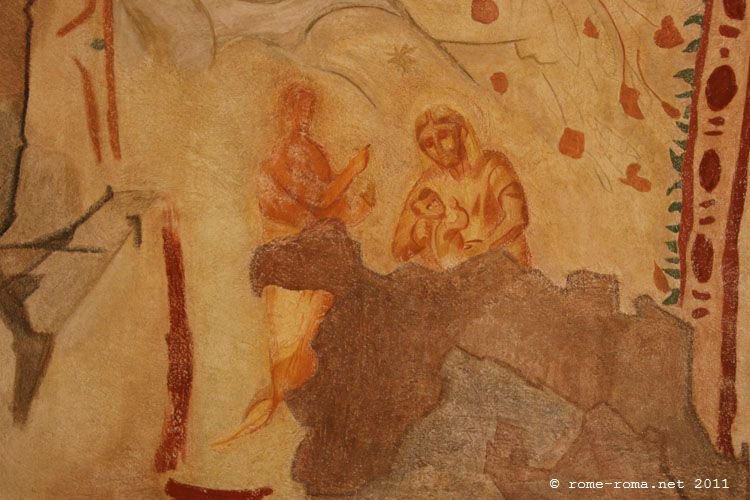
Gerhart Ladner speculates this might be the first image of Mary and Child. Priscilla Catacombs in Rome. Probably third century.
Before getting totally side-tracked by the silly Zmirak controversy I meant to write about Janet Martin Soskice’s remarkable little collection of essays The Kindness of God. It’s a rare theology book that grabs your attention because it seamlessly connects with your life. In the case of the Soskice book it was the kid(s) yelling in the pews phenomenon in contrast with the ascetical indifference (apatheia) championed by the Fathers of both East (Gregory of Nyssa) and West (Augustine).

Ladner’s cover and title meant love at first sight (followed by discernment).
The problem boils down to: what do you with a spiritual tradition that overvalues solitary contemplation when your own life is devoted to lovingly (most of the time) attending to the monstrously shape-shifting phenomena that are growing children?
I took extensive notes for a post about The Kindness of God that I’ll write sometime soon. Soskice also had some fascinating observations (in conversation with Caroline Walker Bynum’s classic Jesus as Mother) about traditional feminine metaphors for God. But for now I won’t talk about that either.
What I’d like to do is quote a passage from a mind-bending book I found by accident in a used bookstore. The title God, Cosmos, and Humankind immediately caught my attention (the cover was pretty cool as well). Gerhart Ladner’s book is basically a survey of the first five centuries of Christian symbolism as it developed through the formation of the biblical canon and later the Councils.
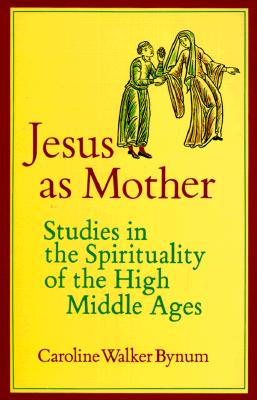
Jesus: Yo Momma?
The book was a little pricey by my standards, fifteen bucks, so I went home, waited a day and checked how much the book sells for online. All the copies I could find were three to four times more expensive. So the next day, in a slightly paranoid state, hoping nobody had bought the book, I went back and got it. Ladner hasn’t disappointed.
Anyway, here’s what Ladner says leading up to a discussion of feminine metaphors for God:
“About 400 there lived in the Egyptian city of Alexandria a Neoplatonic philosopher by the name of Synesius of Cyrene, who eventually–though with certain reservations [I’m told he refused to put away his wife and continued to hunt and throw soirees post consecration]–became Christian and even a bishop. In his hymns Synesius tried to express in a poetic-symbolic way the mystery of the one and the three in the Holy Trinity.”
Here’s an excerpt from the poem:
“Most glorious Offspring of the ineffable Father,
Thee, Blessed One, I hymn, together with the great Father,
and the travail of the Father over Thee,
that Counsel of generation, the medial Beginning,
the Holy Spirit, Center of the Creator, Center again of the Son,
Mother, Sister, and Daughter to Thyself, delivered of the secret Root.
For in order that the Father might be poured out upon the Son,
that very outpouring found a shoot, and stood in the midst,
God, descended from God, in a Son who was God,
and in the renowned outpouring of an immortal Father,
the Son, found a shoot.”
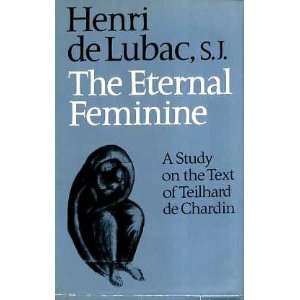
Cover photo of this book? What the? I don’t even… But I bet you didn’t know Cardinal de Lubac was a close buddy of Teilhard.
Ladner then comments on this–perhaps to the dismay of those of you who erroneously think Teilhard de Chardin mischievously devised the notion of an “Eternal Feminine“–in the following way:
“The Holy Spirit is thus the connecting bond in the threefold unity. At the same time Synesius was, consciously or unconsciously, carrying on an ancient tradition, according to which the divine contained not only a male but also a female element. In the Hebrew text of Gen. 1.2, the spirit (actually breath) of God that hovers over the waters could be of female gender. But that same spirit could be seen as the Holy Spirit, from whom Mary conceived the Son of God, who was then born of her in human form (Matt. 1:18ff).
The virgin mother of Jesus is not herself divine, but a human being of perfect purity. At the same time, however, she represents the life-giving divine mother of pre-Christian antiquity raised to a new dimension, no longer in the mythological but instead in the mystical sense. That is also why the Third Ecumenical Council of Ephesus (431) recognized her as the Mother of God (Theotokos). It is important to realize that from earliest times the otherwise pronouncedly male concept of God in Christianity included also the ‘eternal feminine.‘”
How can I not love this Rabelaisian mess of traditions and metaphors?
By the way, the Council of Ephesus marked the first great explosion of Marian piety in the Church (forget the French middle ages). From what I remember the tourist guides telling me, the Council was the main impetus behind the building of Santa Maria Maggiore, which might also be, if my memory serves me right, one of the oldest churches built in honor of Mary.
Also don’t forget that, as John Paul II never got tired of saying, woman was created last and therefore is the pinnacle of all creation.
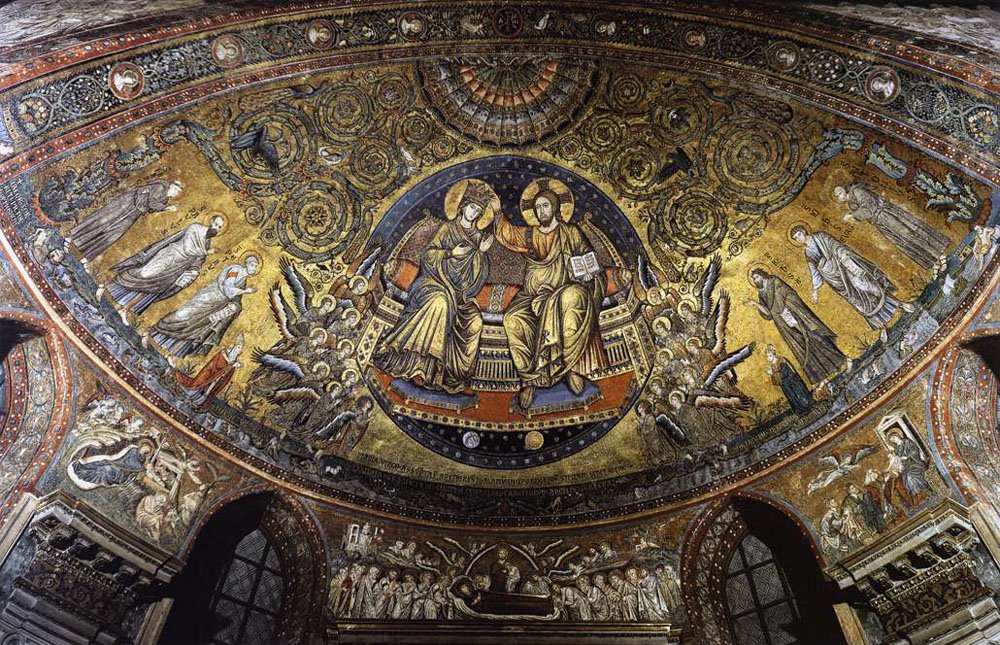
Crown Royal: The glorious fifth century mosaic in Santa Maria Maggiore.
Previous Post

January 11, 2014
Burning Heart: On the Augustinian Strand in American Music
Next Post
January 16, 2014 The Taciturn God of the New Testament
Browse Our Archives
Select a Category #WhyRemainCatholic Abortion Advent Anti-Catholicism Arts Atheism Beauty Benedict XVI Bible Book Review Catholic Cinema Comedy Cosmos: A Space-Time Odyssey Czesław Miłosz Dariusz Karłowicz Devil Easter Eastern Orthodoxy Economics Environment Family Famous Atheists Who Weren't Atheists Guest Post Hans Urs von Balthasar HHS Mandate History Imagination Interview Islam Jean-Luc Marion John Paul II Judaism Just War Lent Literature Little Sisters of the Poor Liturgy Martyrdom Music News Paganism Patristics Phenomenology Philosophy Pierre Hadot Poetry Poland Pop Culture Pope Francis Poverty Prayer Protestantism Rabelais Race Remi Brague Rene Girard Russia Sam Rocha Science & Religion SCOTUS Secularization Sexual Abuse Sexuality Silence Solidarity Stratford Caldecott Synod14 Terrorism Top 10 Uncategorized Walker Percy War Weakened Edition World War II World Youth Day WYD Krakow
Select a Month July 2017 June 2017 May 2017 April 2017 March 2017 February 2017 January 2017 December 2016 October 2016 September 2016 August 2016 July 2016 June 2016 May 2016 April 2016 March 2016 February 2016 January 2016 December 2015 November 2015 October 2015 September 2015 August 2015 July 2015 June 2015 May 2015 April 2015 March 2015 February 2015 January 2015 December 2014 November 2014 October 2014 September 2014 August 2014 July 2014 May 2014 April 2014 March 2014 February 2014 January 2014 December 2013 November 2013 October 2013 September 2013 August 2013 July 2013 June 2013 May 2013
Follow Us!
TAKE THE
Religious Wisdom Quiz
Which Old Testament book is composed mostly of love poems?
Select your answer to see how you score.
Song of Solomon Ruth Ecclesiastes Proverbs
Related posts from Cosmos The In Lost

The Surprising Anti-Capitalist Logic Behind the Catholic Church's...

How is Classical Philosophy is Like War?

Why Does the World's Leading Philosopher Remain a...

Biblical Authority After Babel Cannot Be Built Upon...
TRENDING AT PATHEOS Catholic

The Parable Of The Sower And The Word...
One of Christ’s most famous parables is that of the sower who...

Rejecting Doom: Christian Hope And Human Action
Christianity is a religion of hope. We are to have hope and...

Why I Choose the Eucharist Over the Sermon
Choose the Eucharist, Not the Sermon What are we supposed to get...

5 Design Elements Found in Spiritually Rooted Homes
Putting Spirituality Into Home Decor Our homes are more than our living...

Credo: A Story of God Told with the...
About 10 years ago, I began to imagine a personal "Credo" that...

The Anatomy of Divine Revelation in Catholic Thought
The claim that God has made Himself known to human beings is...
view all Catholic blogs
Ad-Free & Subscriber Log-In Subscription Support
- About Us
- 2026 Calendar
- Videos
- Podcasts
- Library of World Religions
- Faith In Media Tracker
- Advertise With Us
- Write for Us
- Privacy Policy
- Terms of Service
- Do Not Sell My Data
- Contact Us
- Radiant Digital
- Manage Newsletter Subscriptions
- Unsubscribe From Notifications
- Sitemap
Copyright 2008-2026, Patheos. All rights reserved.
Subscription Support Ad-Free & Subscriber Log-In
Follow Patheos