
BuddhistCatholicContemplativeEvangelicalGeneral ChristianHinduJewishLatter-day SaintMuslimNew VisionsProgressive Christian
Beliefs
- Buddhist
- Catholic
- Contemplative
- Evangelical
- General Christian
- Hindu
- Jewish
- Latter-day Saint
- More Voices
- Muslim
- New Visions
- Pagan
- Progressive Christian
Topics
- Religion News
- Food and Religion
- Sports and Religion
- Religious Art
- Religious Music and Entertainment
- Religious Events
- History and Religion
- Style and Religion
- Politics and Religion
- Women in Religion
- Recreation Outdoors and Religion
- Business Finance and Religion
- Careers Workplace and Religion
- Education and Religion
- Family Parenting and Religion
- Health Fitness and Religion
- Home and Religion
- Relationships and Religion
- Technology and Religion
- Travel and Religion
Columnists
- Buddhist Columnists
- Business Finance and Religion Columnists
- Careers Workplace and Religion Columnists
- Catholic Columnists
- Contemplative Columnists
- Education and Religion Columnists
- Evangelists Columnists
- Family Parenting and Religion Columnists
- General Christian Columnists
- Health Fitness and Religion Columnists
- Hindu Columnists
- History and Religion Columnists
- Home and Religion Columnists
- Jewish Columnists
- More Voices Columnists
- Latter Day Columnists
- Muslim Columnists
- New Visions Columnists
- Nonreligious Columnists
- Pagan Columnists
- Politics and Religion Columnists
- Progressive Columnists
- Recreation Outdoors and Religion Columnists
- Relationships and Religion Columnists
- Religion News Columnists
- Religious Art Columnists
- Religious Events Columnists
- Religious Music and Entertainment Columnists
- Sports and Religion Columnists
- Style and Religion Columnists
- Technology and Religion Columnists
- Travel and Religion Columnists
- Women in Religion Columnists
Resource Library
- 2026 Calendar
- Library of World Religions
- The 100 Most Holy Places on Earth
- Patheos Answers
- Podcasts
- Videos
- Faith Leaders Database
- Anglican Episcopalian
- Bahai
- Baptist
- Buddhism
- Christianity
- Confucianism
- Eastern Orthodoxy
- Hinduism
- Holiness and Pentecostal
- ISKCON
- Islam
- Judaism
- Lutheran
- Methodist
- The Church of Jesus Christ of Latter-day Saints
- New Age
- Paganism
- Presbytarian and Reformed
- Protestantism
- Religion Behind the Scenes
- Roman Catholic
- Scientology
- Shia Islam
- Sikhism
- Sufism
- Sunni Islam
- Taoism
- Zen
- See all religions
Research Tools
 Ad-Free & Subscriber Log-In Subscription Support
Follow Patheos 

- Trending:
- Advent
- |
- Forgiveness
- |
- Thanksgiving
- |
- Election
- |
- Seasonal Holidays
- |
- Marriage
 Cosmos The In Lost
- Home
- Catholic
- Subversive Orthodoxy Meets the Libertarian Preferential Option for the Rich
Subversive Orthodoxy Meets the Libertarian Preferential Option for the Rich
Last updated on: January 4, 2014 at 3:07 pm by Artur Rosman
Subversive Orthodoxy Meets the Libertarian Preferential Option for the Rich 2014-01-04T15:07:55-07:00 Artur Rosman
Patheos Explore the world's faith through different perspectives on religion and spirituality! Patheos has the views of the prevalent religions and spiritualities of the world.

The writing of the last series of post has got me thinking about what I find so irritating about the notion of what’s been alternatively called a Tea Party Catholicism, a Neo-Conservative Catholicism, or a (classical) liberal Catholicism.
There’s plenty to be annoyed about besides the fact that these upstart movements subordinate the faith to an economic theory even at the cost of historical truth. Such maneuvers seem so bizarre after 2008, because that was when so many of us became aware that the predictive power, the correlation with reality, the scientific and predictive value of economics, is almost nil.
While attempting to come to terms with my irritation I ran across a long passage from Robert Inchausti’s Subversive Orthodoxy: Outlaws, Revolutionaries, and Other Christians in Disguise that explained it better than anything I could come up with.
It’s a book about the productive insights we can glean from the works of orthodox Christians who were both avant-garde and influenced the culture of modernity in Christian ways. This companion volume to The Ignorant Perfection of Ordinary People surveys thinkers such as Dostoevsky, Chesterton, Jack Kerouac, Dorothy Day, Wendell Berry, Marshall McLuhan, and Rene Girard.
Here is where Inchausti started to hit me hard. It was as if he was pilfering words straight off my brains. Instead of trying to rephrase it for you I’ll let him speak.
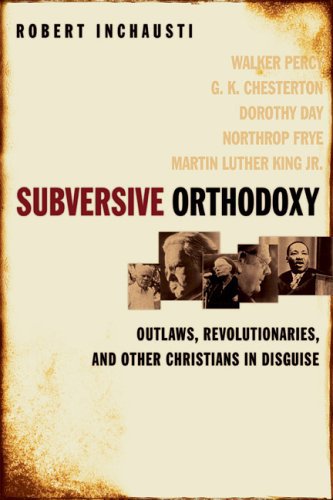
This book will sear your mind.
“Americans, in particular, have been the victims of a myth of national ‘exceptionalism,’ which has been used over and over again to promote policies that have the immediate impact of separating individuals from their land and capital. Between 1983 and 1998, the net worth of the top 1% grew by 42.2%, while the net worth of the bottom 40% dropped by 76.3%. In other words, the bottom 40% of the United States population lost three-fourths of their family wealth over the past twenty years[!].”
He continues on a wider, and even more depressing, scale:
“On a global scale the shift of capital into fewer and fewer hands has been even more pronounced. According to the 1999 United Nations Development Report, eighty countries have per capita incomes lower than they were a decade ago, and the assets of the world’s two hundred richest people total more than the combined assets of 41% of the world’s population–that’s more than the combined wealth of two billion people.”
Inchausti then goes on to cite a passage from Dorothy Day on Distributism and comments on it:
“Day remarked, ‘Under capitalism the many had not the opportunity of obtaining land and capital in any useful amount and were compelled by physical necessity to labor for the fortunate few who possessed these things. But the theory was all right. Distributists want to save the theory by bringing the practice in conformity with it.’ Widespread ownership of property is the only check democracies have against the centralized state and monopoly capitalism, the only social force powerful enough to support local government, preserve local traditions, and keep communities self-sufficient. Large-scale industrial economies work against human happiness by making everyone economically dependent on people and forces they don’t know and can’t control. And in our era of global markets, this situation is becoming even worse.”
He finally shifts into talking about worldliness and how libertarianism only makes the problem worse. Even though he wrote this in 2005 it not only mirrors what pope Francis has said about worldliness, but even cites one of the pope’s main inspirations, the novelist Leon Bloy:
“In order to live with themselves, the rich–those lives built upon the industrial production of workers they never meet–require tokens of their personal entitlement, and this is accomplished through conspicuous consumption [think of the opening pages of Walker Percy’s Lost in the Cosmos] of rolling lawns, swimming pools, maids, gardens, and expensive sport coats. ‘Every man-of-the-world,’ Leon Bloy points out, ‘whether he knows it or not–bears in himself an absolute contempt for poverty, and such is the deep secret honor which is the cornerstone of oligarchies.’ Worldliness, in other words, is essentially the capacity to look past the unfair distribution of the world’s wealth in order to affirm one’s right to its spoils.”
In the next paragraph he makes a direct connection with the problematic aspects of Zmirak et al’s libertarianism and its illiberal consequences:
“This is why the lives of the wealthy so often narrow into a game of waxing and waning delusions of grandeur in which they identify the fate of their financial interests with the fate of civilization itself. And since they cannot imagine living in equality with those who must sell their labor on the job market they themselves have transcended, the rich tend to favor ‘no laws at all.’ The political philosophy of the wealthy is libertarianism, drifting more and more toward anarchy as their capital increases.”
This is why this Mitchell and Webb clip is perhaps not so funny after all:
preferential option for the rich
Previous Post

January 3, 2014
Islam Does Not Need a Reformation
Next Post
January 5, 2014 Lost in the Environment (Rather than Cosmos) of Commercialism
Browse Our Archives
Select a Category #WhyRemainCatholic Abortion Advent Anti-Catholicism Arts Atheism Beauty Benedict XVI Bible Book Review Catholic Cinema Comedy Cosmos: A Space-Time Odyssey Czesław Miłosz Dariusz Karłowicz Devil Easter Eastern Orthodoxy Economics Environment Family Famous Atheists Who Weren't Atheists Guest Post Hans Urs von Balthasar HHS Mandate History Imagination Interview Islam Jean-Luc Marion John Paul II Judaism Just War Lent Literature Little Sisters of the Poor Liturgy Martyrdom Music News Paganism Patristics Phenomenology Philosophy Pierre Hadot Poetry Poland Pop Culture Pope Francis Poverty Prayer Protestantism Rabelais Race Remi Brague Rene Girard Russia Sam Rocha Science & Religion SCOTUS Secularization Sexual Abuse Sexuality Silence Solidarity Stratford Caldecott Synod14 Terrorism Top 10 Uncategorized Walker Percy War Weakened Edition World War II World Youth Day WYD Krakow
Select a Month July 2017 June 2017 May 2017 April 2017 March 2017 February 2017 January 2017 December 2016 October 2016 September 2016 August 2016 July 2016 June 2016 May 2016 April 2016 March 2016 February 2016 January 2016 December 2015 November 2015 October 2015 September 2015 August 2015 July 2015 June 2015 May 2015 April 2015 March 2015 February 2015 January 2015 December 2014 November 2014 October 2014 September 2014 August 2014 July 2014 May 2014 April 2014 March 2014 February 2014 January 2014 December 2013 November 2013 October 2013 September 2013 August 2013 July 2013 June 2013 May 2013
Follow Us!
TAKE THE
Religious Wisdom Quiz
What is the largest Christian denomination in the world?
Select your answer to see how you score.
Orthodox Lutheran Protestant Catholic
Related posts from Cosmos The In Lost

The Surprising Anti-Capitalist Logic Behind the Catholic Church's...

What is the Source of Our Culture of...
How is Classical Philosophy is Like War?

Why Does the World's Leading Philosopher Remain a...
TRENDING AT PATHEOS Catholic

How Discretion Guides Us Away From Extremes
Prudence is an important virtue for all of us. While we should...

Bad Survey Questions Distort Eucharistic Theology
It seems to be the newest thing: someone conducts a bad survey...

If Baptism Washes Away Sin, Why Do Catholics...
The seven sacraments stand as the foundation of Catholic ecclesial life. The...

The Power of Setting a Good Example
Remember last August when the Chicago White Sox hosted a "Pope Hat...

A Catholic Critique of Biblical Unitarianism
If the statistics are to be believed, Unitarianism is rising worldwide. Although...

How Grandma Tourism Helps Grandparents Live Their Vocation
Grandma, The New Travel Influencer What started as a nostalgia-inspired social media...
view all Catholic blogs
Ad-Free & Subscriber Log-In Subscription Support
- About Us
- 2026 Calendar
- Videos
- Podcasts
- Library of World Religions
- Faith In Media Tracker
- Advertise With Us
- Write for Us
- Privacy Policy
- Terms of Service
- Do Not Sell My Data
- Contact Us
- Radiant Digital
- Manage Newsletter Subscriptions
- Unsubscribe From Notifications
- Sitemap
Copyright 2008-2026, Patheos, part of the Radiant Digital network of media brands. All rights reserved.
Subscription Support Ad-Free & Subscriber Log-In
Follow Patheos