
BuddhistCatholicContemplativeEvangelicalGeneral ChristianHinduJewishLatter-day SaintMuslimNew VisionsProgressive Christian
Beliefs
- Buddhist
- Catholic
- Contemplative
- Evangelical
- General Christian
- Hindu
- Jewish
- Latter-day Saint
- More Voices
- Muslim
- New Visions
- Pagan
- Progressive Christian
Topics
- Religion News
- Food and Religion
- Sports and Religion
- Religious Art
- Religious Music and Entertainment
- Religious Events
- History and Religion
- Style and Religion
- Politics and Religion
- Women in Religion
- Recreation Outdoors and Religion
- Business Finance and Religion
- Careers Workplace and Religion
- Education and Religion
- Family Parenting and Religion
- Health Fitness and Religion
- Home and Religion
- Relationships and Religion
- Technology and Religion
- Travel and Religion
Columnists
- Buddhist Columnists
- Business Finance and Religion Columnists
- Careers Workplace and Religion Columnists
- Catholic Columnists
- Contemplative Columnists
- Education and Religion Columnists
- Evangelists Columnists
- Family Parenting and Religion Columnists
- General Christian Columnists
- Health Fitness and Religion Columnists
- Hindu Columnists
- History and Religion Columnists
- Home and Religion Columnists
- Jewish Columnists
- More Voices Columnists
- Latter Day Columnists
- Muslim Columnists
- New Visions Columnists
- Nonreligious Columnists
- Pagan Columnists
- Politics and Religion Columnists
- Progressive Columnists
- Recreation Outdoors and Religion Columnists
- Relationships and Religion Columnists
- Religion News Columnists
- Religious Art Columnists
- Religious Events Columnists
- Religious Music and Entertainment Columnists
- Sports and Religion Columnists
- Style and Religion Columnists
- Technology and Religion Columnists
- Travel and Religion Columnists
- Women in Religion Columnists
Resource Library
- 2026 Calendar
- Library of World Religions
- The 100 Most Holy Places on Earth
- Patheos Answers
- Podcasts
- Videos
- Faith Leaders Database
- Anglican Episcopalian
- Bahai
- Baptist
- Buddhism
- Christianity
- Confucianism
- Eastern Orthodoxy
- Hinduism
- Holiness and Pentecostal
- ISKCON
- Islam
- Judaism
- Lutheran
- Methodist
- The Church of Jesus Christ of Latter-day Saints
- New Age
- Paganism
- Presbytarian and Reformed
- Protestantism
- Religion Behind the Scenes
- Roman Catholic
- Scientology
- Shia Islam
- Sikhism
- Sufism
- Sunni Islam
- Taoism
- Zen
- See all religions
Research Tools
 Ad-Free & Subscriber Log-In Subscription Support
Ad-Free & Subscriber Log-In Subscription Support
Follow Patheos 

- Trending:
- Forgiveness
- |
- Marriage
- |
- Consciousness
- |
- Death Penalty
- |
- Election
- |
- Halloween
 Cosmos The In Lost
- Home
- Catholic
- Islam Does Not Need a Reformation
Islam Does Not Need a Reformation
Last updated on: January 11, 2015 at 2:41 pm by Artur Rosman
Islam Does Not Need a Reformation 2015-01-11T14:41:23-07:00 Artur Rosman
Patheos Explore the world's faith through different perspectives on religion and spirituality! Patheos has the views of the prevalent religions and spiritualities of the world.
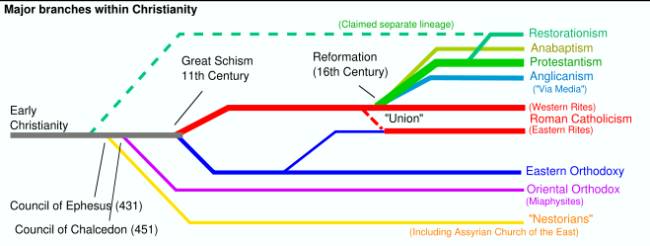
Unity became more elusive than ever for Christianity after the Reformation. The “Early Christianity” branch of this graph also doesn’t do justice to the theological diversity of that period.
After a little bit of polemic the last few days I’d like to write about something completely different: the much popularized necessity for an Islamic Reformation.
When I wrote my complete academic CV up earlier this week I realized that I’ve been either an instructor or a teaching assistant eighteen times during my academic career. Of those courses seven were taught by me as the lead instructor, and eleven as a teaching assistant. [By the way, do let me know if you have any job leads, whether academic or not.]
Being a teaching assistant is a wonderful way to pick up a lot of knowledge you’d be too lazy to pick up any other way. The great thing about it is that this knowledge usually sticks with you, because it is so unusual. In a kind of Hegelian dialectic, thanks to the strangeness of the material, you end up creatively integrating it into your own research.
Nowhere is this more true than when it comes to the last class I TA-ed for at the University of Washington: Political Science 307 World Politics and religion. The class was taught by Anthony Gill, author of Rendering unto Caesar: The Catholic Church and the State in Latin America and The Political Origins of Religious Liberty. I did a fairly well-circulated post about the fascinating reading list for that class which you should check out here.
Double up: non-Western phallocentrism.
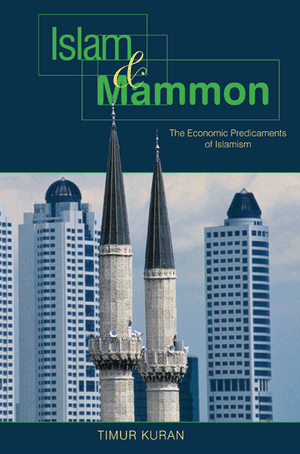
As you’ll note from the link the class culminated with a discussion of Islamic economics and terrorism. Berman’s Radical, Religious, and Violent cuts down stereotypes of Islam as inherently violent. He instead explains how and why religious groups can be (“can” not “must”) especially efficient terrorists (long story short: for various reasons nobody organizes as comprehensively and cohesively as religious groups). On the other hand, Kuran’s Islam and Mammon undercuts what Westerners increasingly see as a positive aspect of the Muslim world they’d like to emulate: Islamic economics (long story short: the economics mostly solidify Muslim identity, but their economic and humanitarian benefits are reportedly few or not quantifiable).
Yet, the most interesting and innovative part of the class proved to be Professor Gill’s lectures on the topic of Islamic history and its consequences. He went down the line listing all the early divisions of Islam. These events should be common knowledge to most of you with at least a cursory interest in history. There was nothing new about the story, except for the contemporary spin Gill put on them.
The way Gill sees it, or at least that’s how I understood him, Islam itself started out divided over authority. It then developed highly decentralized structures, one might say “democratic.” These structures are analogous to what happened with the Protestant denominations that came into being during the Protestant Reformation. Sounds good, doesn’t it?

You sure about that?
The problem (for both Muslims and Protestants) is that there is no central authority, like Rome, or even something more temporary like an Inquisition, to step in an adjudicate conflicts over interpretations, or armed conflicts for that matter. The divisions over the fine points of belief are not worked out through a hierarchically structured world union. Instead, for the most part, they are worked out on the level of the mosque–frequently with each mosque trying to outdo each other in purifying their faith into the fundamentals.
Don’t forget: the concept of fundamentalism, in its more restricted Christian meaning, is something that emerged out of American Protestantism. It was only later applied to other religions
The dangerous aspects of this sort of competitive logic is something that someone like Zmirak totally misses in his Romanticized version of the Reformation, classical liberalism, and their offspring, the nation-state.
It’s not a matter of pitting totalitarian Catholicism against liberal, uhm, I suppose, liberal liberalism. Ask yourself: is it a coincidence the “Wars of Religion” started with the Reformation? The story is more complex in the West and it’s definitely even more complex outside the West.
======================================================================
UPDATE: After the still developing events in France everyone is once again talking about an Islamic Reformation. Happily, not all of it is the usual fodder. One of the most perceptive critics of the earlier version of this post suggested Islam already had a Reformation, the Wahhabist reform.
But the analogy with Christianity breaks down quickly when we consider how Wahhabism was not the dissolution of an earlier unity, but a drive to unite Islam under a fundamentalist reading of the religion.
My contention still stands: Islam still does not need a Reformation.
======================================================================
I’m not done yet with exposing truthiness:
If you’d like to learn more about the connections between Islam and world politics see my TOP10 list on the topic and all my recent posts on Islam, especially “Spreading the Blame: The West’s Exporting of Jihad.”
Previous Post

January 2, 2014
Contra Zmirak: In Praise of the Inquisition
Browse Our Archives
Select a Category #WhyRemainCatholic Abortion Advent Anti-Catholicism Arts Atheism Beauty Benedict XVI Bible Book Review Catholic Cinema Comedy Cosmos: A Space-Time Odyssey Czesław Miłosz Dariusz Karłowicz Devil Easter Eastern Orthodoxy Economics Environment Family Famous Atheists Who Weren't Atheists Guest Post Hans Urs von Balthasar HHS Mandate History Imagination Interview Islam Jean-Luc Marion John Paul II Judaism Just War Lent Literature Little Sisters of the Poor Liturgy Martyrdom Music News Paganism Patristics Phenomenology Philosophy Pierre Hadot Poetry Poland Pop Culture Pope Francis Poverty Prayer Protestantism Rabelais Race Remi Brague Rene Girard Russia Sam Rocha Science & Religion SCOTUS Secularization Sexual Abuse Sexuality Silence Solidarity Stratford Caldecott Synod14 Terrorism Top 10 Uncategorized Walker Percy War Weakened Edition World War II World Youth Day WYD Krakow
Select a Month July 2017 June 2017 May 2017 April 2017 March 2017 February 2017 January 2017 December 2016 October 2016 September 2016 August 2016 July 2016 June 2016 May 2016 April 2016 March 2016 February 2016 January 2016 December 2015 November 2015 October 2015 September 2015 August 2015 July 2015 June 2015 May 2015 April 2015 March 2015 February 2015 January 2015 December 2014 November 2014 October 2014 September 2014 August 2014 July 2014 May 2014 April 2014 March 2014 February 2014 January 2014 December 2013 November 2013 October 2013 September 2013 August 2013 July 2013 June 2013 May 2013
Follow Us!
TAKE THE
Religious Wisdom Quiz
What Christian tradition is famous for the musical "Gregorian chant"?
Select your answer to see how you score.
Presbyterian Methodist Roman Catholic Anglican
Related posts from Cosmos The In Lost

Biblical Authority After Babel Cannot Be Built Upon...

Wendell Berry and the Given Life

The Left Has Magically Discovered Religious Freedom!

The Reformation is Not Done with You
TRENDING AT PATHEOS Catholic

Rejecting Doom: Christian Hope And Human Action
Christianity is a religion of hope. We are to have hope and...

It’s What Comes From Within Which Matters
One of the most difficult things for us to understand is why...

Why I Choose the Eucharist Over the Sermon
Choose the Eucharist, Not the Sermon What are we supposed to get...

5 Design Elements Found in Spiritually Rooted Homes
Putting Spirituality Into Home Decor Our homes are more than our living...

Credo: A Story of God Told with the...
About 10 years ago, I began to imagine a personal "Credo" that...

The Anatomy of Divine Revelation in Catholic Thought
The claim that God has made Himself known to human beings is...
view all Catholic blogs
Ad-Free & Subscriber Log-In Subscription Support
- About Us
- 2026 Calendar
- Videos
- Podcasts
- Library of World Religions
- Faith In Media Tracker
- Advertise With Us
- Write for Us
- Privacy Policy
- Terms of Service
- Do Not Sell My Data
- Contact Us
- Radiant Digital
- Manage Newsletter Subscriptions
- Unsubscribe From Notifications
- Sitemap
Copyright 2008-2026, Patheos. All rights reserved.
Subscription Support Ad-Free & Subscriber Log-In
Follow Patheos