
BuddhistCatholicContemplativeEvangelicalGeneral ChristianHinduJewishLatter-day SaintMuslimNew VisionsProgressive Christian
Beliefs
- Buddhist
- Catholic
- Contemplative
- Evangelical
- General Christian
- Hindu
- Jewish
- Latter-day Saint
- More Voices
- Muslim
- New Visions
- Pagan
- Progressive Christian
Topics
- Religion News
- Food and Religion
- Sports and Religion
- Religious Art
- Religious Music and Entertainment
- Religious Events
- History and Religion
- Style and Religion
- Politics and Religion
- Women in Religion
- Recreation Outdoors and Religion
- Business Finance and Religion
- Careers Workplace and Religion
- Education and Religion
- Family Parenting and Religion
- Health Fitness and Religion
- Home and Religion
- Relationships and Religion
- Technology and Religion
- Travel and Religion
Columnists
- Buddhist Columnists
- Business Finance and Religion Columnists
- Careers Workplace and Religion Columnists
- Catholic Columnists
- Contemplative Columnists
- Education and Religion Columnists
- Evangelists Columnists
- Family Parenting and Religion Columnists
- General Christian Columnists
- Health Fitness and Religion Columnists
- Hindu Columnists
- History and Religion Columnists
- Home and Religion Columnists
- Jewish Columnists
- More Voices Columnists
- Latter Day Columnists
- Muslim Columnists
- New Visions Columnists
- Nonreligious Columnists
- Pagan Columnists
- Politics and Religion Columnists
- Progressive Columnists
- Recreation Outdoors and Religion Columnists
- Relationships and Religion Columnists
- Religion News Columnists
- Religious Art Columnists
- Religious Events Columnists
- Religious Music and Entertainment Columnists
- Sports and Religion Columnists
- Style and Religion Columnists
- Technology and Religion Columnists
- Travel and Religion Columnists
- Women in Religion Columnists
Resource Library
- 2026 Calendar
- Library of World Religions
- The 100 Most Holy Places on Earth
- Patheos Answers
- Podcasts
- Videos
- Faith Leaders Database
- Anglican Episcopalian
- Bahai
- Baptist
- Buddhism
- Christianity
- Confucianism
- Eastern Orthodoxy
- Hinduism
- Holiness and Pentecostal
- ISKCON
- Islam
- Judaism
- Lutheran
- Methodist
- The Church of Jesus Christ of Latter-day Saints
- New Age
- Paganism
- Presbytarian and Reformed
- Protestantism
- Religion Behind the Scenes
- Roman Catholic
- Scientology
- Shia Islam
- Sikhism
- Sufism
- Sunni Islam
- Taoism
- Zen
- See all religions
Research Tools
 Ad-Free & Subscriber Log-In Subscription Support
Ad-Free & Subscriber Log-In Subscription Support
Follow Patheos 

- Trending:
- Forgiveness
- |
- Marriage
- |
- Consciousness
- |
- Death Penalty
- |
- Election
- |
- Halloween
 Cosmos The In Lost
- Home
- Catholic
- Blurred Lines: (Theologically) Nothing is Sacred
Blurred Lines: (Theologically) Nothing is Sacred
Last updated on: December 31, 2013 at 12:37 pm by Artur Rosman
Blurred Lines: (Theologically) Nothing is Sacred 2013-12-31T12:37:44-07:00 Artur Rosman
Patheos Explore the world's faith through different perspectives on religion and spirituality! Patheos has the views of the prevalent religions and spiritualities of the world.

Happy New Year! No, this post isn’t about these guys, nor the women behind the video.
Let’s get back to the principles of Rabelaisian Catholicism. It all started with a post about the problem of the good (instead of evil), then one about the permanent pollution of Christianity with Greek philosophy, another one on the essential pagan additions to Catholic Christianity, and it made its last appearance in a post about David Bentley Hart’s contamination of the doctrine of God.
Rabelaisian Catholicism posits that there nothing is outside the purview of Christianity, that pluralism and contamination is essentially incarnational. Being hybrid is the guiding thread that’s behind the impulse to make everything a holy mess, rather than a nicely ordered and minimalist Protestant church–wine over grape juice.
Some post-Vatican II Catholics worry a lot about the purity of the liturgy and how much the reforms evacuated the sacred from our lives. James Hitchcock’s The Rediscovery of the Sacred is an early example of this fastidiousness. The book is lying right here next to my laptop and the mess on my desk. The problem is (as Hitchcock sees it) the loss of sacred. He defines the sacred as being “in traditional Catholic [the word that]… designates special persons, times, places, or objects viewed as having an especially holy character.” According to the author, the return of the sacred would then turn Catholics back on the right path toward a legitimate appropriation of Vatican II and unity.
Nothing out of the usual.
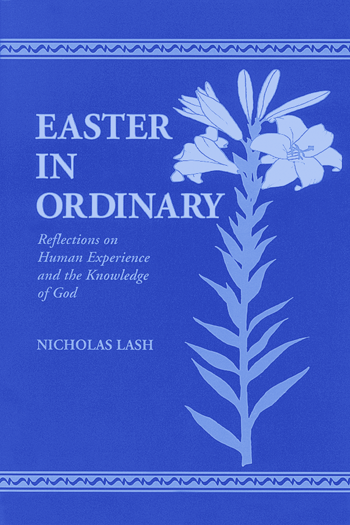
Such assumptions seem to run counter to what I recently read in Nicholas Lash’s Easter in Ordinary:
“If Christianity is a school for the production of persons in relation to the unknown God through discipleship of the crucified, then there is nothing that we do and suffer, think, or feel, or undergo, which may not contribute to such schooling. It follows there is no single activity, or cluster of activities, which alone counts as ‘Christian teaching.'”
Lash’s approach is a lot more holistic than Hitchcock’s, because there is nothing that comes from the hand of God more than something else. The notion that every damn thing after another in our lives is given to us in order to educate us into the Mystery, that it does so through the discipleship of the crucified, reminded me of a figure who not only looms large in my life, but also in the thought of the last three popes, especially Francis as I’ve written here. I’m thinking of the founder of CL, Fr. Giussani.
Abstract painting: nothing represented.
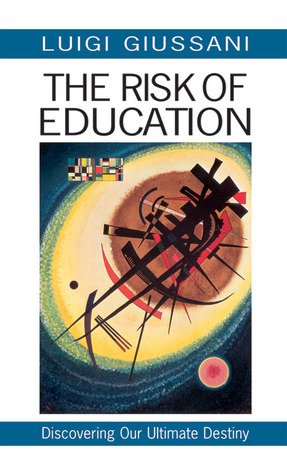
Now compare what Lash says to Giussani in The Risk of Education:
“A great Austrian theologian gave me what I hold to be the best definition of education I have found up to now. He said that education is introduction to reality as a whole. Now why does man need to be introduced to reality as a whole? Because, as the Pope keeps on repeating when he speaks of education or of culture, which is the same thing—because education is the main instrument of culture and in the end the two words have similar roots –, man has to be educated in order to become more himself, to be realized, for man does not realize himself unless by means of an encounter with something else.”
Giussani and Lash seem to be on the same page, don’t they? But this is not merely a modern disease. Just to prove it to you I’ll have you take a look at a classic blurring of the lines between the sacred and secular. This passage comes from an 18th century spiritual master, Fr Jean-Pierre de Caussade, in his classic, Abandonment to Divine Providence:
“There is not a moment in which God does not present Himself under the cover of some pain to be endured, of some consolation to be enjoyed, or of some duty to be performed. All that takes place within us, around us, or through us, contains and conceals His divine action.”
Liturgy changes everything.
Everything is within bounds for these three distinguished theologians.
But does this mean that the liturgy, statues, or holy-days have no significance whatsoever? No, not necessarily.
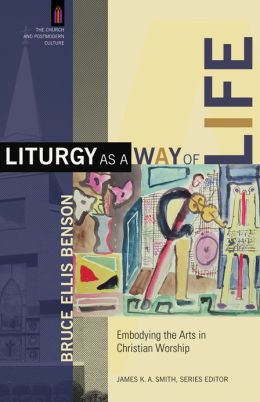
Bruce Ellis Benson provides an understanding of the liturgy that breaks through the false dichotomy between the sacred and the profane in his Liturgy as a Way of Life. His work has interesting echoes with what the Polish philosopher-theologian Dariusz Karlowicz does in the excerpts from his works I’ve posted here, here, and most importantly, in a long preview of his work here. On their accounts the liturgy that goes on in our churches is a spiritual exercise that trains our minds and bodies, our desires, to be responsive to the call of God in everything that we do. Such an understanding takes the liturgy out of the sanctuary and gives it something to do past Sunday. These ways of thinking are ancient, in fact, they are more ancient than Christianity.
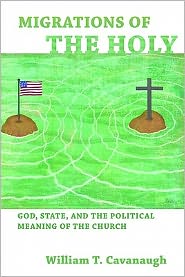
And so to cap it all off with a burst of Rabelaisian blurring of lines: William T. Cavanaugh, in his Migrations of the Holy suggests the liturgy is not sacred, or at least not sacred in the way we moderns tend to think about it:
Holy moly: liturgy is not even confined to churches.
“Today the most significant misunderstanding of the Christian liturgy is that it is sacred. Let me clarify. The problem is that ‘sacred’ has been opposed to ‘secular,’ and the two are presumed to describe two separate—but occasionally related—orbits. The problem is not simply that this separation leaves the church’s liturgy begging for relevance to the ‘real world.’ The problem is rather that the supposedly ‘secular’ world invents its own liturgies, with pretensions every bit as ‘sacred’ as those of the Christian liturgy, and these liturgies can come to rival the church’s liturgy for our bodies and our minds. In this brief essay I want to explore in particular some of the liturgies of the American nation-state. I will suggest first that such liturgies are not properly called ‘secular,’ and second, that the Christian liturgy is not properly cordoned off into the realm of the ‘sacred.’”
Previous Post

December 28, 2013
Blessed are the Cheesecake Makers
Next Post
January 1, 2014 The Pope's Sympathy for the Devil
Browse Our Archives
Select a Category #WhyRemainCatholic Abortion Advent Anti-Catholicism Arts Atheism Beauty Benedict XVI Bible Book Review Catholic Cinema Comedy Cosmos: A Space-Time Odyssey Czesław Miłosz Dariusz Karłowicz Devil Easter Eastern Orthodoxy Economics Environment Family Famous Atheists Who Weren't Atheists Guest Post Hans Urs von Balthasar HHS Mandate History Imagination Interview Islam Jean-Luc Marion John Paul II Judaism Just War Lent Literature Little Sisters of the Poor Liturgy Martyrdom Music News Paganism Patristics Phenomenology Philosophy Pierre Hadot Poetry Poland Pop Culture Pope Francis Poverty Prayer Protestantism Rabelais Race Remi Brague Rene Girard Russia Sam Rocha Science & Religion SCOTUS Secularization Sexual Abuse Sexuality Silence Solidarity Stratford Caldecott Synod14 Terrorism Top 10 Uncategorized Walker Percy War Weakened Edition World War II World Youth Day WYD Krakow
Select a Month July 2017 June 2017 May 2017 April 2017 March 2017 February 2017 January 2017 December 2016 October 2016 September 2016 August 2016 July 2016 June 2016 May 2016 April 2016 March 2016 February 2016 January 2016 December 2015 November 2015 October 2015 September 2015 August 2015 July 2015 June 2015 May 2015 April 2015 March 2015 February 2015 January 2015 December 2014 November 2014 October 2014 September 2014 August 2014 July 2014 May 2014 April 2014 March 2014 February 2014 January 2014 December 2013 November 2013 October 2013 September 2013 August 2013 July 2013 June 2013 May 2013
Follow Us!
TAKE THE
Religious Wisdom Quiz
What does the name "Bethlehem" mean in Hebrew?
Select your answer to see how you score.
House of Stone House of Kings House of Prayer House of Bread
Related posts from Cosmos The In Lost

The Surprising Anti-Capitalist Logic Behind the Catholic Church's...

How is Classical Philosophy is Like War?

Why Does the World's Leading Philosopher Remain a...
How Did the Resurrection Historically Affect Reason?
TRENDING AT PATHEOS Catholic

Rejecting Doom: Christian Hope And Human Action
Christianity is a religion of hope. We are to have hope and...

It’s What Comes From Within Which Matters
One of the most difficult things for us to understand is why...

Why I Choose the Eucharist Over the Sermon
Choose the Eucharist, Not the Sermon What are we supposed to get...

5 Design Elements Found in Spiritually Rooted Homes
Putting Spirituality Into Home Decor Our homes are more than our living...

Credo: A Story of God Told with the...
About 10 years ago, I began to imagine a personal "Credo" that...

The Anatomy of Divine Revelation in Catholic Thought
The claim that God has made Himself known to human beings is...
view all Catholic blogs
Ad-Free & Subscriber Log-In Subscription Support
- About Us
- 2026 Calendar
- Videos
- Podcasts
- Library of World Religions
- Faith In Media Tracker
- Advertise With Us
- Write for Us
- Privacy Policy
- Terms of Service
- Do Not Sell My Data
- Contact Us
- Radiant Digital
- Manage Newsletter Subscriptions
- Unsubscribe From Notifications
- Sitemap
Copyright 2008-2026, Patheos. All rights reserved.
Subscription Support Ad-Free & Subscriber Log-In
Follow Patheos